Key takeaways
- A QSR kiosk and a hospital admissions kiosk share maybe 20% of their stack — the other 80% is vertical-specific interaction, integration and compliance.
- Single-vendor estates across mixed verticals underperform purpose-built ones by 18-35% on transaction completion.
- Per-unit installed costs vary £15k-£70k depending on vertical; banking and healthcare are at the top.
- Deflection rates range from 35% in early-stage retail to 75-85% in mature telecom and government.
- The most avoidable failure is treating bilingual EN/AR as Phase 2 retrofit; second is leaving cash out of Phase 1.
- On-premises AI turns rigid menu trees into guided conversations without sending PHI or KYC outside the perimeter.
- A 100-unit retail business case lands £4.2m-£6.8m five-year net benefit; banking and healthcare go higher.
The horizontal buyer's guide lives at our self-service kiosk TCO and hardware guide. This post is the operator's companion: what self-service machines actually do in five very different verticals. Written for the ops director who knows they want kiosks and now needs to design the right ones for each environment. Pick the vertical-correct pattern first; pick the vendor second.
Who this guide is for
- Retail and QSR operations director. Ordering kiosks, POS integration, payment hardware, queue tie-in. Metric: per-store throughput uplift during peak.
- Telecom retail estate lead. SIM activation, plan changes, top-ups, bill payment, device collection. You want to redeploy 30-45% of branch FTE without dropping NPS.
- Banking branch operations director. Cheque deposit, bill payment, card pickup, account servicing. Wired into Temenos, Finacle or Mambu, with an audit team that rejects anything without a tamper-evident transaction log.
- Government service-centre lead. Licence renewal, civil status, tax, fee collection. National identity integration, bilingual EN/AR with full RTL, WCAG 2.2 AA as a procurement gate.
- Hospital admissions and outpatient operations lead. Patient check-in, registration, appointment confirmation, queue ticket issuance. EMR speaks HL7 v2 and FHIR; PHI cannot leave the perimeter. Needs proper PHI handling and HL7 FHIR integration.
What is a self-service machine in 2026?
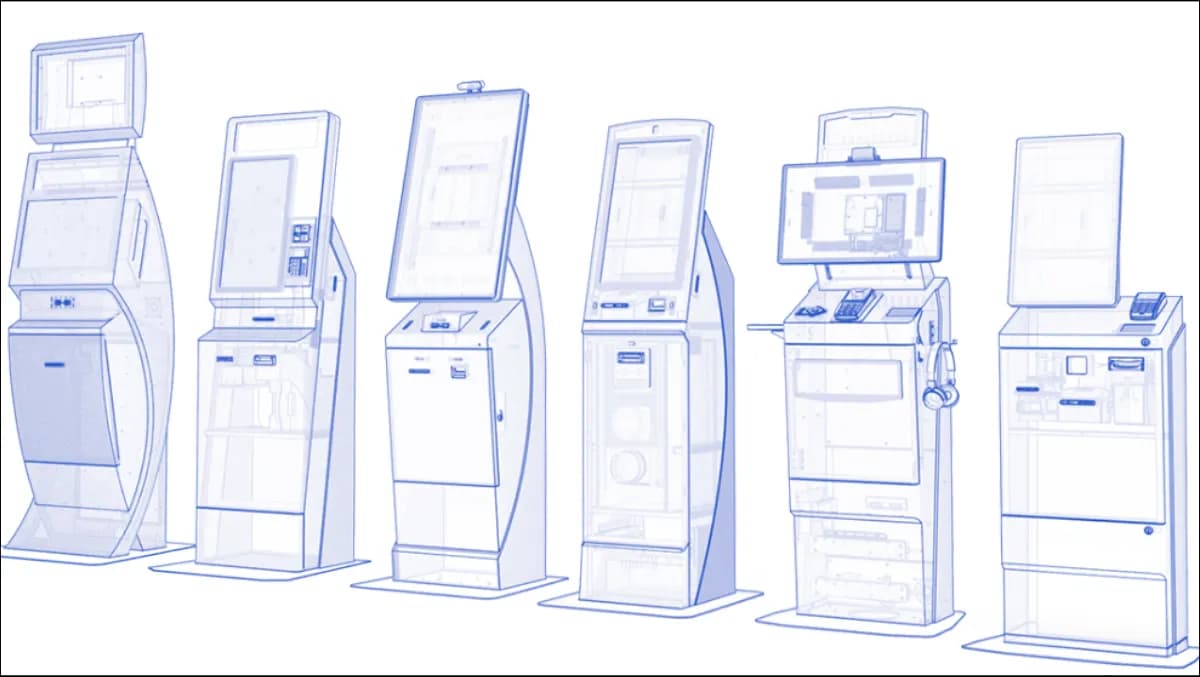
A self-service machine — kiosk, ATM-style terminal, smart locker, ordering pillar, admissions tower — completes a transaction end-to-end without a staff member. In 2026 it is a touchscreen front-end, a peripheral stack (printer, scanner, card reader, cash recycler, biometric pad) and a runtime that talks to back-end systems through documented APIs.
The customer expects it to do what a human could do. If it cannot complete the transaction, they walk out. An admissions kiosk that prints a ticket but cannot collect insurance or verify identity sees 40-55% of patients abandon. Deflection rate is a function of how completely the kiosk finishes, not how attractively it starts.
The other big shift is sovereign data handling. Hospitals, banks and governments routinely refuse platforms that route customer data through a vendor's public cloud; procurement specs now ask for sovereign on-premises deployment as baseline. A serious 2026 platform ships full RTL and LTR at the framework layer. English plus Arabic is the production baseline for the self-service kiosk platform we ship; French, Spanish, German, Portuguese, Italian, Dutch, Turkish, Urdu and Hindi are localised per engagement.
The five-vertical pattern catalogue
Five patterns. They are deliberately not interchangeable: each has a different interaction model, integration map, hardware profile, dominant failure mode and ROI lever.
Pattern 1 — Retail and QSR ordering kiosks
Interaction model. Tap language, browse menu, configure modifiers, apply loyalty, pick dine-in or takeaway, pay, take a printed order number. Target: 60-90 seconds. Over 120 and basket size drops.
Integration map. Operator's existing POS for menu and inventory; kitchen display system; loyalty platform; payment terminal (Ingenico, PAX, Verifone — kiosk owns UI, terminal owns the EMV transaction); and the queue management system for order-number issuance and pickup signage.
Hardware profile. Floor-standing 22-32 inch touchscreen, NFC and EMV payment slot, thermal printer (Epson, Star Micronics), barcode scanner. Cash is rare in QSR but still 25-35% in convenience retail, which adds a recycler (Glory, Cash Code, JCM), anti-skimming bezels and a tamper switch.
Failure mode. Treating the kiosk as a UI over an unchanged POS. The kiosk renders the cashier's category tree; customers navigate a five-level menu. Throughput drops 20-30%.
ROI lever. Per-store throughput uplift during peak, plus 9-14% AOV uplift from default upsell prompts. Pattern in our retail industry playbook.
Pattern 2 — Telecom retail store kiosks
Interaction model. Customer walks in cold or arrives with an SMS or WhatsApp reservation. Kiosk authenticates (ID scan plus OTP, or biometric), surfaces active accounts, lets them pick SIM activation, plan change, top-up, bill payment, device collection, warranty intake, or escalate.
Integration map. BSS for plan catalogue and customer master; OSS for SIM provisioning; billing platform; identity broker (often a national identity gateway); payment hardware; queue-management for escalation. Device collection adds a smart-locker with one-time PIN.
Hardware profile. Floor-standing 24-32 inch screen, NFC and EMV terminal, document scanner with OCR for national ID, optional fingerprint reader, thermal printer. Flagship stores add passport-photo capture for new-line onboarding.
Failure mode. Multi-step ID verification. Telecom abandonment runs 18-32% versus 5-12% in QSR. Single-step identity at session start, cached, fixes it.
ROI lever. FTE redeployment. A store that deflects 60-75% to kiosks runs on 40-55% of prior advisor headcount and reallocates the rest to outbound sales or device fitting. Pattern in our telecom industry playbook.
Pattern 3 — Banking branch kiosks
Interaction model. Customer authenticates with debit card and PIN, biometric or face match. Menu is scoped to regulator-permitted actions: cheque deposit with image and amount capture, bill payment, statement printing, card pickup from a smart cassette, inter-account transfer, standing-order set-up. Higher-risk actions escalate to a teller with a warm handover.
Integration map. Three layers. The core banking platform — Temenos T24, Finacle, Mambu or homegrown — through documented APIs or ISO 20022. The card management system. The cheque-processing platform with MICR line read. Plus a tamper-evident audit trail with customer ID, kiosk ID, timestamp and transaction reference per action.
Hardware profile. Free-standing tamper-evident enclosure, 22-27 inch screen, EMV motorised card reader, cheque scanner with MICR, smart-cassette for card dispense, biometric pad (often a vein reader), thermal printer. Higher-end models add a cash recycler with reconciliation feed.
Failure mode. Underestimating core integration scope. 4-week estimates routinely overrun to 12-18 weeks: session pooling, batched-versus-realtime negotiation per transaction type and a separate NFR test pass.
ROI lever. Compliance audit time plus FTE redeployment. A branch that moves 65-80% of high-volume teller transactions onto kiosks redeploys 2-4 teller FTE. The CFO-facing lever is reduced audit prep time. Pattern in our banking industry playbook.
Pattern 4 — Government one-stop kiosks
Interaction model. Citizen scans national ID, optionally authenticates with OTP or biometric, sees services scoped to the centre and their profile, completes a guided form, pays the fee, prints the receipt. Target: 4-7 minutes for a routine renewal.
Integration map. National identity for authentication and demographic lookup; the line-of-business application for each ministry; a fee-collection gateway that consolidates payments; an appointment system for services needing a human officer; queue-management for counter routing. Bilingual EN/AR with full RTL is non-negotiable; WCAG 2.2 AA is a procurement gate.
Hardware profile. Anti-vandal touchscreen, accessibility-compliant pedestal height (760-880 mm), ID and document scanner, signature pad, thermal printer, EMV terminal, optional fingerprint reader. Accessibility: headphone jack, screen-magnifier mode, high-contrast colour scheme.
Failure mode. Ignoring accessibility until procurement audit. Teams list WCAG 2.2 AA as a tick-box then discover three months before go-live that the pedestal is non-compliant. Re-engineering is a 6-10 month delay.
ROI lever. Citizen service time plus complaint reduction. The political lever is the median wait time, reported publicly in most jurisdictions and folded into ministerial KPIs. Pattern in our government industry playbook.
Pattern 5 — Hospital admissions and outpatient kiosks
Interaction model. Patient identifies with national ID, hospital card or appointment QR, sees their booked appointment, confirms attendance, updates demographic and insurance if changed, pays any co-pay, prints a queue ticket and forms, is directed to the correct waiting area. Walk-ins are triaged and routed.
Integration map. EMR through HL7 v2 for legacy systems and HL7 FHIR for modern ones, reading appointments, demographics and insurance and writing back check-in events; the PAS for ticket assignment; the insurance authorisation gateway for real-time eligibility; the payment terminal; the queue management system; the wayfinding system; and the bilingual clinic management platform.
Hardware profile. Free-standing 22-32 inch screen with anti-microbial coating, ID scanner, insurance card scanner, thermal printer, EMV terminal with NFC, optional patient-photo camera, headphone jack. Hospital environments add wipeable bezels and hand-sanitiser station.
Failure mode. Leaving PHI handling unresolved. Teams ship with patient data flowing through a vendor's cloud and discover at DPIA they cannot legally operate it. Design for on-premises from day one.
ROI lever. Front-desk FTE redeployment plus reduced no-show rate. A well-implemented admissions kiosk cuts front-desk transactional load by 55-75%; kiosk-confirmed patients show up at higher rates than those who silently absorbed an SMS reminder. Pattern in our healthcare industry playbook.
How do you choose between a single-vendor, per-vertical or custom-built estate?
Three procurement archetypes recur across the rollouts we work on.
| Decision factor | Single-vendor | Per-vertical purpose-built | Custom-built on a platform |
|---|---|---|---|
| Up-front capex | Lowest | Mid | Highest |
| Vertical fit | Worst — one form factor compromises every vertical | Best — right enclosure per vertical | Best — designed per vertical on a shared runtime |
| Time to first vertical live | 8-12 weeks | 12-20 weeks per vertical | Slow first, fast subsequent |
| Integration debt | Highest — vendor cloud lock-in | Mid | Lowest — operator owns the runtime |
| Sovereign deployment | Often impossible | Sometimes | Always |
| 5-year cost (100-unit mixed estate) | £2.8m-£4.2m + cloud fees | £3.5m-£5.4m | £4.1m-£5.8m, no recurring vendor fees |
For a mixed estate of three or more verticals, single-vendor looks attractive at procurement but underperforms because the form factor and integration map are wrong for at least two of the three. Per-vertical purchasing wins on operational fit but creates a multi-vendor estate painful to operate at HQ. Custom-built-on-a-platform wins on five-year economics if the operator runs the platform internally after build-out — the fixed-fee phased engagement model we use.
> Want a fixed-fee Discovery price before the end of the call? Talk to Zeour engineering — 30-minute scoping conversation, no slideware, and a published pricing band by the time we hang up.
How much does a self-service kiosk estate cost in 2026?
Per-vertical installed cost per unit (hardware plus software plus integration plus first-year care):
- Retail and QSR. £15k-£40k. Lower end is a slim-pedestal screen with card-only payment and thermal printer; upper end adds cash recycling, loyalty and queue tie-in.
- Telecom. £18k-£45k. Identity hardware drives the band — biometric plus ID scanner plus photo capture pushes the top.
- Banking. £25k-£60k. Tamper-evident enclosure, motorised card reader, cheque scanner and smart-cassette dispense are the drivers.
- Government. £22k-£55k. Accessibility-compliant enclosure plus national identity plus fee-collection consolidation drives the upper range.
- Healthcare. £30k-£70k. EMR integration, PHI certification, infection-control enclosure and audit-grade trail are the drivers.
Platform-level engagement costs:
- Discovery. £18k-£45k, fixed-fee, 3-5 weeks.
- Build, small (5-20 units, single vertical). £85k-£220k, 10-16 weeks.
- Build, enterprise (50+ units, multi-vertical). £320k-£950k, 16-32 weeks.
- Integrate (per back-end). £45k-£180k, 4-8 weeks each.
- Pilot (single-site, 2-week supervised live). £18k-£35k.
- Care Plan (year one). 12-18% of build cost annually.
More detail in our horizontal TCO and hardware guide and published pricing bands.
ROI calculator — build a defensible business case in 7 steps
Step 1 — Establish the baseline transaction volume
Measure for two weeks per site, peak and off-peak, by transaction type. Variance between perceived and measured volume is routinely 30-40%.
Step 2 — Determine which transactions are kiosk-eligible
Not every transaction is. Typical kiosk-eligible share: QSR 75-90%, telecom 60-75%, banking 55-75%, government 65-85%, healthcare 60-80%.
Step 3 — Estimate realistic deflection rate per vertical
New estates land 35-55% in year one, mature estates 65-85%. Multiply eligible volume by deflection rate to get kiosk-handled transactions per site per day.
Step 4 — Cost the human transaction
Loaded hourly cost divided by transactions per hour, plus overheads. Typical: QSR £8-£14, telecom £15-£28, banking £22-£42, government £18-£32, hospital admissions £18-£30.
Step 5 — Calculate annual labour displaced
Kiosk-handled transactions per site per day × labour cost × trading days × sites. Gross saving before amortisation.
Step 6 — Amortise kiosk capex over five years
Use five years even if hardware lasts seven — software refresh cycle is shorter. Add annual care plan. Subtract from gross saving.
Step 7 — Layer in the secondary lever per vertical
QSR: 9-14% AOV uplift. Telecom: NPS uplift to retention. Banking: audit prep reduction (£40k-£120k per branch/year). Government: complaint reduction. Healthcare: no-show reduction (£35-£180 per averted no-show).
Worked example — 100-store retail. 220 eligible transactions per store/day, deflection ramps 40% to 75% over three years, £11 loaded cashier cost per transaction-hour, 6.5 transactions per hour, 350 trading days, £28k installed per store, 14% care plan. Five-year net benefit £4.2m-£6.8m, breakeven month 18-22.
Seven failure modes from real deployments
Failure mode 1: One kiosk vendor across all verticals. The QSR pedestal is wrong for banking, the banking tamper-enclosure wrong for hospitals. Operators who consolidate for capex efficiency lose 18-35% on completion. Standardise the runtime, not the enclosure.
Failure mode 2: Underestimating back-end integration scope. The core banking platform, EMR or national identity is always more constrained than the scoping document suggests. Plan integration as a parallel multi-month workstream.
Failure mode 3: Ignoring accessibility until procurement audit. WCAG 2.2 AA is a procurement gate in government and healthcare. Non-compliant kiosks face 6-10 month remediation. Build to AA from day one.
Failure mode 4: No staff training for the new operating model. Kiosks change the staff role from transaction-handler to floor-manager. Ship without training and kiosks become broken signage in 6 weeks. Budget two days of training per branch per quarter for year one.
Failure mode 5: Cash handling left as Phase 2. The most common scope error in retail and government. Cash recycler integration changes enclosure, security, reconciliation and regulatory profile. Decide cash in or out at Discovery.
Failure mode 6: Bilingual EN+AR retrofitted instead of engineered. Adding Arabic with full RTL to a single-language platform is 3-6× the cost of doing it at framework layer in Phase 1. Specify bilingual EN+AR with full RTL as a Phase 1 baseline.
Failure mode 7: Vendor-cloud-only platform fails compliance audit. Banks, hospitals and government audit teams routinely reject platforms that route customer data through a vendor's public cloud. Insist on a sovereign on-premises option at Discovery.
Migration path — moving from your current stack
Phase A — Single-vertical pilot. Pick the vertical with the clearest deflection upside (usually QSR or telecom) and stand up 3-8 kiosks at one site for an 8-week supervised pilot. Measure deflection, completion, abandonment by step, NPS impact.
Phase B — Vertical-template formalisation. Codify the pilot as a template: interaction flows, integration adapters, hardware spec, training pack, support runbook. The template becomes the rollout unit.
Phase C — Cross-vertical rollout. Add second and third verticals using their own templates but the same shared runtime, identity broker and management console. Shared runtime stops the estate fragmenting; per-vertical templates keep each interaction model correct.
Phase D — Multi-tenant consolidation at HQ. Once two verticals are at 30+ units, consolidate onto a single HQ console with role-based access by vertical, cross-vertical analytics and a single audit log. Operator self-sufficiency is the exit.
Implementation playbook
- 1Discovery (2-4 weeks). Per-vertical interaction model, integration audit, hardware BoM, accessibility assessment, bilingual scope, sovereign posture, fixed-fee scope.
- 2Build (8-16 weeks). Per-vertical kiosk app, shared runtime, identity broker, peripheral drivers, audit trail, bilingual EN+AR shell, WCAG 2.2 AA pass, integration adapters.
- 3Integrate (3-5 weeks per back-end). Core banking, EMR, national identity, payment, queue-management, wayfinding. Each is its own milestone.
- 4Pilot and Go-Live (4 weeks). 2 weeks supervised dual-running, 1 week kiosk-primary with human fallback, 1 week with managed handover.
- 5Operate. Operator-owned. Care Plan covers spares, monitoring, quarterly updates and L3 hotline. 90-day exit window for full internalisation.
Frequently asked questions
How is a retail QSR kiosk different from a banking branch kiosk?
Transaction time: QSR 60-90 seconds versus banking's 2-4 minutes — different menu depth and defaults. Integration map: QSR talks to a POS and a kitchen display; banking talks to a core banking platform and a card management system. Hardware: QSR has card-only payment and a thermal printer; banking has motorised card readers, cheque scanners and smart-cassette dispense. The runtime can be the same; the kiosk app, enclosure and peripherals are different builds.
Why do telecom self-service kiosks have higher abandonment than retail?
Identity verification. A QSR kiosk does not need to know who the customer is — payment authorises the transaction. A telecom kiosk doing SIM activation must authenticate against the customer master, usually national ID scan plus OTP. Multi-step verification kills the flow. Single-step identity at session start, cached, fixes it.
How do you handle PHI on a hospital self-service kiosk?
Keep it inside the hospital network. The kiosk runtime, EMR connector, audit log and identity broker all run inside the perimeter. PHI never leaves to a vendor cloud. Sessions terminate when the patient walks away or after a 90-second timeout. Full pattern in our bilingual on-prem clinic management guide.
Should government one-stop kiosks accept cash?
It depends on fee-payment volume. If 25-40% of fee transactions are cash today, removing cash at rollout pushes those citizens back to the human counter and erodes deflection. Either include cash recycling in Phase 1, or run a fee-payment-channel migration in parallel before the kiosk goes live.
What does it take to integrate with national identity systems?
Three things. A documented adapter from the national identity gateway to the kiosk's identity broker — protocol is country-specific, usually SOAP, REST or a custom secure-channel API. A formal accreditation process, typically 8-16 weeks. An audit-log feed back to the national identity authority for every authentication event. Treat it as a parallel workstream from week one of Build.
How do banking core systems constrain the kiosk interaction model?
Three ways. Granularity: many cores expect batched messages, wrong for real-time cheque deposit — you need a real-time adapter or session-pool. NFR sensitivity: high-frequency reads against the customer master need a read-replica. Error handling: cores return cryptic codes that must be mapped to user-friendly kiosk messages — a 12-week task for Temenos or Finacle estates of any size.
Why is WCAG 2.2 AA non-negotiable in healthcare and government?
Public procurement teams in both sectors have written it into standard criteria in most jurisdictions. Failure to meet AA blocks the kiosk from a public-facing role and frequently triggers a complaint to the disability rights ombudsman. Build to AA from day one; the cost is 8-15% on top of a non-accessible build, and the retrofit cost is 4-7×.
How do you measure cash-handling reconciliation on a self-service kiosk estate?
Every cash transaction is logged with denomination breakdown, cassette ID and transaction reference. End-of-day reconciliation reads the cassette against the logged tape; any discrepancy is flagged. Net position goes to treasury through a daily file in the same format as your existing ATM estate. Per-machine variance over 0.05% sustained triggers a service call — almost always a sensor fault.
What's the typical FTE redeployment per 10 kiosks deployed in a banking branch?
In a high-volume retail branch, 10 kiosks doing the right transaction mix redeploy 2-4 teller FTE — usually 3 in steady state. Redeployed staff move to relationship management or back-office processing. In a corporate or wealth branch the play is different: fewer kiosks focused on cheque deposit and statement printing, redeploying 1-2 FTE per 10. The driver is transaction mix, not kiosk count.
How does on-premises AI change the self-service kiosk interaction model?
It turns rigid menu trees into guided conversations. An open-weight LLM on a branch edge node can interpret "I want to deposit a cheque and pay my electricity bill" and walk the customer through the right sequence without forcing a four-level menu. On-premises inference means PHI, KYC or fiscal data never leaves the perimeter. Architecture in our on-premises AI deployment guide.
Where Zeour fits
Zeour Ltd ships the self-service kiosk platform and the surrounding runtime — queue management, virtual queueing, appointment booking, wayfinding, customer feedback, digital signage, visitor management — as one sovereign-by-default codebase inside the operator's perimeter. Bilingual EN+AR with full RTL is engineered at the framework layer. Engagements are fixed-fee phased with a 90-day exit window; the operator owns the repo, keys and runbook at exit. For enterprise development services or digital transformation consultation, talk to Zeour engineering — 30 minutes, no slideware, published pricing band by end of call.
---
Last updated: May 17, 2026 — by the Zeour engineering team.