Key takeaways
- Virtual queueing over WhatsApp + SMS cuts in-branch dwell time 40-70% and abandonment 25-50% when wired into the same routing engine as physical tickets.
- WhatsApp Business API + SMS aggregator + web QR is the production-grade three-channel architecture — single-channel deployments fail at the worst possible moment.
- Operator must hold the WhatsApp BSP contract directly; vendor-held BSP relationships create permanent lock-in and cannot transfer at vendor change.
- Pre-approved Meta template libraries take 24-72 hours per cycle to approve — submit in week 1 of Build or you will slip Go-Live.
- Messaging operating cost: budget £10k-£40k annually for a 50-branch estate at 30k tickets/month; platform Build £40k-£600k depending on scale.
- PHI never flows over WhatsApp or SMS — virtual tickets carry an opaque ID only, even in healthcare deployments.
- Telemetry parity is non-negotiable: virtual tickets must emit the same operational events as physical, in the same data warehouse, under the same SLA.
Virtual queueing over WhatsApp and SMS lets customers join a branch queue from outside the building, watch their position in real time, get a 5-minute heads-up, and walk in at the moment of service. Implemented properly, it cuts in-branch dwell time by 40-70%, reduces abandonment by 25-50%, and changes the lobby from a waiting room into a transaction space. Implemented as a bolt-on, it floods customer-service channels, generates angry WhatsApp threads, and gets quietly switched off in month three. This guide is the operator playbook — architecture, message templates, fallback flows, compliance, pricing — so you do not end up in month three.
Who this guide is for
- Retail Banking Programme Director. You run multi-branch operations and need to reduce lobby congestion without losing the high-touch advisory conversations. The architecture, telemetry and messaging-cost sections are written for you.
- Hospital Patient Flow Lead. You need queueing that respects PHI under HIPAA and local rules while still notifying patients on their phones. Read the healthcare PHI guidance and the templates section closely.
- Government Service Centre Manager. You are scoping virtual queues across a national service estate under PDPL and need a sovereign-deployable solution. Pricing and the migration path will frame your business case.
- Telecom / Retail Operations Lead. You manage 100+ service points and want a low-friction virtual queue that scales without per-region BSP renegotiation. The buyer's checklist will sharpen your RFP.
What is virtual queueing in 2026?
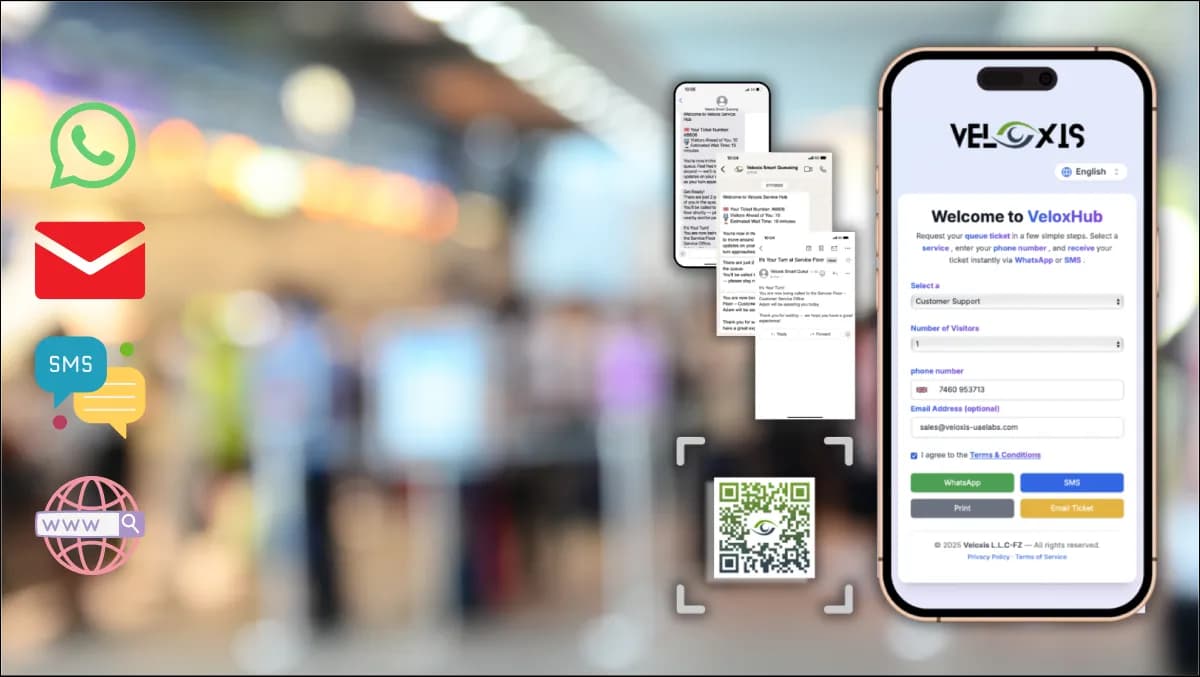
Virtual queueing is the practice of issuing a queue ticket that lives on the customer's phone instead of a thermal printer. The customer joins via a QR code, a link, a WhatsApp message, an SMS keyword or a web form; receives a ticket ID and an initial wait estimate; gets push updates as position changes; and is called to a specific counter by an in-app message + branch display when their turn arrives.
What makes it operationally different from "text us when ready" is the routing layer underneath. The virtual ticket lives in the same engine as physical tickets, competes for the same counters under the same skill-based routing rules, and counts against the same SLA. There is no separate "virtual queue" — there is one queue, with multiple intake channels.
WhatsApp and SMS are the two channels that matter for 95% of operators because they are the universal default on every phone, in every country, with no app install. Mobile apps are a nice-to-have for high-frequency customers (banking premium tier, hospital chronic-care patients). For walk-in volume, WhatsApp + SMS is the architecture. Web links (scanned from a QR at the door, or tapped from a branch-locator page) round out the channel mix.
The 13-criterion scoring rubric — score every vendor
Thirteen items. Each: criterion, why, and a one-line operational test.
- 1WhatsApp Business API certified. Why: a personal-account scraper will be shut down by Meta and customers will lose access mid-transaction. Test: ask for the BSP letter of authorisation in writing.
- 2Template message library. Why: pre-approved Meta templates for join, position update, heads-up, call-to-counter, no-show and reschedule remove 1-2 weeks per cycle of approval delay. Test: request the stock template list with Meta approval status.
- 3SMS fallback. Why: when WhatsApp fails (no internet, account suspended, region-locked), the system must transparently fall back to SMS via a licensed aggregator. Test: disable WhatsApp in staging and verify SMS continues.
- 4Bilingual templates. Why: English + Arabic baseline with full RTL is mandatory; other locales (French, Spanish, German, Portuguese, Italian, Dutch, Turkish, Urdu, Hindi) added per engagement. Test: request a rendered Arabic template screenshot from staging.
- 5Live position + ETA. Why: the customer should tap a link and see live position, branch wait time and counter assignment, not just a join confirmation. Test: tap the test link and watch position update as another ticket is issued.
- 6Geo-fence arrival nudge. Why: when the customer is within 500m and 5 minutes to call, send the heads-up — reduces no-shows 15-30%. Test: simulate location in staging and verify the nudge fires.
- 7Two-way handling. Why: when the customer replies "cancel" or "reschedule", the system must handle it without human agent involvement. Test: reply CANCEL to a live ticket and verify the queue updates.
- 8Anti-abuse + rate limiting. Why: per-MSISDN throttling, duplicate-ticket detection and blocklist/allowlist stop bot flooding. Test: issue 10 tickets from one number in 60 seconds and verify throttling.
- 9GDPR + PDPL compliance. Why: consent on join, subject-access support, server-side retention, no MSISDN forwarding to third parties. Test: request a DSAR for a test MSISDN and time the response.
- 10Operator-owned WhatsApp BSP relationship. Why: you hold the BSP contract — if you change vendor, your phone number and template library come with you. Test: check the BSP letter names the operator as principal.
- 11Display + audio call-forward integration. Why: the virtual ticket must trigger the same display + audio call as a physical ticket. Test: issue a virtual ticket and verify the in-branch display calls it.
- 12Telemetry parity. Why: virtual tickets must emit the same operational events as physical (wait time, service time, abandonment, no-show) into your warehouse. Test: request a 24-hour sample event stream covering both channels.
- 13Failover to physical ticketing. Why: if WhatsApp + SMS both fail, the lobby kiosk must still issue tickets. Test: disable both messaging channels in staging and verify the kiosk continues.
How do WhatsApp, SMS, in-app and web compare for queueing?
| Channel | Reach | Cost / message | Latency | Best for |
|---|---|---|---|---|
| WhatsApp Business API | 95%+ in most markets | £0.005-£0.05 (template-dependent) | <2s | Default; rich messaging, two-way, media |
| SMS (aggregator) | ~100% (any phone) | £0.02-£0.08 | <5s | Fallback; markets with weak WhatsApp; older demographics |
| In-app push | Existing app users only | Effectively free | <1s | Premium banking, chronic-care, frequent flyers |
| Web link (QR-scan) | Anyone who scans | Free | Real-time | First-time walk-ins; pop-up events |
The production architecture is layered: web-link as the join surface (QR at the door, link in your branch-locator app), WhatsApp as the live channel, SMS as the silent fallback, in-app push for the customer cohort that has your app. Single-channel deployments are fragile — never bet a queue on one carrier. For high-value banking cohorts, in-app push on top of WhatsApp is the gold standard; for occasional-visit government services, web QR + WhatsApp + SMS is the right base layer.
How much does virtual queueing cost in 2026?
Virtual queueing pricing has three layers: the platform, the messaging and the integration.
- Platform Discovery (fixed-fee): £8k-£18k for a multi-branch mid-market deployment; £15k-£40k for enterprise. Output: routing rules, message templates, fallback flows, integration map.
- Platform Build (8-10 weeks): £40k-£90k for mid-market; £200k-£600k for enterprise national rollouts.
- Integration (3-5 weeks): £15k-£60k. WhatsApp BSP onboarding, SMS aggregator integration, CRM/identity wiring.
- Pilot + Go-Live (4 weeks): £15k-£40k. 1-3 branches live, staff training, SOP for the customer-service team.
- Messaging operating cost: highly volume-dependent. A 50-branch bank running 30,000 virtual tickets per month at 4 messages per ticket lands at £600-£2,400 per month for WhatsApp + £1,200-£4,800 for SMS fallback (5-10% of volume). Budget £10k-£40k annually for messaging.
- Care Plan: from free Self-Sufficient up to Enterprise tier with 24/7 incident response.
See the published pricing model for full bands and the services overview for engagement structure.
> Want a fixed-fee scope before the end of the call? Talk to engineering — 30 minutes, no slideware, and a published pricing band for your estate by the time we hang up. We work alongside your CX, marketing and IT teams from the first call.
ROI calculator — 6-step model for virtual queueing
Step 1 — measure the baseline in-branch dwell
- Average dwell time per visit × visits per branch per day × branches in scope = baseline dwell-hours per day
- × 250 trading days ÷ 60 = annual baseline customer dwell-hours
Step 2 — apply a defensible dwell reduction
- Industry-benchmark dwell reduction for virtual queueing: 40-70% (mid-market), 50-75% (enterprise with geo-fence nudge)
- Recovered customer-hours per estate = baseline × reduction %
Step 3 — calculate abandonment recovery
- Current unqueued abandonment (typical 8-18%) − projected virtual-queue abandonment (typical 2-4%) = recovered transactions %
- × baseline visits × average transaction margin × 250 = annual recovered margin
Step 4 — calculate no-show reduction
- Without a 5-minute heads-up: virtual tickets see 8-15% no-show
- With heads-up + reschedule shortcut: 3-6% no-show
- Recovered counter-time per branch per day = no-show reduction × baseline visits × average service time
Step 5 — add the staff productivity uplift
- Counter idle time reduction from steadier inbound flow: 8-15%
- × FTE per branch × loaded cost × branch count = annual productivity uplift
Step 6 — subtract the all-in cost
- Build + Integrate + Pilot + 5-year messaging + 5-year Care Plan = 5-year TCO
- 5-year net benefit = (5 × annual gross benefit) − 5-year TCO
- Payback period (months) = TCO ÷ (annual gross benefit ÷ 12)
For a 50-branch bank at 600 visits/day, the model lands payback inside 9-14 months and 5-year net benefit in the £8M-£20M range. See the parallel QMS buyer's guide for the full physical-queue economics.
Message templates — the ones that actually work
The template library is where most deployments live or die. Meta requires every WhatsApp Business API template to be pre-approved; rejections delay go-live by 1-2 weeks per cycle. Six templates cover 90% of virtual queueing scenarios. Draft them in Discovery, submit in week 1 of Build, iterate any rejections during Integrate.
- 1Join confirmation. "Hi {{name}}, you're in line at {{branch}}. Ticket {{ticket}}, position {{pos}}. Estimated wait {{eta}} minutes. Track live: {{link}}. Reply CANCEL to leave the queue."
- 2Position update (every 3 positions or 5 minutes). "Update for ticket {{ticket}} at {{branch}}: position {{pos}}, ETA {{eta}} min." Throttle to avoid notification fatigue.
- 3Five-minute heads-up. "Almost your turn — ticket {{ticket}} at {{branch}}, ~{{eta}} min. Please head to the branch now. Reply DELAY if you need more time."
- 4Call to counter. "It's your turn — please proceed to counter {{counter}} at {{branch}}. Show ticket {{ticket}} on arrival."
- 5No-show / reschedule prompt. "We called ticket {{ticket}} but couldn't see you. Reply REJOIN to take the next available slot, or RESCHEDULE to book a different time via {{link}}."
- 6Cancellation confirmation. "Ticket {{ticket}} cancelled. Thanks for letting us know. Rejoin anytime: {{link}}."
Keep templates content-bland — never include PII, financial detail, or clinical context. For healthcare, the rule is harder: no patient name, no service detail, only the opaque ticket ID and the location. PHI never flows over WhatsApp or SMS, full stop.
Seven anti-patterns we see in failed deployments
Anti-pattern 1: parallel queues. The vendor wires virtual tickets into a separate queue with separate counters. Walk-ins jump it; virtual customers feel cheated; abandonment spikes. The fix: one queue, one routing engine, one SLA — channels are intake, not separate lines.
Anti-pattern 2: no SMS fallback. WhatsApp coverage is brilliant until it isn't — Meta account suspensions, template deprecations, regional outages, customers on phones with no internet. Single-channel deployments fail at the worst possible moment. Always layer.
Anti-pattern 3: vendor-owned BSP contract. The QMS vendor buys the WhatsApp Business API access on the operator's behalf and refuses to transfer it. Switching vendor means losing your phone number and your template library. Insist on operator-held BSP contract from day one.
Anti-pattern 4: untemplated free-text messages. A vendor that lets agents send free-text WhatsApp messages to customers will be rate-limited inside two weeks. Meta only allows templated messages outside the 24-hour service window. The fix is to template everything and enforce it at the platform layer.
Anti-pattern 5: notification spam. Sending a position update every 30 seconds turns the channel into noise; customers mute it and miss the call-to-counter. The fix is to throttle position updates to every 3 positions or every 5 minutes, whichever is later.
Anti-pattern 6: PHI in messages. A clinic vendor that ships templates including the consulting doctor's name or the service ("Diabetes clinic — your turn") has just leaked PHI over an unencrypted channel. The fix is opaque ticket ID + location only, with full context kept inside the on-prem MediCare deployment.
Anti-pattern 7: cross-border messaging without consent. Sending a WhatsApp or SMS to a customer's roaming number while they are in a different jurisdiction breaches PDPL and several other regimes without explicit opt-in. The fix is jurisdiction-aware consent capture and a messaging suppression list.
Anti-pattern 8: shared service number. Reusing one WhatsApp number across multiple brands or estates muddles brand and breaks deliverability. The fix is one number per brand and an explicit BSP onboarding per estate.
Migration path — moving from your current stack
Most operators already have something — a basic SMS appointment reminder, a "join the queue" web form, or no virtual flow at all. The Zeour migration pattern is parallel-shadow then cutover.
Phase A (weeks 1-3): shadow capture. The new virtual queue is exposed at the door QR but does not yet route — tickets continue to come from the lobby kiosk. Telemetry captures join intent and customer journey behaviour.
Phase B (weeks 4-7): single-service cutover. One service line moves to virtual-first (e.g. account-opening). Customers who join virtually get heads-up nudges and walk in at call. Lobby kiosk continues for everything else.
Phase C (weeks 8-12): full pilot. Pilot branch routes all services through unified virtual + physical queue. Daily review of abandonment and no-show metrics. Templates iterated based on rejection rate and customer feedback.
Phase D (weeks 13+): estate rollout. 4-8 branches per week. Existing SMS reminder contracts wound down. If you are coming from a basic virtual queue bolt-on, the full Zeour routing engine takes over the BSP relationship and the legacy is decommissioned inside 12 weeks of cutover.
Implementation playbook
- 1Discovery (2-4 weeks). Customer journey workshops, message templates drafted, WhatsApp BSP shortlisted, SMS aggregator selected, integration map signed off. Output: a fixed-price scope.
- 2Build (8-10 weeks). Virtual queue engine wired into the routing layer; templates submitted to Meta for approval (start week 1 — approvals take time); SMS gateway integrated; admin UI for template + flow management. Weekly demos with the operator.
- 3Integrate (3-5 weeks). WhatsApp BSP cutover, CRM identity match, branch-locator + appointment cross-link, audit + consent capture wired to the operator's GDPR/PDPL toolchain.
- 4Pilot + Go-Live (4 weeks). 1-3 branches in shadow mode (virtual tickets issued but physical still primary), then full cutover. Customer-service team trained on cancel/reschedule edge cases. Daily review of message templates and abandonment metrics.
- 5Operate. Quarterly template review (Meta deprecates templates regularly). Volume scaling. Add geo-fence nudge in month 4. Expand to mobile-app push for premium customers in month 6.
Frequently asked questions
Do customers need to install an app to use virtual queueing?
No. WhatsApp is already installed on 95%+ of phones in most markets; SMS works on every phone with no install. The customer scans a QR code at the door or taps a link in your branch-locator and is in the queue in under 10 seconds. Mobile apps are a parallel premium channel, not a prerequisite.
What happens when WhatsApp Business API is suspended or rate-limited?
A production system falls back to SMS transparently — the customer never sees the failure. Templates and routing logic mirror across channels. If both fail (rare), the lobby kiosk still issues physical tickets and the branch keeps running. Single-channel deployments are the operational risk; layered ones are not.
How does virtual queueing affect no-show rates?
Without a heads-up nudge, virtual tickets see 8-15% no-show rates (vs 1-3% for physical). With a geo-fence-triggered 5-minute heads-up and a confirm-or-cancel reply, no-shows drop to 3-6%. Adding a reschedule shortcut in the same message brings them under 4%. The architecture decides the number.
Is WhatsApp virtual queueing GDPR and PDPL compliant?
Yes — when configured properly. Consent is captured on first join (a clear opt-in line in the template), retention is enforced server-side (typically 30-90 days post-ticket), subject-access requests are handled via the same toolchain as the rest of the QMS, and no MSISDN is forwarded to third parties. The HIPAA posture for clinics is similar — PHI never flows over WhatsApp.
Can this run for a hospital with patient data sensitivity?
Yes. The virtual ticket carries an opaque ID, never a patient name or medical detail. Confirmation messages are content-bland ("Your ticket is ready — please head to floor 2"). The full patient context stays inside the on-prem MediCare deployment. This is the architecture used in production by clinics across healthcare deployments.
Is there a hard daily message limit per number?
WhatsApp Business API throttles outbound templates per business number based on quality rating. Verified business numbers in good standing tier up to unlimited; new numbers start at 1k unique recipients per 24h and tier up over 2-4 weeks. The platform layer enforces throttling per number and queues bursts to stay inside policy.
How do you handle multi-language for a mixed customer base?
Detect customer preferred language at join (from the QR-scan URL parameter, the customer profile, or an opt-in question) and route all subsequent template selection accordingly. English + Arabic baseline ship as production; French, Spanish, German, Portuguese, Italian, Dutch, Turkish, Urdu, Hindi added per engagement. Each new locale is a 3-file change plus Meta template re-approval.
What happens if a customer's phone runs out of battery between join and call?
The position is held until the call-to-counter event; if the customer does not appear within the configured grace window (typically 5 minutes), the ticket flips to no-show and the next ticket is called. Reply REJOIN brings them back to the next slot. The flow is designed to fail safe — no customer is dropped silently.
How much does it cost to run, end-to-end?
Platform Build + Integrate + Pilot lands at £100k-£250k mid-market, £400k-£1.2M enterprise. Annual messaging cost £10k-£40k for a 50-branch estate at typical volumes; £40k-£150k for a 200-branch enterprise. Care Plan from free (Self-Sufficient) to enterprise 24/7 with SLA. See pricing for the published bands.
How fast can you go live with virtual queueing if the QMS already exists?
If a Zeour QMS is already live, virtual queueing layers on in 6-10 weeks (BSP onboarding, template submission, integration, pilot). If the operator is greenfield, 16-22 weeks total. Anyone promising 3-week WhatsApp queueing has skipped Meta approval and will run into the rate-limit ceiling at first volume spike.
Where Zeour fits
Virtual queueing only works when it lives inside the same routing engine as physical, appointments and staff-issued tickets. Zeour ships virtual queueing as part of the same routing engine as physical queue management and online appointments — one ticket ID, one SLA, one telemetry stream. WhatsApp Business API + SMS aggregator + web QR are layered by default. Templates ship bilingual EN/AR with full RTL; any other locale added per engagement. Sovereign on-prem or hybrid deployment for banking, healthcare, government and telecom operators who cannot send customer data to a vendor cloud. Fixed-fee phased delivery, published pricing, 90-day exit window. Reference deployments include Servizz.gov Malta, Kuwait National Bank London and IIB Bank Iraq. Browse the wider case studies, the glossary or the blog. Book a demo or request a quote to scope your estate.
---
Last updated: May 17, 2026 — by the Zeour engineering team.