
Retail — Stores, Malls & Service Counters
Cut queue abandonment by 50%, push real-time signage to thousands of screens across a mall, and capture customer feedback at every touchpoint. Cloud or on-prem; engineered multilingual — extensible to any locale per engagement; integrated with your POS and loyalty platforms.
Production references
What Zeour deployments deliver for retail operators.
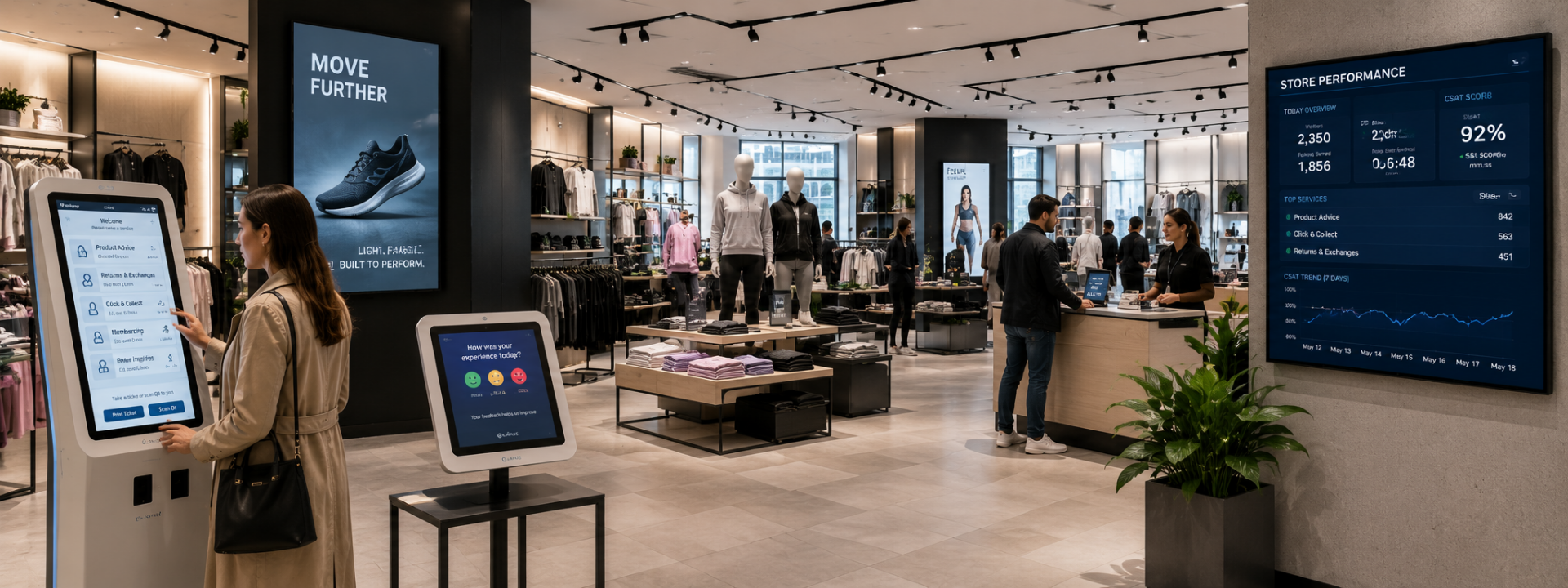
Virtual queueing + WhatsApp ticketing — customers shop the mall while waiting.
RFID card lifecycle + Android Compose kiosks + barrier-gate GPIO.
Till-tablet micro-survey vs. legacy paper card.
Video, image, YouTube, weather, clock, RSS, QR, social, countdown, data viz — composable in the canvas WYSIWYG.
The four problems we hear from retail buyers in every Discovery.
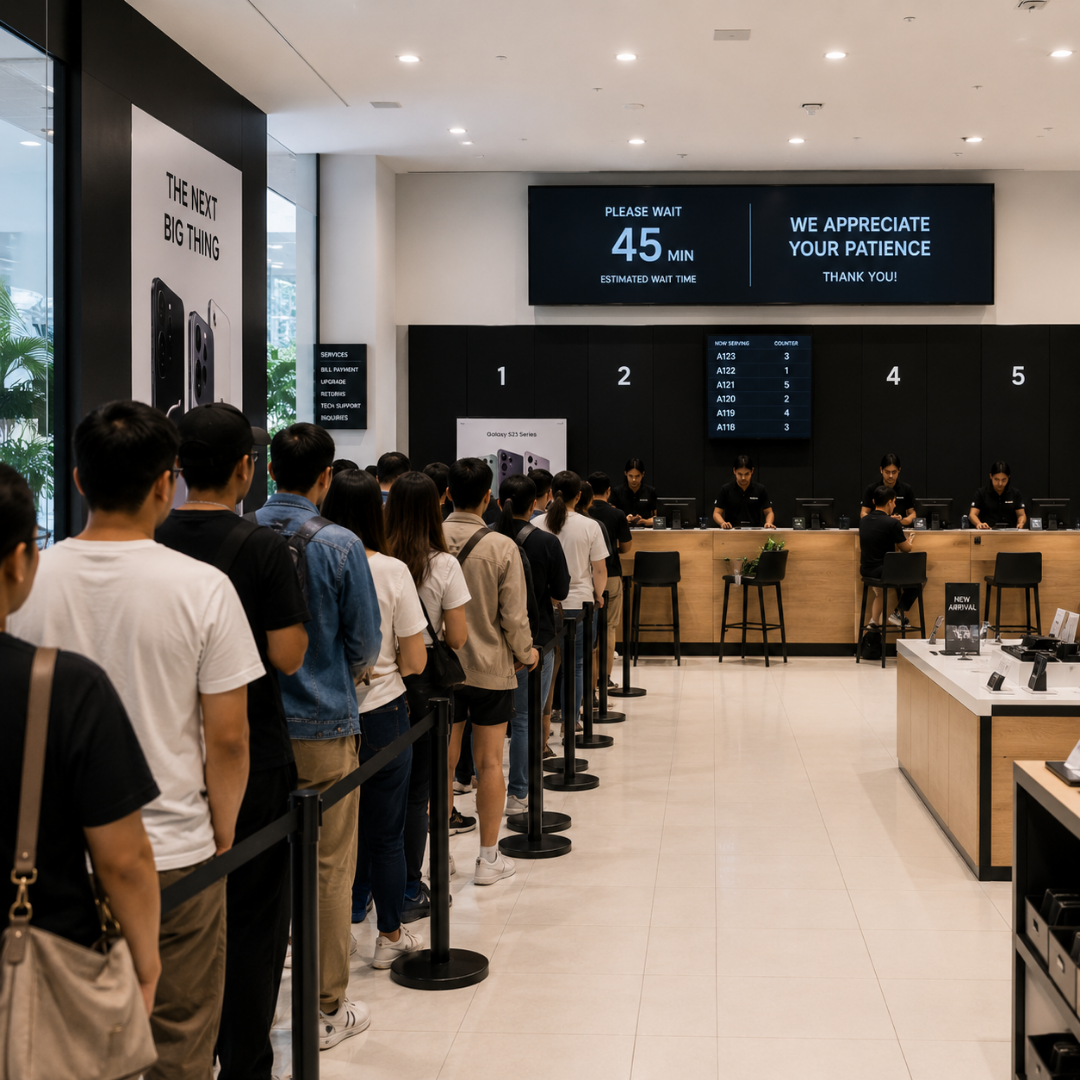
Queue abandonment is unmeasured revenue loss
Customers who join a service-counter queue and leave never get counted in the lost-sale metric. Most chain retailers run blind on this number; a virtual-queue layer makes it visible and recoverable.
Mall signage is updated by twenty different tenants
Multi-tenant malls have anchor stores, dozens of small tenants, emergency broadcast requirements and a building-management overlay. A signage CMS that doesn't handle Building → Floor → Department → Screen Group hierarchy breaks within a quarter.
Feedback at the till is a paper card no-one fills in
Paper CSAT cards have a 2–4% completion rate. A tablet kiosk at the till with a 3-question micro-survey hits 35–55% on a typical retail floor.
Mall parking is the first and last customer impression
A slow parking exit (driver paying with cash, no RFID, no licence-plate-recognition) is the negative anchor of the entire shopping trip. Sub-5-second exit via RFID + barrier-gate GPIO is the table-stakes target.
Solutions deployed in retail today.
Every solution below is in production with at least one retail operator. Click any card for the full deep-dive.
Concrete deployment scenarios.
Hypermarket service counter
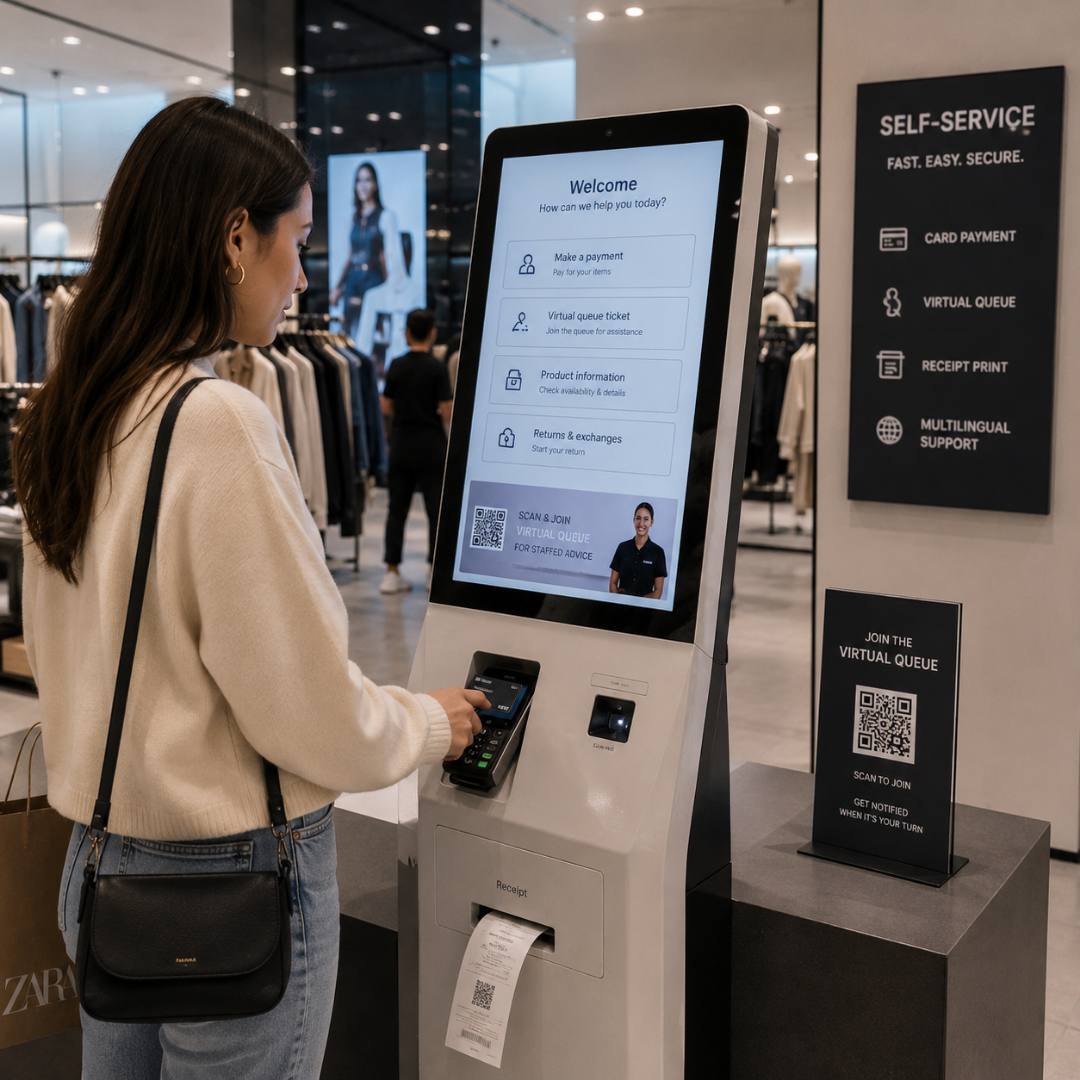
Customer collects a virtual ticket via WhatsApp on entering the store; gets a predictive wait; shops the floor; gets called when the counter is ready; total dwell time is positive (more time browsing).
Mall multi-tenant signage
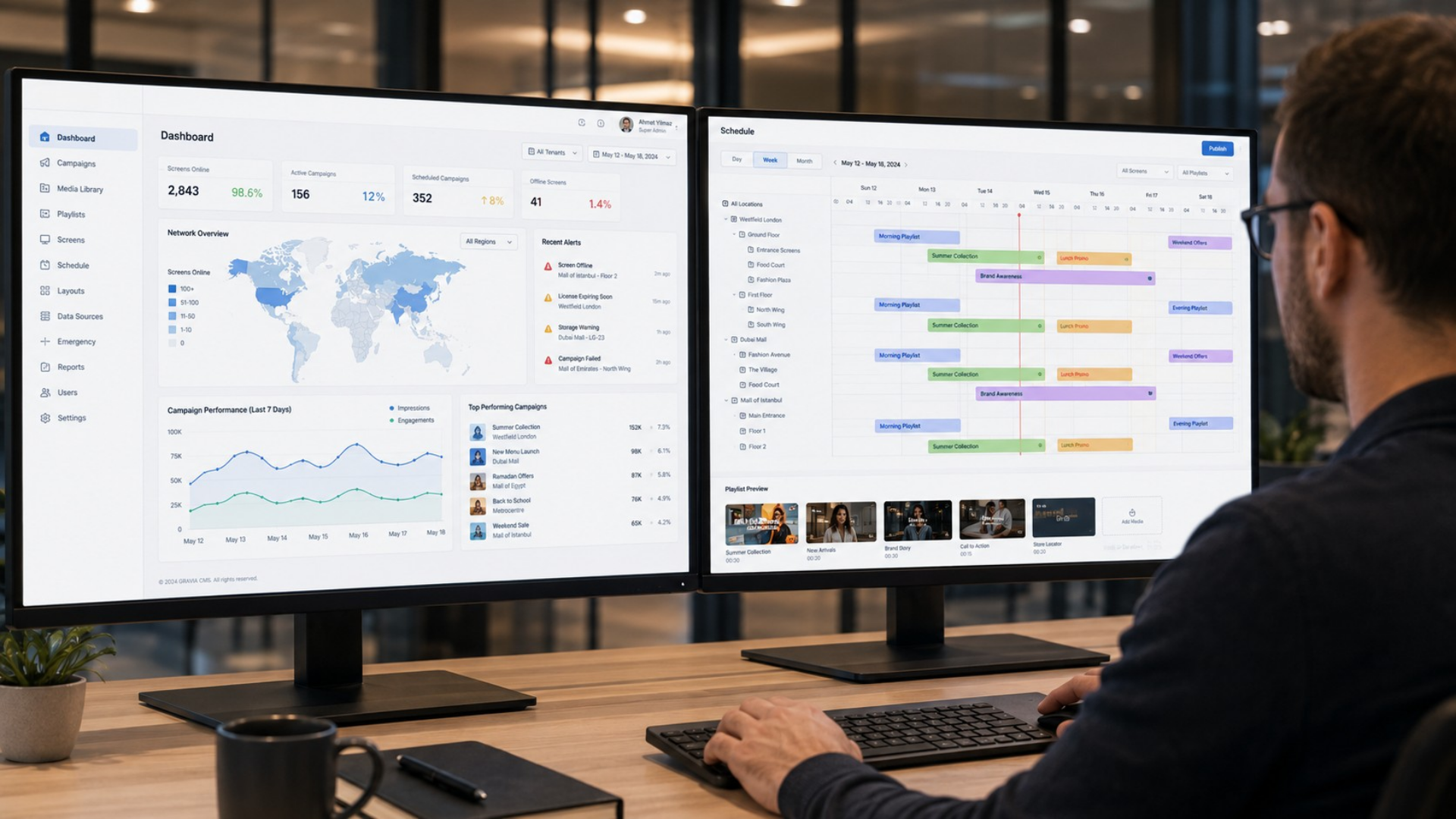
Building → Floor → Department → Screen Group hierarchy; tenant-scoped editor; emergency broadcast overrides every screen in five seconds; ClamAV antivirus on every upload; HealingVideo HLS fallback so screens never go blank.
Mall parking with RFID + LPR
RFID card issued to mall employees and VIP shoppers; LPR for everyone else; staff card-management console; real-time Socket.IO monitoring; per-car-size pricing profiles.
In-store CSAT at the till
iPad / Android tablet at the till with 3-question micro-survey; results land in the manager's dashboard live; sentiment analysis flags negative experiences for follow-up within 24 hours.
Deep dive — Zeour engineering for the retail reality.
Why multi-tenant signage is the hardest part of a mall
A modern mall is not a single signage operator — it's a building manager, fifty-plus tenants, an emergency-services overlay, a security overlay, and a marketing operator all sharing the same screen estate. GRAVIA handles this via a Building → Floor → Department → Screen Group hierarchy, with per-tenant RBAC scoped to the screens the tenant owns. Emergency broadcasts override every screen in five seconds, irrespective of which tenant is currently playing what. Each upload runs through ClamAV antivirus; URLs are HMAC-signed; 2FA is mandatory in cloud mode. HealingVideo HLS fallback and the SmartPlay fallback chain mean screens never go blank — if a tenant's primary playlist fails, the player walks the fallback chain until something renders. The whole platform is built for the case where the operator doesn't trust every tenant equally and needs to enforce that boundary in the CMS itself.
What virtual queueing changes in a chain-retail floor
Walk-up queues at service counters (returns, customer service, account opening, click-and-collect) are the standard pattern. Two things happen when you add a virtual-queue layer on top. First, the floor manager finally sees the abandonment number — how many customers joined the queue, looked at the wait, and left. That is unmeasured revenue loss and the first number that improves under any decent virtual-queue deployment. Second, dwell time changes character: the customer who joins a virtual queue via WhatsApp and goes shopping has a positive dwell — they're browsing, not standing — and they convert at a measurably higher rate than the customer who stood in line. The economics are clear within a single quarter on a typical chain-retail floor.
Parking as the bookends of the customer trip
Parking entry and parking exit are the first and last interactions a customer has with a mall, hypermarket or service centre. A slow exit (driver hunting for cash, no RFID, no LPR, the kiosk needs a card insert that takes ten seconds) is the negative anchor of the entire trip — even if the in-store experience was great. Smart Parking ships an Android Compose kiosk fleet driving ICT104U card readers + barrier-gate GPIO + hardware watchdog via the smdt SDK, with sub-5-second leave at exit as the SLA. Sovereign on-prem licensing: every deployment is RSA-SHA256 signed to specific server MAC addresses; no SaaS phone-home. Re-localisable to any market — UK, EU, Americas, GCC, MENA, Africa, Asia — in days, not months.
Feedback that's actually actionable
Customer Feedback ships as a 3-question till-tablet flow as the default, with optional follow-up modes (post-visit SMS / WhatsApp / email survey). Real-time results land in the manager's dashboard with sentiment analysis flagging negative experiences for a 24-hour follow-up window. CSAT, NPS and a custom-question score are tracked simultaneously. The dashboard ships with the standard slice-and-dices (per store / per till / per day-of-week / per hour-of-day / per agent) and exports to CSV or the operator's BI tool. The end state is a metric that gets watched, not buried — most retail rollouts cut negative-experience-to-resolution from days to under 4 hours within the first month.
Regional notes — what changes per market.
United Kingdom + European Union
GDPR + UK DPA 2018, integration with chain-retail POS systems (Cegid / Aptos / NewStore and others), PCI DSS 4.0 for any payment kiosks, cloud-first commercial.
Americas
Integration with US chain-retail POS systems; PCI DSS 4.0 for payment kiosks; cloud or on-prem option for mall operators.
GCC + MENA
RTL Arabic shipping in the same build as English, integration with mall-tenant ERP systems, PDPL-aligned consent capture, WhatsApp as the dominant customer-comms channel, sovereign on-prem option for mall operators.
Africa + Asia
Sovereign on-prem option for mall operators that want visitor data on their perimeter; integration with regional POS systems scoped per engagement.

Compliance frameworks
- PCI DSS 4.0
- GDPR
- UK DPA 2018
- PDPL
- ISO 27001
Active regions
- · United Kingdom
- · European Union
- · Americas
- · GCC
- · MENA
- · Africa
- · Asia
Production references.
Questions retail buyers always ask.
Retail deployments in production.
Talk to an engineer who has shipped this for retail.
A 30-minute scoping call with the team that builds and operates Zeour — not a generalist account exec. We’ll walk your branch / site / network profile and give you a fixed-fee Discovery price by the end of the call.
Retail — concepts you'll meet
Definitions for the operational terms that appear across this industry page.