
Healthcare — Clinics, Hospitals & Diagnostics
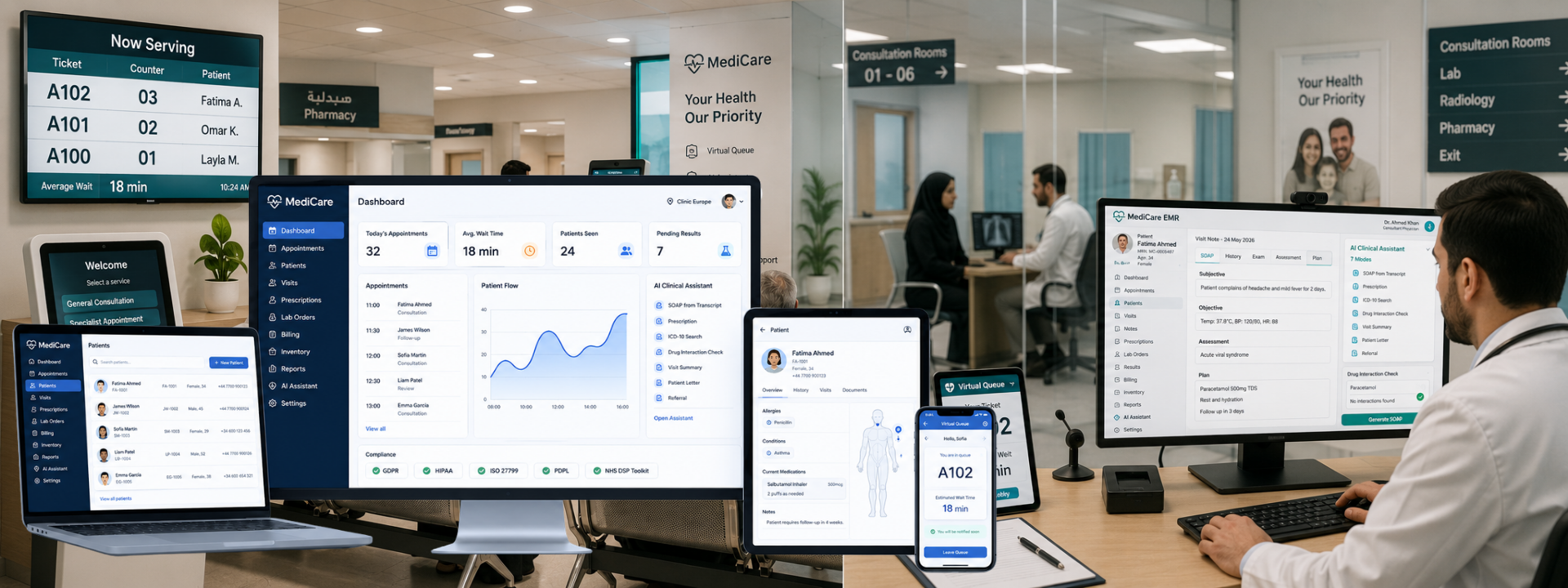
Cut charting time by 55%, average outpatient wait by 45 minutes, and bring a 7-mode AI Clinical Assistant on-premise inside the clinic's own perimeter — without sending patient data to anyone. Engineered multilingual, extensible to any locale per engagement. HIPAA / GDPR / PDPL aligned.
Production references
What Zeour deployments deliver for healthcare operators.
7-mode AI clinical assistant on-premise — SOAP, prescription, ICD-10, drug-interaction, summary, patient-letter, referral.
Virtual queueing — patients wait at home, arrive when called.
Multi-site hospital group, Middle East — 6-month measure.
Multilingual (full RTL) ship as a production baseline; any other locale added per engagement.
The four problems we hear from healthcare buyers in every Discovery.
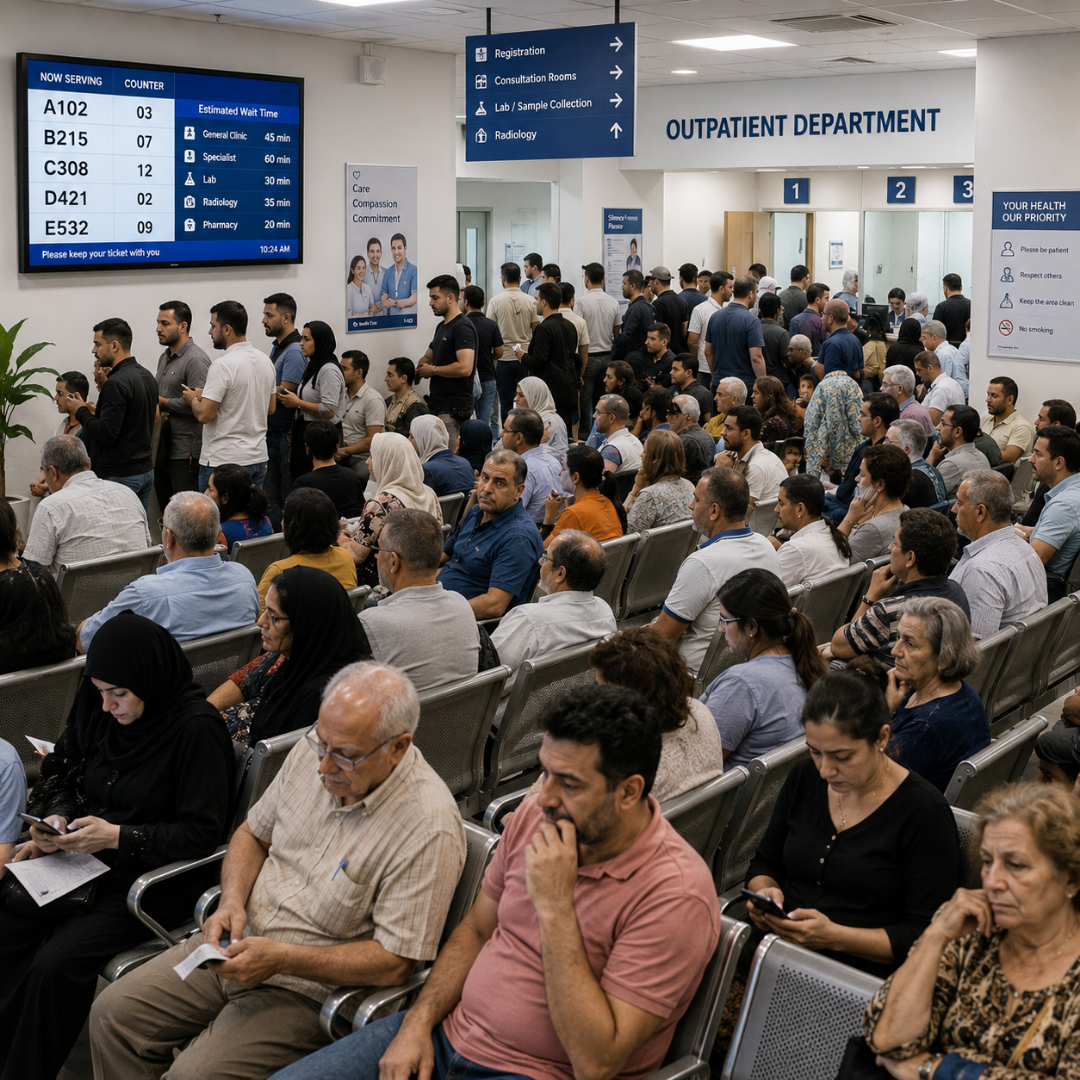
Outpatient lobbies are still 45-minute waits
Walk-in volume + scheduled appointments collide. Patients sit, families crowd the lobby, and the perceived-wait metric is the loudest driver of the patient-satisfaction score.
Charting is the doctor's second job
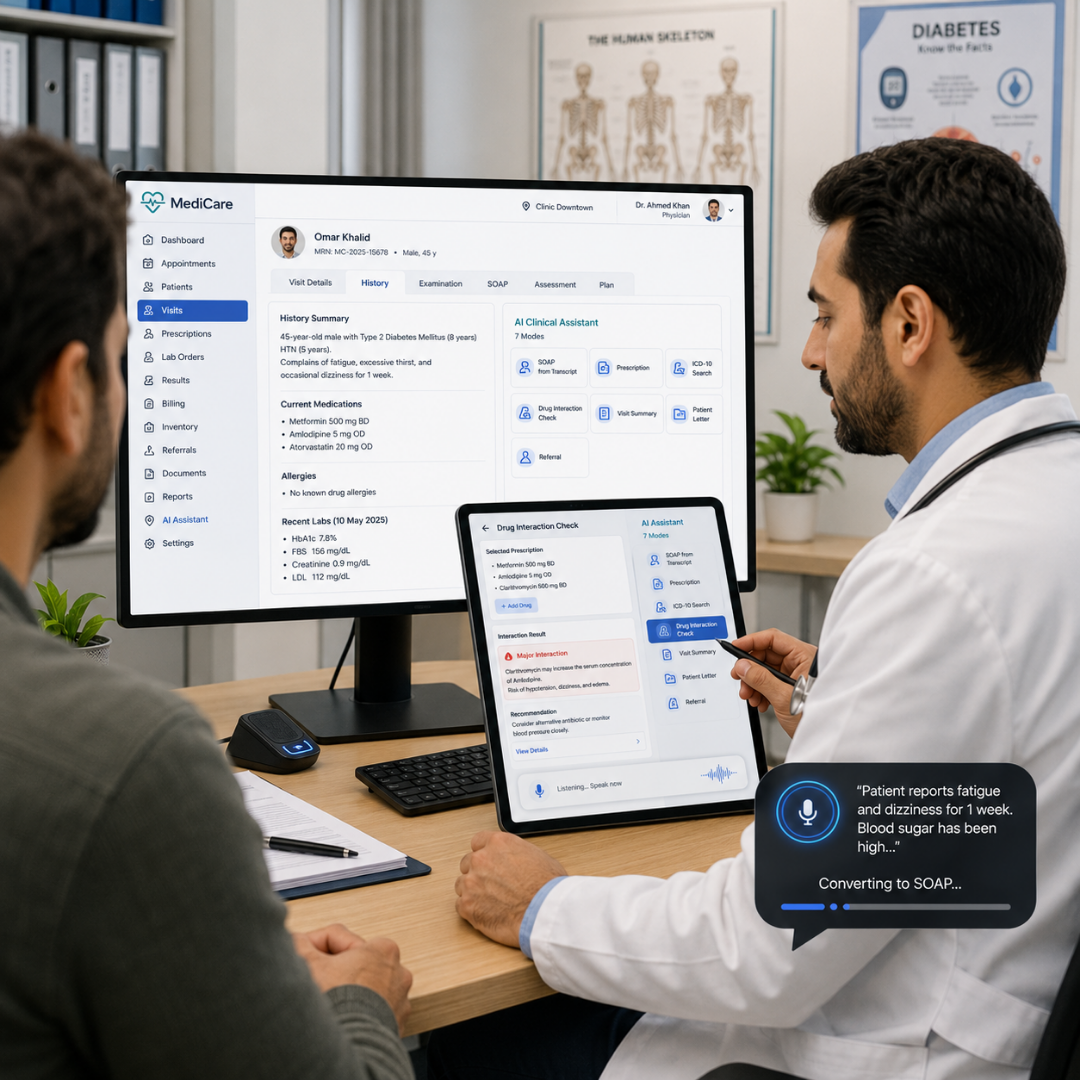
Free-text SOAP notes, ICD-10 lookup, prescription writing, drug-interaction checks — the doctor spends 40% of the consultation on the keyboard. A 7-mode AI clinical assistant on-premise cuts this in half without sending patient data anywhere.
Multilingual patients, monolingual EMRs
Clinics in multilingual markets see English, Arabic, Spanish, French, Urdu, Turkish, Tagalog and many more in the same waiting room. Most EMRs ship English-only with a label translation layer that breaks on name handling, prescription instructions and lab-result PDFs.
Patient data leaving the perimeter is a legal problem
HIPAA + GDPR + PDPL + national health data residency rules push hospitals toward on-prem deployment. SaaS EMRs that phone home fail the procurement review. Sovereign on-prem with on-prem AI is the only option that clears.
Solutions deployed in healthcare today.
Every solution below is in production with at least one healthcare operator. Click any card for the full deep-dive.
Concrete deployment scenarios.
Outpatient clinic — virtual queueing + EMR
Patient books via WhatsApp / web; gets predictive wait; arrives 10 minutes before slot; ticket auto-converts; doctor opens MediCare with patient history pre-loaded; AI suggests SOAP draft from the consultation transcript.
Multi-site hospital group — single EMR, multiple sites
Each site runs MediCare on-prem on its own server (MySQL + Next.js 16 standalone, Caddy reverse proxy). Cross-site patient pull via signed API; central reporting through a federated query layer.
Diagnostic centre — lab + queue + signage
Patient queues for sample collection; sample tracked via barcode through the lab; result published to portal + WhatsApp; lobby signage shows live wait estimate by sample type.
Hospital wayfinding — kiosk + mobile handoff
Visitor enters at the main entrance; kiosk shows multi-floor route; QR handoff to mobile with 30-minute secure session; the route updates as floors / lifts change status.
Deep dive — Zeour engineering for the healthcare reality.
On-premises AI inside a clinic — what it actually means
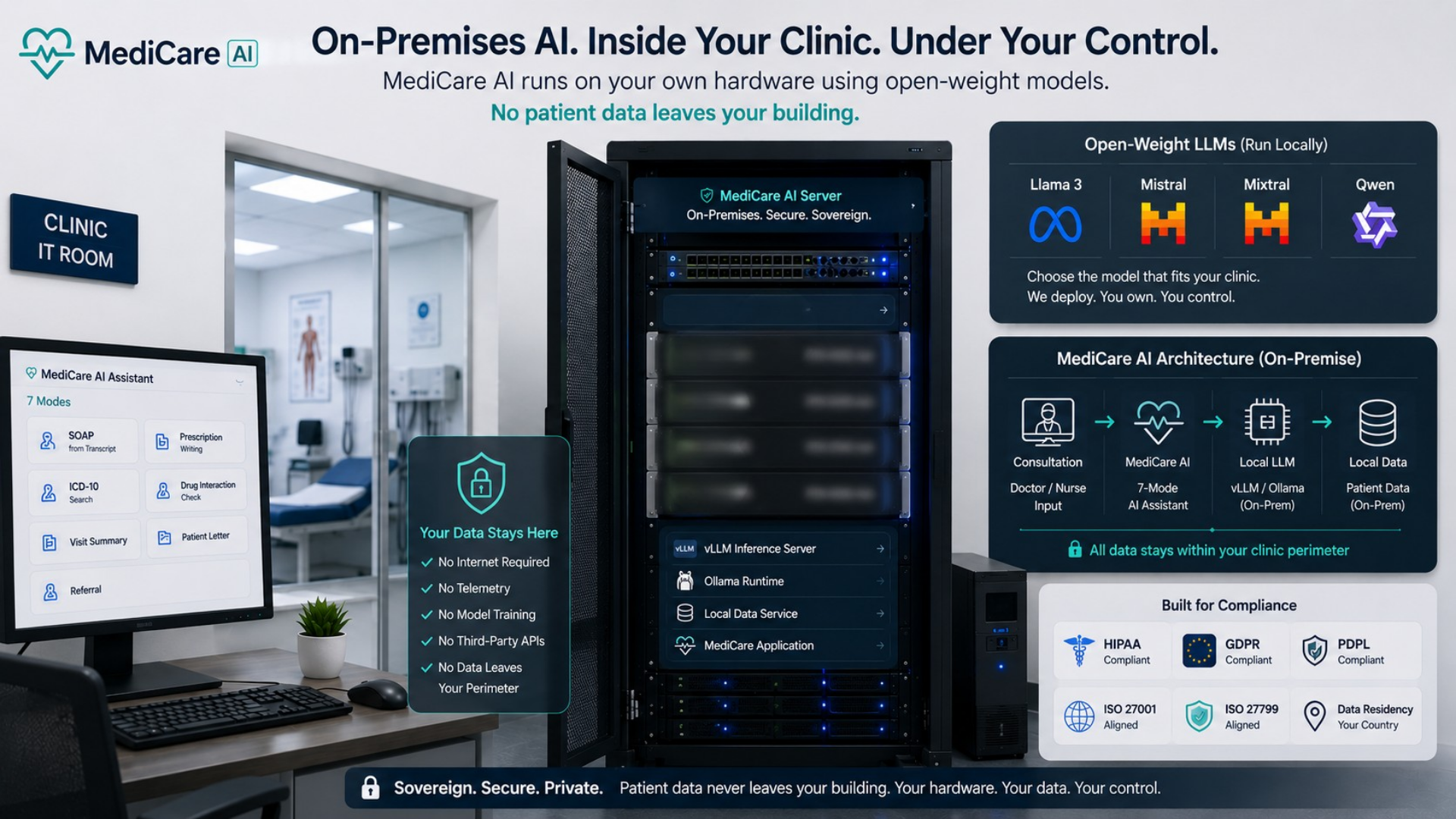
The AI Clinical Assistant runs as a local LLM on the clinic's own hardware — the clinic procures, we design, deploy and operate. The reference deployment is an open-weight model (Llama 3, Mistral or Qwen) served via vLLM or Ollama on a single workstation-class GPU sized to the practice's concurrency profile. For practices without a GPU, the CPU-only mode runs against a 7B-parameter model with acceptable latency for the seven modes we ship: SOAP-from-transcript, prescription writing, ICD-10 search, drug-interaction check, visit summary, patient letter, and referral. Patient data never leaves the clinic's perimeter. There is no telemetry, no model-training feedback, no third-party API call. This is the only deployment pattern that clears a strict HIPAA / GDPR / PDPL review without consent-form gymnastics. Operators who already have a CME workflow keep it; the assistant slots in as a drafting tool, not a decision-maker.
What ships in a MediCare clinic deployment
Patient records with body-diagram annotations, drag-and-drop appointment scheduling, SOAP visit notes with ICD-10 search built in, prescriptions with drug-interaction checking, lab orders + samples + results with barcode tracking, billing with integer-amount accounting (no floating-point rounding errors), inventory tracking, WebRTC telemedicine running on the clinic's own signalling server, and a patient self-service portal — all under RBAC across Admin / Doctor / Reception / Lab Tech. The whole stack runs on MySQL + Next.js 16 standalone behind a Caddy reverse proxy on a single Linux server. Backups are scheduled mysqldump snapshots and trivially scriptable. The clinic's IT team can administer the entire stack with standard Linux skills — no proprietary tooling.
Wayfinding + queueing inside a multi-floor hospital
A typical hospital deployment combines two GLARUS modules with the wayfinding system. Patients enter at the main entrance and use a kiosk to find their department; the route handles lifts, stairs, internal corridors, and floor changes via picture-in-picture. A QR-handoff transfers the route to the patient's phone with a 30-minute secure session. Once at the department, the patient joins the local queue via virtual ticket; the lobby signage shows live wait estimates. The same wayfinding map is shared with cleaning, security and maintenance teams via an admin console — the floor graph is a single source of truth. Floor-graph BFS handles routing; client-side Dijkstra plus polygon wall-collision avoidance handles the visual path on the kiosk.
Pricing posture for healthcare buyers
MediCare is licensed per-clinic (per-server) with a one-time licence purchase plus 18–22% annual maintenance covering updates, security patches and SLA support — sovereign on-prem only. Queue / virtual-queue / appointment / wayfinding / signage are available either as subscription (cloud) or perpetual licence + maintenance (on-prem). A typical mid-size outpatient clinic stack runs in the low-five-figure GBP range for software; hardware is sized separately. The ROI calculator on /pricing models this against your specific patient volume, doctor count and current charting overhead.
Regional notes — what changes per market.
United Kingdom + European Union
NHS DSP Toolkit alignment, GDPR + UK DPA 2018, NHS Number aware where applicable, integration with private medical insurance claim flows, on-prem option for clinic groups that want data inside the perimeter.
Americas
HIPAA alignment, on-prem deployment option for clinic groups and diagnostic networks; configurable insurance / claim integration scoped per engagement.
GCC + MENA
PDPL alignment, Hijri calendar in appointment booking, RTL Arabic shipping in the same build as English, VAT-aware billing, integration with national health-ID systems where in production.
Africa + Asia
Sovereign on-prem deployment as default; configurable currency / phone-number formatting; on-prem AI clinical assistant runs on the clinic's own GPU or CPU-only for smaller practices.

Compliance frameworks
- HIPAA
- GDPR
- PDPL
- NHS DSP Toolkit
- ISO 27799
- ICD-10
- HL7 / FHIR
Active regions
- · United Kingdom
- · European Union
- · Americas
- · GCC
- · MENA
- · Africa
- · Asia
Production references.
GLARUS queue management deployed for the hospital's outpatient clinic — ticketed patient flow that routes patients to the right consultation room without front-desk triage.
GLARUS queue management for the centre's outpatient clinics — ticketed patient flow so clinic patients are routed and called in order without front-desk congestion.
Questions healthcare buyers always ask.
Healthcare deployments in production.
Talk to an engineer who has shipped this for healthcare.
A 30-minute scoping call with the team that builds and operates Zeour — not a generalist account exec. We’ll walk your branch / site / network profile and give you a fixed-fee Discovery price by the end of the call.
Healthcare — concepts you'll meet
Definitions for the operational terms that appear across this industry page.