
Digital Transformation Consulting Services
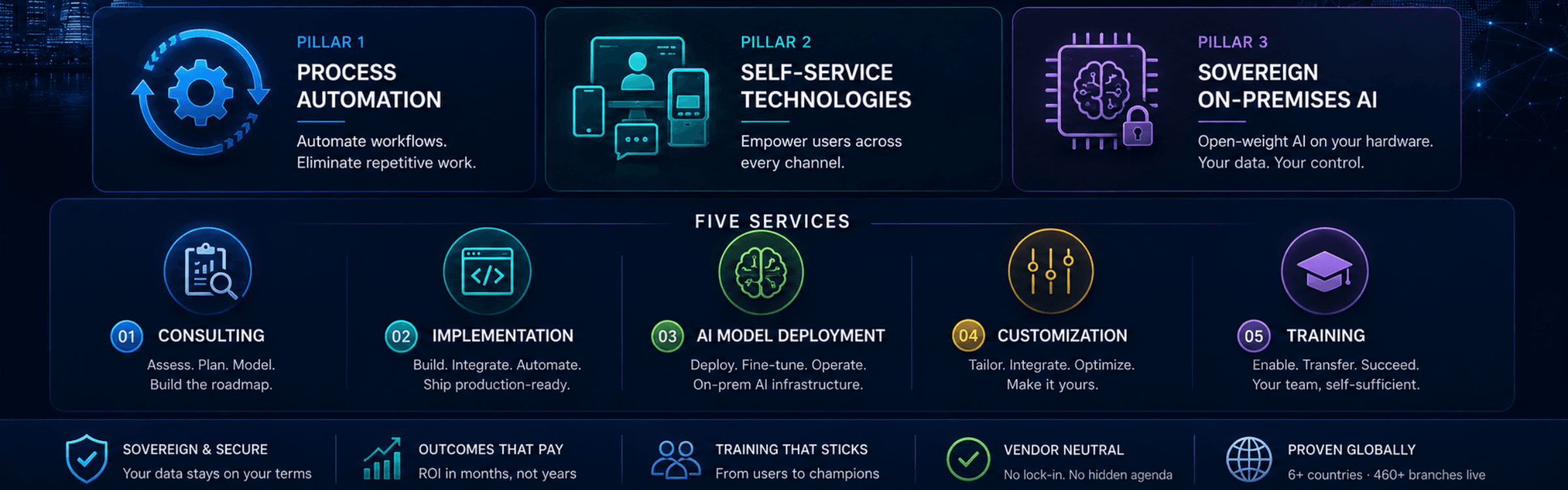
Zeour offers digital transformation consulting for organisations improving manual processes and customer service operations. The service covers process automation, self-service technology and on-premises AI, combining assessment and planning with implementation, customisation and staff training.
Assess Processes and Plan Implementation
Identify where manual work, disconnected systems or service bottlenecks create operational friction. The engagement turns those findings into a roadmap and an implementation scope, with training and handover for the team that will operate the result.
Turning the Roadmap into Operational Systems
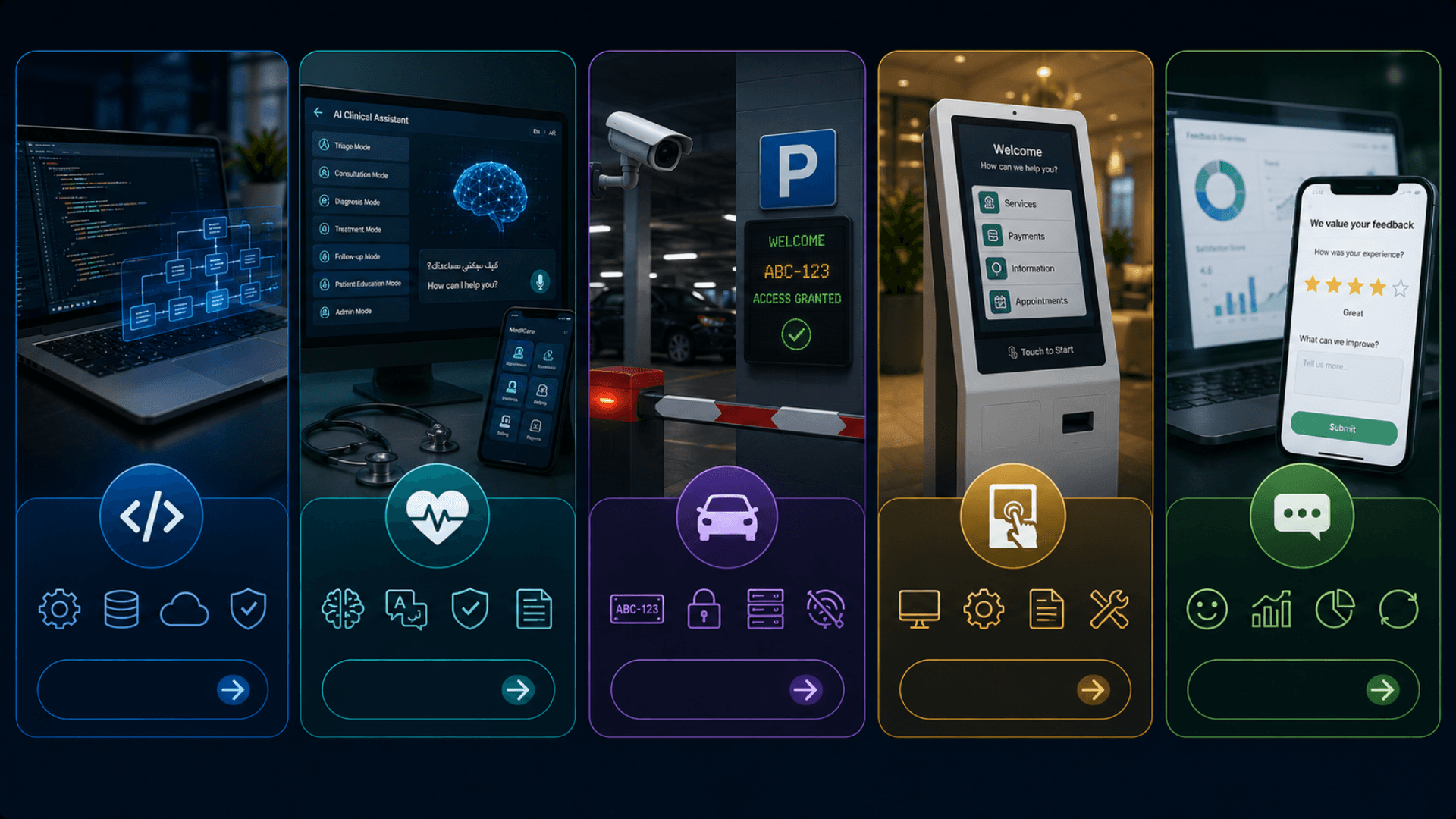
Where the roadmap calls for custom applications, enterprise software development services cover the build. A self-service kiosk project can address specific customer transactions.
Use customer feedback tools to examine service experience, and review queue management software when the priority is customer flow at physical service locations.
Automation, Self-Service and On-Premises AI Advisory
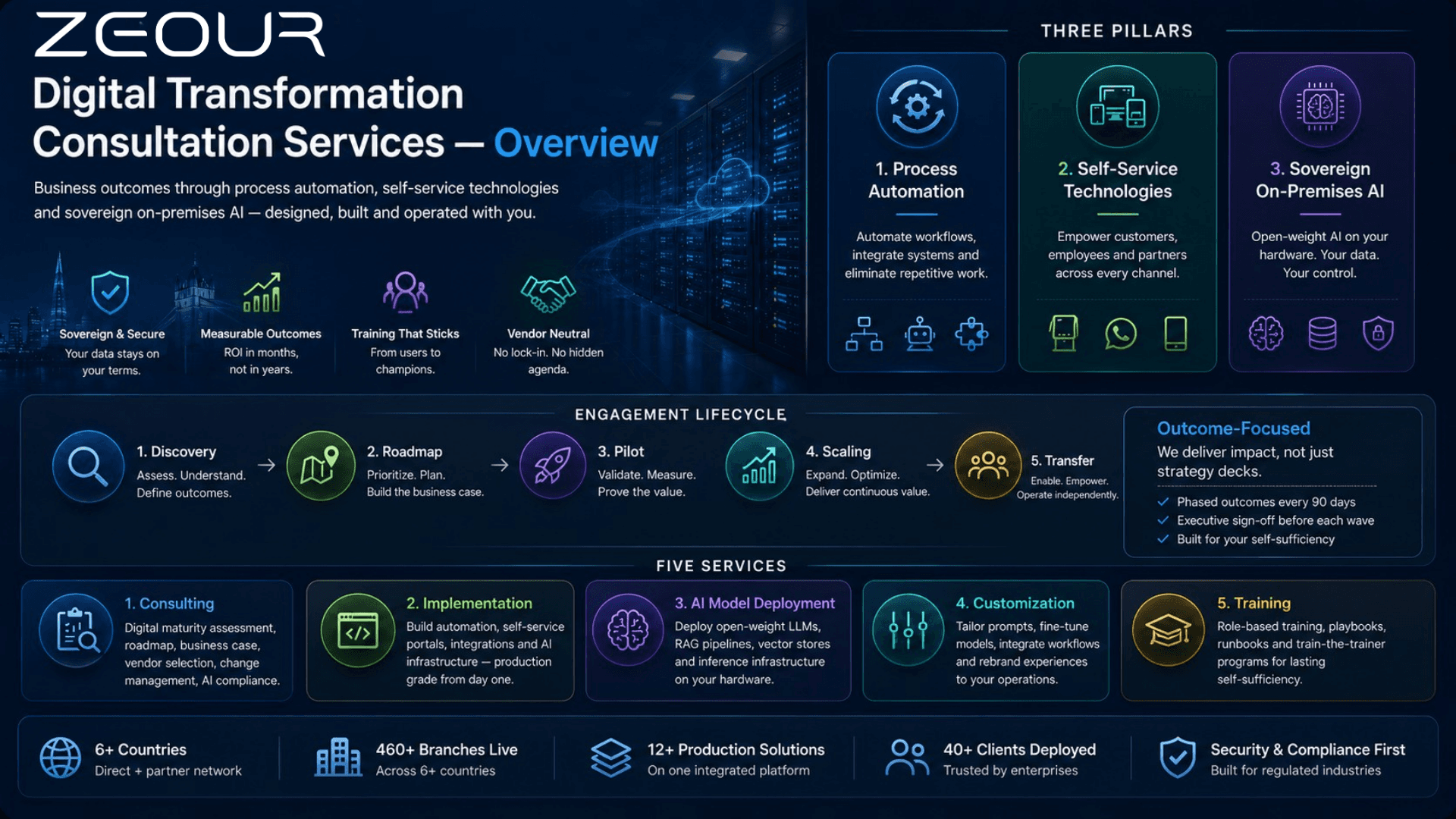
Zeour Digital Transformation Consultation is structured around three pillars (process automation, self-service technologies, on-premises AI) and five services (consulting, implementation, AI model deployment, customization, training). Every engagement is a phased program — discovery + roadmap up front, then 90-day waves of validated delivery, then a deliberate transfer phase that leaves your team self-sufficient. The AI competency is the standout: we ship a 7-mode AI Clinical Assistant in production today (MediCare on OpenAI Responses API; the same pattern adapts to local open-weight LLMs running entirely on your hardware). Vendor-neutral advice; phased outcomes every 90 days; the deliverable is your operating self-sufficiency.
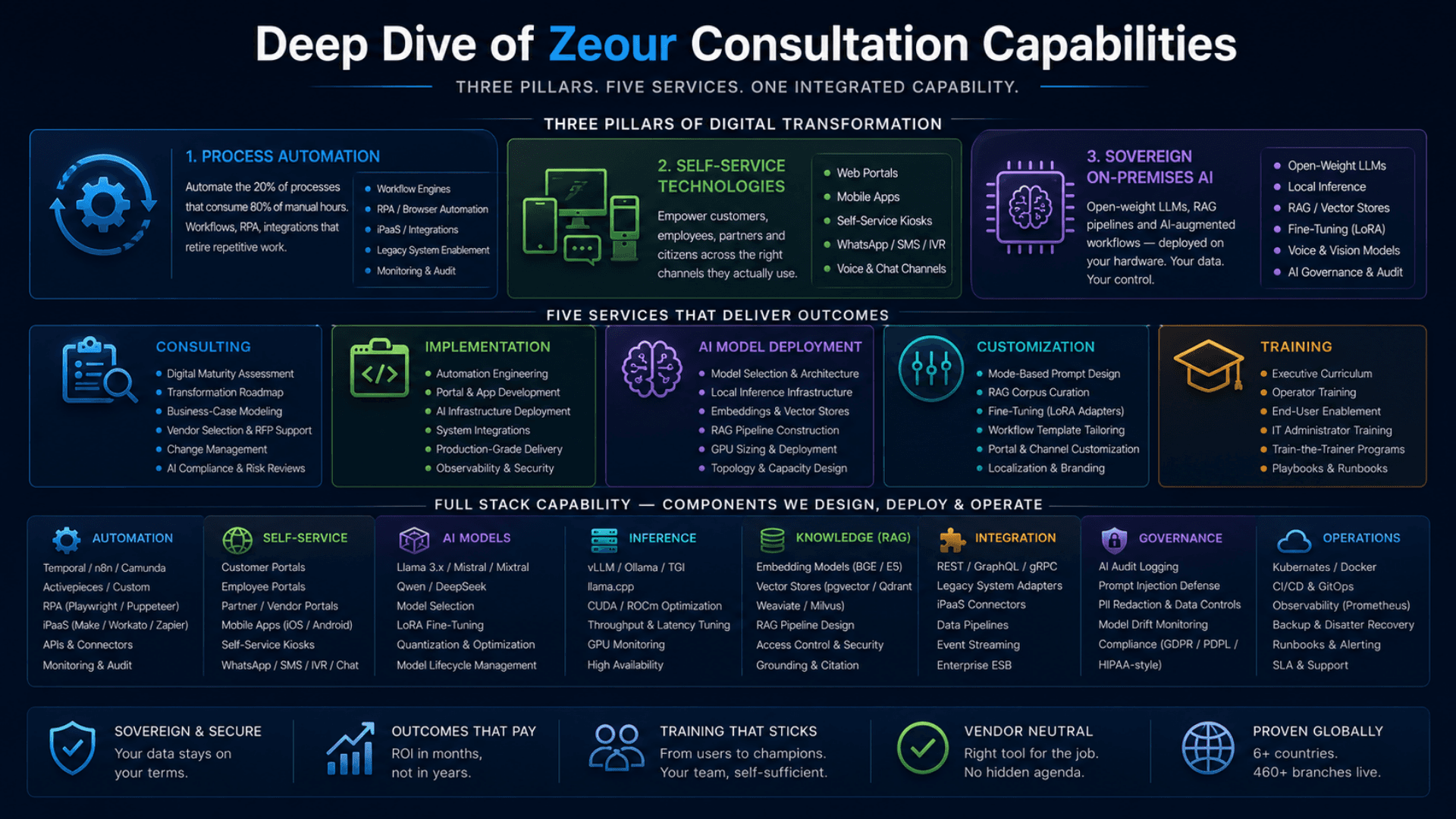
Zeour Digital Transformation Consultation helps companies digitalise their services and operations through three pillars: process automation (workflow engines, RPA, integration platforms that retire repetitive manual work), self-service technologies (customer + employee portals, kiosks, mobile apps, WhatsApp / SMS / IVR channels), and sovereign on-premises AI (open-weight large language models, vision models, voice models, RAG pipelines, and AI-augmented workflows that run entirely on the operator's own hardware — patient data, customer data, and classified material never leave the perimeter). The service stack is the full path from problem to outcome: consulting (digital-maturity assessment, transformation roadmap, business-case modelling, vendor selection), implementation (the build itself, often delivered in partnership with our Enterprise Development team), AI model deployment (open-weight LLMs, fine-tuning, embedding pipelines, on-prem inference infrastructure, GPU sizing), customisation (tailoring deployed AI and automation to your specific operations — prompts, RAG corpora, workflow templates), and training (role-based curricula for executives, operators, and end users, with operations playbooks, runbooks, and train-the-trainer programmes that make your team self-sufficient). The same team that ships our production AI assistant in MediCare (7-mode OpenAI Responses API, evidence-based prompts, audit-logged interactions) is what you engage. Advisory engagements scale down as well as up — a short fixed-fee review for an SME is as legitimate as a ministry-level transformation programme.
Key Functionalities
Pillar 1 — Process Automation
Workflow engines (Temporal, n8n, Activepieces, Camunda, custom orchestrators), RPA / browser automation for legacy systems without APIs (Playwright, Puppeteer, UiPath alternatives), iPaaS for inter-system glue (Make, Workato, Zapier, custom adapters). The pattern: identify the 20% of processes that consume 80% of manual hours, automate those first, measure the payback, then expand.
Pillar 2 — Self-Service Technologies
Customer + employee + vendor + partner portals, self-service kiosk programs (we build the kiosks too — see the Self-Service Kiosk solution), conversational channels (WhatsApp Business, SMS, IVR, voice assistants, chat widgets). Channel mix matched to your audience — not "let's add a portal" by reflex.
Pillar 3 — On-Premises AI Solutions
Open-weight large language models (Llama 3.x, Mistral, Mixtral, Qwen, DeepSeek) deployed on your hardware, local inference infrastructure (vLLM, llama.cpp, Ollama, TGI), RAG pipelines against your knowledge base (pgvector / Qdrant / Weaviate / Milvus + sentence-transformers / BGE / E5), fine-tuning with LoRA adapters for domain-specific tuning, voice + vision models (Whisper, local TTS, OCR / document understanding). Hybrid cloud / on-prem topologies for operators who want both.
Service 1 — Consulting
Digital maturity assessment, transformation roadmap, business-case modeling, vendor selection + RFP support, change management, AI compliance reviews, AI risk frameworks. The advisory layer that produces the buildable roadmap and steers the program.
Service 2 — Implementation
The build itself, delivered alongside (or by) our Enterprise Development team. Workflow automation engineering, self-service portal engineering, AI infrastructure deployment, RAG pipeline construction, integration with existing systems. Production-grade from day one — CI/CD, observability, security, accessibility, performance baked in.
Service 3 — AI Model Deployment
We design the architecture, deploy the stack, and operate it alongside your team. Infrastructure advisory (GPU sizing for H100 / L40S / MI300X, throughput + latency modeling against your concurrency targets, procurement guidance — you buy direct from the vendor, we validate). Model selection (open-weight vs commercial, base vs fine-tuned), inference infrastructure provisioning (vLLM / Ollama / TGI / llama.cpp), embedding pipeline + vector store deployment, deployment-topology design across air-gapped / private VPC / on-prem Kubernetes / edge.
Service 4 — Customization
Tailoring deployed AI and automation to your specific operations: mode-based prompt engineering (one tightly-scoped mode per use case), RAG corpus curation, fine-tuning with LoRA adapters when prompt + RAG isn't enough, workflow template customization, self-service portal rebranding + localization. The "make it yours" layer that turns a generic deployment into a fit-for-purpose tool.
Service 5 — Training
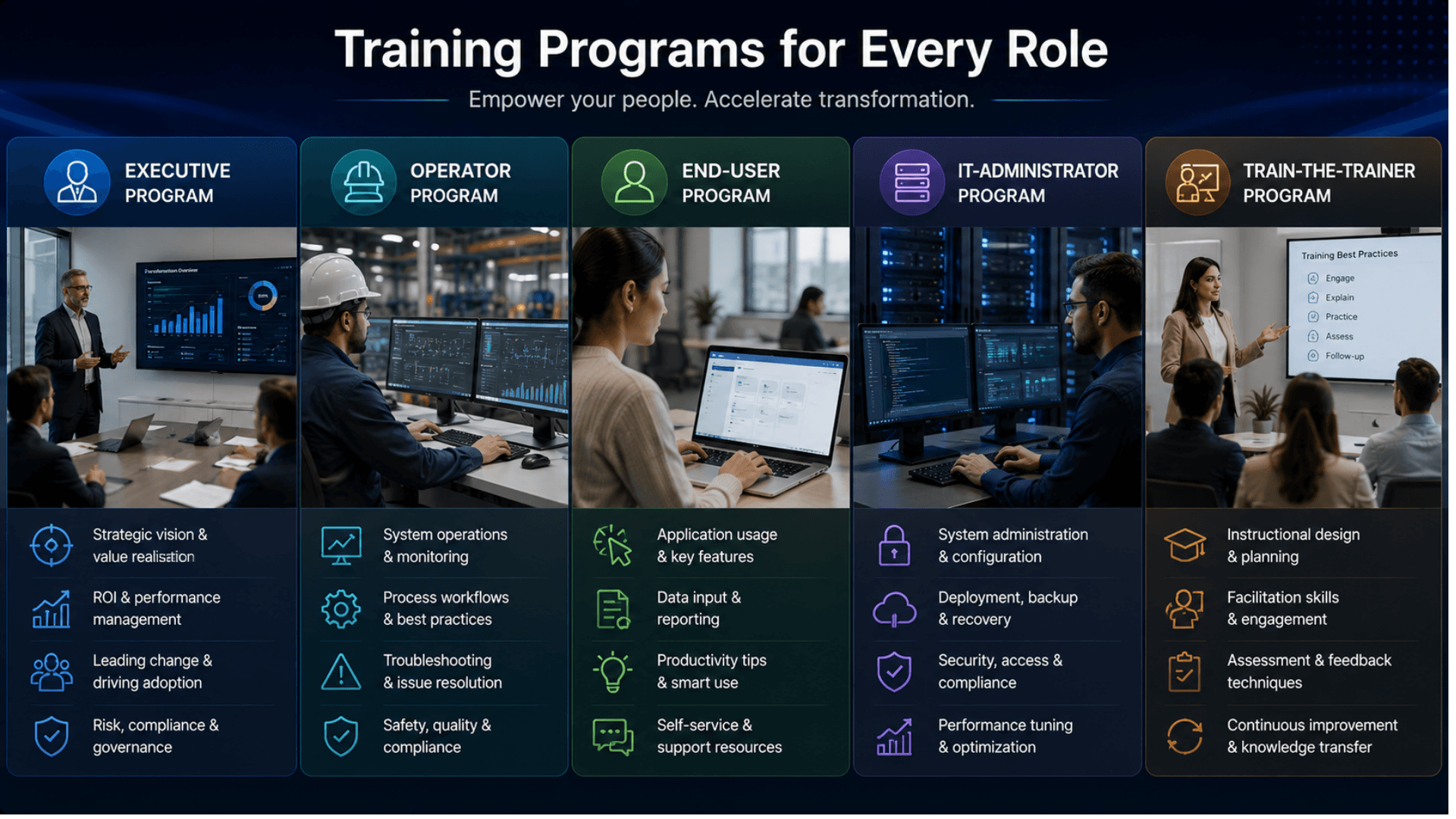
Role-based curricula across four tracks: executive (90-minute briefings + quarterly check-ins), operator (8-16 hour day-to-day curriculum), end-user (2-8 hour, often e-learning + LMS), IT administrator (40-80 hour deep-dive on AI infrastructure operation). Plus train-the-trainer programs that develop your internal champions into capable trainers for ongoing onboarding.
Software Components
Consulting & Assessment
Digital Maturity Frameworks
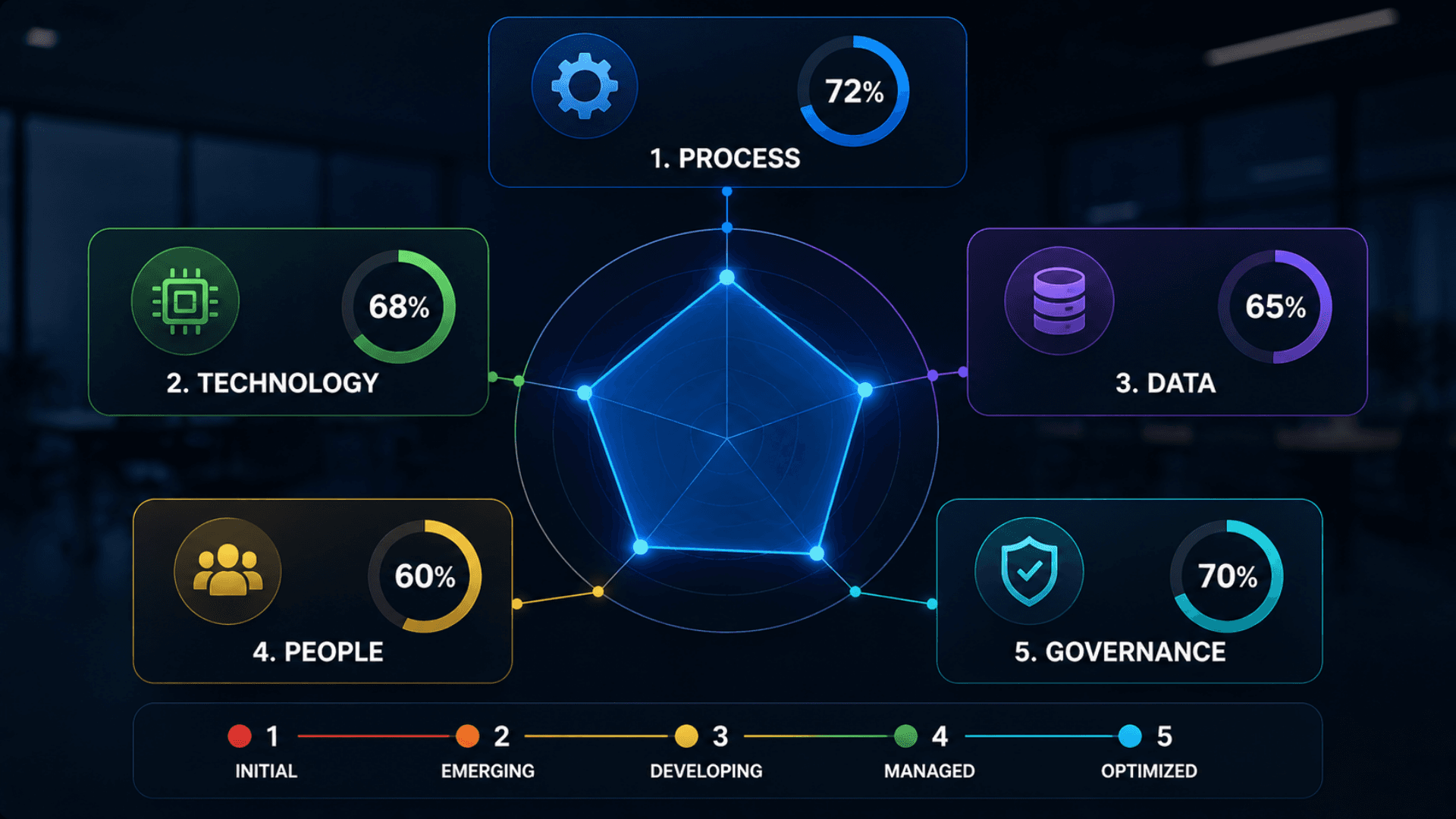
Industry-benchmark frameworks across five dimensions: process maturity, technology maturity, data maturity, people / culture maturity, governance maturity. Adapted to your industry (banking, healthcare, government, retail, etc.).
BPMN 2.0 Process Mapping
Standard notation for current-state + target-state process maps. Surfaces automation candidates, decision gates, handoff friction, and process-redesign opportunities.
Business-Case Modeling Templates
Baseline-target-cost-payback-NPV models with sensitivity analysis. Tailored per wave. Executive-ready in standard board formats.
Vendor RFP Frameworks
Structured requirements catalog → scored short-list → reference calls → vendor demos → 3-year + 5-year TCO model → exit-cost analysis. Vendor-neutral; no resale margin behind the recommendation.
Automation Stack
Workflow Engines (Temporal · n8n · Activepieces · Camunda)
Choice depends on team skill, scale, and licensing constraints. Temporal for long-running stateful workflows; n8n / Activepieces for visual workflow design; Camunda for BPMN-driven enterprise BPM; custom orchestrators when the use case is unusual.
RPA / Browser Automation
For legacy systems without APIs. Playwright, Puppeteer, and UiPath alternatives. We prefer browser automation over commercial RPA when the integration depth + cost ratio favors it.
iPaaS / Integration Platforms
Make / Workato / Zapier when the integrations are commodity. Custom adapters when the integration depth or volume warrants. Hybrid is common.
Self-Service Stack
Web Portals
Customer, employee, vendor, partner portals on the same engineering stack that ships every product on this site.
Mobile Apps
Native and cross-platform mobile apps when workflow speed or offline operation matters — built in whichever stack best fits your team. Otherwise mobile-responsive web.
Self-Service Kiosks (we build the kiosks too)
See the Self-Service Kiosk solution for the kiosk program. End-to-end strategy + hardware + software + content + operations.
Conversational Channels
WhatsApp Business API, SMS gateways (Twilio, regional providers), IVR (Asterisk, Twilio Voice), chat widgets (custom + commercial), voice assistants where the use case warrants.
On-Premises AI Stack
Open-Weight LLMs (Llama 3.x · Mistral · Mixtral · Qwen · DeepSeek)
Llama 3.1 8B / 70B and Llama 3.3 70B for general-purpose. Mistral 7B / Mistral Large for European workloads. Mixtral 8x22B for mixture-of-experts efficiency. Qwen 2.5 32B / 72B for strong multilingual including Arabic. DeepSeek V3 for cost-efficient large-context workloads.
Local Inference Servers (vLLM · llama.cpp · Ollama · TGI)
vLLM for high-throughput batched inference; llama.cpp for CPU + quantized GPU inference; Ollama for developer-ergonomic local deployment; TGI (Text Generation Inference) for production HF-stack deployments. We pick based on hardware + latency requirements.
Vector Databases (pgvector · Qdrant · Weaviate · Milvus)
pgvector for operators already on PostgreSQL (lowest operational surface area); Qdrant for high-performance vector workloads; Weaviate for managed knowledge graphs; Milvus for very-large-scale vector workloads.
Embedding Models (sentence-transformers · BGE · E5)
Open-weight embedding models for the retrieval side of RAG. BGE-M3 and E5-large for multilingual including Arabic; sentence-transformers MiniLM for fast, small-footprint workloads.
Fine-Tuning Stack (LoRA · PEFT · Axolotl · Unsloth)
LoRA / QLoRA adapters via PEFT, Axolotl, or Unsloth for domain-specific tuning. Lightweight, cheap to train, easy to switch between domains.
Voice + Vision Models
Whisper for speech-to-text (open-weight); local TTS via Coqui / Piper; vision models (Llama 3.2 Vision, Qwen-VL, MiniCPM-V) for OCR + document understanding.
AI Governance & Compliance
AI Audit Logging
Every prompt + response captured to a structured audit log. Reviewable by compliance officers, exportable to BI / SIEM. Retention windows + right-to-be-forgotten workflows tailored to your regulator.
Mode-Based Prompt Design
Tightly-scoped modes (see MediCare's 7 clinical modes for the reference pattern). Each mode has an explicit system prompt with evidence-based constraints, context auto-assembly rules, and output format requirements.
Prompt-Injection Defense
Input validation, output sanitization, multi-prompt isolation, allow-listed tools, blocked-pattern detection. Layered defense, not a single guardrail.
Grounding & Citation Enforcement
RAG grounds every response in your authoritative knowledge base with traceable citations; mode-based prompts forbid free-form invention; an evaluation harness scores outputs against golden datasets; production telemetry surfaces drift over time.
Training & Knowledge Transfer
Role-Based Curricula
Executive (90 min + quarterly), operator (8-16 hr), end-user (2-8 hr), IT administrator (40-80 hr). Each curriculum has objectives, content, hands-on labs, and assessments.
Operations Playbooks + Runbooks
Step-by-step guides for day-to-day operation, incident response, capacity planning, model retraining, license renewal, RAG corpus updates. Living documents — updated as the system evolves.
Train-the-Trainer Programs
Develop your internal champions into capable trainers for ongoing onboarding without us. Includes facilitator guides, lab environments, and assessment rubrics.
LMS Integration + SCORM Content
Moodle, TalentLMS, custom LMS integration. SCORM packages for organizations that need standards-compliant content distribution.
Hardware Components
AI Infrastructure — Sizing Advisory (you procure, we validate)
NVIDIA H100 (80 GB) / H200
Top-tier inference + fine-tuning. Single-card runs Llama 3.3 70B at full precision; multi-card runs frontier models. Where we point large-operator deployments and AI-as-a-shared-resource scenarios. You buy direct from your hardware vendor or cloud — we don't mark up silicon.
NVIDIA L40S (48 GB)
Cost-efficient inference for large open-weight models. Llama 3.3 70B (quantised), Qwen 72B (quantised), Mixtral 8x22B. Strong choice for mid-budget large-operator deployments. Procurement direct from vendor.
AMD MI300X (192 GB)
Very large model serving at lower cost-per-GB-VRAM than NVIDIA. Software stack maturing fast (ROCm + vLLM + llama.cpp). Where we point operators with AMD-friendly ops teams. Procurement direct from vendor.
AI Infrastructure — Workstation-Class GPUs
NVIDIA RTX 6000 Ada (48 GB)
Workstation-class GPU for single-clinic / single-branch / single-team scenarios — serious local AI without going to data-center hardware. Quiet, single-PSU. Runs Llama 3.1 8B, Mistral 7B and quantised Qwen 32B comfortably, plus quantised Llama 3.3 70B. Datacentre-EULA compliant. Procured direct from the vendor.
NVIDIA RTX PRO 6000 Blackwell (96 GB)
Next-generation workstation-class GPU with substantially more VRAM — headroom for larger quantised models or higher concurrency on a single card. Datacentre-EULA compliant. Procured direct from the vendor.
AI Infrastructure — CPU-Only
x86 Server (32+ GB RAM)
CPU-only inference for Llama 3.2 1B / 3B, Phi-3, smaller Qwen. Suitable for low-volume, low-latency-tolerant workloads: single-user clinical assistants, IT helpdesks, internal knowledge bases. Surprisingly capable for narrow use cases.
Edge Devices (Mini PCs · Embedded Linux)
For distributed deployment patterns where each site runs its own small AI. Latest mini-PCs with integrated NPUs (Intel Core Ultra, AMD Ryzen AI) can serve Llama 3.2 1B/3B at acceptable speed.
Self-Service Hardware
Self-Service Kiosks
See the Self-Service Kiosk solution. Android panels, x86 touchscreen panels, payment-enabled kiosks. Strategy + hardware + software + content + operations.
Reception / Counter Workstations
Standard x86 PCs with 22"+ touchscreens for staff-attended self-service-assist scenarios.
Mobile Devices (iPads, Android tablets)
For field staff, in-store associates, hospital rounding, security patrols. Native or web-based depending on workflow speed requirements.
Training Infrastructure
Lab Environments (Cloud or On-Prem)
Isolated training environments where operators can practice on a non-production copy of the system. Reset between cohorts. Reduces fear-of-mistake during training.
Recording + Streaming Setup
For live + remote hybrid training sessions. Recordings become long-tail training content for new joiners.
LMS Server (Moodle / TalentLMS / Custom)
On-prem LMS for organizations with data-residency rules; cloud LMS otherwise. SCORM-compliant content distribution.
Transformation Engagement Architecture
A Zeour transformation engagement is a three-tier operational architecture: a discovery + advisory tier (how we produce the buildable roadmap), an implementation + AI deployment tier (how we deliver each wave's outcome), and a transfer + enablement tier (how we leave your team self-sufficient). The same three-tier shape applies whether the engagement is healthcare, banking, government, retail, or education — only the content of each tier changes.
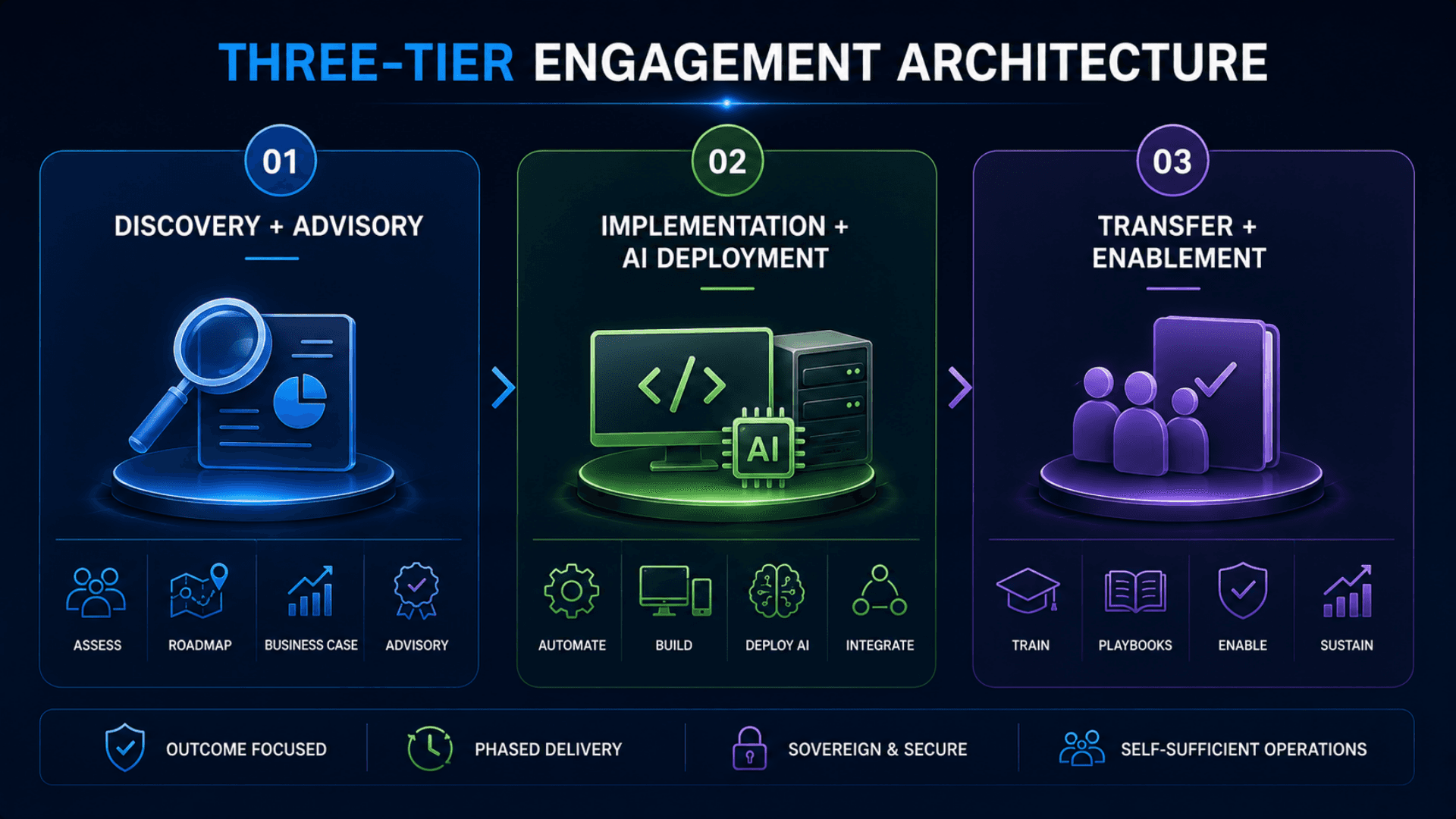
Tier 1 — Discovery + Advisory Architecture
Maturity Assessment · Roadmap · Business Case · Vendor Selection · Change Management
- Digital maturity assessment across five dimensions (process, technology, data, people, governance)
- BPMN 2.0 current-state + target-state process mapping
- Phased transformation roadmap (90-day waves with measurable outcomes)
- Quantified business case for the first wave (baseline / target / cost / payback / NPV / sensitivity)
- Vendor-neutral selection support (no resale margin; no preferred-vendor relationships)
- Change management plan (stakeholder map, communication plan, resistance management)
- Executive sign-off gate before each wave starts
Tier 2 — Implementation + AI Deployment Architecture
Automation · Self-Service · On-Prem AI · Customization · Integration
- Automation engineering (Temporal · n8n · Activepieces · Camunda · custom orchestrators · Playwright / Puppeteer · iPaaS)
- Self-service portal engineering on a modern, component-driven web stack
- Self-service kiosk programs delivered in partnership with our kiosk team
- Conversational channels (WhatsApp Business · SMS · IVR · chat · voice)
- On-prem AI deployment: open-weight LLMs · inference servers · vector stores · embeddings · LoRA fine-tuning
- Mode-based prompt engineering · RAG pipeline construction · AI audit logging
- Integration with existing systems via REST · GraphQL · gRPC · iPaaS · browser automation
Tier 3 — Transfer + Enablement Architecture
Role-Based Training · Operations Playbooks · Train-the-Trainer · Advisory Check-Ins
- Role-based curricula across four tracks: executive · operator · end-user · IT-administrator
- Operations playbooks: day-to-day, incident response, capacity planning, model retraining, license renewal
- Runbooks for AI infrastructure operation: GPU monitoring, inference server lifecycle, RAG corpus updates
- Train-the-trainer programs: facilitator guides, lab environments, assessment rubrics
- LMS integration + SCORM content for ongoing onboarding without us
- 90-day advisory check-ins post-transfer; quarterly executive reviews continue
- Success metric: operator self-sufficiency for day-to-day operations
Operational & Resilience Pipeline
Real-time- Phased outcomes every 90 days — never a 12-month strategy phase before code is written
- Executive sign-off gate before each wave starts — either side can pause / pivot / exit
- On-prem AI inference + RAG pipelines run entirely on the operator's hardware — zero data exfiltration
- AI audit logging tailored to regulator requirements (GDPR / PDPL / HIPAA-style)
- Vendor-neutral recommendations with no resale margin behind them
- Training programs launch before go-live so end users feel prepared, not surprised
- Transfer phase deliberately makes the consulting team replaceable in operator day-to-day
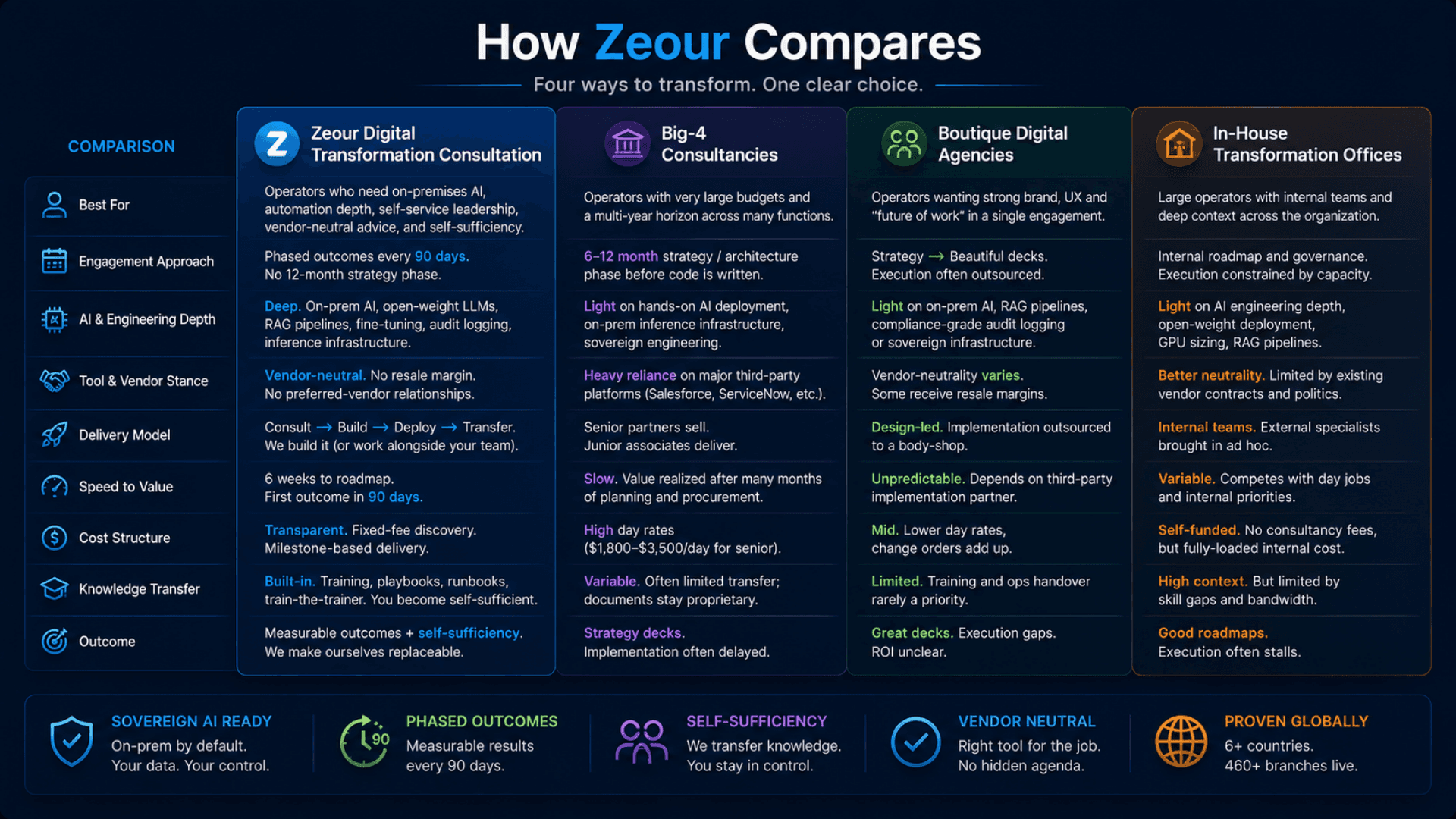
Zeour Digital Transformation Consultation vs Big-4 Consultancies vs Boutique Digital Agencies vs In-House Transformation Offices
Most digital transformation work today goes to one of four destinations. Each has trade-offs; we sit deliberately at the intersection of what sovereignty-sensitive operators actually need: AI engineering depth, vendor-neutral advice, phased outcomes every 90 days, and a transfer phase that leaves the operator self-sufficient.
Zeour Digital Transformation Consultation
Best for: Operators who need on-premises AI capability (sovereignty-sensitive sectors), automation depth (workflow engines + RPA + iPaaS), self-service program leadership, vendor-neutral advice with no resale margin, and a transfer phase that leaves them self-sufficient.
- Three pillars: process automation · self-service technologies · on-premises AI
- Five services: consulting · implementation · AI model deployment · customization · training
- Phased outcomes every 90 days — never a 12-month strategy phase
- AI engineering depth (open-weight LLMs · RAG pipelines · LoRA fine-tuning · audit logging)
- Sovereign on-prem AI as a default capability
- Vendor-neutral · no resale margin · no preferred-vendor relationships
- Transfer phase + train-the-trainer programs leave you self-sufficient
- Reference implementations in production (MediCare AI · Smart Parking · GLARUS portfolio)
Big-4 Consultancies
Best for: Operators with very large budgets and a multi-year horizon who need broad transformation programs across many functions.
- 6-12 month strategy / architecture phase before code is written
- Senior partners sell · junior associates deliver
- Heavy reliance on third-party platforms (Salesforce · ServiceNow · Workday)
- High day rates ($1,800-$3,500/day for senior associates)
- Strong on regulated-industry compliance (banking · government)
- Vendor lock-in via proprietary deliverables and change-order economics
- Light on hands-on AI deployment, on-prem inference infrastructure, sovereign engineering
Boutique Digital Agencies
Best for: Operators wanting strong brand / UX / "future of work" thought leadership in a single transformation engagement.
- Strong on brand · UX · "future of work" decks
- Light on hands-on engineering for on-prem AI · hardware-coupled software · RAG pipelines
- Often outsource the implementation to a body-shop
- Strategy → beautiful PDF; execution → stalled
- Limited specialty depth in compliance-grade audit logging or sovereign infrastructure
- Vendor-neutral varies (some receive resale margins)
In-House Transformation Office
Best for: Operators large enough to sustain a 8-25 person transformation office with deep cross-functional capability.
- Strong on context · stakeholder relationships · institutional knowledge
- Light on AI engineering depth · open-weight LLM deployment · GPU sizing · RAG pipelines
- Strong on roadmap · light on implementation outside of the office's comfort zone
- Best paired with external specialty (e.g. on-prem AI) rather than replaced
- Self-funded — no consultancy fees but fully-loaded internal cost
- Often constrained by internal political dynamics in cross-functional changes
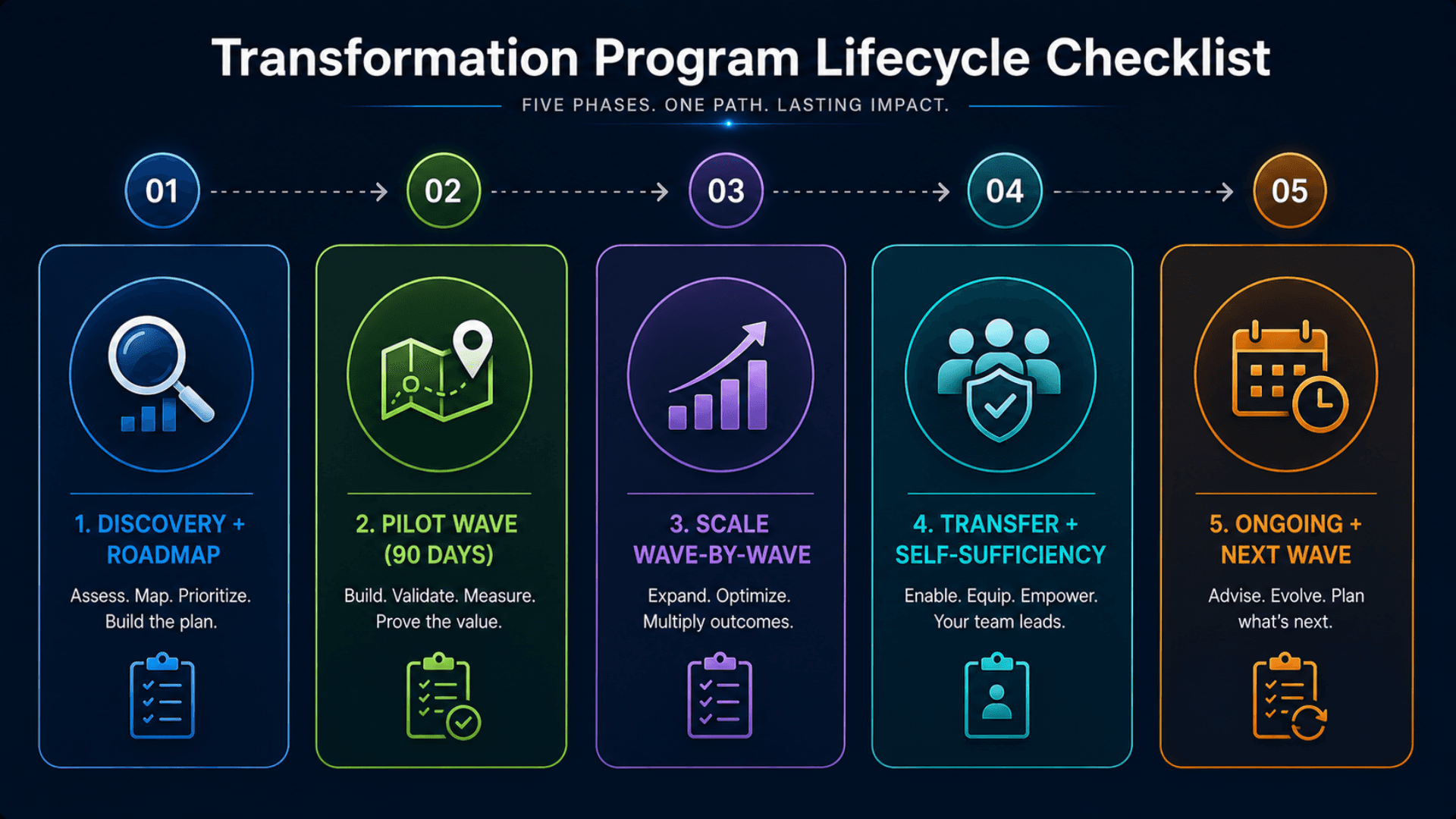
Transformation Program — Lifecycle Checklist
A practical 5-phase transformation playbook. Use it as the operator-side checklist before, during, and after the engagement.
- 01
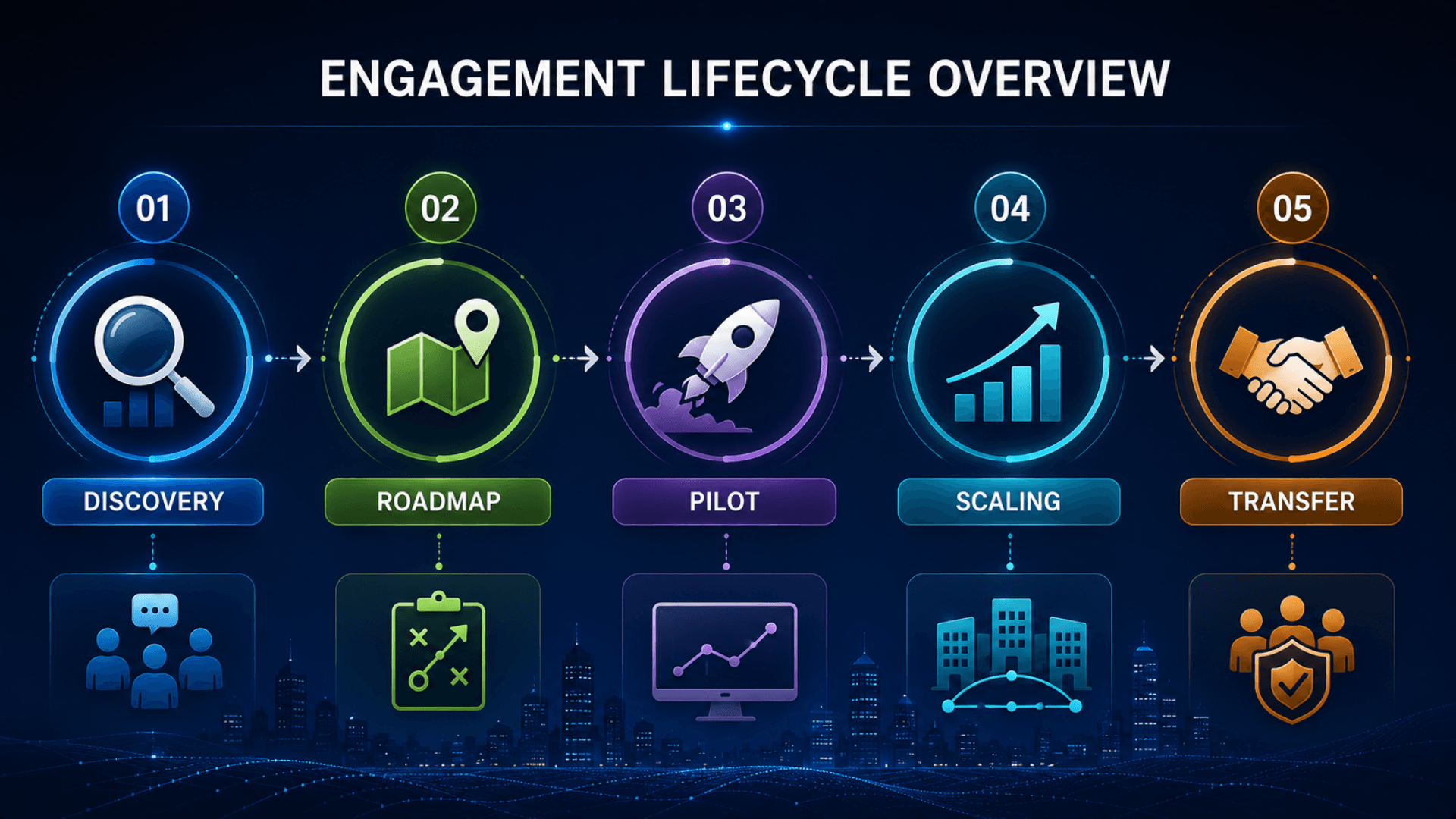
1) Discovery + Roadmap (Weeks 1-6)
ChecklistIdentify the business problem in 1-2 sentences (not a technology wish-list)Confirm executive sponsorship and the budget envelopeWorkshop with executives, operators, end users (and IT / security / compliance teams)Score digital maturity across the five dimensions; benchmark against industryBPMN 2.0 current-state + target-state process mappingProduce the phased transformation roadmap with 90-day waves and ROI thresholdsProduce the business case for the first wave (baseline / target / cost / payback / NPV)Decision gate: proceed to pilot wave, or pause / pivot / exit - 02
2) Pilot Wave (Weeks 7-19)
ChecklistPick the highest-impact, lowest-risk wave to start withStand up the engagement: shared backlog, weekly demo cadence, milestone payment planFor AI components: provision GPU hardware (or CPU sizing), deploy local LLM stack, build RAG pipelineFor automation: deploy workflow engine, build first 3-5 automation flows, integrate with existing systemsFor self-service: launch the first portal / kiosk / WhatsApp / IVR surfaceLaunch the training programs in parallel (executive, operator, end-user, IT-admin)Decision gate: continue to scaling waves, or pause at pilot for in-house ownership - 03
3) Scaling Waves (Months 4-12)
ChecklistRoll the validated pilot pattern to additional departments / sites / business unitsEach wave has its own business case and outcome metricDeepen customization: domain-specific fine-tuning, expanded RAG corpora, additional automation flowsStrangler-fig cutover from legacy systems (route progressively, not big-bang)Quarterly executive reviews to validate wave outcomes and approve the next waveTraining programs continue in parallel — new cohorts onboarded by your train-the-trainers - 04
4) Transfer + Self-Sufficiency (Months 10-12)
ChecklistOperations playbooks, runbooks, incident-response procedures handed overAI infrastructure handover including GPU monitoring + model retraining + RAG corpus updatesTrain-the-trainer programs complete; internal champions certifiedLMS integration and SCORM content live for ongoing onboardingDocumentation final pass: every system, every flow, every model documentedSuccess criterion: the operator can onboard new staff and expand without us - 05
5) Advisory Check-Ins + Next Wave (Months 12+)
Checklist90-day advisory check-ins post-transfer; quarterly executive reviews continueOn-demand support for incidents, escalations, model-retraining decisionsNext-wave consultation when the operator is ready for the next transformation phaseAnnual digital-maturity reassessment to track progress and identify the next priorityRenewed engagement structured around new waves (not perpetual retainers)
Digital Transformation Consultation Gallery
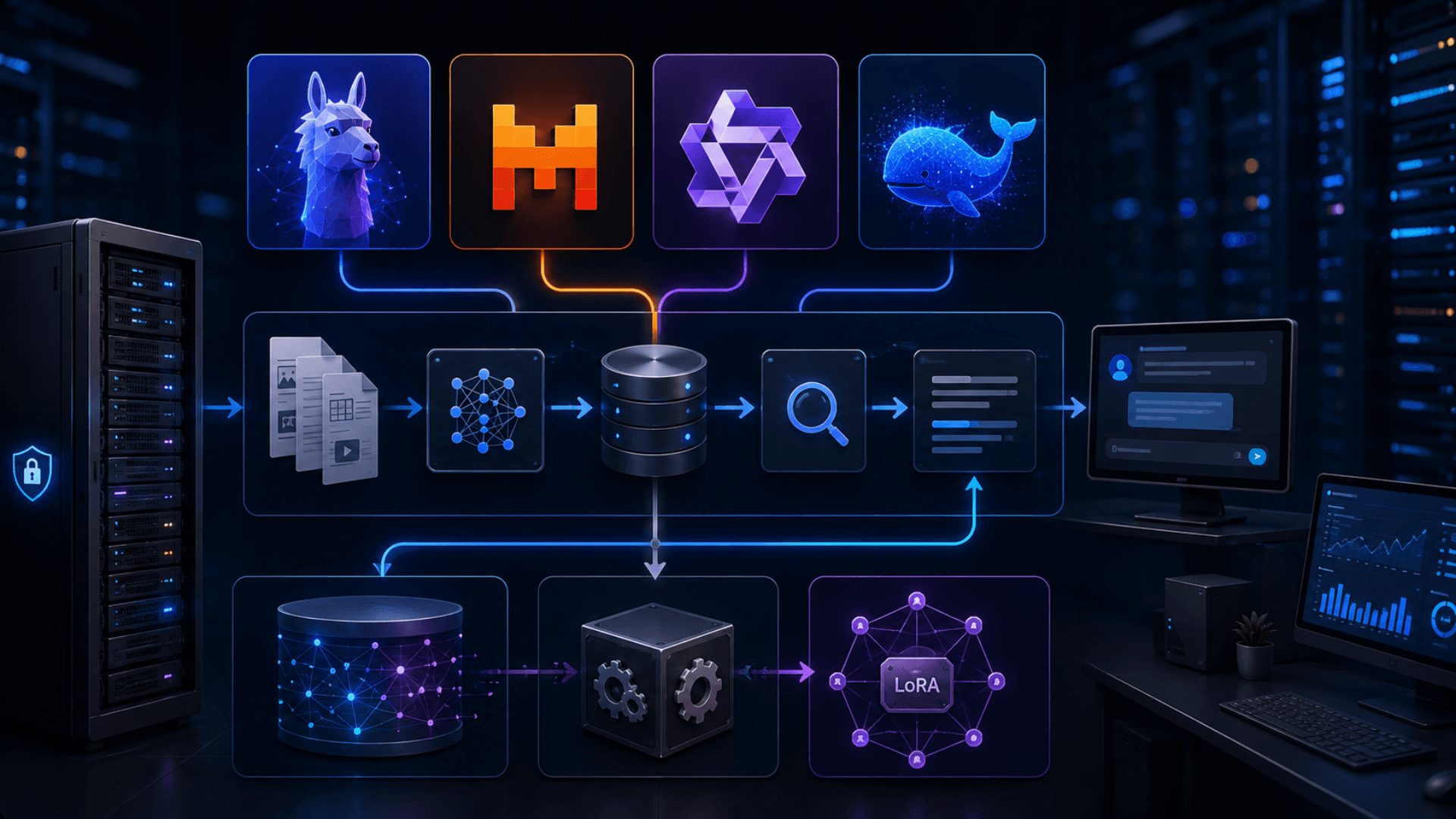
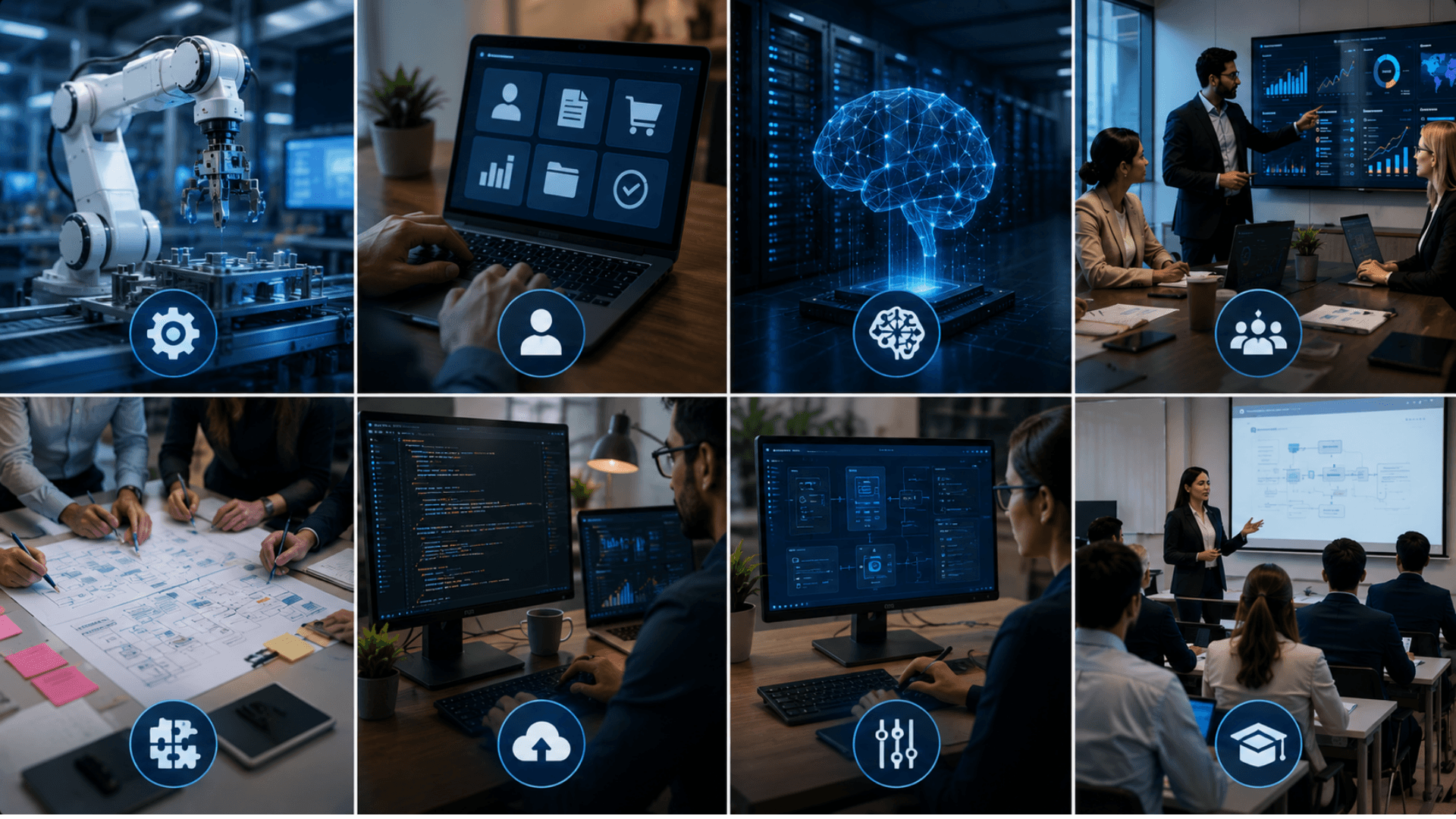
Visual highlights of the Zeour Digital Transformation engagement — three pillars (automation, self-service, on-prem AI), five services (consulting, implementation, AI deployment, customization, training), and the production-grade reference patterns.

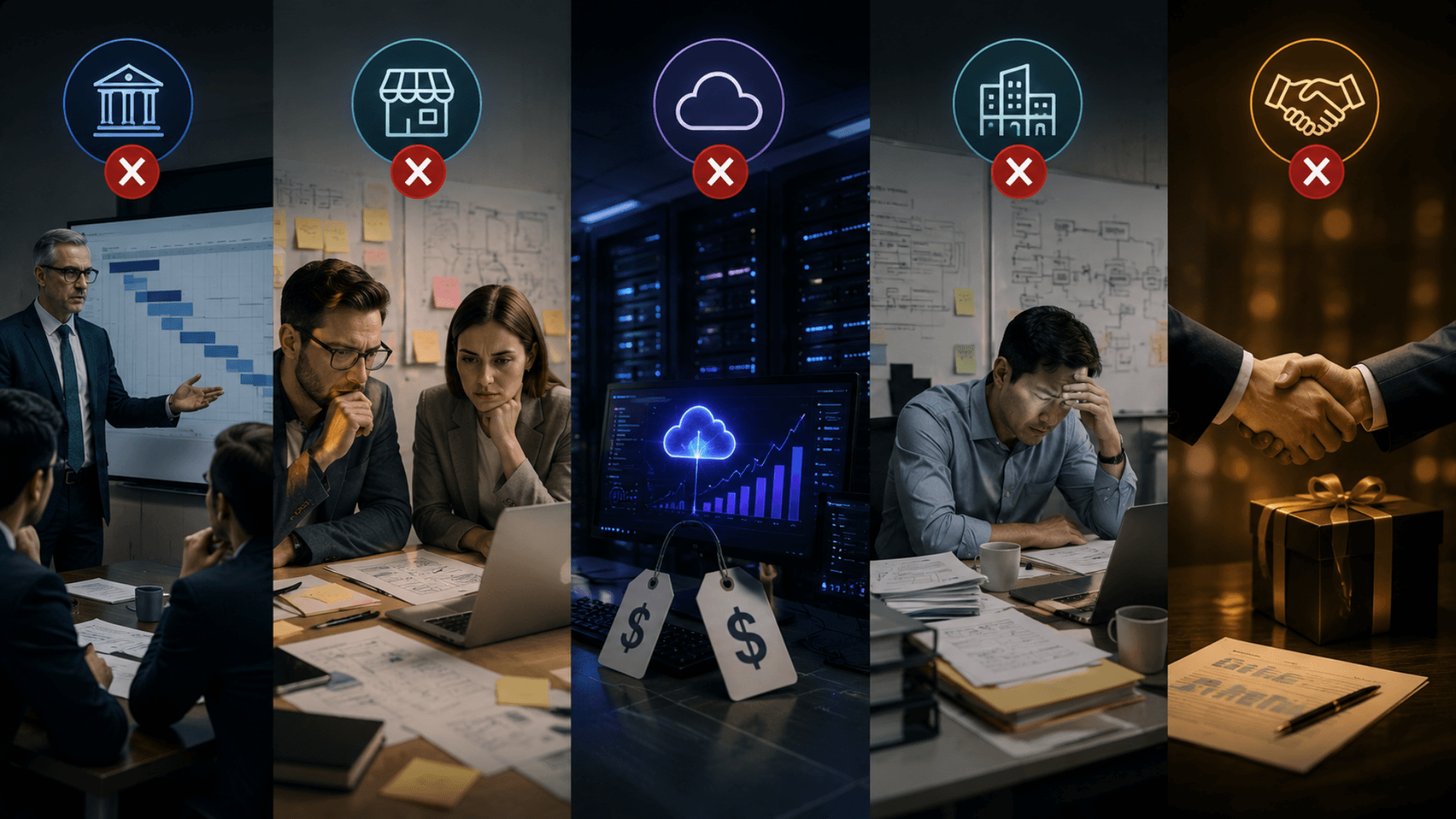
Why Strategy-Deck Consulting Fails
Strategy-deck consulting bills the analysis and skips the build — here is why delivery-led digital transformation consulting is essential.
Big-4 Consultancies Sell the Architecture Phase
Six-to-twelve-month strategy decks, senior partners selling, junior associates delivering, vendor lock-in via proprietary deliverables and change-order economics. By the time the architecture document is signed off, the world has shifted and the consultancy is positioned to bill the change orders.
Phased Outcomes, Not Architecture Decks
Discovery + roadmap is 6 weeks fixed-fee. After that, every 90 days produces a measurable outcome in a real department / site / business unit. No 12-month strategy phase before code is written.
Boutique Digital Agencies Skip the Hard Parts
Many boutique digital-transformation firms are strong on brand, UX, and "future of work" decks — but light on the engineering depth required for on-prem AI, hardware-coupled software, RAG pipelines, compliance-grade audit logging, or sovereign infrastructure. The roadmap looks beautiful; the execution stalls.
Engineering Depth Backed by a Public Portfolio
Every product on this site is something our team built and operates today. MediCare's AI Clinical Assistant proves we ship AI in production with discipline. Smart Parking proves we ship sovereign on-prem with RSA-signed license gates. The roadmap recommendations come from people who have actually built the patterns they recommend.
Cloud-Only AI Hosts Inference Outside Your Perimeter
Major cloud AI services run inference in US / EU data centers by default. For sovereignty-sensitive operators — healthcare, banking, government, defense, and regional operators with data-residency rules — that conflicts with residency requirements and regulator expectations even when the cloud model itself is excellent. The constraint is where the inference runs, not the quality of the model.
Sovereign AI Without Giving Up Capability
Open-weight LLMs (Llama 3.x, Mistral, Mixtral, Qwen, DeepSeek) deployed on your hardware are within striking distance of frontier cloud models for most enterprise use cases. We size hardware, deploy inference infrastructure, build RAG pipelines, and audit-log every interaction.
In-House Transformation Offices Lack AI Depth
Many large organizations stand up internal "digital transformation offices" that produce good roadmaps but lack the AI engineering depth to actually deploy a fine-tuned Llama 70B on local H100s with a RAG pipeline against an internal SharePoint corpus. The roadmap stays a PDF.
AI Depth That Closes the In-House Office's Gap
We partner with your in-house transformation office (or replace it if you don't have one). The AI deployment, fine-tuning, embedding pipeline, vector store, and inference infrastructure are handed over with operations playbooks + runbooks + train-the-trainer programs so your team operates without us in the medium term.
Training Is the First Thing Cut From Budgets
When transformation programs run over budget, training is the first line item cut. The technology lands; the people who need to use it don't know how. Adoption stalls; the transformation's ROI doesn't materialize; the program is judged a failure even though the technology works.
Training Is a First-Class Deliverable, Not a Line Item
Every wave includes role-based curricula (executive, operator, end-user, IT administrator), operations playbooks, runbooks, and train-the-trainer programs. The success metric is your operating self-sufficiency at the end of the program — not how many slides we delivered.
Vendor-Funded "Consultancies" Recommend Their Sponsors
Many transformation consultancies receive resale margins from SaaS vendors and recommend those vendors disproportionately. The operator gets a recommendation that maximizes the consultancy's margin, not the operator's outcome.
Vendor-Neutral Advice With No Resale Margin
We have no resale relationships with third-party SaaS vendors and no markups on hardware. The recommendation reflects what fits your operation, not what maximizes our margin. Every engagement ends with the operator owning the deployed stack and being free to replace it without us.
Digital Transformation Features
Digital Maturity Assessment — process, technology, data, people, governance scored against industry benchmarks
Transformation Roadmap — phased, prioritized, costed, with explicit ROI thresholds per phase
Business-Case Modeling — quantified before/after, payback period, NPV, sensitivity analysis
Vendor Selection & RFP Support — neutral evaluation across SaaS, on-prem, and hybrid options
Process Discovery & Mapping (BPMN 2.0) — current state, future state, gap analysis, automation candidates
Workflow Automation Engineering — Temporal, n8n, Activepieces, Camunda, custom orchestrators
RPA & Browser Automation — for legacy systems without APIs (UiPath alternatives, Playwright, Puppeteer)
iPaaS / Integration Platform as a Service — Make / Workato / Zapier / custom adapters
Self-Service Portal Engineering — customer portals, employee portals, vendor portals, partner portals
Self-Service Kiosk Programs — strategy, hardware, software, content, operations (we build kiosks too)
Conversational Channels — WhatsApp Business, SMS, IVR, voice assistants, chat widgets
On-Premises Large Language Models — Llama 3.x, Mistral, Mixtral, Qwen, DeepSeek, deployed on your infrastructure
Local Inference Infrastructure — vLLM, llama.cpp, Ollama, Text Generation Inference (TGI), CUDA optimization
Infrastructure Advisory — GPU sizing for H100 / A100 / L40S / MI300X, throughput + latency modeling, capacity planning; you procure direct from the vendor, we validate
Deployment Models — air-gapped / fully offline · private VPC or dedicated tenant · on-prem Kubernetes or bare metal · edge / branch inference
CPU-Only Inference for Smaller Models — Llama 3.2 1B/3B, Phi-3, suitable for edge / low-budget deployments
Fine-Tuning & LoRA Adapters — domain-specific tuning (medical, legal, financial, regional language)
Embedding Pipelines & Vector Stores — sentence-transformers, BGE, E5, pgvector, Qdrant, Weaviate, Milvus
RAG (Retrieval-Augmented Generation) — your knowledge base + your LLM + your access control
Mode-Based AI Prompt Engineering — tightly-scoped modes (see MediCare's 7 clinical modes for the reference pattern)
AI Audit Logging & Governance — every prompt + response captured for compliance review
Hybrid Cloud / On-Prem AI Topologies — sensitive inference on-prem, public-data inference in cloud
Voice & Vision Model Deployment — Whisper for speech-to-text, local TTS, vision models for OCR / document understanding
AI-Augmented Workflow Customization — embedding AI into existing approval flows, ticket triage, document review
Change Management — stakeholder mapping, communication plan, resistance management, executive sponsorship
Role-Based Training Curricula — executive, operator, end-user, IT-administrator tracks
Train-the-Trainer Programs — your internal team becomes self-sufficient
Operations Playbooks & Runbooks — incident response, capacity planning, model retraining, license renewal
LMS Integration & E-Learning Content — Moodle, TalentLMS, custom LMS, SCORM packages
Sovereign AI Compliance Reviews — GDPR · PDPL · HIPAA-style audit-readiness for AI deployments
AI Risk Frameworks — grounding & citation enforcement, prompt-injection defence, data-leakage controls, model-drift monitoring
KPIs & Outcome Tracking — baseline, target, monthly review, executive dashboards
90-Day Pilot → 12-Month Program → Transfer to In-House — the engagement is structured to leave your team self-sufficient
Digital Transformation Components
Automation, Self-Service and On-Premises AI Advisory.
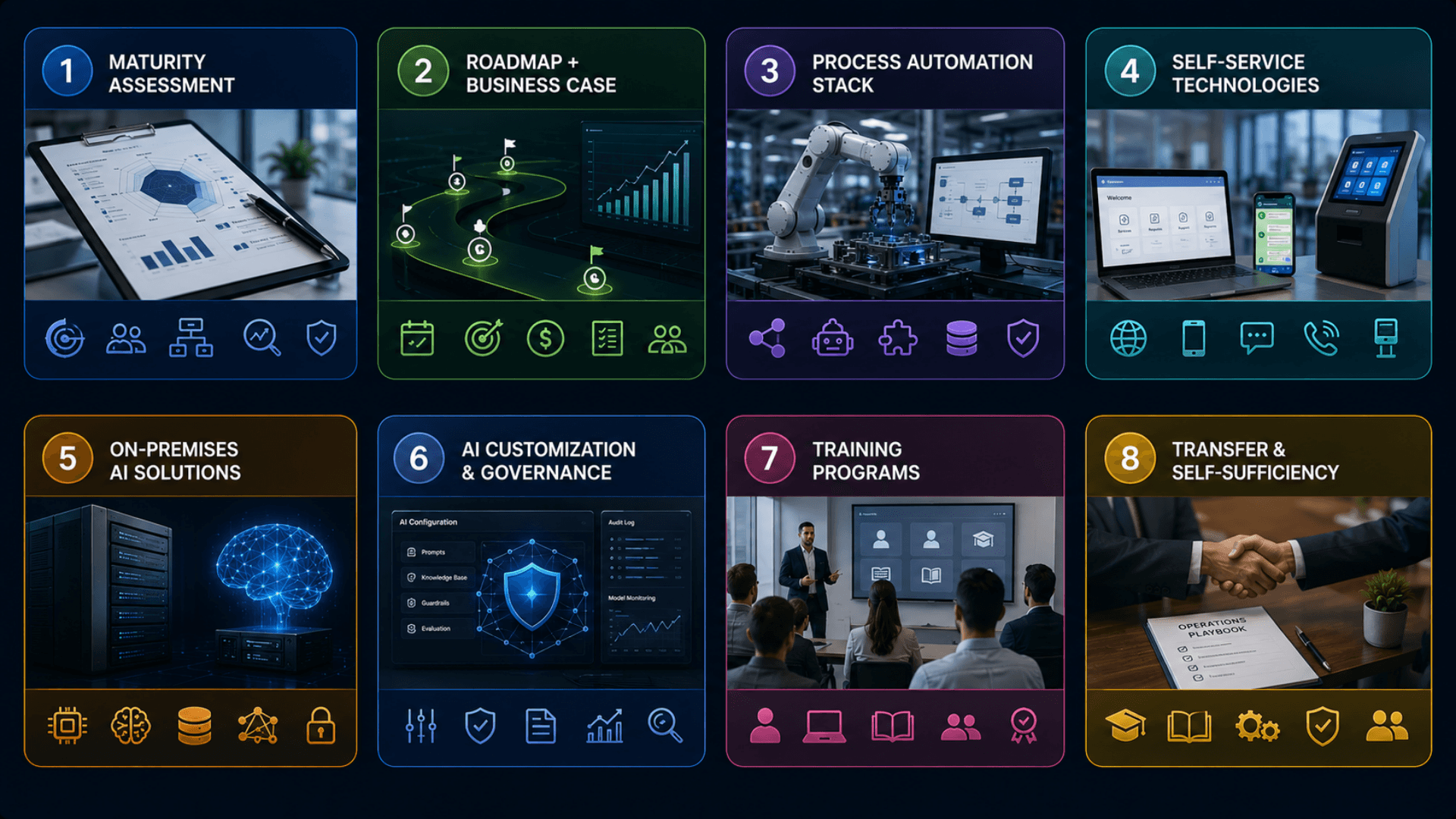
Digital Maturity Assessment
Score current state across five dimensions (process, technology, data, people, governance) against industry benchmarks.
- Stakeholder workshops with executives, operators, end users
- BPMN 2.0 current-state + target-state process maps
- Gap analysis and automation-candidate identification
- AI-applicable workflow identification with risk assessment
Transformation Roadmap + Business Case
Phased, prioritized, costed roadmap with explicit ROI thresholds per phase and a quantified business case for the first wave.
- 90-day waves with measurable outcome targets per wave
- Baseline-target-cost-payback-NPV business-case modeling
- Vendor selection support (vendor-neutral; no resale margin)
- Executive sign-off gate before each wave
Process Automation Stack
Workflow engines, RPA, iPaaS, custom orchestrators. The 20% of processes that consume 80% of manual hours, automated first.
- Temporal · n8n · Activepieces · Camunda · custom
- Playwright / Puppeteer browser automation for legacy systems without APIs
- iPaaS adapters (Make / Workato / Zapier / custom) for inter-system glue
- Audit logging tied into the operator's SIEM
Self-Service Technologies
Customer + employee + vendor + partner portals; kiosk programs; conversational channels (WhatsApp, SMS, IVR, voice, chat).
- Web portals built on the same proven engineering stack as our product portfolio
- Native + cross-platform mobile apps when workflow speed matters
- Self-service kiosk programs end-to-end (strategy + hardware + software + content + ops)
- WhatsApp Business + SMS + IVR + chat widgets where the audience warrants
On-Premises AI Solutions
Open-weight LLMs deployed on the operator's hardware. The standout differentiator.
- Llama 3.x / Mistral / Mixtral / Qwen / DeepSeek model selection
- vLLM / llama.cpp / Ollama / TGI inference servers
- RAG pipelines against your knowledge base (pgvector / Qdrant / Weaviate / Milvus)
- LoRA fine-tuning for domain-specific tuning when prompt + RAG isn't enough
AI Customization & Governance
Mode-based prompts, RAG corpus curation, audit logging, prompt-injection defence, grounding & citation enforcement, model-drift monitoring.
- Mode-based prompt design (reference: MediCare's 7 clinical modes)
- Audit logging tailored to your regulator (GDPR / PDPL / HIPAA-style)
- Layered prompt-injection defense
- Evaluation harness scoring outputs against golden datasets
Training Programs
Role-based curricula (executive, operator, end-user, IT-admin) + operations playbooks + runbooks + train-the-trainer programs.
- Live + remote hybrid sessions; recorded for long-tail onboarding
- SCORM packages + LMS integration (Moodle / TalentLMS / custom)
- Train-the-trainer kits to develop your internal champions
- Lab environments for hands-on practice without production risk
Transfer & Self-Sufficiency Phase
Operations playbooks, runbooks, model retraining schedules, RAG corpus update workflows handed over.
- Train-the-trainer programs complete; internal champions certified
- Operations playbooks + runbooks + incident response procedures handed over
- AI infrastructure operation handover including GPU monitoring + model retraining
- 90-day advisory check-ins post-transfer; quarterly executive reviews continue
Implementation Priorities and Team Readiness
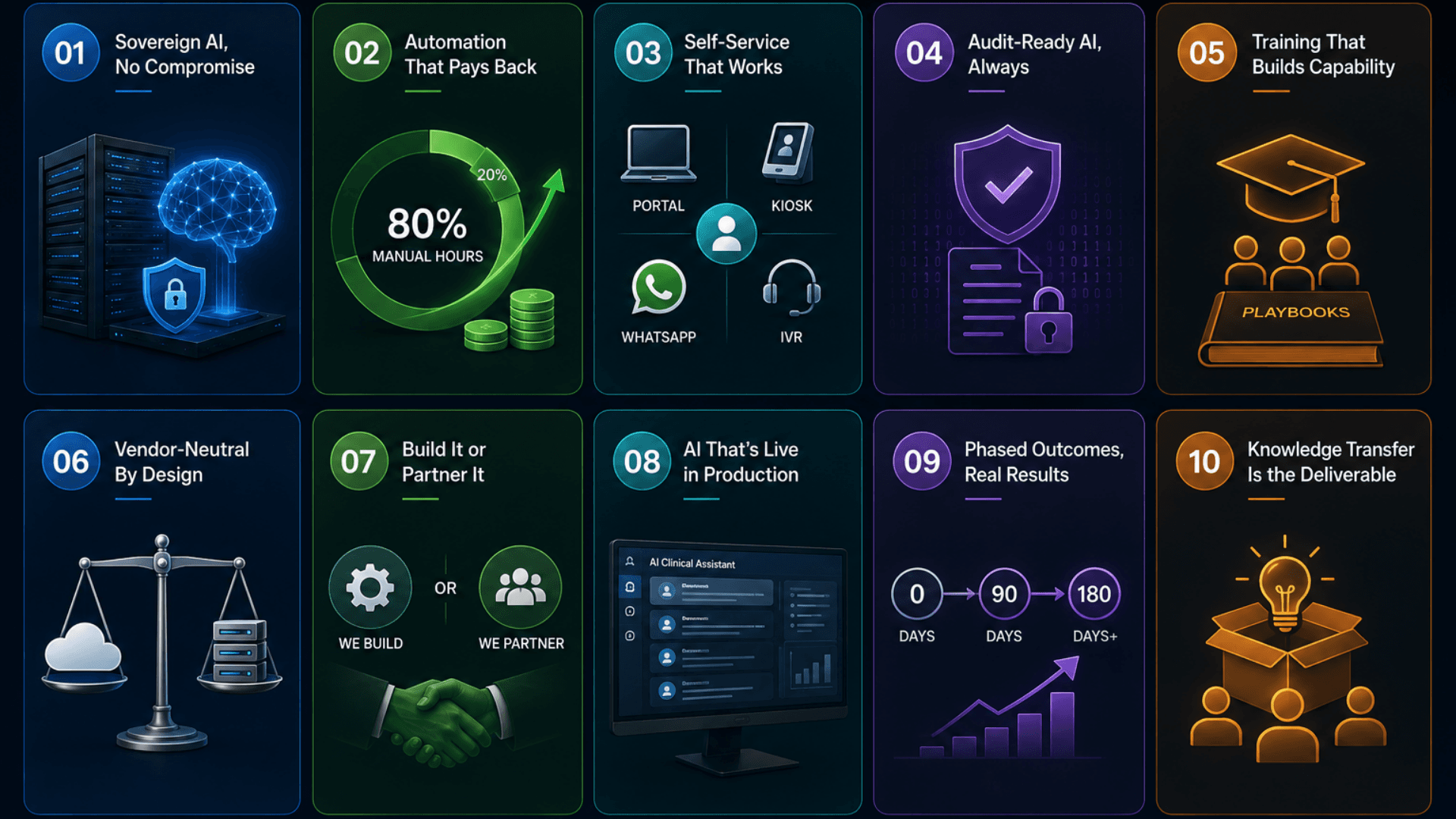
Sovereign AI without giving up capability — open-weight LLMs deployed on your hardware match the accuracy of cloud APIs for most enterprise use cases
Automation that pays back in months, not years — focus on the 20% of processes that consume 80% of manual hours
Self-service that customers actually use — channel mix matched to your audience (portal + kiosk + WhatsApp + IVR, not just "a portal")
Compliance-aware AI from day one — every prompt + response audit-logged; data residency a deployment knob, not a vendor decision
Training that sticks — role-based curricula + operations playbooks + train-the-trainer; your team becomes self-sufficient by month 6
Vendor-neutral advice — we recommend the right tool (cloud, on-prem, open-source, commercial), not the tool that maximizes our margin
Real implementation capability — when the roadmap is signed off we can also build it (Enterprise Development), or hand off to your in-house / preferred partner
A team that ships AI in production — MediCare's AI Clinical Assistant is live; we know what works and what hallucinates
Phased outcomes, not waterfall promises — every 90 days a measurable outcome, not a fat deliverable
Knowledge transfer is the deliverable, not a side note — the goal is to make ourselves replaceable in your operations
From Operational Assessment to Team Handover
Move through assessment, solution design, implementation and training with a defined scope at each stage.
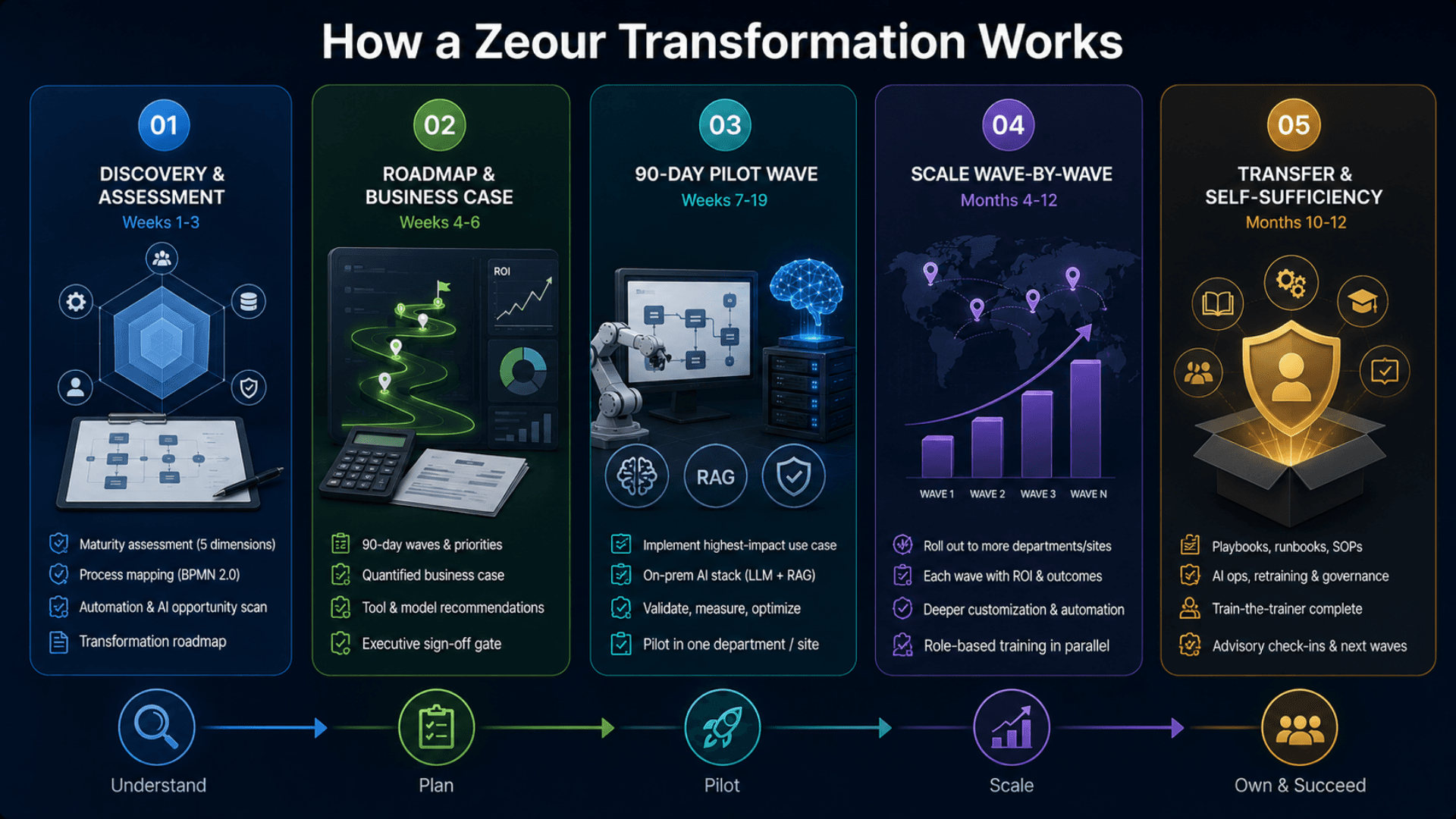
Digital Maturity Assessment (Weeks 1-3)
Workshops with executives, operators, and end users. Score current maturity across five dimensions (process, technology, data, people, governance) against industry benchmarks. Map current-state and target-state with BPMN 2.0. Identify automation candidates, self-service opportunities, and AI-applicable workflows. Deliverable: a buildable transformation roadmap with phased priorities, cost ranges, and ROI thresholds.
Roadmap & Business Case (Weeks 4-6)
Prioritize the roadmap into 90-day waves. Build a quantified business case for the first wave (baseline metrics, target metrics, costs, payback period, NPV, sensitivity analysis). Recommend tools — automation engines, self-service channels, AI models (open-weight vs commercial, on-prem vs cloud), GPU hardware (or CPU sizing for smaller deployments). Vendor-neutral. Executive sign-off gate before the first wave starts.
90-Day Pilot Wave (Weeks 7-19)
Pick the highest-impact, lowest-risk process for the first wave — typically a high-volume self-service or automation candidate that frees substantial operator time. We deliver the implementation alongside your team (or alongside our Enterprise Development team where bespoke build is needed). For AI components: validate the GPU sizing against your throughput targets (you procure direct from the vendor — we don't resell hardware), deploy the local LLM stack (vLLM / Ollama / TGI), build the RAG pipeline against your knowledge base, design mode-based prompts with evidence-based constraints. Pilot in a single department / site / business unit.
Scale Wave-by-Wave (Months 4-12)
Validated patterns roll out to additional departments / sites / business units in 90-day waves. Each wave has its own business case and outcome metric. Customization deepens — domain-specific fine-tuning, expanded RAG corpora, additional automation flows. Training programs run in parallel: executive briefings, operator curricula, end-user enablement, IT-administrator deep-dive, train-the-trainer sessions for your internal champions.
Transfer & Self-Sufficiency (Months 10-12)
Operations playbooks, runbooks, incident-response procedures, model-retraining schedules, license-renewal workflows handed over. Train-the-trainer programs complete — your internal team can onboard new staff, expand to new departments, and operate the AI infrastructure without us. We remain available for advisory check-ins, escalations, and the next-wave consultation. The success metric is that you don't need us anymore for the day-to-day.
Digital Transformation Use Cases by Industry
Explore the service environments relevant to dt consultation.
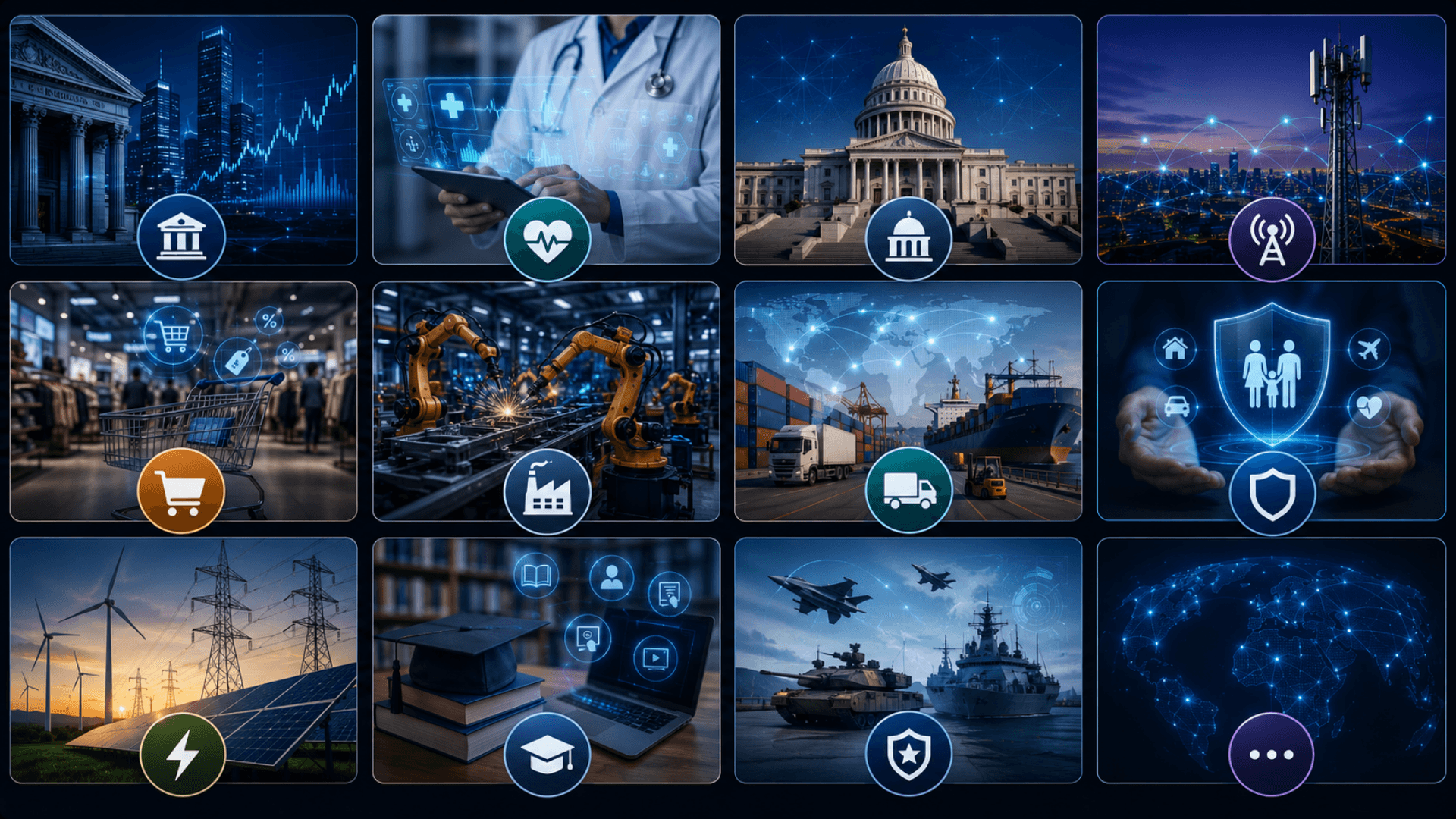
Open the deep dive by vertical
Digital Transformation Consulting Services FAQs
Get answers to the most common questions about our dt consultation.
Is digital transformation consultation only for large organisations?
What does Zeour Digital Transformation Consultation actually do?
What does "on-premises AI" mean concretely?
Will an open-weight LLM be good enough? Won't we need GPT-4 or Claude?
What's the difference between this and your Enterprise Development services?
How long does a typical transformation engagement take?
What does it cost?
Can you help us with vendor selection? We don't know if we should buy SaaS or build on-prem.
Do you help with AI compliance and governance?
What does AI fine-tuning involve, and is it worth it?
What hardware do we need for on-prem AI?
Do you offer training, and what does training cover?
How does the engagement leave us self-sufficient?
Will we be locked into your tooling?
How do you handle change management and resistance?
What if the transformation requires bespoke software builds?
Where do you operate?
Explore Related Solutions
Explore implementation services and operational products that may form part of a transformation roadmap.
Ready to Transform Your Operations with Digital Transformation?
Discuss your workflows, deployment requirements and integration scope with the Zeour team.
DT Consultation — concepts you'll meet
Definitions for the operational terms that appear across this page. Tap any chip to read the long-form entry plus its cross-links.