Self-service machines stopped being a novelty around the time supermarket self-checkout lanes outnumbered staffed ones at most urban grocery branches. The interesting question in 2026 is not whether brands are investing — they obviously are — but why the spend keeps accelerating even as labour markets in some regions soften and capital is more expensive than it was three years ago. The answer is that the operational economics changed in a way most boardrooms only fully internalised in the last two budget cycles.
The economics changed, not the appetite
The surface explanation is the one every operator gives a board: customer preference, lower per-transaction cost, higher throughput at peak. All true. The deeper explanation is that the unit economics of a touchscreen, a printer, a card reader, an Android compute board and a steel enclosure have collapsed. A kiosk that cost roughly USD 9,000 fully built in 2018 costs roughly USD 2,400 today for equivalent capability. Once the hardware passes the threshold where it pays back in under twelve months at modest utilisation, you stop debating ROI and start arguing about how many to deploy and where.
The second economic shift is more subtle. Brands that ran a single-channel kiosk programme five years ago — buy a kiosk, plug in payment, run it for five years — now run a fleet motion. Kiosks are part of a self-service ecosystem that includes mobile pre-arrival flows, virtual queue tickets, web check-in, in-app upsell, and staff-handover tablets. The kiosk is no longer the destination; it is one node in a flow that the customer moves through.
The third shift is around staffing. Across most of the markets we ship into — United Kingdom, European Union, Americas, GCC, MENA, Africa, Asia — the operational reality is that the brands cannot hire and retain the volume of front-line staff they used to assume. Self-service moves the routine 80% of transactions to a kiosk and reserves human attention for the 20% that needs it. That is not a labour-replacement story — it is a labour-allocation story, and it is what the operations directors are actually solving for.
What is actually being deployed in 2026
Four patterns dominate enterprise spend.
Hospitality check-in and check-out. Hotels run kiosks in the lobby for arrival, room-key issue, and express checkout. The differentiator is integration depth into the PMS — Opera, Mews, Cloudbeds, Apaleo, and the operator-built systems for premium properties — and into the door-lock provider (Salto, Assa Abloy, Dormakaba). A kiosk that issues a hotel room key against the live PMS in a single transaction is the operational win. A kiosk that captures the arrival and asks the guest to walk to the front desk anyway is the deployment that gets pulled out at the next refresh.
Healthcare patient self-arrival. Clinics and hospital outpatient floors are deploying kiosks for arrival confirmation, ID verification, and copay collection. The compliance posture is HIPAA in the US, GDPR plus member-state health-data rules in the EU, and the equivalent national frameworks across the GCC, MENA, Africa and Asia. The integration depth is into the EMR — HL7 v2, FHIR R4, or a direct EMR adapter where the EMR is custom (which is most of the time in operator-owned clinical systems). The MoH Kuwait deployment is one of the references for this pattern at the public-sector scale.
Government counter automation. Ministries and municipalities across all the regions we ship into are deploying kiosks for licence renewal, fee payment, document collection, and ID-card pickup. The integration is into the national identity system where in production, the payment gateway operated by the domestic acquiring bank, and the document-issuance backend. Sovereignty matters here — most of these deployments are on-prem by procurement requirement. Servizz.gov Malta and the MFCR Malta deployments are the European public-sector references; equivalent deployments run across the Iraq passport offices and the broader public-sector install base.
Retail order-and-pay. Quick-service restaurants and casual dining run kiosks for order placement and payment. The measurable lift is in average order value, not throughput — kiosks upsell more consistently than staff, and customers customise more aggressively when they are not waiting on someone with a queue behind them. SpaceNK in the UK is the retail reference for premium-brand counter automation.
Why the smart deployments are operator-grade, not vendor-grade
The failure mode for kiosk programmes is the same in every market: a glossy pilot lands, lasts six months, and then degrades. Touchscreens scratch. Printers jam. Card readers go EOL. The fleet management story was never invested in. By month nine, half the kiosks have an out-of-service sticker and the FM team is filing tickets that take three weeks to close. The board signs off on a refresh that costs as much as the original deployment, and the cycle repeats.
The operators getting this right in 2026 are the ones who treat the kiosk fleet the way airline ground operations treat boarding-pass printers — as production infrastructure with an SLA, a parts depot, and a known mean time to repair. They run a centralised fleet console that monitors every kiosk's heartbeat, printer paper level, card reader status, and uptime. They keep spare parts on-site for the high-failure components. They run a quarterly hardware-refresh cadence rather than a five-year rip-and-replace.
The second discipline is integration depth. A kiosk that runs in isolation is a glossy demo. A kiosk that issues a hotel room key against the live PMS, confirms a patient against the live EMR, dispatches a queue ticket against the live queue management system, and reconciles a payment against the domestic acquiring bank's settlement file is infrastructure. The integration sockets are what separate the two — and they are the part that most vendor pilots skip because they are unglamorous and take real engineering hours.
The third discipline is language coverage. English and Arabic with full RTL is the production baseline across the markets Zeour ships into. Additional locales — French, Spanish, German, Portuguese, Italian, Dutch, Turkish, Urdu, Hindi and more — are added per engagement based on the operator's market footprint. The brands that ship to a multilingual customer base in a monolingual interface lose the transactions that mattered most.
Where the spend goes next
The next 24 months of kiosk investment will not be about new use cases. The use cases are settled. The spend will go into three places: fleet management discipline (consoles, SLAs, parts depots, refresh cadences), integration depth (deeper adapters into the PMS, EMR, POS, payment, identity, and queue systems already in production), and on-premises AI augmentation (RAG over the operator's knowledge base, mode-based prompts for in-kiosk guidance, voice interaction where the local language coverage supports it).
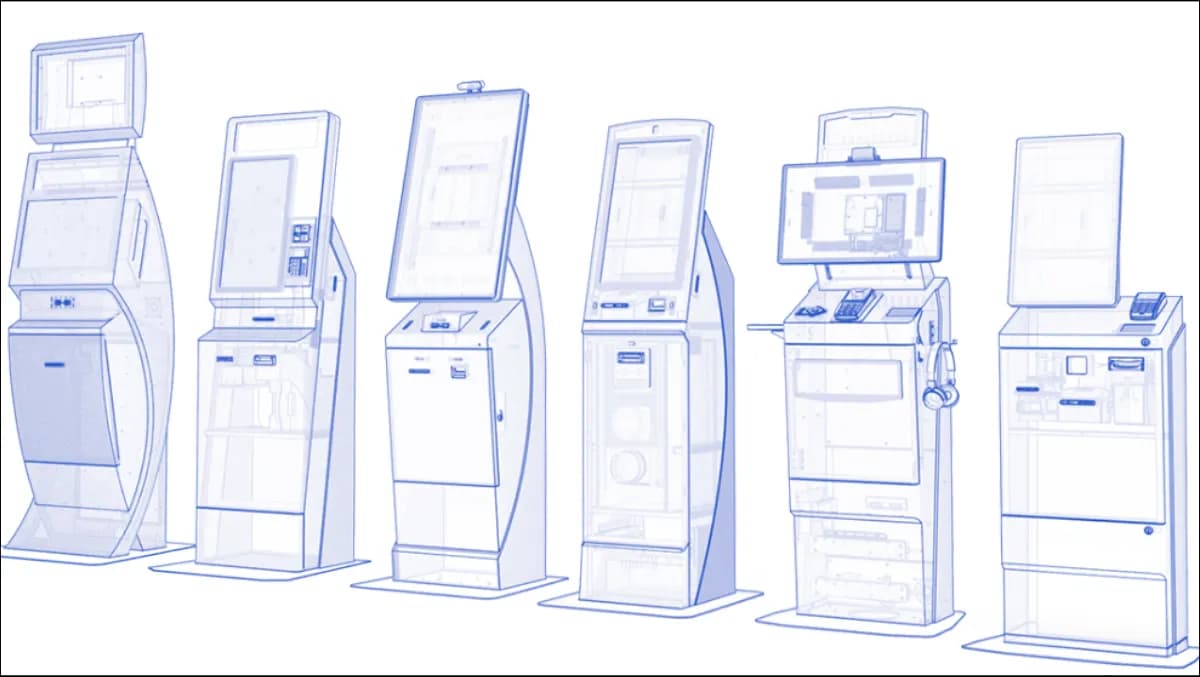
This is the model the Digital Self-Service Kiosk line is designed around. Steel enclosures rated for public-space use, Android compute that can be swapped in under five minutes, fleet console with real-time status, and integration adapters into PMS, EMR, payment, identity, and queue systems out of the box. The operator owns the deploy keys, the configuration, and the runtime — sovereign on-prem deployment is the default, not an add-on. When a brand asks why leading peers are investing, the honest answer is: because the kiosk is no longer the experiment. It is the production layer, and the operators who treat it that way are pulling ahead of the ones who still treat it as a marketing-funded pilot.