Key takeaways
- A QSR order kiosk, a hotel check-in kiosk, a supermarket self-checkout and an airport travel-retail kiosk share almost no hardware, UX or integration DNA — treating them as one procurement is the most expensive mistake estate teams make.
- Sustained AOV uplift on QSR order kiosks lands at 12-22% when upsell prompts are tuned to dwell-time data; pushing harder flips conversion.
- Hotel check-in kiosks pay back fastest when wired to the PMS with a keycard dispenser and a terminal supporting pre-authorisation holds.
- Retail self-checkout shrinkage runs 1.5-3.5x staffed-lane shrinkage; the gap closes with weight sensors, computer vision and a 1:4 attendant ratio.
- Payment-terminal lock-in is the silent killer of kiosk economics — specify Ingenico, PAX or Verifone semi-integrated terminals.
- Travel retail and airport food and beverage kiosks need real multi-currency, real multi-language and real offline behaviour — not checkbox features.
- A 50-site QSR estate clears net positive in month 9-14; a 200-lane retail self-checkout estate clears in month 18-30.
This post is the vertical-deep companion to the horizontal self-service kiosk TCO buyer's guide. The TCO guide compares hardware bands and licensing models; this one drills into what a kiosk actually does in four production environments — each with its own interaction model, hardware profile, integration map and ROI lever.
Who this guide is for
- QSR and fast-casual estate directors. 20-500 sites, peak bottleneck at order entry, POS at the centre. You want hardware specs, integration scope and a credible AOV uplift number before you commit.
- Hotel operations directors at multi-property groups. 10-200 properties, PMS at the heart, tired of queues at the 4pm peak. You need a kiosk that issues keycards, takes pre-auths and upsells without breaking guest experience.
- Multi-site retail estate directors. Supermarkets, electronics, fashion, DIY. Deciding between full self-checkout, assisted-checkout and scan-and-go. You need clarity on shrinkage controls, age-verification workflow and the right lane ratio.
- Airport and travel-retail operations leads. Landside and airside food and beverage and duty-free, customer mix changing hourly. You need kiosks that handle six-plus currencies and ten-plus languages without crashing during a flight bank.
What is retail and hospitality self-service in 2026?
A self-service kiosk is an unattended customer-facing computer with payment, peripherals and an integration to the operator's transaction backbone — POS, Property Management System, inventory, loyalty, payment gateway. The kiosk is not the system of record; it is a UX surface driving a transaction in the system of record. Get that wrong and you will spend the back half of the programme reconciling stock and folio mismatches.
What separates real implementation from shelfware has little to do with the touchscreen. It is the depth of the POS or PMS integration, the calibration of the upsell engine, the discipline of the payment-terminal spec, and the change-management around staff. Estates that under-invest in change management see kiosks abandoned within six months even when hardware works perfectly.
The 2026 shift is on-device intelligence — computer-vision item recognition, voice input and recommendation engines running locally, not in a public-cloud API on every transaction. The reasons covered in the on-premises AI deployment guide apply directly: a kiosk that cannot take an order during a cloud outage is a liability. Kiosks also coexist with table-side QR, mobile check-in, digital keys and scan-and-go phones — the programme must be designed as a multi-channel portfolio.
The 4-vertical kiosk pattern catalogue
Four verticals, four very different machines.
Quick-service restaurants and fast-casual
Interaction model. Customer chooses dine-in or takeaway, builds an order, sees upsell prompts at modifier and basket stages, pays at the kiosk or counter, the order lands on the kitchen display. Target 60-110 seconds for a 3-4 item basket. Peak throughput 35-50 orders per hour per kiosk.
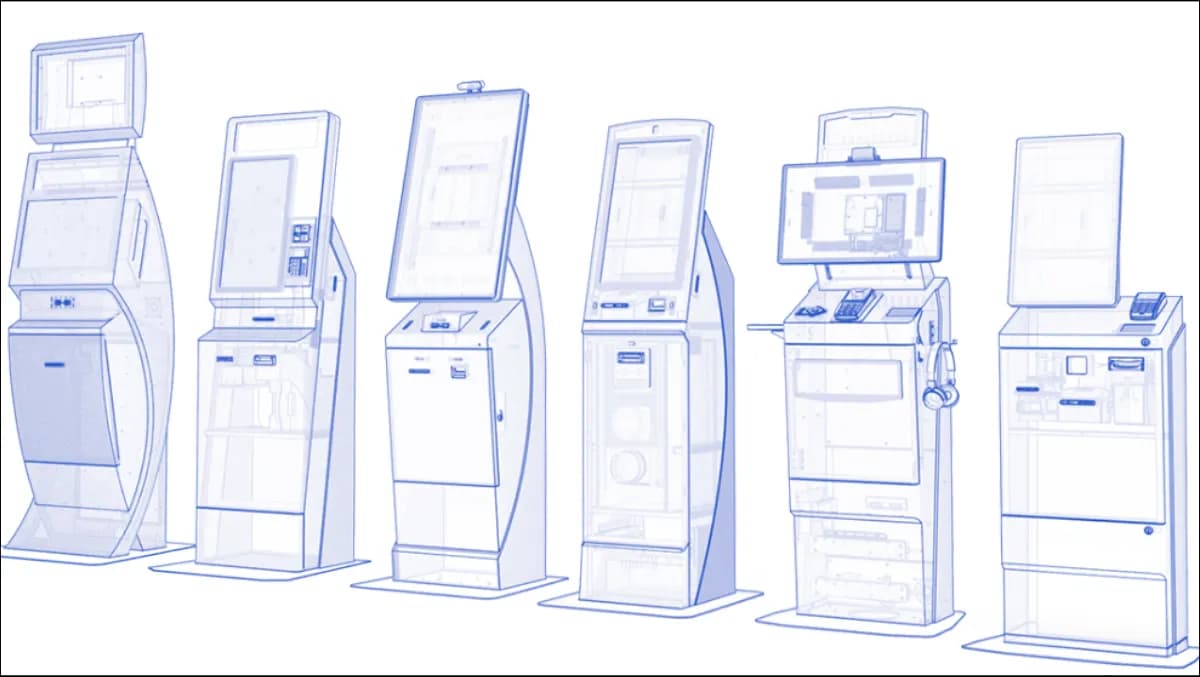
Hardware profile. Pedestal kiosk, 22-32 inch portrait touchscreen, Ingenico Self-3000 / Lane-5000 or equivalent PAX or Verifone terminal in a recessed bezel, 80mm Epson or Star Micronics thermal printer, optional barcode scanner, accessibility headphone jack. Build cost £8k-£20k per kiosk.
Integration map. POS is the only mandatory integration; the kiosk publishes orders as if they were counter orders. Optional: kitchen display, loyalty, gift-card processor, mobile-ordering app, aggregator pools. Orders must land in the same product mix report as counter orders.
UX patterns. Default to flagship language with a selector top-right (4-8 languages for tourist-heavy locations — see multilingual deployment). Upsell prompts tuned by dwell time; the right window is 1.2-2.5 seconds after a modifier choice. Abandonment flushes the basket after 90 seconds idle but keeps the session warm for 30 more. Errors default to staff handover.
Failure mode. Treating the kiosk as the POS rather than a UX surface on the POS. You end up with two systems of record, two catalogues, two pricing engines.
ROI lever. AOV uplift. Honest sustained range 12-22% over a 6-month window. Anything above includes price increases or novelty-pilot effects.
Hotel check-in and check-out
Interaction model. Guest identifies reservation by booking reference, name or scanned passport, the kiosk pulls folio from the PMS, confirms or amends room type, takes pre-auth, optionally upsells, dispenses keycard. Target 90-180 seconds routine, 240-360 with upsell or document scan.
Hardware profile. Pedestal kiosk with 22-27 inch touchscreen, integrated keycard encoder and dispenser, payment terminal with pre-auth support, ID scanner where required, signature pad, A4 receipt printer. Build cost £18k-£45k.
Integration map. PMS is the heart. Without proper PMS integration the kiosk is decoration. Beyond that: keycard system (vendor SDK from the lock manufacturer), payment gateway for pre-auth, loyalty for tier recognition, optionally the PMS upsell module. HID Origo and equivalent cloud-credential systems let you issue a mobile key in parallel with the physical keycard.
UX patterns. Language selection up front (8-12 languages for international properties), accessibility shortcuts on the home screen, hard call-front-desk button on every screen. Upsell tree two screens maximum, skippable in one tap.
Failure mode. Skipping the keycard dispenser to save money. A kiosk that sends the guest to the front desk for a key has not done a check-in.
ROI lever. Front-desk FTE redeployment plus upsell. A working estate redeploys 0.5-1.5 FTE per property and adds £8-£24 upsell across 30-45% of arrivals.
Retail self-checkout and assisted-checkout
Interaction model. Customer scans items (or has them recognised by overhead computer vision), places them on the bagging area which weighs to confirm, scans loyalty, applies coupons, pays by card or wallet. Target 35-90 seconds for a 5-15 item basket. An attendant covers 4-8 lanes handling age-verification, weight mismatches and voids.
Hardware profile. Lane-style kiosk with 19-22 inch touchscreen, 1D/2D barcode scanner (Honeywell, Zebra or Datalogic), weighing scale calibrated to local trade standards, contactless and chip-and-pin terminal, optional cash recycler (CashCode, JCM or Glory), receipt printer, age-verification light, overhead camera. Build cost £6k-£18k card-only; add £8k-£18k for cash.
Integration map. POS is mandatory and deep — every scanned barcode is a real-time price lookup. Loyalty, coupon processor, age-verification override workflow, shrinkage analytics, cash management, payment gateway. Age-verification is the integration most under-scoped at procurement time.
UX patterns. Default flow has to be fast — every extra tap costs throughput. Weight mismatches surface as 'an attendant is on the way' with the lane number on the console. Multi-language must cover local catchment. Coupons and loyalty redeemable by scan and manual code.
Failure mode. Deploying self-checkout without an attendant-to-lane ratio matching basket complexity. 1:4 for small-basket retail, 1:3 for supermarkets with frequent age-verified items.
ROI lever. Peak-hour FTE redeployment and shrinkage control. The shrinkage difference between a well-instrumented self-checkout estate and a poor one is 0.4-1.2% of revenue annually — on a £40m supermarket this can outweigh staffing saving by 2x.
Travel retail and airport food and beverage
Interaction model. Passenger approaches during a flight bank, selects language and currency, browses or scans products, deals with duty-free allowances and boarding-pass scanning where required, pays by card or wallet. Target 40-180 seconds.
Hardware profile. Pedestal kiosk with 24-32 inch touchscreen, multi-currency payment terminal, boarding-pass scanner (2D imager), receipt printer, ruggedised housing. Food and beverage adds the QSR hardware profile plus boarding-pass capture. Build cost £15k-£40k.
Integration map. Multi-currency pricing engine with real-time FX, allowance and duty calculation, departure control system integration for boarding-pass verification, multi-currency settlement, airside inventory, loyalty. Operators with multiple concessions run a tenant-shared software layer — the multi-tenant digital signage architecture maps closely.
UX patterns. 8-15 languages for major hub airports. Currency defaults to departure country, one-tap changeable. Time pressure means flows must be ruthlessly short. Offline behaviour matters more than in any other vertical.
Failure mode. Treating airport kiosks like supermarket self-checkout. Customer mix, time pressure, currency and offline requirements are categorically different.
ROI lever. Throughput uplift during flight banks. A working estate processes 1.4-2.1x the transaction volume of a staffed counter in the same square metres at peak.
How do you choose between QSR, retail self-checkout and hotel check-in patterns?
You do not — you choose per vertical and refuse to consolidate.
| Dimension | QSR order kiosk | Hotel check-in kiosk | Retail self-checkout | Travel retail kiosk |
|---|---|---|---|---|
| Form factor | Pedestal, 22-32 inch portrait | Pedestal with keycard slot | Lane-style, 19-22 inch landscape | Pedestal, ruggedised |
| Transaction time | 60-110 sec | 90-180 sec | 35-90 sec | 40-180 sec |
| Critical peripherals | Receipt printer, payment terminal | Keycard dispenser, ID scanner | Scale, scanner, optional cash recycler | Boarding-pass scanner, multi-currency terminal |
| Critical integration | POS | PMS + door lock | POS + inventory + age-verification | Multi-currency engine + allowance calc |
| Typical uplift | 12-22% AOV | £8-£24 per check-in | None directly (volume play) | Volume + cross-currency margin |
| FTE redeployment | 1-2 per site | 0.5-1.5 per property | 0.5-1.5 per store | 0.3-1.0 per concession |
| Unit hardware cost | £8k-£20k | £18k-£45k | £6k-£18k card-only | £15k-£40k |
There is almost no overlap. A platform claiming to do all four well either describes four distinct product lines under one brand or has not done any deeply. Choose a partner that has shipped reference implementations in your specific vertical. Be explicit about hardware-software separation — operators routinely buy a turnkey kiosk-plus-payment bundle and discover two years in they cannot change the terminal without re-certifying the fleet. See the hardware-software separation discussion in the TCO guide.
> Want a fixed-fee Discovery price before the end of the call? Talk to Zeour engineering — 30-minute scoping conversation, no slideware, and a published pricing band by the time we hang up.
How much do retail and hospitality kiosks cost in 2026?
Costs split into hardware-per-unit, integration-per-system and software-platform-per-estate.
- Discovery (fixed fee): £18k-£45k single-vertical, £35k-£85k multi-vertical.
- Build small (1-3 pilot sites): £80k-£250k software plus hardware. One POS or PMS integration, baseline UX, basic upsell engine.
- Build enterprise (multi-vertical or 10+ site rollout): £300k-£800k software platform plus hardware. 2-4 integrations, full upsell engine, multi-language framework, attendant console, multi-tenant catalogue.
- POS / PMS integration (per system): £30k-£80k QSR POS; £40k-£100k retail POS plus inventory; £40k-£120k PMS plus door-lock plus payment-gateway; £80k-£200k multi-currency travel-retail with boarding-pass verification.
- Pilot (per site): £15k-£40k including installation, telemetry, first UX iteration, staff training. Duration 6-12 weeks.
- Care Plan (per year): 18-25% of build cost annually.
For the full hardware-band breakdown and licensing-model comparison, see the self-service kiosk TCO buyer's guide.
ROI calculator — build a defensible business case in 7 steps
Step 1 — Baseline current transaction economics
Measure current AOV (QSR / travel retail), revenue per available room (hotel), revenue per transaction (retail), peak-hour throughput per site or lane.
Step 2 — Estimate AOV or upsell uplift
Apply 8-15% AOV uplift for QSR, £6-£18 per check-in for hotel, 0% for retail self-checkout (volume play), 4-9% basket uplift for travel retail from language-localised merchandising.
Step 3 — Estimate FTE redeployment
Staff hours per peak day spent on routine transactions the kiosk will absorb. QSR: order-taking minutes per peak hour × 365. Retail: cashier minutes minus the attendant role you must add back. Hotels: front-desk minutes minus the upsell-coaching minutes you redeploy.
Step 4 — Estimate throughput uplift in space-constrained sites
For airport food and beverage, travel retail and high-traffic QSR — measure transactions per square metre at peak today, apply the 1.4-2.1x multiplier for kiosk-rich layouts.
Step 5 — Estimate shrinkage delta (retail only)
With computer vision and the right attendant ratio, expect 0.3-0.6% above staffed lanes. Without those controls, expect 1.0-2.0%.
Step 6 — Sum revenue and cost effects
Gross annual benefit = AOV uplift + FTE redeployment + throughput uplift − shrinkage delta − annual Care Plan − hardware refresh provision (20% of unit cost annually, 5-year refresh).
Step 7 — Worked example: 50-site QSR estate
50 sites × 2 kiosks, £4,200 daily revenue per site at £8.50 AOV, 14% AOV uplift, 1.5 FTE redeployed at £28k loaded cost. Hardware: 100 kiosks at £14k plus 50 sites at £55k POS integration = £4.15m capex. Software: £450k Build plus £100k Care Plan. Year-one benefit: £3.0m AOV plus £2.1m FTE minus £100k Care Plan = £5.0m. Payback on the £4.6m programme: month 11. Five-year net benefit: ~£19.5m.
Seven failure modes from real deployments
Failure mode 1: One kiosk vendor across QSR plus hotel plus retail. Each vertical needs different hardware, integration patterns and UX. Fix: scope each vertical as its own procurement with a shared software layer where genuinely shared (catalogue, upsell, telemetry, feedback capture) and separate hardware teams per vertical.
Failure mode 2: Underestimating POS or PMS integration scope. Procurement budgets 30% of what they need, then the project slips three months when the POS vendor takes 8 weeks to certify each menu change. Fix: scope integration as a separate workstream with its own milestones and contingency.
Failure mode 3: Self-checkout without age-verification workflow. Estates ship self-checkout and discover alcohol or tobacco abandonment is 18-30% because attendant handoff takes 90 seconds. Fix: design the workflow end-to-end with a 20-second handoff target.
Failure mode 4: Upsell pushed too aggressively. AOV rises in the first three weeks, operators push harder, conversion drops 4-7%. Fix: instrument abandonment telemetry, set a hard conversion floor, rotate variants monthly.
Failure mode 5: No multi-language support in tourist retail and airports. Estates ship with 2-3 languages and wonder why kiosks underperform. Fix: capture actual language mix in Discovery, target 8-15 languages for airports — see multilingual deployment patterns.
Failure mode 6: Kiosks installed but staff not retrained. Operators tell staff 'help customers' without changing roles. Six months later the kiosks are dark. Fix: redesign the role explicitly (greeter, attendant, upsell coach), include staff in pilot iteration, instrument kiosk-usage as a managed metric.
Failure mode 7: Payment-terminal lock-in. Operators take a turnkey bundle and cannot switch acquirers without re-certifying the fleet, paying 30-80 basis points above market. Fix: specify semi-integrated payment with Ingenico, PAX or Verifone and a gateway abstraction supporting multiple acquirers from day one.
Migration path — moving from your current stack
Phase A — Pilot in one branch (weeks 1-12). Pick one representative site. Install 2-4 kiosks. Run the full software stack with telemetry. Iterate weekly on UX, upsell and staff workflow.
Phase B — Iteration on telemetry (weeks 13-24). Add 3-8 more sites. Build the runbook: attendant console training, daily-open and daily-close procedures, hardware support escalation.
Phase C — Estate rollout (months 7-18). 4-10 sites per month for retail, 2-5 properties per month for hotels, 6-15 sites per month for QSR. Maintain a tight feedback loop with the first wave.
Phase D — Multi-tenant consolidation (months 19-30). Consolidate onto a single multi-tenant platform if you have multiple brands, concessions or franchisees. Multi-tenant catalogue, pricing, payment routing and per-tenant telemetry become the operating model.
Implementation playbook
- 1Discovery (2-4 weeks). Fixed-fee scoping. Architecture, hardware spec, integration scope with POS or PMS vendor named, pilot plan, fixed-price Build proposal.
- 2Build (8-16 weeks). Software build, hardware procurement (payment terminals take 6-10 weeks to certify), integration in parallel, attendant console, telemetry.
- 3Integrate (3-5 weeks). End-to-end testing on POS or PMS sandboxes. Payment certification. Peak-hour load testing. Accessibility certification where required.
- 4Pilot and Go-Live (4 weeks). Pilot site, telemetry-driven iteration, staff training, runbook validation. Site-by-site go-live thereafter.
- 5Operate. Care Plan for software updates, telemetry tuning, hardware support and 6-monthly upsell retuning. Operator owns the codebase, license keys and deployment pipeline at the 90-day exit — see the operator self-sufficiency model.
Frequently asked questions
How does a QSR order kiosk differ from a retail self-checkout?
The QSR order kiosk builds an order from a curated menu, drives upsell and sends the order to a kitchen display. The retail self-checkout scans items from a vast catalogue, weighs them on the bagging area, and handles age-verification. Different hardware, integrations and ROI levers. They share the word 'kiosk' and almost nothing else.
What is the typical AOV uplift from order kiosks?
In QSR the honest sustained range is 12-22% over a 6-month window after upsell tuning. Vendors quote higher but those usually include price increases or novelty pilots. Demand uplift from queue removal is real but should be a separate line item — see the average order value measurement framework.
How do hotel check-in kiosks integrate with PMS systems?
Through a documented PMS integration API — every major PMS exposes one but surface area varies. Minimum surface: read reservation; write check-in confirmation; write room assignment; write folio entries; trigger keycard issuance; read loyalty tier. Without all six, the kiosk has gaps that push guests back to the front desk. PMS scope is the most common reason hotel programmes slip.
How do you handle age-verification at retail self-checkout?
Design end-to-end with a 20-second attendant handoff target. The kiosk detects age-verified items via product master data, lights up an attendant call indicator, pauses. Attendant arrives, verifies ID, taps approve, kiosk resumes. Treat as a workflow with hardware, software and human steps — not a UI prompt.
What payment hardware should you specify for a kiosk estate?
Semi-integrated terminals from Ingenico, PAX or Verifone with PCI P2PE certification. The terminal handles card data, the kiosk handles the rest — PCI scope reduced dramatically. Specify the payment gateway as a separate procurement so you keep acquirer choice. Mount in a recessed bezel satisfying accessibility height.
How do self-service kiosks affect staff headcount?
Less than buyers expect on day one, more than they expect on day three hundred. Day-one impact: 0.5-1.5 FTE redeployable per high-volume site at steady-state. Day-three-hundred depends on what the operator does with the time: greeter and assist roles drive conversion uplift; redirected to nothing means the FTEs evaporate. Self-checkout estates add back the attendant role at 1:3 to 1:4.
How do you handle peak-hour throughput on kiosk-only checkout?
Four levers: kiosk-to-lane ratio (size for peak), attendant-to-lane ratio (1:3 complex, 1:4 simple), basket-complexity routing (simple to express, full to standard), and graceful fallback to staffed lanes during true peak. If queue length at the attendant console exceeds 2 customers, you are under-resourced on attendants.
What is the right kiosk-to-staffed-lane ratio in supermarket retail?
6-10 self-checkout lanes plus 2-3 staffed lanes for small-basket flow plus 2-3 for full-basket flow. If more than 60% of baskets exceed 15 items, weight toward staffed lanes; if more than 70% are under 10 items, weight toward self-checkout. The wrong ratio shows up as a queue on the basket side the kiosks cannot help with, usually 4-8 weeks after rollout.
How do airport kiosks handle multi-currency and multi-language?
Real multi-currency pricing (not display-time conversion that fails at settlement), real-time FX from the treasury feed, currency defaulting to departure country and one-tap changeable, framework supporting 8-15 languages. The settlement side is the under-scoped half — payment gateway and back-office reconciliation must both understand multi-currency. See the airports industry surface for context.
How does on-premises AI fit into retail and hospitality self-service?
Three places. First, computer-vision item recognition at self-checkout — on-device or in-branch inference, latency under 200ms per item. Second, on-device voice input for accessibility, no audio leaving the branch. Third, branch-local recommendation models personalising upsell using basket history without sending personal data to a cloud API. All three sit on the stack covered in the on-premises AI deployment guide, respecting the sovereignty posture the rest of the GLARUS queue and flow portfolio maintains.
Where Zeour fits
If you are scoping a kiosk programme spanning QSR, hotels, retail self-checkout or travel retail, the digital self-service kiosk solution is the entry point. It ships as a software platform with hardware-agnostic peripheral support, multi-tenant catalogue and pricing, an upsell engine with telemetry, and the multi-language framework built in. It plugs into the wider queue management, virtual queue, online appointment, digital signage and customer feedback ecosystem. Scoping starts with Discovery and a fixed-fee proposal — see pricing bands and enterprise development services. Vertical context: retail, airports, education and healthcare all have live patterns in our portfolio.
---
Last updated: May 17, 2026 — by the Zeour engineering team.