
Telecom Service Centres
Segment the service-centre queue by visit reason (SIM, billing, technical, retention), let customers join via WhatsApp from outside the store, capture per-reason CSAT at exit, and push real-time signage across the network. Built for the operational tempo of GCC + MENA telecoms.
Production references
What Zeour deployments deliver for telecom operators.
Service-type definitions in MSA / GLITT; agents skill-routed per reason.
MobileWCSA integrates with WhatsApp Business API as a first-class channel alongside web, mobile, SMS, QR.
Exit-tablet survey ties result to the visit reason; manager dashboard slices automatically.
One CIO console; per-country localisation + regulator alignment.
The four problems we hear from telecom buyers in every Discovery.
One queue for SIM, billing, technical and retention is wrong
The customer who came to swap a SIM has a 4-minute visit; the customer disputing a bill has a 25-minute visit. Mixing them in one FIFO destroys throughput and CSAT for both.
Customers want to join the queue from outside the store
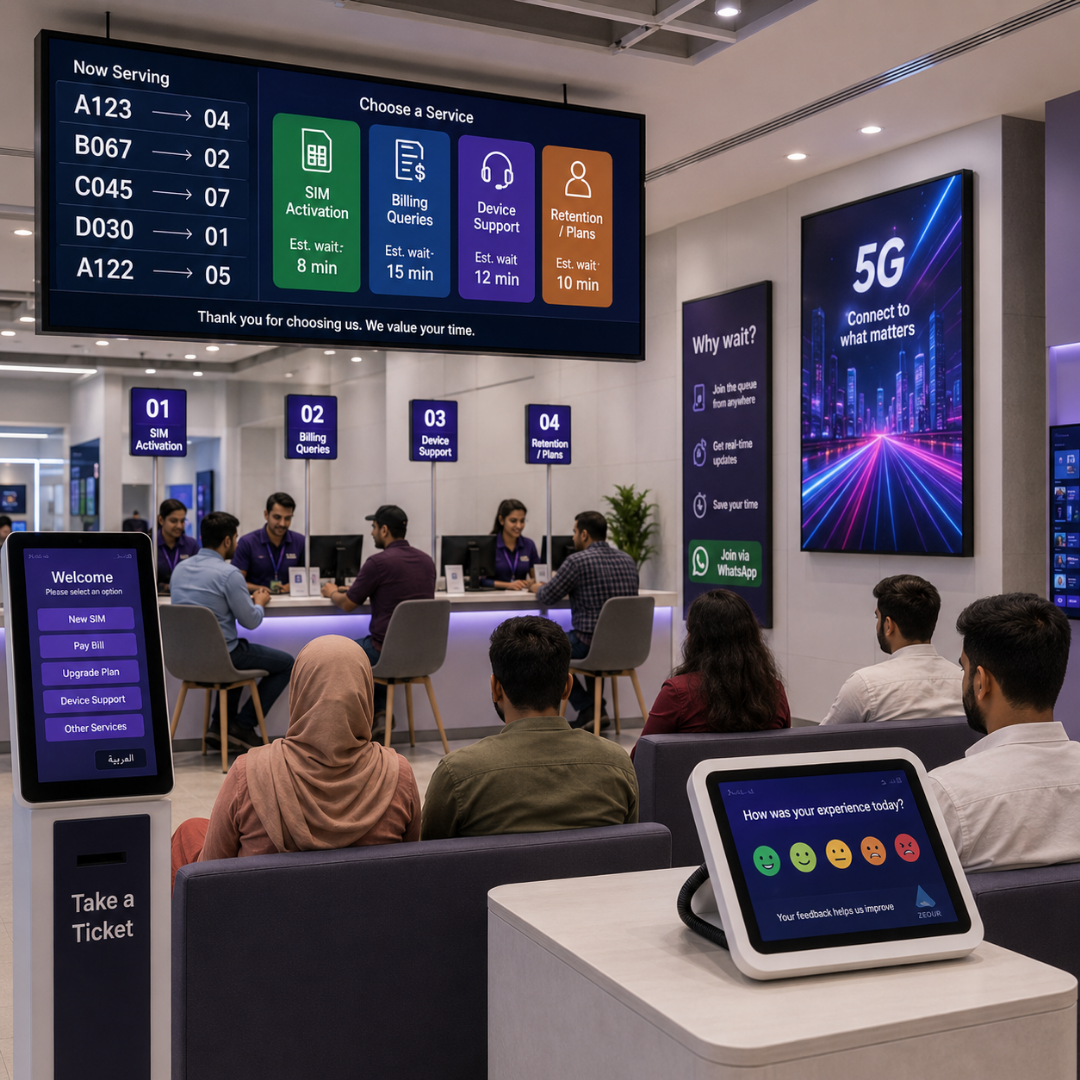
Walking into a store, seeing a 35-minute queue, and leaving is the dominant abandonment pattern. WhatsApp ticketing changes the maths — the customer joins from the parking lot or their office.
Per-visit-reason CSAT is hard without segmentation
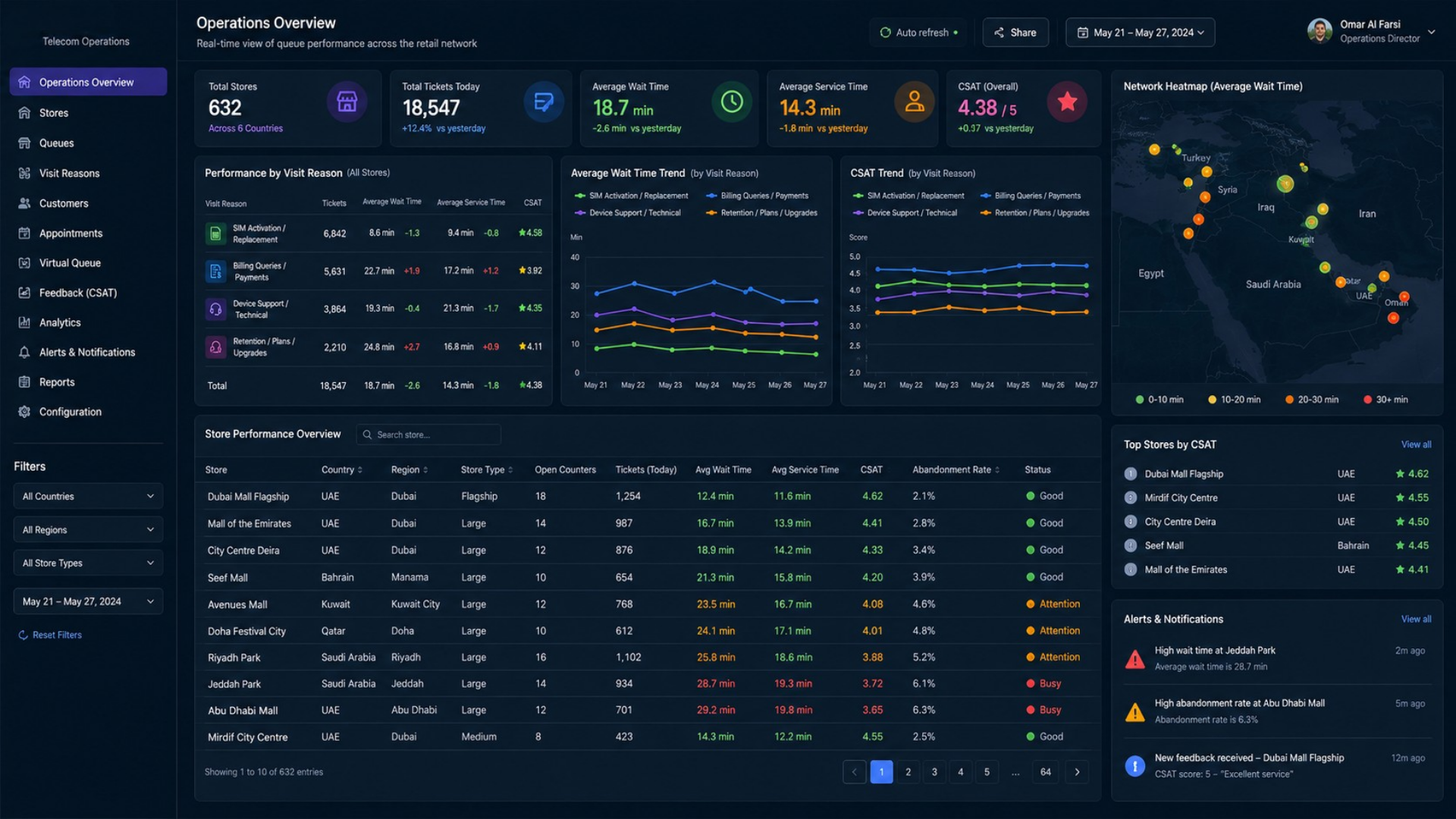
Aggregated CSAT hides systemic problems. If billing visits average 3.2 and technical visits average 4.6, you need the segmentation to act. Most legacy queue platforms can't deliver this.
Multi-region rollout needs central governance + per-country localisation
A Tier-1 telecom operating in 6 countries needs central rule configuration with per-country language / currency / regulator profiles. Without central governance the brand experience drifts.
Solutions deployed in telecom today.
Every solution below is in production with at least one telecom operator. Click any card for the full deep-dive.
Concrete deployment scenarios.
Flagship store — high-volume mixed reasons
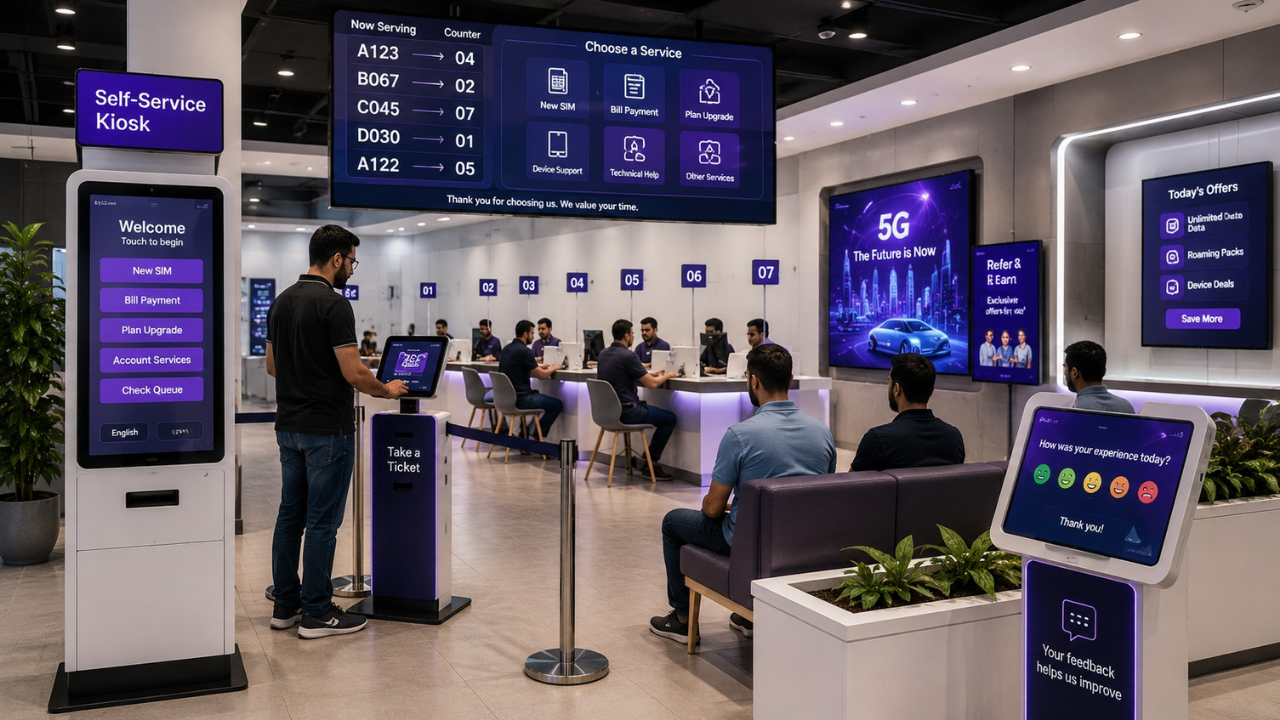
Customer enters; kiosk asks visit reason; routes to skill-appropriate agent; predictive wait shown; signage shows live queue position; CSAT captured at exit tied to visit reason.
Virtual queueing via WhatsApp
Customer messages the store's WhatsApp Business number; gets a virtual ticket; gets predictive wait + reminders; auto-converts to live ticket on arrival; can re-route to a less busy nearby store.
Appointment booking for technical / VIP
24/7 web / WhatsApp booking with technical-specialist calendar sync; OTP-verified ID; ICS invite; reminders; auto-convert to live ticket 10 minutes before slot.
Self-service SIM dispense kiosk
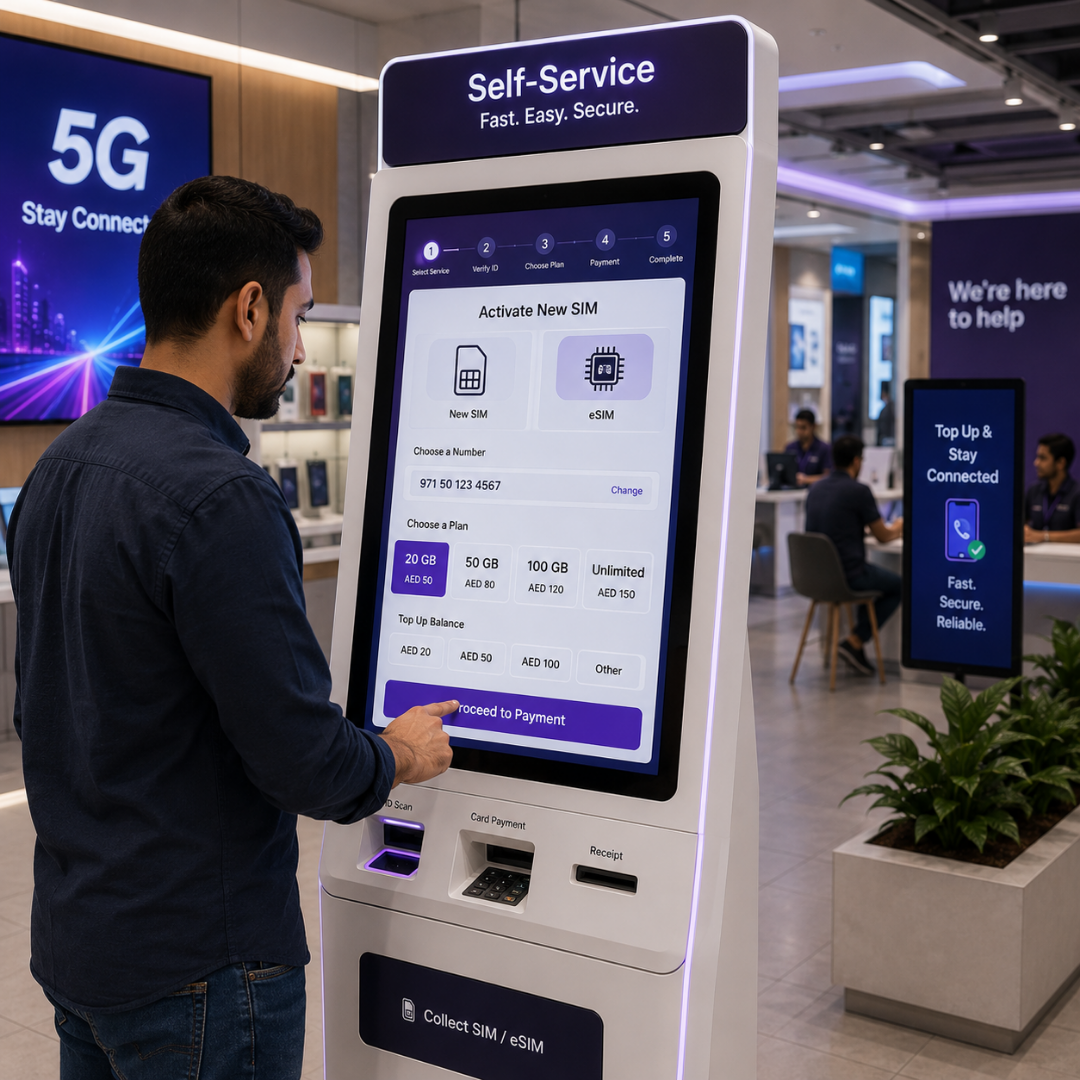
KYC + national-ID-verified SIM dispense at an unmanned kiosk; integrated with the operator's provisioning API; reduces counter staffing for routine swaps.
Deep dive — Zeour engineering for the telecom reality.
Why per-visit-reason segmentation is the first move
A telecom service centre serves four broadly-different visit reasons: SIM (swap, port, replacement), billing (dispute, payment, plan change), technical (device repair, eSIM, troubleshooting), and retention (cancellation, renewal). Each has a different average duration, a different staffing skill profile, and a different CSAT distribution. Mixing them in one FIFO destroys throughput AND CSAT — the 4-minute SIM customer waits 25 minutes behind the billing dispute, then complains; the billing customer doesn't get enough time and re-visits the next day. The fix is service-type definitions in MSA / GLITT with skill-routing: each agent is profiled against which reasons they can serve, and the routing engine assigns tickets accordingly. The throughput uplift is visible in week one; the CSAT uplift takes 30-60 days as the negative-experience tail drops.
WhatsApp as the primary virtual-ticket channel
In GCC + MENA markets, WhatsApp is the dominant customer-comms channel for telecom — more than email, more than SMS for non-OTP traffic, often more than the operator's own app. MobileWCSA integrates with the WhatsApp Business API as a first-class channel alongside web, mobile, SMS, Telegram and QR. The customer messages the store's WhatsApp number; gets a virtual ticket; gets predictive wait + reminders; auto-converts to a live ticket on arrival. Importantly, the customer can re-route to a less-busy nearby store if their current store is over-booked — the routing engine reads queue depth across nearby branches in real time. This single feature changes the demand profile across a metro and reduces over-loading on flagship stores.
Multi-country governance without losing local control
A Tier-1 telecom operating across 6 countries has central brand standards (service types, escalation flows, SLAs, KPI targets) and per-country localisation requirements (language, currency, regulator-specific rules, identity-verification integrations). MSA / GLITT handles the central layer; per-country deployments inherit defaults and override what they need. Adding a new country (or a new acquired MVNO brand) is a configuration exercise, not a redeployment — the platform supports 100+ branches per country and 6+ countries under one CIO console. Per-country sovereign on-prem is an option for regulator-mandated cases (typical in the GCC); cloud SaaS works elsewhere.
What a fixed-fee multi-country rollout looks like
Phase 1 — Discovery: fixed-fee, 3–6 weeks, on-site at the largest service-centre cluster in each country. Output: a written Statement of Work with binding per-country deployment dates and KPI thresholds. Phase 2 — Pilot: 1–3 flagship stores per country over 4–6 weeks; central CIO console live; per-country localisation in production. Phase 3 — Roll-out: per-country, typically partner-led for networks beyond 50 stores. Phase 4 — Operate or hand-over: 12-month operator-care with named SLAs, or a 90-day hand-over where the telecom's own team takes over with the repo, licence and deploy keys. The operator self-sufficiency at exit is the design goal — no vendor lock-in.
Regional notes — what changes per market.
United Kingdom + European Union
GDPR + UK DPA 2018, Ofcom alignment for vulnerable-customer flows, integration with the operator's CRM (Salesforce, Microsoft Dynamics and others) for visit-context lookup.
Americas
Integration with US MNO / MVNO CRM and identity systems scoped per engagement; cloud or on-prem option for regulator-facing deployments.
GCC + MENA
RTL Arabic shipping in the same build as English, integration with national identity systems where in production, PDPL alignment, sovereign on-prem option for regulator-facing deployments.
Africa + Asia
Engineered multilingual — extensible to any locale per engagement, mobile-money integration where in production, sovereign on-prem deployment for regulator-mandated cases.

Compliance frameworks
- GDPR
- UK DPA 2018
- PDPL
- ISO 27001
- Telecom-regulator alignment (Ofcom / CITC / TRA)
Active regions
- · United Kingdom
- · European Union
- · Americas
- · GCC
- · MENA
- · Africa
- · Asia
Questions telecom buyers always ask.
Talk to an engineer who has shipped this for telecom.
A 30-minute scoping call with the team that builds and operates Zeour — not a generalist account exec. We’ll walk your branch / site / network profile and give you a fixed-fee Discovery price by the end of the call.
Telecom — concepts you'll meet
Definitions for the operational terms that appear across this industry page.