
Government Service Centres & Public Sector
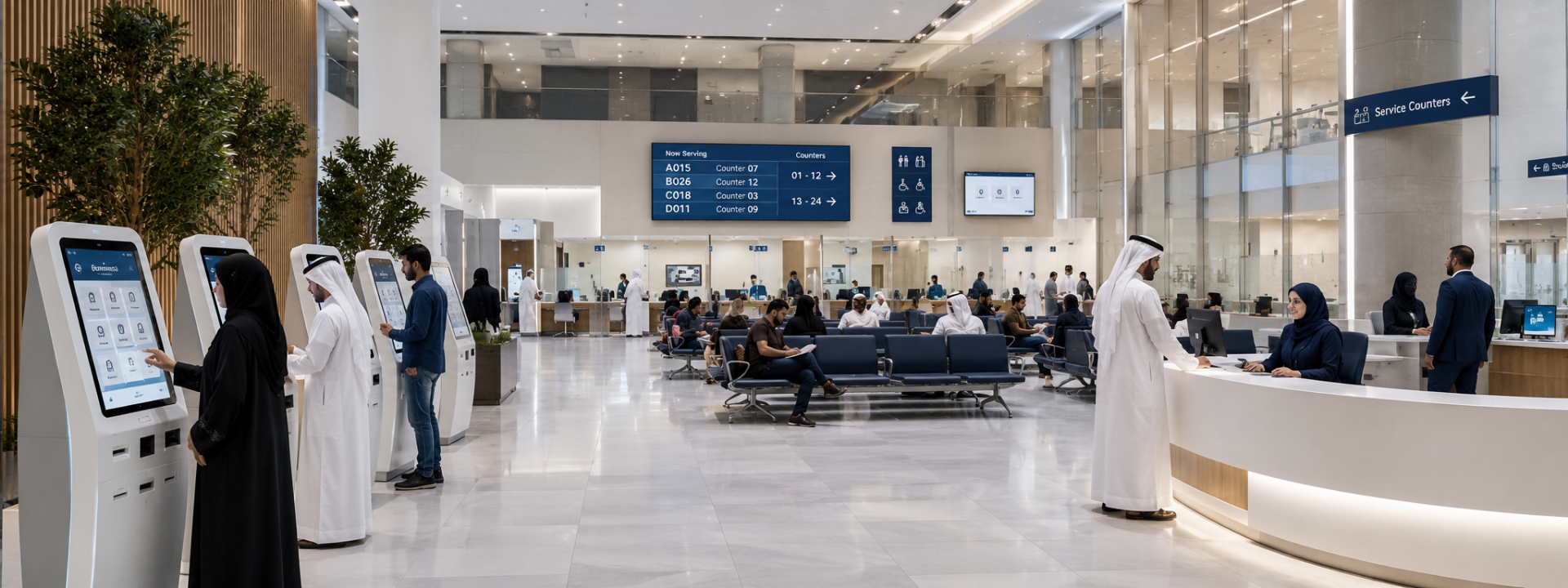
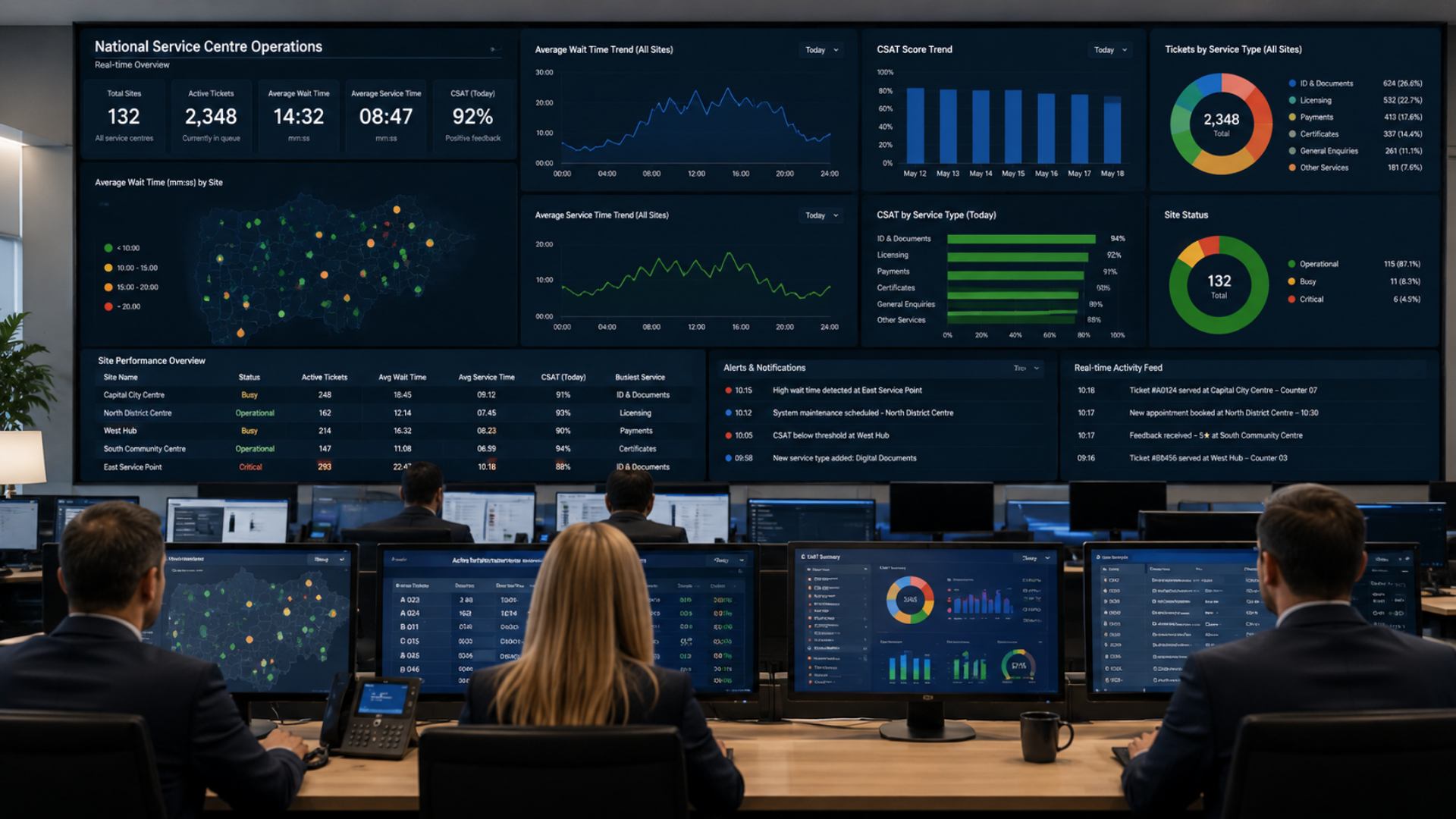
Standardise citizen flow across 50+ service centres under one CIO console. Sovereign on-prem deployments only; audit log on every administrative action; engineered multilingual — extensible to any locale per engagement. Deployed at ministries, defence compounds and embassy networks worldwide.
Production references
What Zeour deployments deliver for government operators.
Single MSA / GLITT for service-type definitions; per-branch RBAC.
Achievable on Phase 2 roll-out with virtual queueing + appointment + kiosk.
Multilingual (full RTL) ship as a production baseline; any other locale added per engagement.
Every administrative action logged with actor-snapshot, denormalised so logs survive user deletion.
The four problems we hear from government buyers in every Discovery.
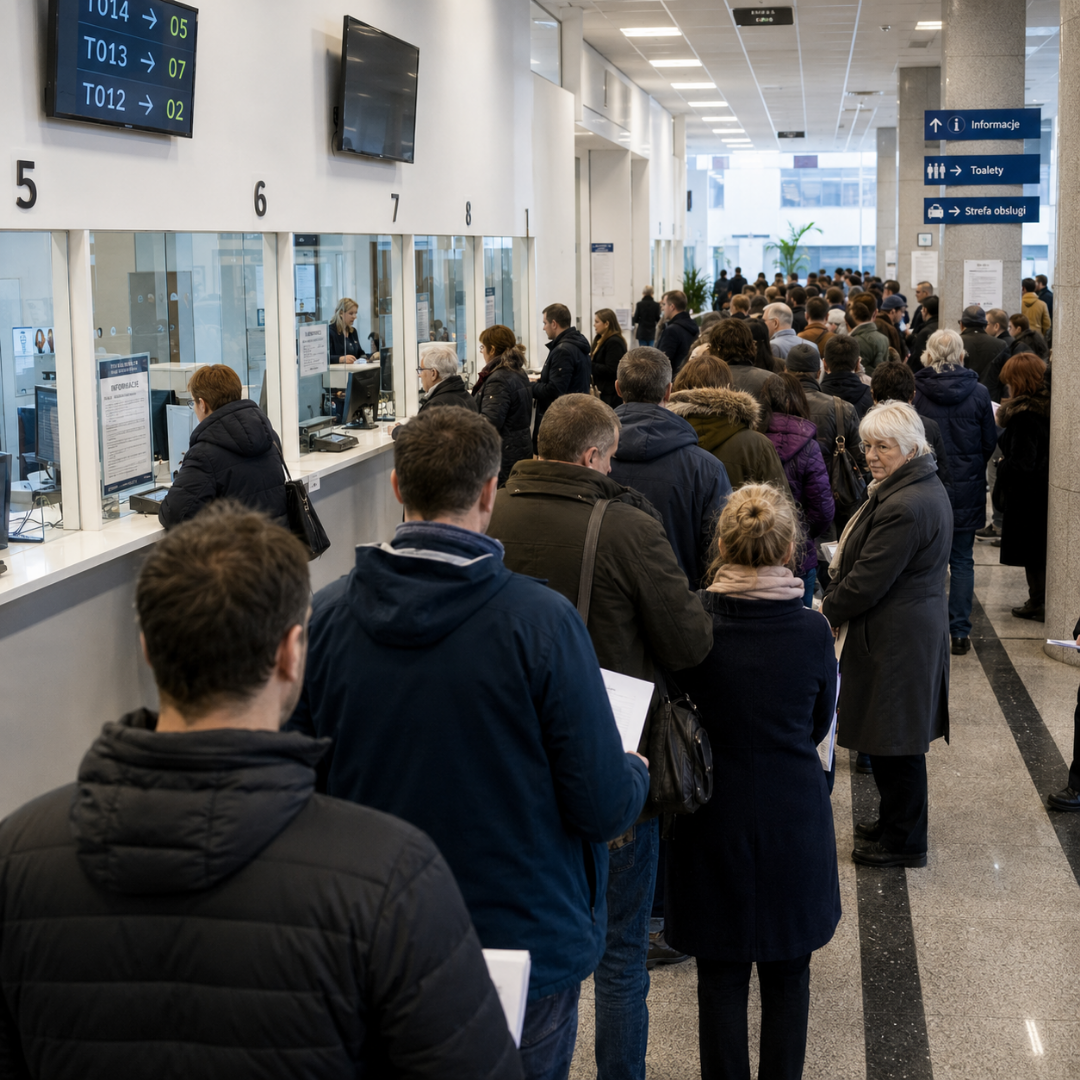
Citizen wait time is now a published KPI
Most GCC governments publish service-centre satisfaction scores quarterly. A 35-minute average wait is no longer politically survivable; ministries are mandated to bring it under 15 minutes.
Multilingual citizens, monolingual paper forms
A service hall sees English, Arabic, Spanish, French, Urdu, Tagalog, Bengali and many more in the same morning. Citizen kiosks and queue boards have to switch language per-citizen, not per-deployment.
Sovereign data is non-negotiable
Citizen-identifying data must stay inside the country's perimeter. SaaS queue / kiosk / visitor systems that phone home to a foreign region fail the procurement security review on day one.
Audit trail on every administrative action
Who changed the queue priority? Who approved the visitor? Who issued the badge? Public-sector procurement requires append-only audit logs that survive RBAC changes and personnel transitions.
Solutions deployed in government today.
Every solution below is in production with at least one government operator. Click any card for the full deep-dive.
Concrete deployment scenarios.
Service-hall walk-in queue
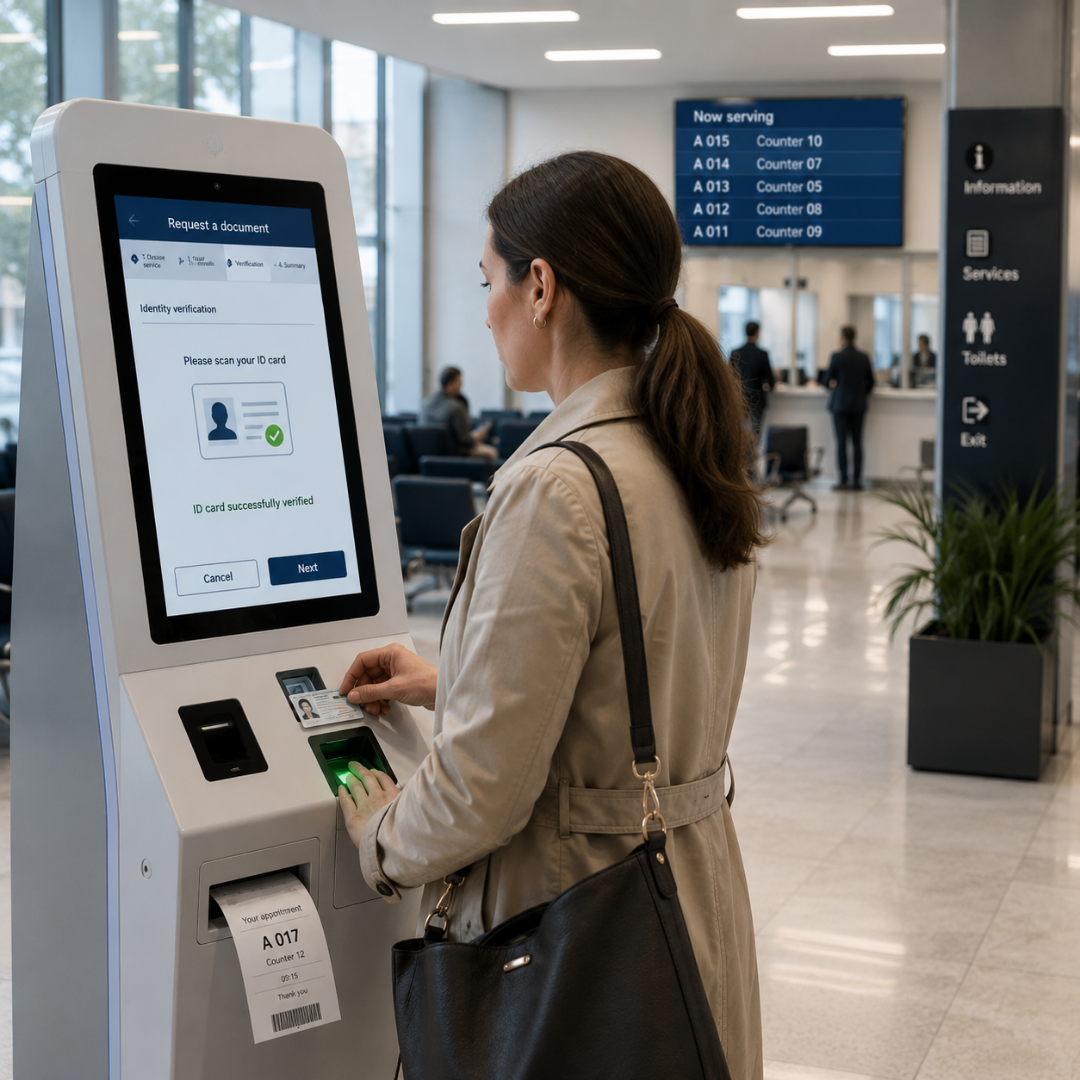
Citizen enters; kiosk shows service-type menu in their language; ticket prints with predicted wait; counter calls the ticket; digital signage shows live position; feedback captured at exit.
Embassy / consulate appointment booking
24/7 web / WhatsApp booking with visa-type-specific slots, identity verification at booking (passport scan), ICS invite, reminders, auto-convert to live ticket on arrival.
Defence-compound visitor management
Pre-registered visitor list pulled from AD; gate prints badge with photo + valid-from / valid-until; overdue-visit security escalation after configurable threshold; full audit trail.
Citizen-facing self-service kiosk
Common transactions (utility payment, fine payment, certificate request, document upload, status check) handled at a kiosk in the citizen's language with national-ID-card or OTP authentication.
Deep dive — Zeour engineering for the government reality.
What sovereign on-prem deployment actually means in practice
Every byte of citizen data stays inside the operator's perimeter. The deployment runs on the operator's own hardware (Linux or Windows VM), behind the operator's own reverse proxy, with no outbound calls. The licence gate is RSA-SHA256-signed to specific server MAC addresses; tampering breaks the licence. Updates ship as signed bundles via a delivery channel the operator controls — there is no auto-update or telemetry channel. The data layer is PostgreSQL or MySQL, backup-able with standard tooling (pg_dump or mysqldump on a cron schedule). The operator's own IT team can administer the entire stack with standard skills. This is the only pattern that clears a strict national-data-residency review without consent-form gymnastics.
Multilingual citizen flow as engineering, not translation
The customer-facing layer supports RTL and LTR at the framework layer; Arabic, Urdu and any added RTL locale render correctly out of the box including mixed-script names, RTL-aware number formatting, currency placement and Hijri / Gregorian calendar handling. The kiosk UI auto-switches per citizen via a language picker on the first screen; the ticket print spool selects the correct script (RTL spool for RTL scripts, LTR for LTR). Certificate PDFs, citizen-letter PDFs and lab-result PDFs respect the active locale. Adding a new locale (Tagalog, Bengali, French, Spanish, German, Portuguese, Italian and others) is a three-file change and ships in days.
Visitor management for defence and embassy networks
Pre-registration via the secure host portal with ICS calendar invite, identity verification + photo capture at the gate, smart-card inventory management (issued / returned / lost / replaced), host email notifications via SMTP or Microsoft Graph, overdue-visit security escalation, meeting-room display companion app for receptionists, and full audit trail with denormalised actor snapshot (logs stay readable after user deletion). 5-role RBAC is scoped per building / department: Receptionist, Host, Security, Compound Admin, Tenant Admin. All deployments run on-prem; the system has been in production at GCC defence compounds and embassy networks for multiple years.
How a multi-ministry roll-out is structured
Phase 1 — Discovery: 2–6 weeks, fixed-fee, on-site at the largest service centre. Output: a written Statement of Work with binding per-branch deployment dates. Phase 2 — Pilot: 1–3 service centres over 4–6 weeks; KPI thresholds (wait time, satisfaction, throughput) agreed in advance and tested. Phase 3 — Roll-out: the rest of the network, typically partner-led if the network exceeds 20 centres. Phase 4 — Operate or hand-over: 12 months of operator-care with named SLAs, or a 90-day hand-over where the ministry's own team takes over with the repo, licence and deploy keys. Operator self-sufficiency at exit is the design goal — no vendor lock-in.
Regional notes — what changes per market.
United Kingdom
NCSC Cyber Essentials, GDPR + UK DPA 2018, Cabinet Office DDaT design standards, on-prem deployment option for departments handling official-sensitive material.
European Union
GDPR + national data-protection frameworks, integration with national identity systems where in production, sovereign on-prem deployment for ministries that require it.
GCC + MENA
PDPL alignment, RTL Arabic shipping in the same build as English, Hijri calendar in appointment booking, integration with national identity systems where in production, sovereign on-prem deployment is the standard procurement requirement.
Africa + Asia
Sovereign on-prem deployment as default; configurable currency / phone-number / identity-system formatting; full audit trail in the operator’s chosen working languages; fully air-gappable where required.

Compliance frameworks
- GDPR
- PDPL (KSA / UAE)
- ISO 27001
- NCSC alignment (UK)
- Classified-data handling
- Cabinet-Office DDaT
Active regions
- · United Kingdom
- · European Union
- · GCC
- · MENA
- · Africa
- · Asia
Production references.
Questions government buyers always ask.
Government deployments in production.
Talk to an engineer who has shipped this for government.
A 30-minute scoping call with the team that builds and operates Zeour — not a generalist account exec. We’ll walk your branch / site / network profile and give you a fixed-fee Discovery price by the end of the call.
Government — concepts you'll meet
Definitions for the operational terms that appear across this industry page.