
Enterprise Software Development Services
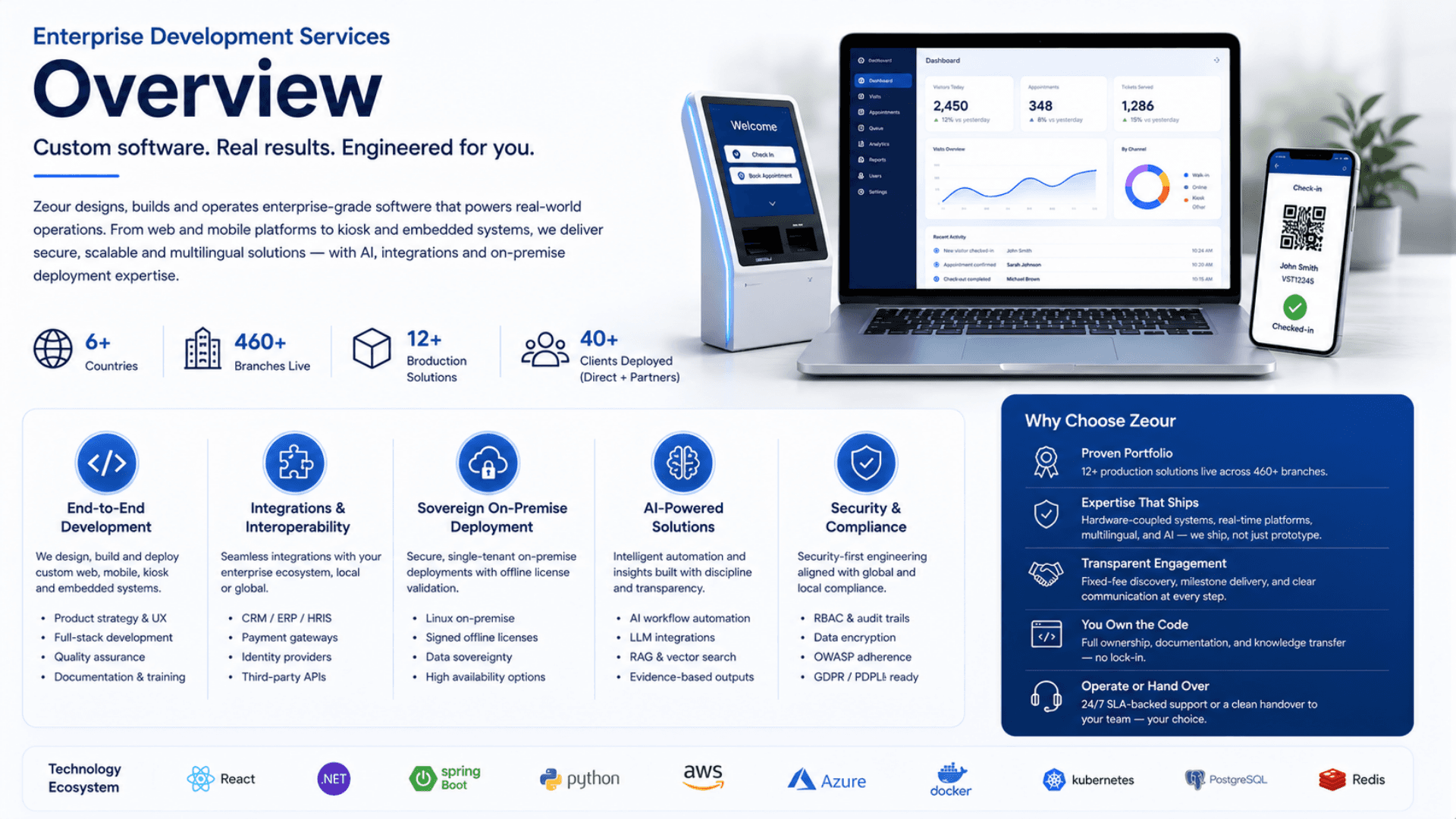
Zeour provides enterprise software development services for organisations commissioning custom operational systems. The team designs and builds web, mobile, kiosk and hardware-connected applications, with integration work shaped around the customer's workflows and existing systems.
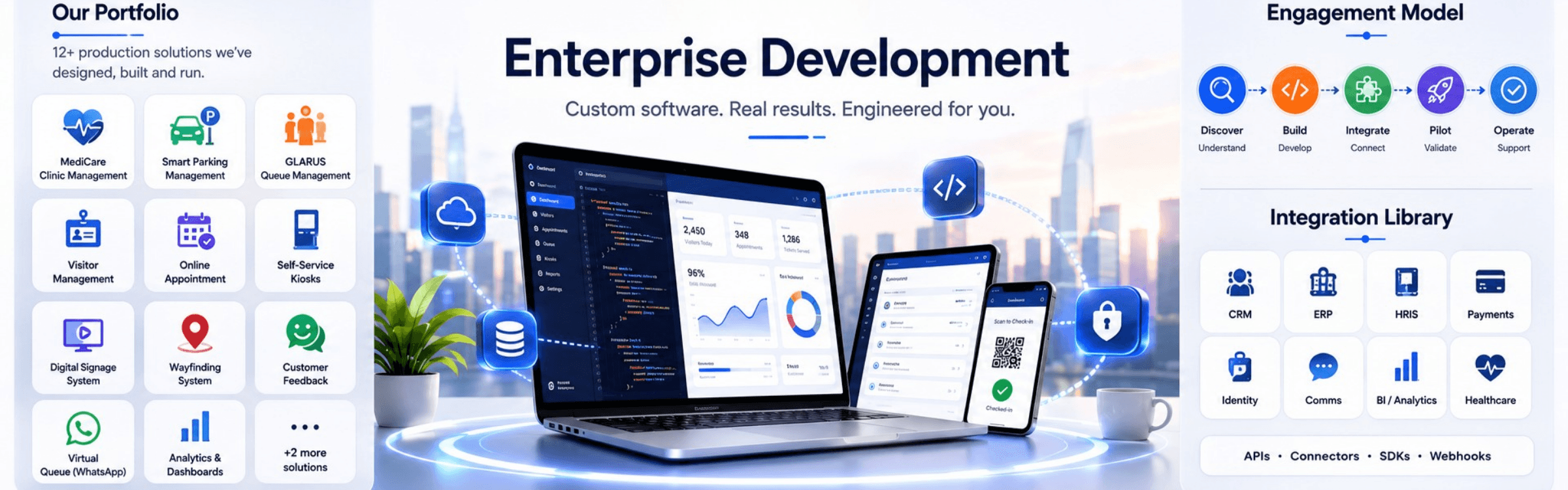
Bespoke Applications Built Around Your Operations
Define the business process, users and interfaces before selecting the application architecture. Engagements can cover a focused workflow or a broader platform, with delivery, deployment and handover described in the project stages below.
From Advisory Work to a Custom Build
Use digital transformation consulting to assess operational priorities before commissioning software. For a customer-facing device project, explore bespoke self-service kiosks.
The product portfolio also includes the MediCare clinic management system and smart parking management, with their domain-specific workflows described on dedicated pages.
Application Engineering, Integration and Delivery
An engagement with Zeour is not a marketing relationship — it's an engineering relationship. The team that designed and built MediCare Clinic Management (multilingual EMR, 7-mode AI clinical assistant, WebRTC telemedicine), Smart Parking (Android kiosk with native serial + GPIO hardware control, offline-validated license gate, real-time monitoring), GLARUS Queue Management (multi-branch real-time queue platform), Wayfinding (multi-floor indoor navigation with QR handoff), Digital Signage (CMS-driven digital signage at scale), Visitor Management, Online Appointment, Self-Service Kiosks, and Customer Feedback — that same team is what you engage. We are stack-pragmatic: the language and framework are chosen per engagement and for the team that will inherit the codebase — the production portfolio shows the depth we bring, not a closed menu of technologies. We work in two-pizza teams (2-4 engineers, one lead, one designer when needed), in 2-4 week milestones with weekly demos, with fixed-fee outcomes and transparent change-order pricing. Discovery is a 2-week fixed-fee phase that produces a buildable SRS; either side walks away at that point with no further commitment.
Zeour Enterprise Development — we design, build, and operate corporate-grade software for organizations that take their software seriously. Custom web platforms, mobile apps, kiosk fleets, embedded/hardware-coupled systems, real-time services, AI-augmented workflows, system integrations (CRM / ERP / HRIS / payment gateways / BI / national health systems / lab analyzers / payment terminals / card readers / GPIO barriers), legacy modernization, cloud migration, on-premise deployments, DevOps + CI/CD, security hardening, and 24/7 support. Every other solution on this site — MediCare Clinic Management, Smart Parking, GLARUS Queue Management, Wayfinding, Digital Signage, Visitor Management, Online Appointment, Self-Service Kiosks, Customer Feedback — is something our team designed, built, and operates today. The same team is available for your bespoke engagement. Engagements are sized to the problem, not the company — a focused single-workflow build for a small firm is as valid an engagement as a national platform.
Key Functionalities
Stack-Pragmatic by Default
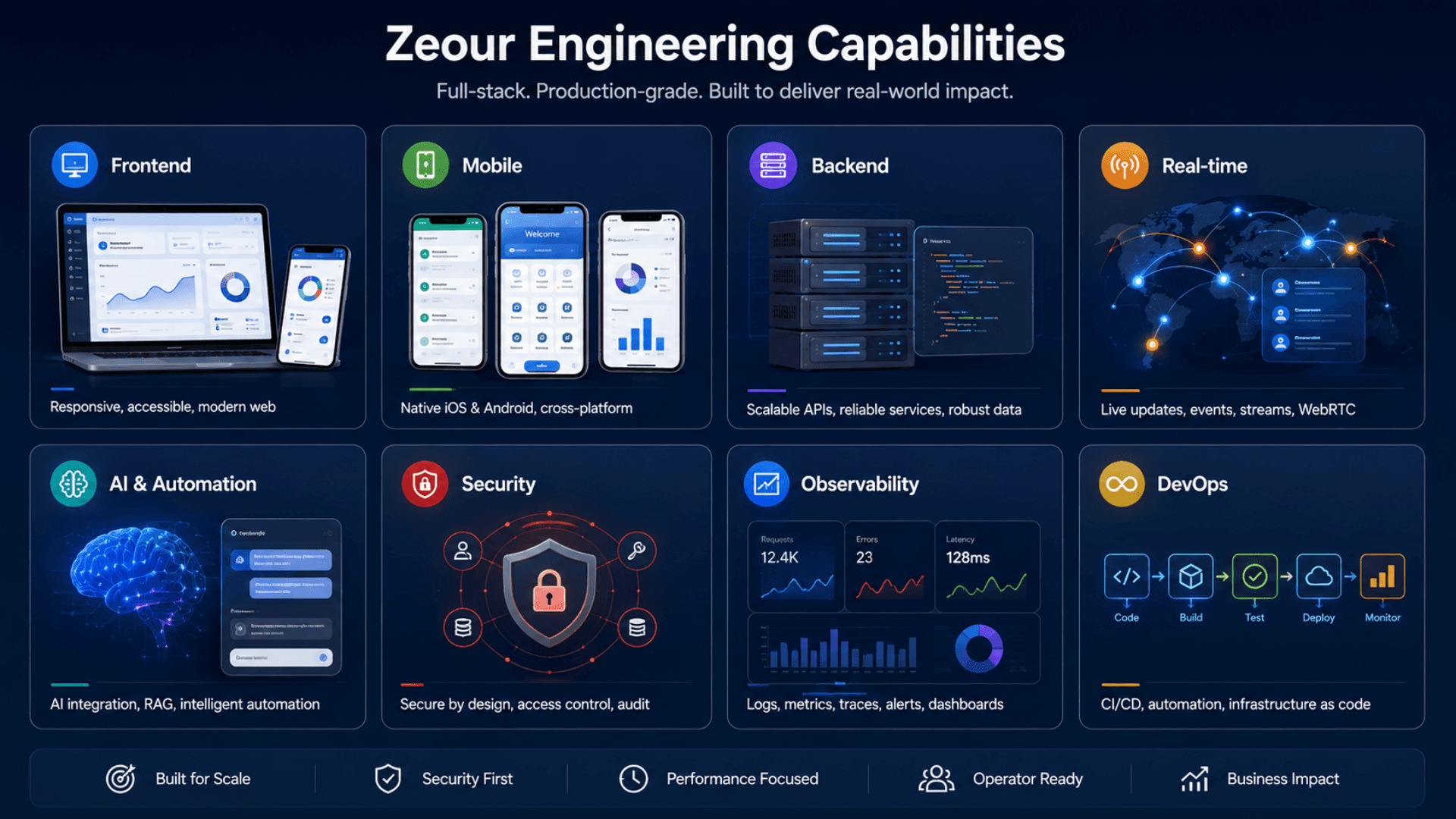
We choose the language and framework per engagement and for the team that will own the code — fluent across JavaScript / TypeScript, Java / Spring, .NET, Python / Django, Go, PHP / Laravel and more. If your estate already standardizes on a stack, we build on it rather than asking you to re-platform.
Custom Enterprise Web Platforms
Modern component-driven web applications with strict typing, standalone production builds, deployable in the cloud or on a single Linux box (or HA pair). Technologies we reach for often include React, TypeScript and Tailwind. Reference: every solution on this site.
Native + Cross-Platform Mobile
Native Android and iOS plus cross-platform options. Locked-down, watchdog-fed kiosk and tablet builds. We recommend the toolkit based on the team that will inherit the app. Reference: Smart Parking Android kiosk.
Real-Time Services
Event fan-out, live dashboards, WebRTC peer-to-peer video / audio signaling, in-call chat, room-based architecture. Reference: MediCare telemedicine, Smart Parking real-time monitor.
AI Integration with Discipline
Disciplined LLM integration — mode-based prompts (one tightly-scoped mode per feature), evidence-based system prompts, context auto-assembly from existing data, configurable model (cloud or on-premises), caching, audit logging. Reference: MediCare AI Clinical Assistant with 7 modes.
System Integrations
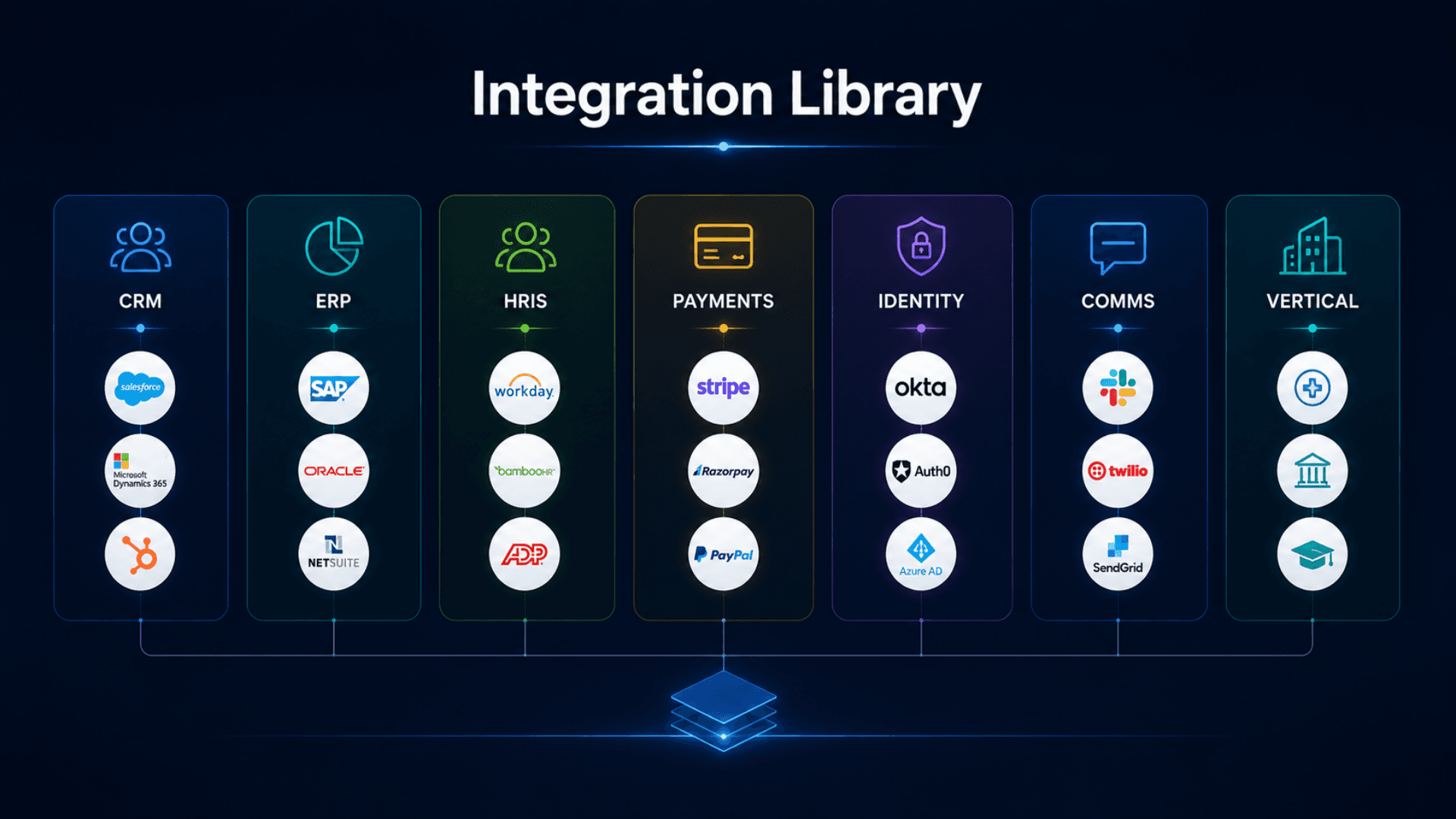
CRM, ERP, HRIS, BI, payment gateways, identity providers, comms, vertical-specific (HL7, FHIR, lab analyzers, banking core, POS). Reference implementations for the most common integrations; documented integration playbook.
Legacy Modernization (Strangler-Fig)
PHP, classic ASP, VB6, Delphi, COBOL gateways, stored-procedure-heavy SQL Server. Keep legacy running, build new alongside, route progressively, decommission per-module. Operator sees continuous value through the migration.
Cloud Migration & On-Prem Deployment
AWS / GCP / Azure for managed cloud. Sovereign on-prem Linux deployments for sovereignty-sensitive sectors. Hybrid topologies (on-prem core + cloud burst for analytics) for operators who want both.
DevOps + CI/CD
Build → migrate → health-check pipelines on GitHub Actions / GitLab CI. Blue-green + canary deployments. Infrastructure-as-code. Dedicated secret management — production secrets never sit in plaintext alongside the code.
Security Engineering
RBAC matrices, append-only audit logging, modern password hashing, secure session tokens with configurable TTL, signed offline license gates, mTLS for service comms, OWASP Top 10 hardening, dependency-vulnerability scanning in CI. Pen-test pass as a release gate.
Multilingual Engineering
Full RTL Arabic + LTR English baseline with document direction switching, locale-aware Intl.NumberFormat, currency switching, phone format per country, date format per locale, PDF rendering that picks the correct script. Reference: MediCare + Smart Parking, both shipped today with EN/AR and architected for any further locale (French, Spanish, German, Portuguese, Italian, Dutch, Turkish, Urdu, Hindi and more) to drop in as a 3-file change.
Observability + Performance + Accessibility
OpenTelemetry tracing, Prometheus metrics, Grafana dashboards, Sentry error capture. Lighthouse 95+, sub-second TTFB, image optimization, code-splitting. WCAG 2.1 AA — keyboard navigation, screen-reader compatibility, focus management, color contrast.
Documentation, Runbooks & Training
Operations playbooks, deployment guides, role-based training materials. Every engagement ends with the operator owning the repo, the license, the deploy keys, the docs, and the runbooks.
Software Components
Web & Mobile Engineering Depth
Modern Web Application Engineering
Component-driven web apps with strict typing, standalone production builds, and on-prem or cloud deployment. Technologies we reach for often include React, TypeScript and Tailwind — and we work equally in other web ecosystems (Java/Spring, .NET, Python/Django) where they suit the estate better.
Native Android & iOS
Native Android and iOS applications for enterprise field-staff and self-service scenarios, including locked-down, watchdog-fed kiosk builds. We choose the toolkit for the team that will own the app.
Cross-Platform Mobile
Cross-platform mobile is on the table when the use case warrants it — internal apps, simple consumer apps, MVPs. We recommend the approach based on the team you'll inherit the codebase to, not a house preference.
Backend & Data Engineering Depth
Server Runtimes & Frameworks
We are fluent across the major server ecosystems — Node / TypeScript, Java / Spring, .NET / C#, Python (Django, FastAPI), Go, PHP / Laravel — and pick the runtime per engagement and per the inheriting team.
Relational & Document Databases
Relational databases (PostgreSQL, MySQL, SQL Server) for the majority of workloads; document stores when the data shape genuinely calls for it. Migrations, indexing, replication; the schema is the source of truth. Reference: the MediCare and Smart Parking data models.
Caching & In-Memory Stores
In-memory stores such as Redis for distributed rate limiting, caching, and real-time fan-out at scale — applied where they earn their place, not by default.
API Design
REST as the default; GraphQL when client query patterns warrant it; gRPC for high-volume service-to-service comms. Every API has an OpenAPI spec and a documented partner portal.
Real-Time, AI & Hardware Depth
Real-Time Mini-Services
Lightweight real-time services for live activity, dashboards, and alerts that degrade gracefully if offline. Reference: Smart Parking real-time monitor, MediCare notifications.
WebRTC Video & Signaling
WebRTC peer-to-peer video / audio with signaling and in-call chat. Reference: MediCare telemedicine.
Disciplined AI Integration
Mode-based prompts, evidence-based system prompts, context auto-assembly, configurable model (cloud or on-premises), caching, audit logging. Reference: MediCare AI Clinical Assistant with 7 modes.
RAG Pipelines + Vector Search
When the use case warrants — enterprise document search, support-ticket triage, contract analysis. Vector search on self-hosted or hosted infrastructure depending on data sensitivity.
Hardware-Coupled Software
Serial-controlled card readers, GPIO-driven peripherals, hardware watchdog feeding, and vendor hardware SDK integration. Reference: Smart Parking native hardware control for RFID readers and barrier gates.
DevOps, Security & Observability Depth
CI/CD Pipelines
Build → migrate → health-check → deploy pipelines on GitHub Actions / GitLab CI. Blue-green + canary deployments. Dependency-vulnerability scanning + lint + typecheck + tests as release gates.
Infrastructure-as-Code
Idempotent, reviewable, version-controlled infrastructure for cloud deployments and on-prem provisioning alike.
Reverse Proxy & Deployment
A hardened reverse proxy with compression, security headers and automatic TLS; single-VM, containerized, or orchestrated deployment chosen for operator skill and system criticality, not fashion.
Signed Offline License Gates
Cryptographically signed license files with offline validation and expiry checks for sovereign deployments. Reference: Smart Parking license gate, productionized.
Observability
Structured logs, traces, metrics, error capture. Dashboards per operator role (engineer, ops, business). Alerting via PagerDuty / Opsgenie / Slack / email.
Production Secret Management
Production secrets live in a dedicated managed secrets store or KMS — never in plaintext alongside the code. Rotation is a documented playbook, not a panic activity.
Hardware Components
Server Hardware (Operator-Side)
Industrial Branch Server
A compact Linux branch server that comfortably hosts a single-site enterprise application, database, mini-services and reverse proxy.
Standard x86 Linux Server
Any modern x86 server with adequate RAM and SSD storage. For HA we deploy a pair behind a load balancer with a replicated database.
Cloud Equivalent
For managed cloud: equivalent compute instances on AWS / GCP / Azure, with managed databases.
Kiosk Hardware
Android Panel PCs
Touchscreen Android panel PCs running our locked-down kiosk apps for self-service, parking and queueing scenarios.
Standard x86 Touchscreen Panels
For self-service kiosks where Android is not the right fit — Windows IoT or Linux running a Chromium kiosk shell. Reference: GLARUS self-service kiosks.
RFID / MIFARE & EMV Card Readers
Serial- or USB-connected RFID / MIFARE card readers and contactless EMV readers for payment kiosks. We write native drivers when vendor SDKs are unavailable.
Vendor Hardware SDKs
We integrate manufacturer SDKs for GPIO control and watchdog handling, and write native protocols ourselves when documentation is incomplete. Smart Parking is the reference.
Hardware-Coupled Peripherals
Barrier-Gate Relays
GPIO-pulsed relays driving electric barrier gates. Reference: Smart Parking.
Thermal Printers
Standard-format thermal printers for queue tickets, receipts, prescriptions and certificates. USB or LAN; the driver layer is well-supported.
ANPR Cameras (Optional)
Per-lane ANPR cameras for parking deployments needing a secondary identity factor. Integrates with the platform via REST.
Hardware Watchdogs
The kiosk app feeds a hardware watchdog at fixed intervals; if the app hangs, the panel reboots automatically.
Operator Workstations
Reception / Counter Workstations
Standard x86 PCs with 22"+ touchscreens for staff CRUD work — patient registration, card issuance, top-ups, visit booking.
Operations / Admin Workstations
Standard x86 PCs with 24"+ displays for ops centers showing dashboards, realtime monitors, system health, fleet status, KPIs.
Mobile Staff Devices
iPads + iPhones + Android tablets for field staff — visit captures, nurse rounding, security patrols, on-site service. Native mobile apps where workflow speed matters.
Enterprise Engagement Architecture
An engagement with Zeour is a three-tier operational architecture: a delivery tier (how the team works with you), an engineering tier (the stack we ship on), and an operations tier (how the system runs in production). Each tier is documented, transparent, and reusable across the 12 products on this site.
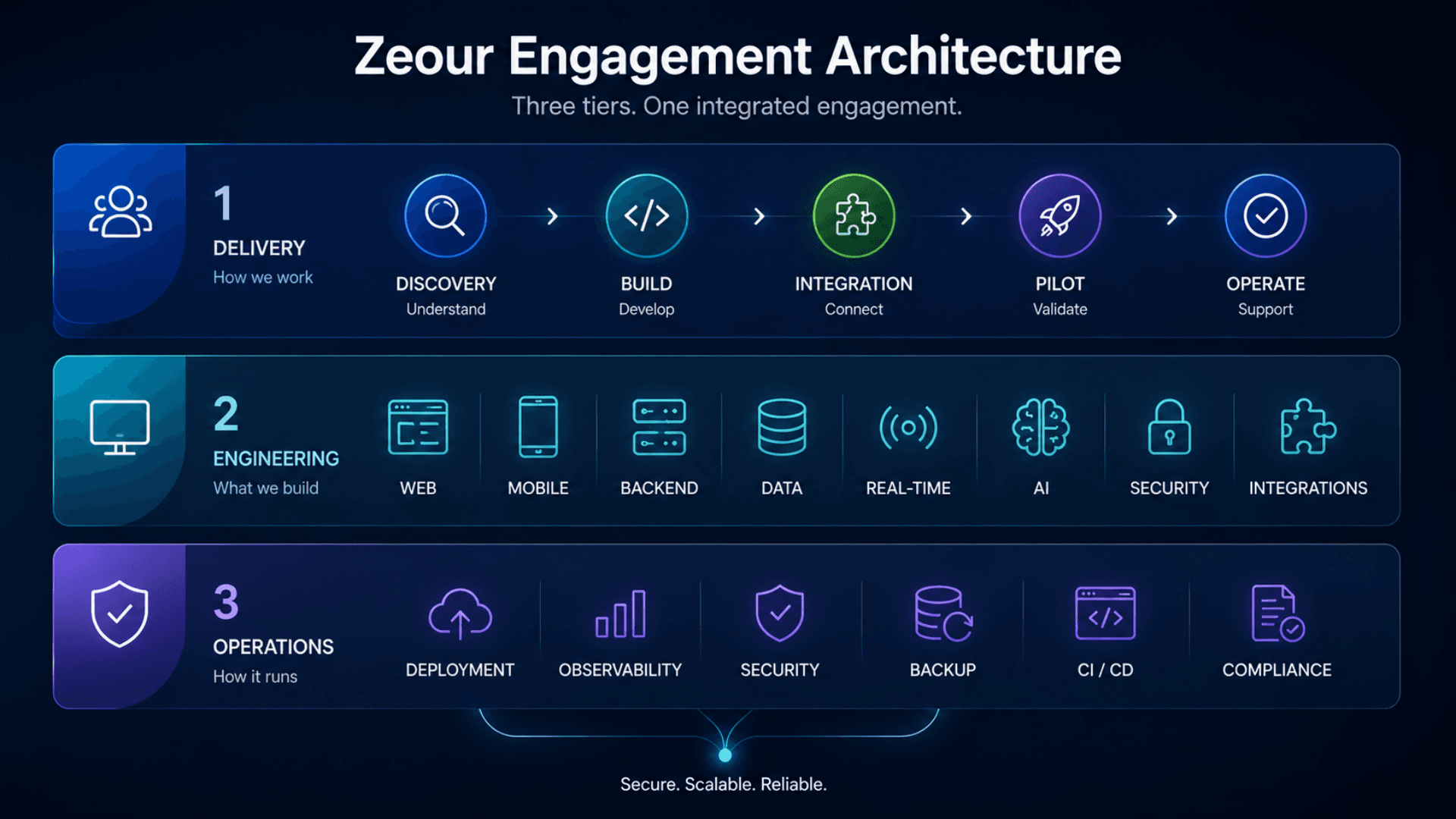
Tier 1 — Delivery Architecture
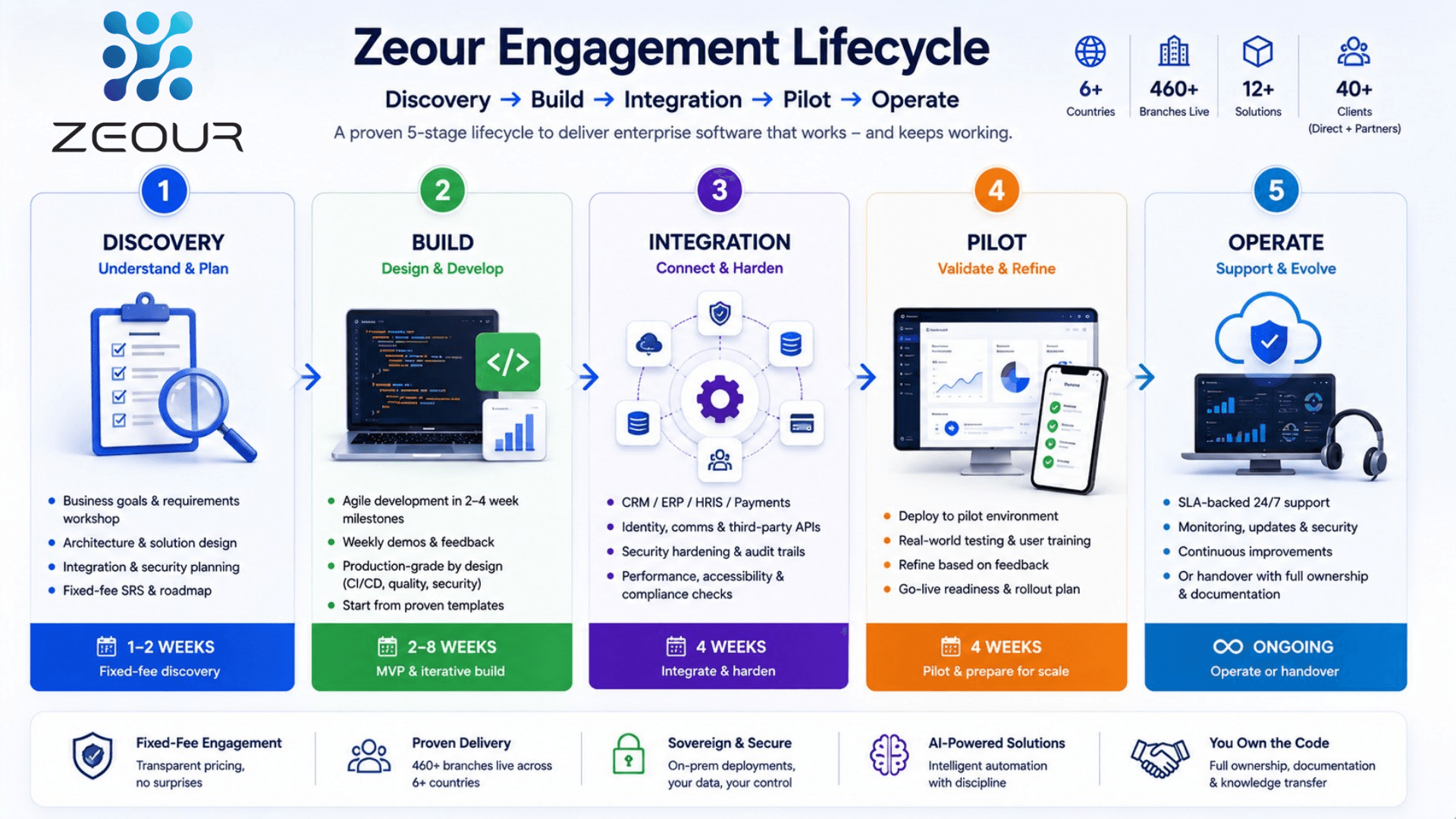
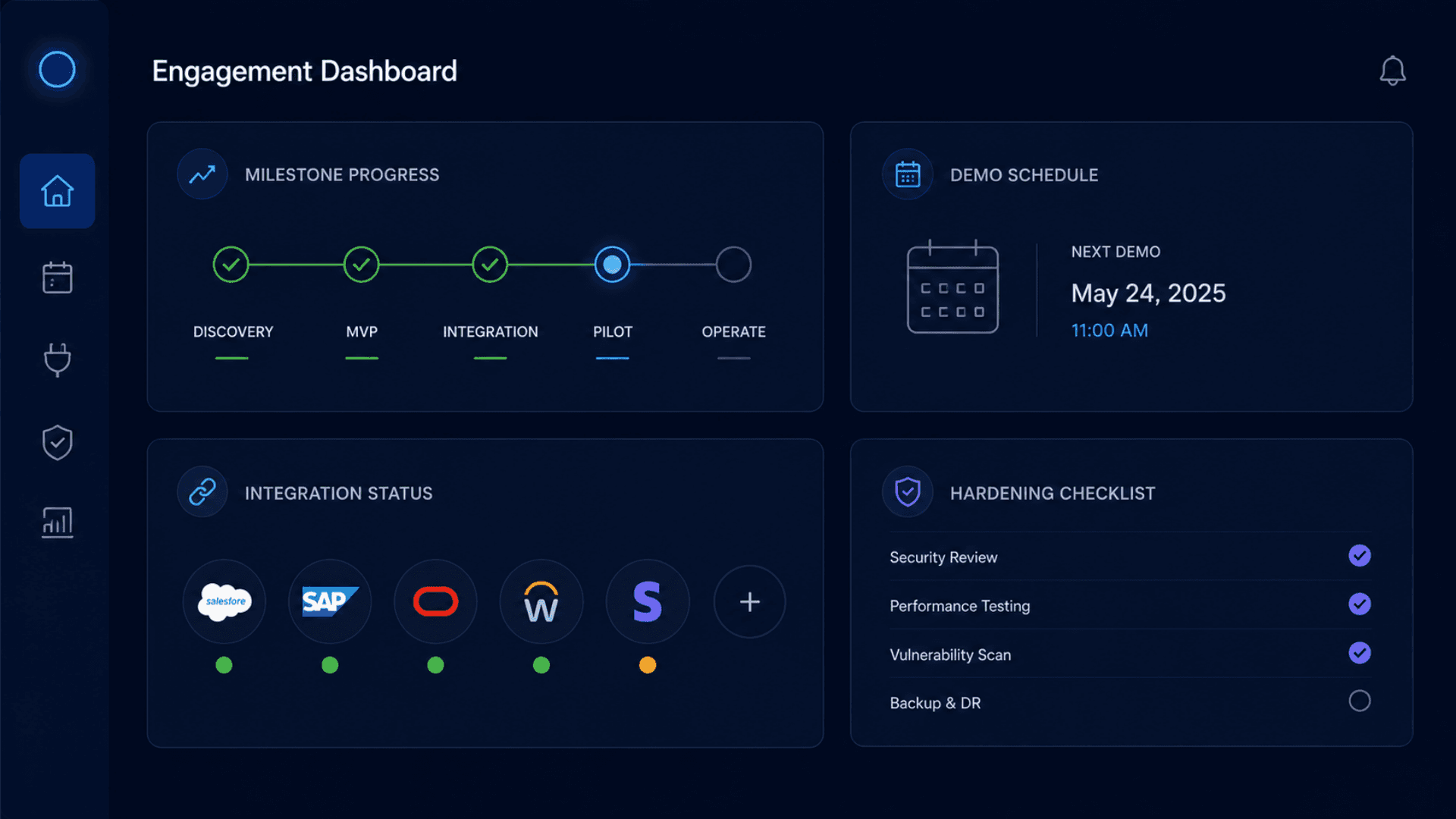
Discovery · Build · Integration · Pilot · Operate
- Discovery: 2 weeks fixed-fee → buildable SRS + architecture + fixed-fee build estimate
- Build: 2-4 week milestones with weekly demos and fixed milestone prices
- Integration: 4 weeks for CRM / ERP / HRIS / payment / identity / comms / vertical integrations
- Pilot: 4 weeks of supervised production rollout + iteration on friction points
- Operate: monthly retainer SLA-backed support OR full hand-over to in-house team
- Either side can walk at any milestone boundary with no further commitment
- Documentation, runbooks, and training delivered as part of every milestone
Tier 2 — Engineering Capability
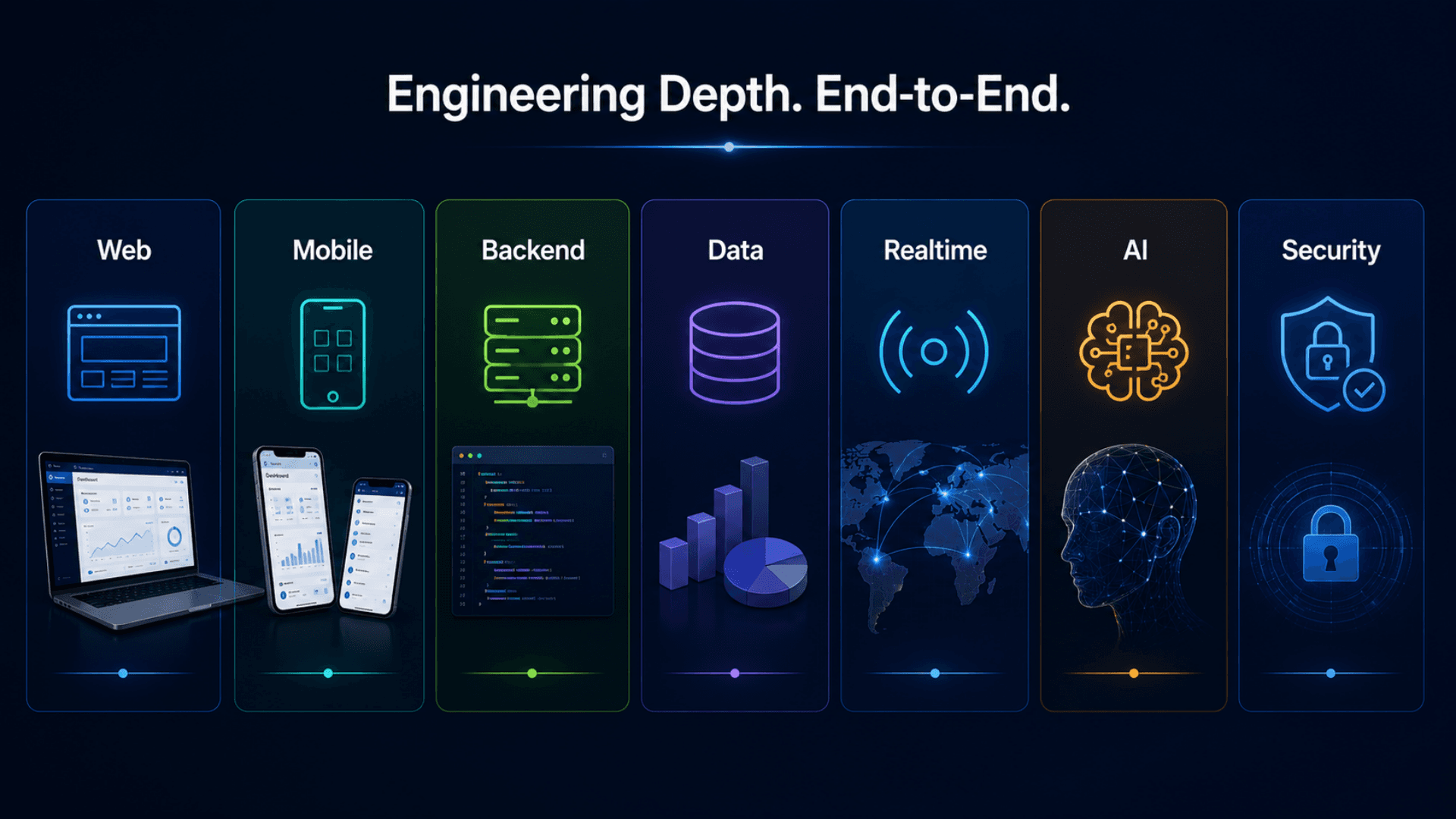
Stack-pragmatic · Web · Mobile · Backend · Data · Realtime · AI · Security
- Stack-pragmatic: the language and framework are chosen per engagement and for the inheriting team — fluent across JavaScript / TypeScript, Java / Spring, .NET, Python / Django, Go, PHP / Laravel and more
- Web: modern component-driven applications; technologies we reach for often include React, TypeScript and Tailwind
- Mobile: native Android and iOS, plus cross-platform options where they fit the team that will own the app
- Backend: REST + GraphQL + gRPC + OpenAPI on the runtime best suited to the estate
- Data: relational and document databases — PostgreSQL / MySQL / SQL Server / Redis / MongoDB — right tool for the job
- Realtime: event fan-out and WebRTC peer-to-peer video / audio
- AI: disciplined LLM integration with mode-based prompts; cloud or on-premises models
- Security: RBAC matrices + audit log + modern password hashing + signed offline licenses + mTLS where appropriate
Tier 3 — Operations Architecture
Deployment · Observability · Backup · Security · Compliance
- Deployment: hardened reverse proxy + managed services for on-prem; containers / orchestration for cloud; infrastructure-as-code throughout
- CI/CD: GitHub Actions / GitLab CI build → migrate → health-check → deploy pipelines; blue-green + canary
- Observability: traces + metrics + dashboards + error capture, per operator role
- Backup: scheduled relational-database snapshots to NAS / object storage with documented restore drills
- Secrets: a managed secrets store or KMS; never plaintext alongside the code; rotation as a documented playbook
- Compliance: GDPR / PDPL / HIPAA-style audit trails + right-to-be-forgotten workflows baked in
- Sovereign on-prem default for healthcare / government / banking / regional operators
Operational & Resilience Pipeline
Real-time- Production-grade from day one — CI/CD, observability, security, accessibility, performance baked in (not retrofitted)
- Real-time mini-services degrade gracefully if offline (no single point of failure)
- On-prem deployments validated by a signed offline license gate
- Scheduled relational-database backups; RTO in minutes; RPO matches backup cadence; restore drills documented
- Audit log captures every protected action — compliance-ready for healthcare / government / banking
- SLA-backed 24/7 support post go-live; or full hand-over to in-house team
- Pen-test pass before every major release; dependency-vulnerability scanning in CI
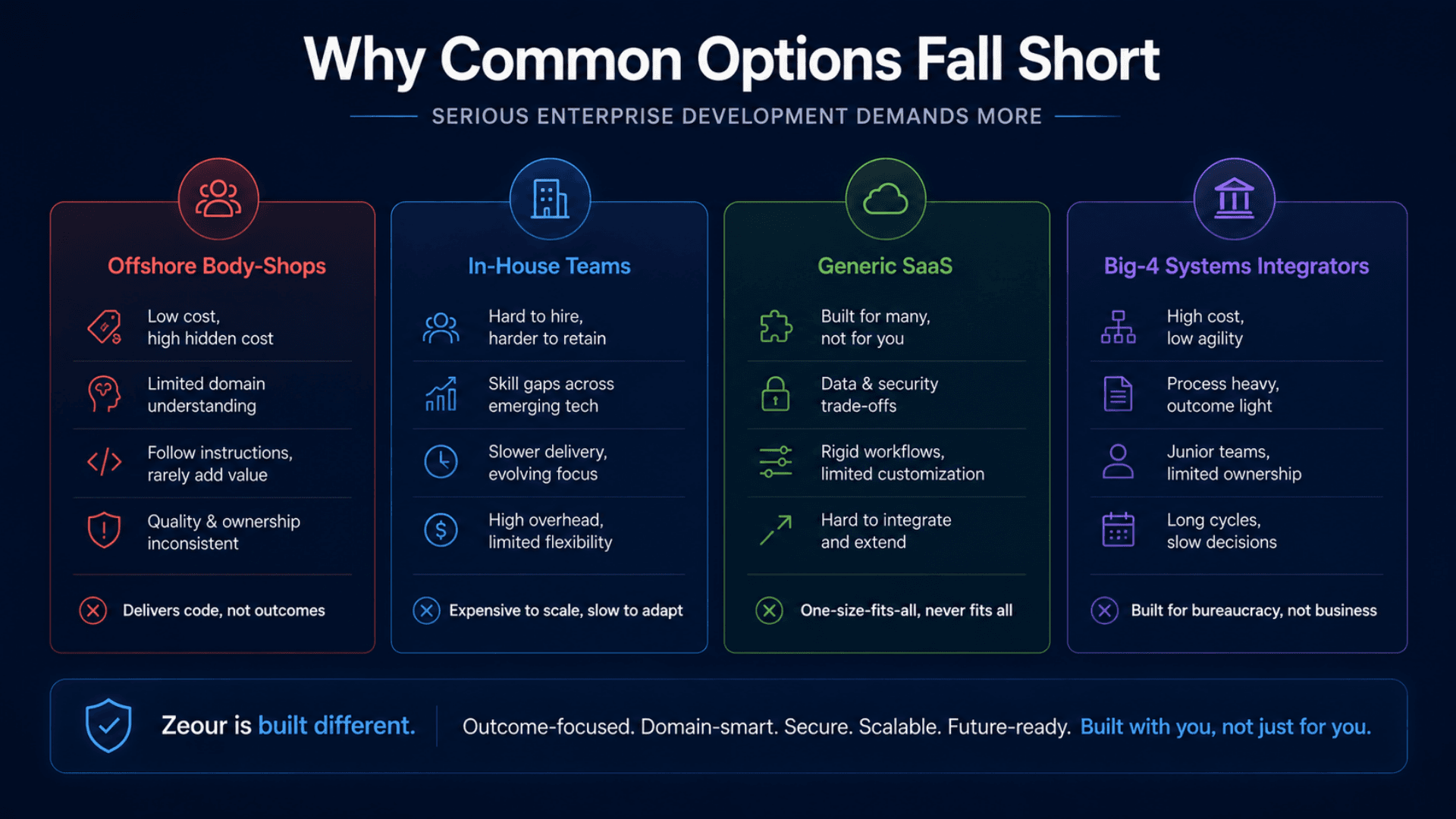
Zeour Enterprise Development vs Offshore Agencies vs In-House vs Systems Integrators
Most enterprise software work today gets done in one of four ways. Each has trade-offs; we sit deliberately at the intersection of the things organizations actually need.
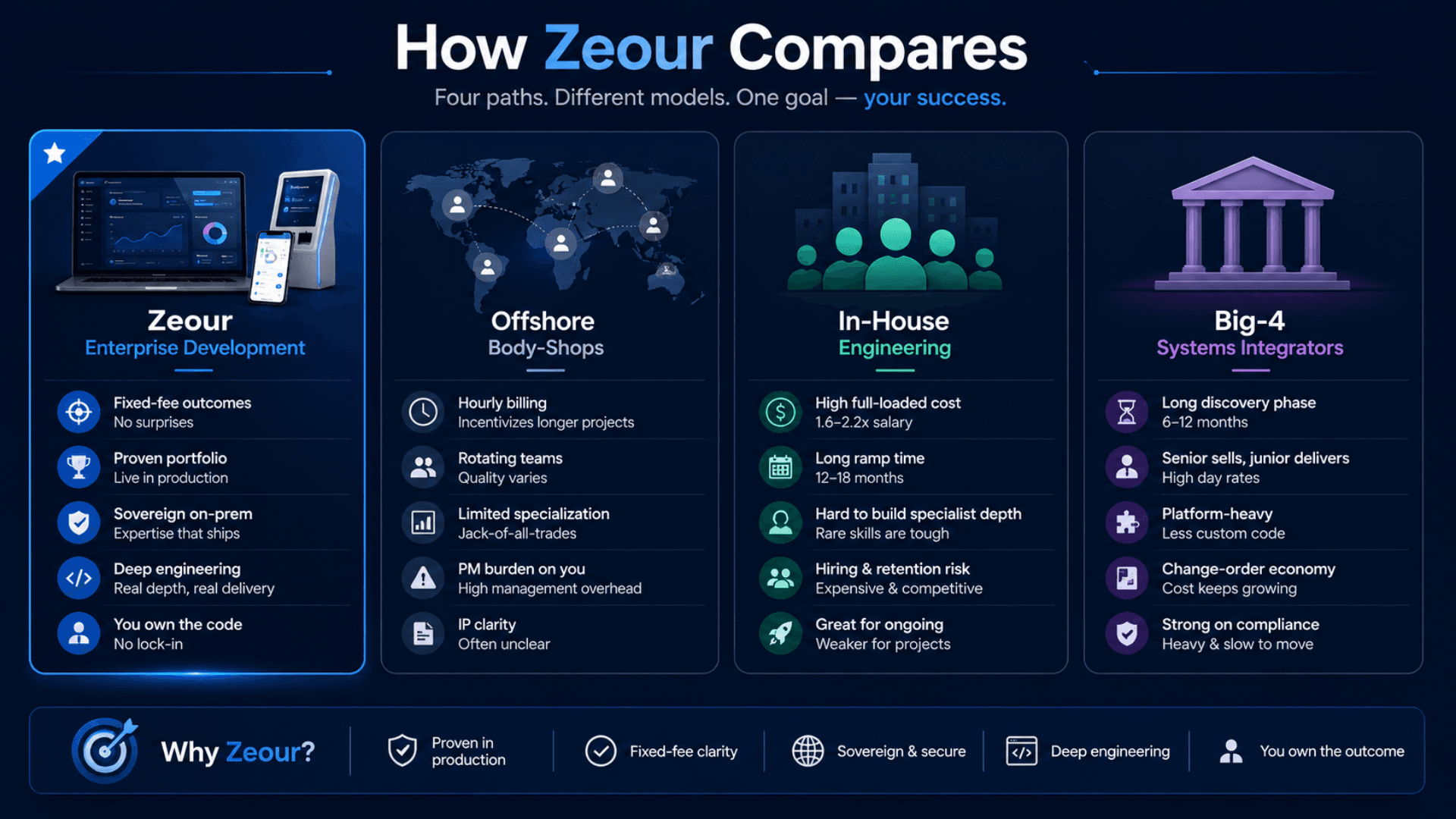
Zeour Enterprise Development
Best for: Operators who need engineering depth (multilingual EMRs, RFID kiosk fleets, real-time platforms, on-prem license gates, hardware-coupled software, AI with discipline, multi-integration programs), fixed-fee outcomes, and a team that genuinely ships in production today.
- Fixed-fee discovery → buildable SRS → fixed-fee milestone build
- Public portfolio of production systems (every solution on this site is real)
- Flagship templates head-start your build by weeks-to-months
- Sovereign on-prem expertise (Smart Parking + MediCare + GLARUS portfolio)
- Multilingual / RTL Arabic as a first-class skill
- Hardware-coupled software competence (serial, GPIO, Android kiosks, WebRTC)
- AI integration with discipline (mode-based prompts, evidence-based)
- Operator owns repo + license + deploy keys at the end (no lock-in)
- SLA-backed operate OR 90-day clean hand-over
Offshore Body-Shop Agencies
Best for: Operators willing to manage a large remote team day-to-day and absorb project-management risk in exchange for low hourly rates.
- Per-developer-hour billing — structurally incentivized to extend
- Rotating teams — pay for fresh-hire learning curve each project
- Limited specialty depth (multilingual / RTL / hardware / sovereign on-prem rare)
- Project-management risk on the operator
- Often no production portfolio you can verify
- IP arrangements often unclear at the end of the engagement
In-House Engineering Team
Best for: Operators large enough to sustain a 6-15 person product-engineering org with deep specialization.
- Full-loaded cost: 1.6-2.2× salary (benefits, equipment, software, management, training)
- 12-18 months from first hire to first production system
- Specialization depth (Android kiosks, WebRTC, HL7) often impractical to build in-house
- Hiring + retention in 2026's labor market: hard and expensive
- Best for ongoing product evolution; weak for project-shaped delivery
- Can pair well with a specialist external team for jumps in capability
Systems Integrators (Big-4 Consultancies)
Best for: Operators with very large budgets and a multi-year time horizon who need broad transformation programs across many functions.
- 6-12 month architecture / discovery phase before code is written
- Senior partners sell; junior associates deliver
- Heavy reliance on third-party platforms (Salesforce, ServiceNow, Workday) — light on custom code
- High day rates ($1,800-$3,500/day for senior associates)
- Strong on regulated-industry compliance (banking, government)
- Vendor lock-in via proprietary deliverables and change-order economics
Enterprise Development Engagement — Lifecycle Checklist
A practical 5-phase engagement playbook. Use it as the operator-side checklist before, during, and after the engagement.
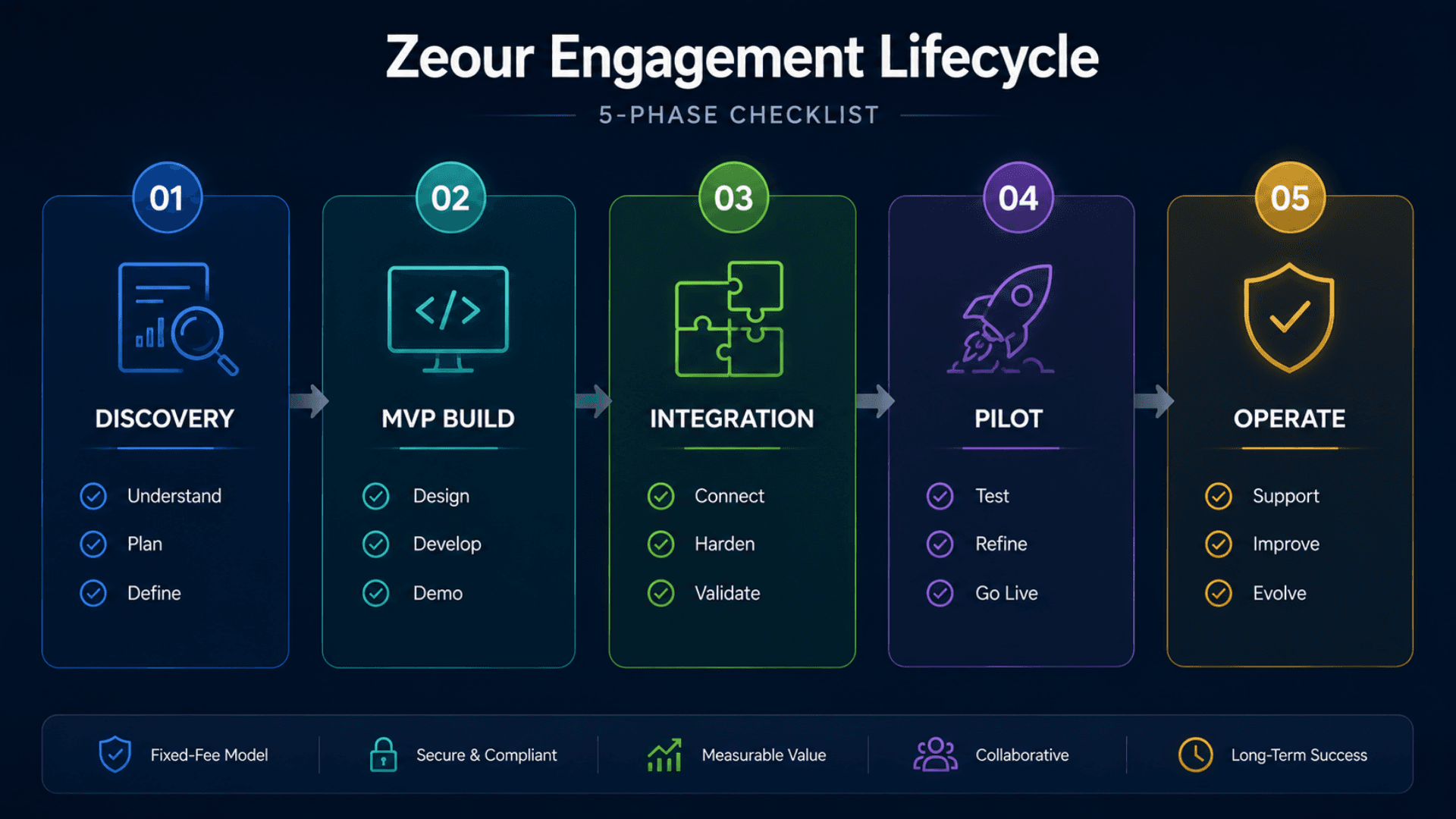
- 01
1) Discovery + Architecture (Week 1-2)
ChecklistIdentify the business problem in 1-2 sentences (not a technology wish-list)Map constraints: regulatory, sovereignty, budget, timeline, integration boundariesWorkshop with stakeholders (executive sponsor, operations lead, security, IT, end users)Produce the SRS + architecture diagram + buildable fixed-fee estimateDecide on-prem vs cloud vs hybrid; pick reference flagship template if applicableDecision gate: proceed to build, or part ways with no further commitment - 02
2) MVP Build (Week 3-8)
ChecklistStand up the engagement: shared backlog, weekly demo cadence, milestone payment planSet up CI/CD + observability + production secret management from day one (not retrofitted)Build to weekly demos; surface friction points before they compoundOperator-side: assign a product-owner counterpart with decision authorityOperator-side: line up the data + access for integrations in parallel (avoid the integration cliff at week 9)Decision gate: continue to integration + hardening, or pause at MVP for in-house ownership - 03
3) Integration + Hardening (Week 9-12)
ChecklistWire up CRM / ERP / HRIS / payment / identity / comms / vertical integrationsSecurity hardening: RBAC matrix, audit log, OWASP pass, dependency scan, secret managementAccessibility audit (WCAG 2.1 AA) + performance audit (Lighthouse 95+)Documentation: runbooks, deployment guides, role-based training materialsPen-test pass + remediation as a release-gate, not an afterthought - 04
4) Pilot + Go-Live (Week 13-16)
ChecklistDeploy to a pilot site (on-prem or cloud) and sit-by with operator staff through the first weekIterate on friction points discovered in real use — not just from QATrain staff and admins; deliver runbooks + role-based training materialsStrangler-fig cutover from legacy systems (route progressively, not big-bang)Roll out to additional sites / departments / regions as success criteria are met - 05
5) Operate + Support (Ongoing)
ChecklistSLA-backed 24/7 support with monthly retainer; quarterly roadmap reviewsRolling feature additions, security patches, dependency upgrades, capacity planningOr: hand over the repo, the license file, the deploy keys, the docs, and the runbooks90-day exit window — take the keys and run the system yourself any timeKPIs: uptime, MTTR, security-incident count, user NPS, business outcome metrics
Enterprise Development Portfolio
Visual highlights of Zeour Enterprise Development — the engagement model, the engineering stack, the operations architecture, and the production portfolio that proves it.
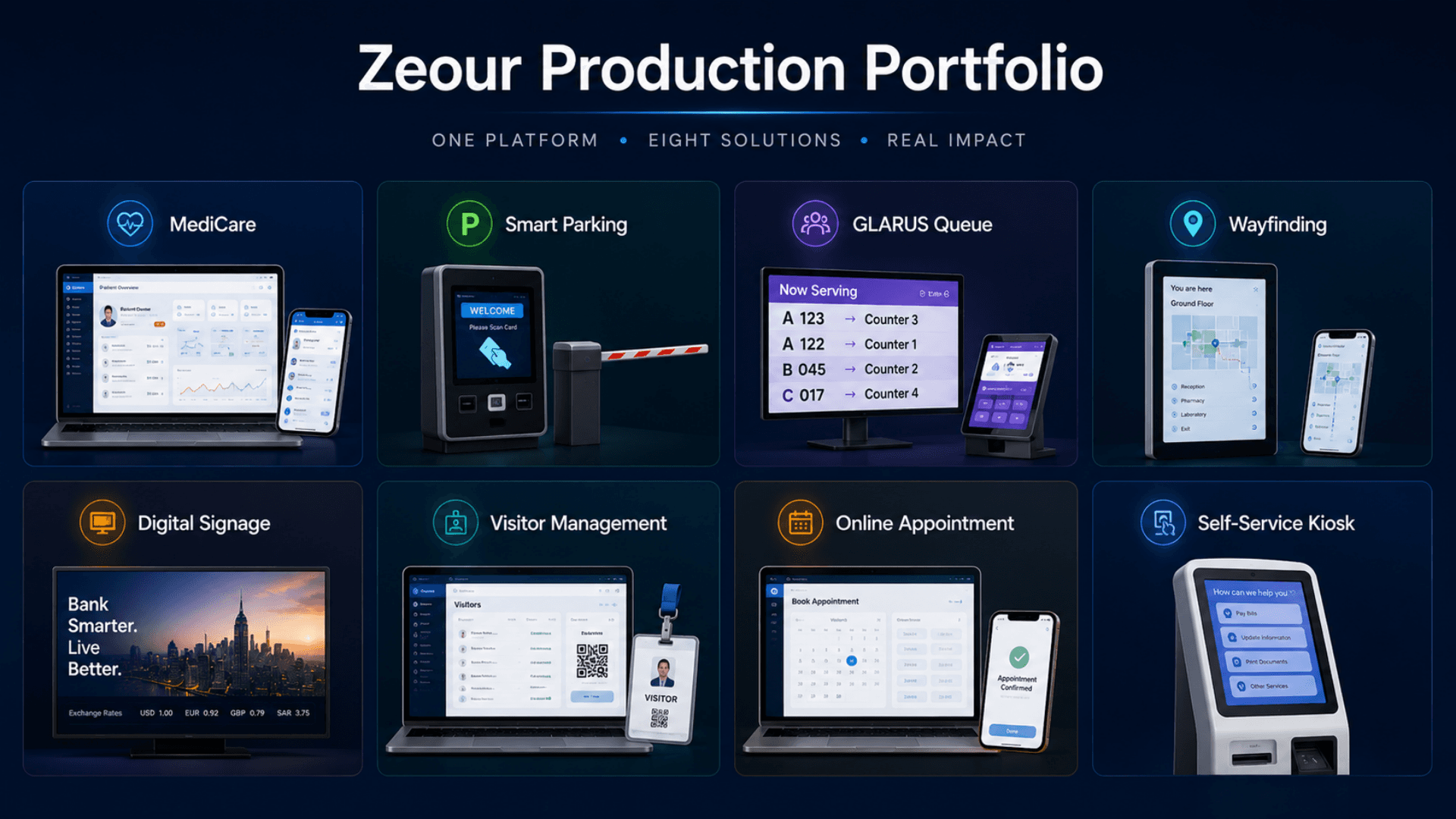
Why Traditional Software Delivery Fails
Hourly offshore agencies and the hidden cost of in-house hiring both work against you — here is why fixed-fee enterprise development is essential.
Offshore Body-Shop Agencies Optimize for Hours Billed
The traditional "offshore agency" model is structurally misaligned: the agency gets paid per developer-hour, so longer projects = more revenue. Quality is uneven, accountability dilutes across rotating teams, and you end up paying for the team's learning curve on every fresh hire.
Fixed-Fee Outcomes, Not Hours Billed
Every milestone is a fixed price for a specific deliverable. Change-orders are explicit and priced before being absorbed. We have no incentive to drag a project out; we have every incentive to ship the right thing fast.
In-House Engineering Carries Hidden Cost
Hiring, retention, training, benefits, equipment, software licenses, management overhead, sick days, holidays — full-loaded cost of a senior engineer is 1.6-2.2× the salary. For a small or mid-size operator, building specialist depth (Android kiosks, WebRTC, HL7 integrations) in-house often doesn't pay back.
Engineer Once, Reuse Many Times
Our flagship templates (MediCare, Smart Parking, GLARUS, Wayfinding, Digital Signage, Visitor Management) head-start your build by weeks to months. You pay for customization, not for foundational engineering we've already done.
Generic SaaS Doesn't Fit Regulated or Localized Operators
Off-the-shelf SaaS works fine for English-speaking operators with no data residency concerns. The moment you add a non-default locale, configurable currency, country-specific phone validation, GDPR / PDPL compliance, on-premise requirements, or a regulator-specific audit-trail format, generic SaaS collapses.
Multilingual + Sovereign + Compliance-Aware by Default
RTL Arabic UI, configurable currency (GBP / EUR / USD / SAR / AED and any other), country-specific phone validation, on-prem deployment, signed offline license gates, audit-trail-as-data-model — all first-class skills. We do this every day; it's not "a feature."
Systems Integrators Solve the Wrong Problem
Traditional systems integrators sell you a months-long architecture phase before any code is written. By the time the architecture document is signed off, the requirements have shifted and the SI is well-positioned to bill for the change orders.
Build First, Architect Continuously
We don't do 6-month architecture phases. The 2-week discovery produces a buildable SRS + architecture; the architecture evolves through weekly demos and per-milestone reviews. You see working software in week 3, not month 6.
"Innovation Labs" Don't Ship to Production
Many vendors offer beautiful innovation-lab prototypes that never make the leap to production. Without operational discipline (CI/CD, observability, security, accessibility, performance, runbooks), a beautiful demo becomes an expensive shelfware investment.
Production-Grade From Day One
CI/CD, observability (logs + traces + metrics + error capture), security (RBAC + audit log + signed licenses + mTLS), accessibility (WCAG 2.1 AA), performance (Lighthouse 95+) are baked in from week 1, not retrofitted at the end.
Sovereignty / On-Premise Expertise Is Genuinely Rare
Most modern engineers have only deployed to AWS / GCP / Azure. Sovereign on-prem deployments — single-tenant Linux server, signed offline license gates, scheduled database backups, watchdog-fed kiosks — require a specific muscle that most agencies have never built.
Sovereign On-Prem Is a Specialty, Not a Side Hustle
We genuinely ship single-tenant on-prem systems in production today — Smart Parking, MediCare, and most of the GLARUS portfolio. The signed-offline-license, watchdog-fed-kiosk, scheduled-backup pattern is our default, not our exception.
Enterprise Development Features
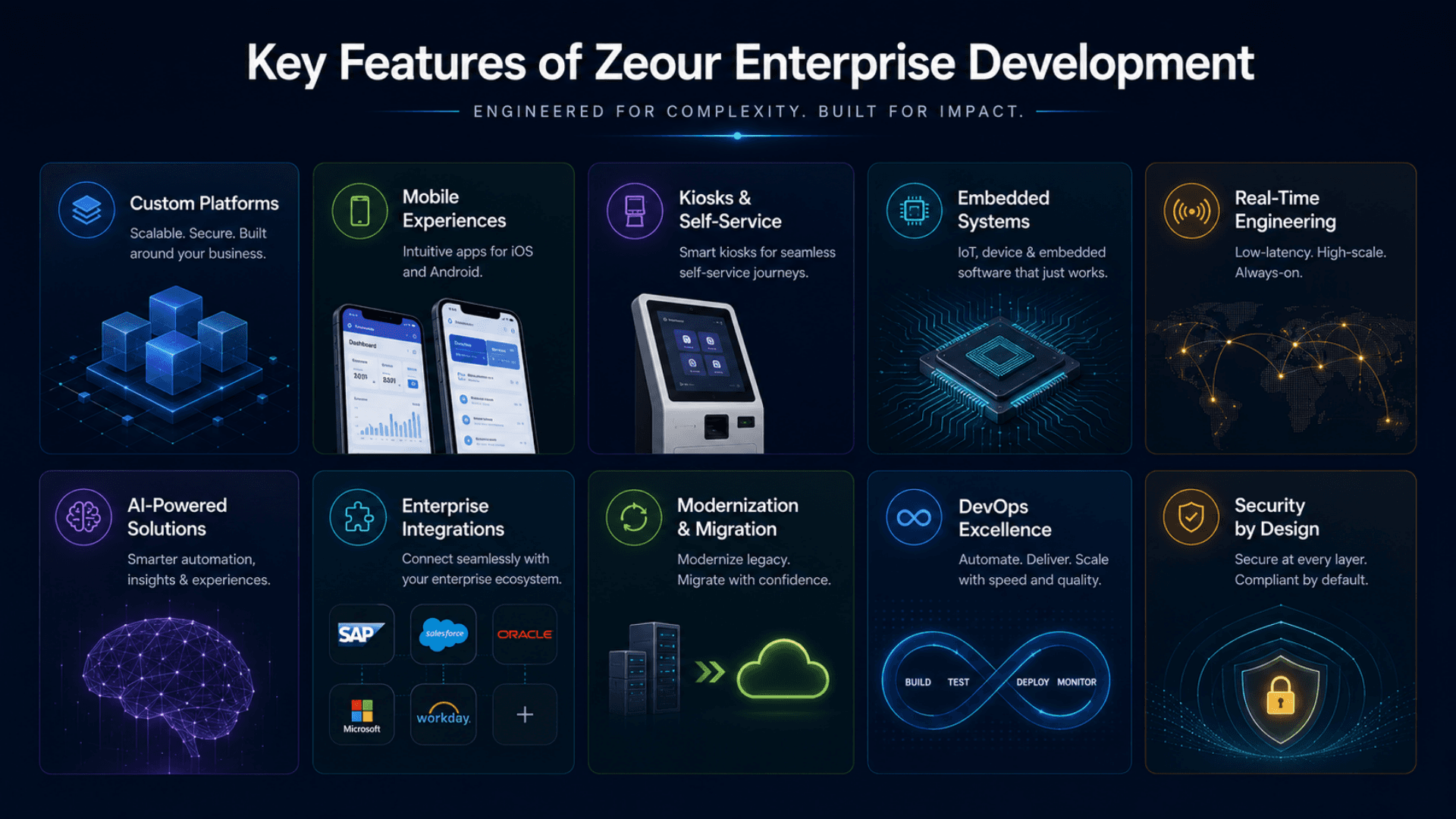
Stack-Pragmatic Engineering — we choose the right stack per engagement and per the team that will inherit the codebase: fluent across JavaScript / TypeScript, Java / Spring, .NET, Python / Django, Go, PHP / Laravel and more
Custom Enterprise Web Platforms — modern component-driven web apps; technologies we reach for often include Next.js, React, TypeScript and Tailwind, with other ecosystems applied where they fit the estate better
Native + Cross-Platform Mobile Apps — native Android and iOS plus cross-platform options; we recommend the toolkit based on the team that will own the app long-term
Kiosk & Tablet Software — locked-down, watchdog-fed kiosk and tablet builds for self-service, parking, queueing and visitor workflows
Embedded / Hardware-Coupled Systems — serial-controlled card readers, GPIO-driven peripherals, vendor hardware SDK integration
Real-Time Services — event fan-out, live dashboards, WebRTC peer-to-peer video / audio, signaling and in-call chat
AI Integrations — disciplined LLM integration, vector search, RAG pipelines and in-context summarization; cloud or on-premises models
System Integrations — CRM (Salesforce, HubSpot, Zoho), ERP (SAP, Oracle, Microsoft Dynamics, Odoo), HRIS, BI (Power BI, Tableau, Metabase)
Payment Gateway Integrations — Stripe, Adyen, and regional payment processors and aggregators worldwide
Identity & Auth Integrations — SAML, OIDC, OAuth2, SCIM, Active Directory, LDAP, Okta, Azure AD, Google Workspace
Communication Integrations — Twilio, WhatsApp Business, SMS gateways, email providers (SendGrid, Mailgun, SES)
Vertical-Specific Integrations — HL7 / FHIR for healthcare, ICD-10 catalogs, lab analyzers, banking core systems
Database Engineering — relational and document databases (MySQL, PostgreSQL, SQL Server, Redis, MongoDB); migrations, indexing, replication
API Design — REST, GraphQL, gRPC, OpenAPI specs, versioning strategy, SDK generation, partner-portal docs
Legacy Modernization — strangler-fig migrations from PHP / VB6 / Delphi / classic ASP to modern stacks
Cloud Migration & On-Prem Deployment — AWS, GCP, Azure, and sovereign on-prem Linux deployments
DevOps + CI/CD — GitHub Actions, GitLab CI, build → migrate → health-check pipelines, blue-green + canary
Security Engineering — RBAC matrices, audit logging, OWASP hardening, modern password hashing, signed offline licenses, mTLS
Multilingual Engineering — full RTL Arabic + LTR English baseline, extensible to any locale your buyer needs (French, Spanish, German, Portuguese, Italian, Dutch, Turkish, Urdu, Hindi and more)
Localization at the Engineering Layer — Intl.NumberFormat per locale, currency, phone format, date format
On-Premise Licensing Engineering — RSA-SHA256 license files, MAC-bound activation, offline validation
Observability — structured logging, OpenTelemetry, Prometheus + Grafana, Sentry, uptime monitors
Performance Engineering — Lighthouse 95+, sub-second TTFB, CDN strategy, image optimization, code-splitting
Accessibility (WCAG 2.1 AA) — keyboard navigation, screen-reader compatibility, focus management, color contrast
PDF + CSV Generation — jsPDF + autotable, invoices, prescriptions, audit reports, regulatory submissions
Realtime Dashboard Engineering — Recharts, D3, live data feeds, executive KPI views, drill-down analytics
Multi-Tenant + Single-Tenant Architectures — operator choice, not architecture default
Documentation, Runbooks & Training — operations playbooks, deployment guides, role-based training materials
24/7 Support & SLA-Backed Operations — incident response, rolling updates, capacity planning
Enterprise Development Components
Application Engineering, Integration and Delivery.
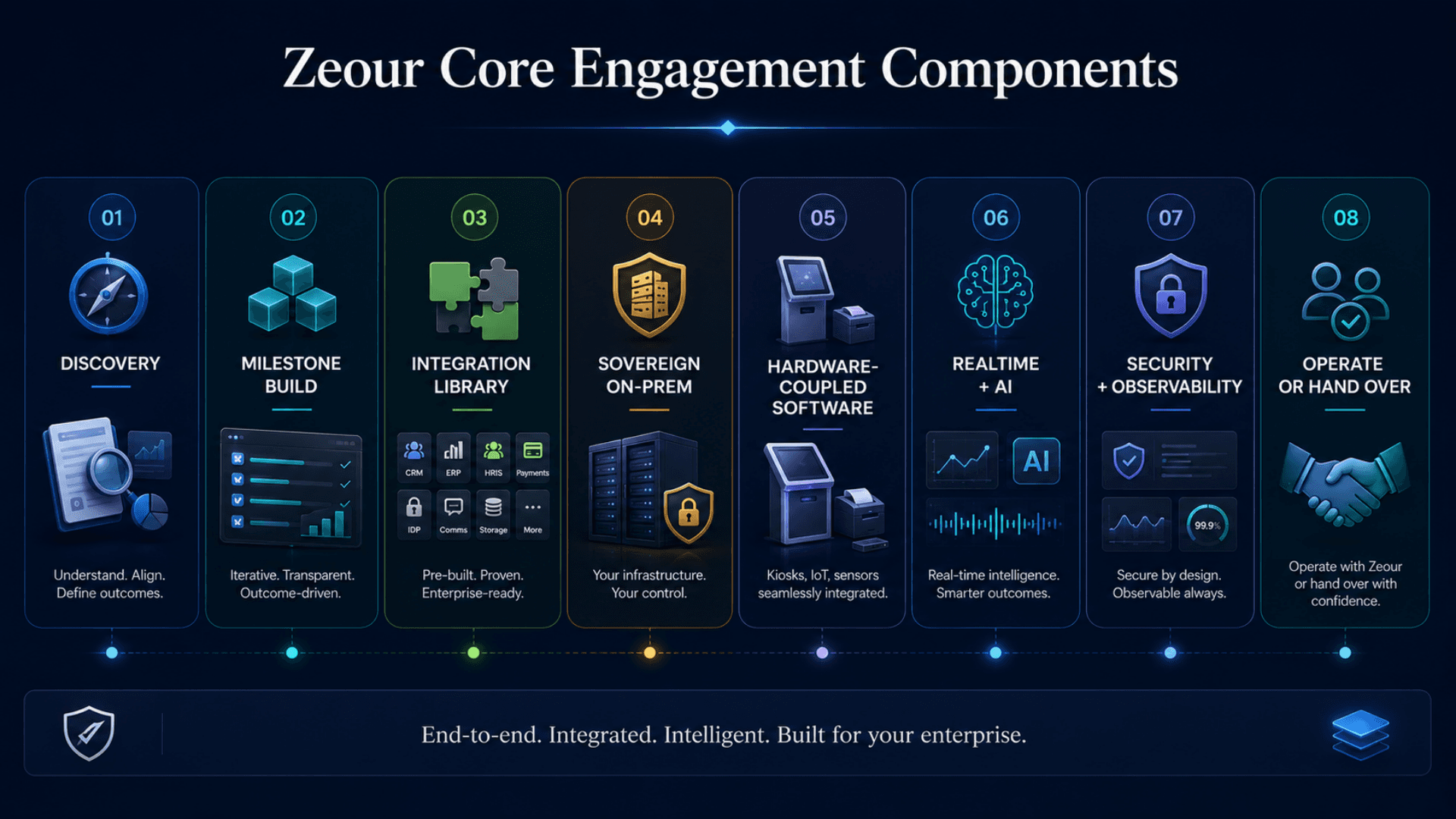
Fixed-Fee Discovery + Architecture
2 weeks. Workshop with your team to map the business problem, constraints, integration boundaries, security model, deployment topology.
- Deliverable: buildable SRS + architecture + fixed-fee build estimate
- Either side walks at the end of discovery with no further commitment
- Discovery fee credited against build cost if you proceed
- Discovery is the only thing that produces a real quote
Milestone-Based Build with Weekly Demos
2-4 week milestones, fixed price per milestone, change-orders explicit and priced.
- Weekly demo: working software, not slides
- Two-pizza team: 2-4 engineers, one lead, one designer when needed
- Start from flagship templates when applicable (head start of weeks-to-months)
- Production-grade from day one (CI/CD, observability, security, accessibility, performance baked in)
Integration Library + Playbook
Reference implementations for the most common integrations: CRM, ERP, HRIS, BI, payment gateways, identity, comms, vertical-specific.
- Salesforce / HubSpot / Zoho / SAP / Oracle / Dynamics / Odoo / Workday
- Stripe / Adyen / Mada / Knet / Qi Card / ZainCash / FastPay
- SAML / OIDC / OAuth2 / SCIM / AD / LDAP / Okta / Azure AD / Google Workspace
- Twilio / WhatsApp Business / SendGrid / Mailgun / SES
- HL7 / FHIR / ICD-10 / lab analyzer SDKs / banking core systems / POS
Sovereign On-Premise Engineering
Single-tenant Linux deployment with a hardened reverse proxy and a signed offline license gate. The pattern that ships Smart Parking and MediCare today.
- Hardened reverse proxy with security headers + compression + automatic TLS
- Managed application service with scheduled database backups
- Cryptographically signed license file with expiry checks
- License validates offline; failure mode = locked-down branded notice, not failed-open
Hardware-Coupled Software Specialty
Android kiosks, serial-controlled card readers, GPIO-driven barrier peripherals, vendor hardware SDK integration, hardware watchdogs.
- Locked-down single-purpose kiosk apps, landscape-locked, RTL-aware
- Dual hardware modes per kiosk (vendor gateway or native serial + GPIO)
- Hardware watchdog feeding via vendor SDK
- Hardware diagnostics screen accessible from the kiosk header
Real-Time & AI Disciplined Engineering
Real-time event fan-out, WebRTC video signaling, and disciplined LLM integration with mode-based prompts.
- Lightweight real-time mini-services for activity / telemedicine / notifications
- WebRTC for peer-to-peer video / audio with in-call chat
- Mode-based AI prompts with evidence-based constraints
- Context auto-assembly + audit logging for every AI interaction
Security, Observability & Compliance
RBAC matrices, append-only audit logging, RSA license gates, OWASP hardening, OpenTelemetry / Prometheus / Grafana / Sentry, GDPR / PDPL / HIPAA-style controls.
- RBAC per-role × per-module × {view, create, edit, delete}
- Audit log captures every protected action with user + entity + metadata
- Modern password hashing; configurable session TTL
- Pen-test pass as a release gate, not an afterthought
Operate or Hand Over — Operator's Choice
SLA-backed 24/7 support with 90-day exit window. Or hand over the repo, the license, the deploy keys, the docs, and the runbooks to your in-house team.
- Monthly retainer scaled to system criticality + SLA tier
- Operator owns the repository, the license file, the deploy keys, the docs
- No perpetual contract; the goal is mutual value, not lock-in
- 90-day exit window: take the keys and run the system yourself any time
Workflow Fit and Software Ownership
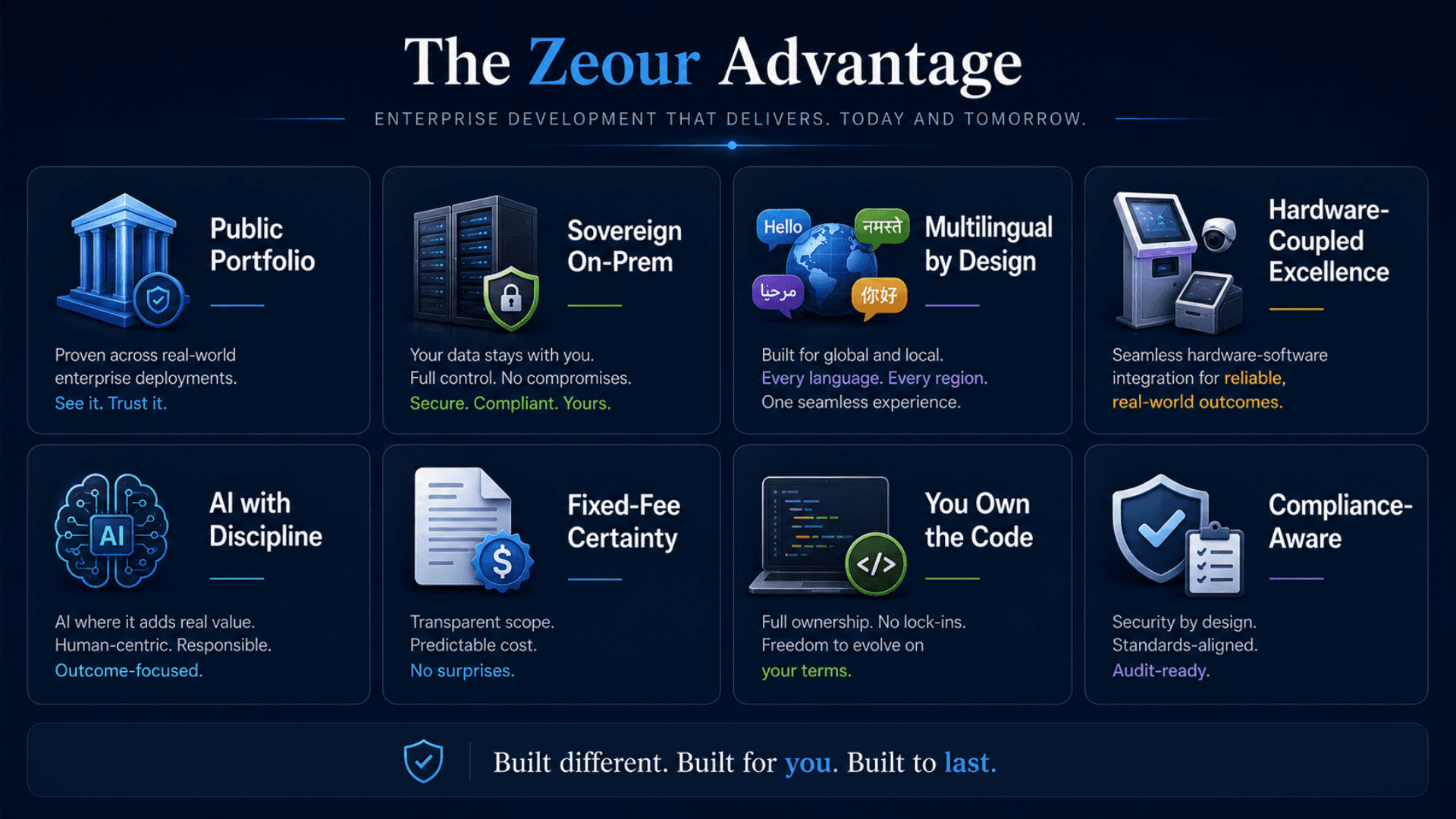
A team with a public portfolio — every Zeour product on this site is real, deployed, and in production
Sovereign on-premise expertise — we genuinely run the offline-validated license gate, single-tenant playbook
Multilingual engineering as a first-class skill — RTL Arabic + LTR English + extensible localization
Hardware-coupled software competence — serial card readers, GPIO peripherals, Android kiosks, WebRTC are not "research"; they ship
AI integration without the buzzword tax — mode-based prompts, evidence-based constraints, cloud or on-prem models
Fixed-fee discovery + transparent build estimates — no surprise change-orders mid-engagement
Code you can own — every engagement ends with the operator owning the repo, the license, and the deploy keys
Compliance-aware engineering — GDPR, PDPL, HIPAA-style audit trails, right-to-be-forgotten workflows built in
Single-week MVPs from a proven template — start from MediCare / Smart Parking / GLARUS, not from scratch
Lifetime cost of ownership transparency — open-source-leaning stack, no per-seat SaaS taxes for your users
From Discovery to Software Handover
Review how requirements become an implementation scope, a tested application and an operated system.
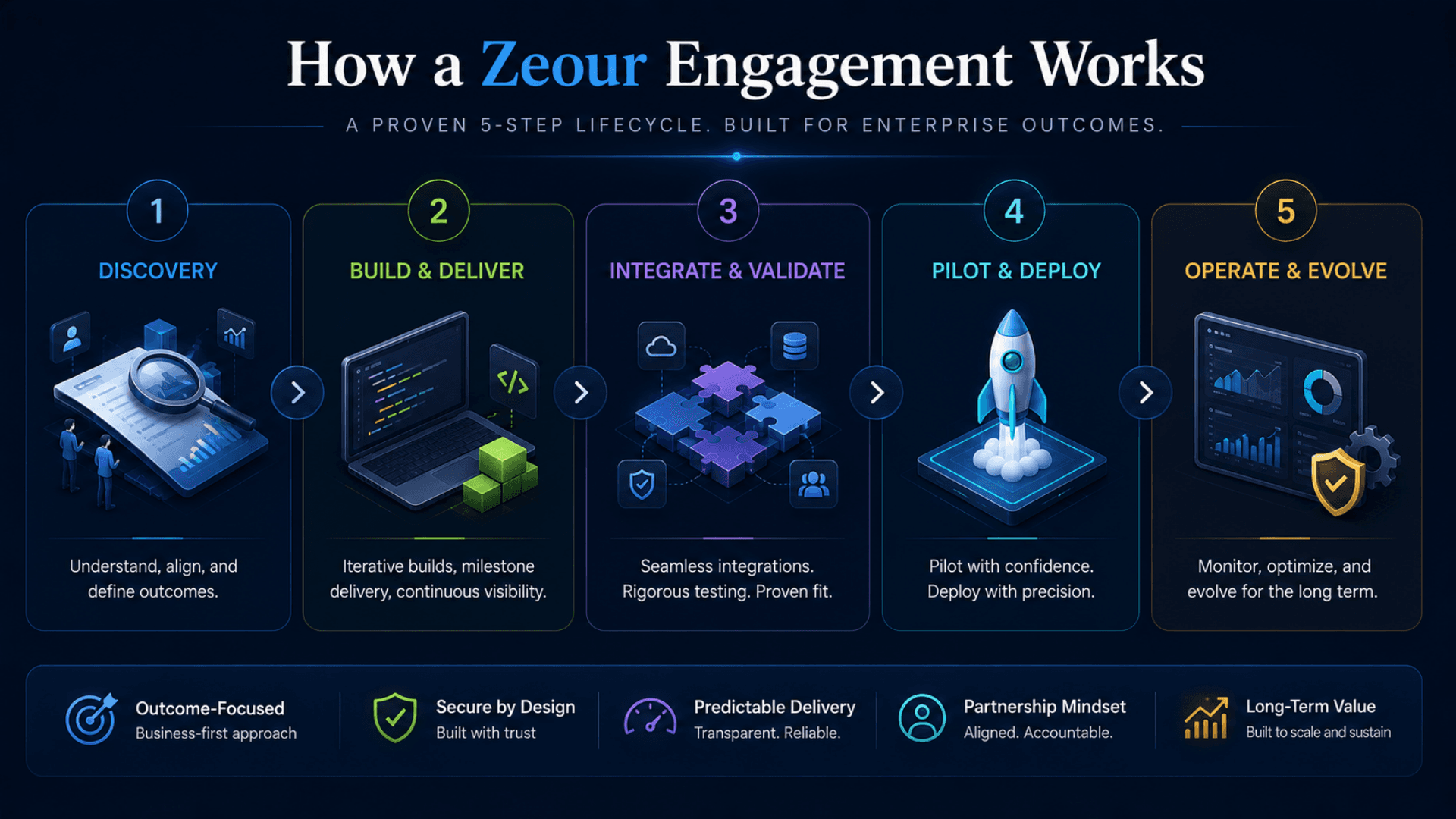
Discovery + Architecture (Week 1-2)
Workshop with your team to understand the business problem, constraints (regulatory, sovereignty, budget, timeline), users, success metrics. We map the system architecture, integration boundaries, data model, security model, deployment topology, and produce a fixed-fee build estimate with milestones. Deliverable: an SRS (software requirements spec) + architecture diagram + fixed-fee proposal. Either side can walk away at this point — no further commitment.
MVP Build (Week 3-8)
A two-pizza team (2-4 engineers, one lead, one designer when needed) builds the MVP. We start from one of our flagship templates (MediCare / Smart Parking / GLARUS / Wayfinding / Digital Signage / Visitor Management) when applicable — head start of weeks-to-months — and customize from there. Weekly demos. Production-grade from day one (CI/CD, observability, security baked in, not retrofitted).
Integration + Hardening (Week 9-12)
Connect to your CRM / ERP / HRIS / payment gateways / national health systems / lab analyzers / card readers / hardware peripherals / etc. Security hardening (RBAC, audit logging, modern password hashing, signed offline licenses, mTLS where appropriate). Accessibility audit (WCAG 2.1 AA). Performance audit (Lighthouse 95+, sub-second TTFB). Documentation: runbooks, deployment guides, role-based training. Pen-test pass before go-live.
Pilot + Go-Live (Week 13-16)
Deploy to a pilot site (on-prem or cloud, your call). Sit-by with the operator team through the first week. Iterate on friction points discovered in real use. Train staff and admins. Roll out to additional sites / departments / regions as success criteria are met. Cut over from legacy systems via a strangler-fig plan, not a big-bang switch.
Operate + Support (Ongoing)
SLA-backed 24/7 support, incident response, monthly capacity reviews, quarterly roadmap reviews. Rolling feature additions, security patches, dependency upgrades. Or we hand over the repo, the license, and the deploy keys to your in-house team and you operate yourself. Your choice — we don't build dependence into the engagement.
Enterprise Development Use Cases by Industry
Explore the service environments relevant to enterprise dev.

Open the deep dive by vertical
Enterprise Software Development Services FAQs
Get answers to the most common questions about our enterprise dev.
Do you take on small, focused development projects — or only large enterprise builds?
What does Zeour Enterprise Development actually do?
What tech stack do you use?
Do you build cloud, on-premise, or both?
How do integrations work?
Can you modernize our legacy system without a rewrite?
How does your engagement model work?
Do you offer time-and-materials or staff augmentation?
What about security and compliance?
Are you multilingual / Arabic-capable?
Do you do AI integrations?
Do you build kiosks and hardware-coupled software?
How long does a typical engagement take?
What does it cost?
Where do you operate?
Will we own the code at the end?
What if the engagement is too small for you?
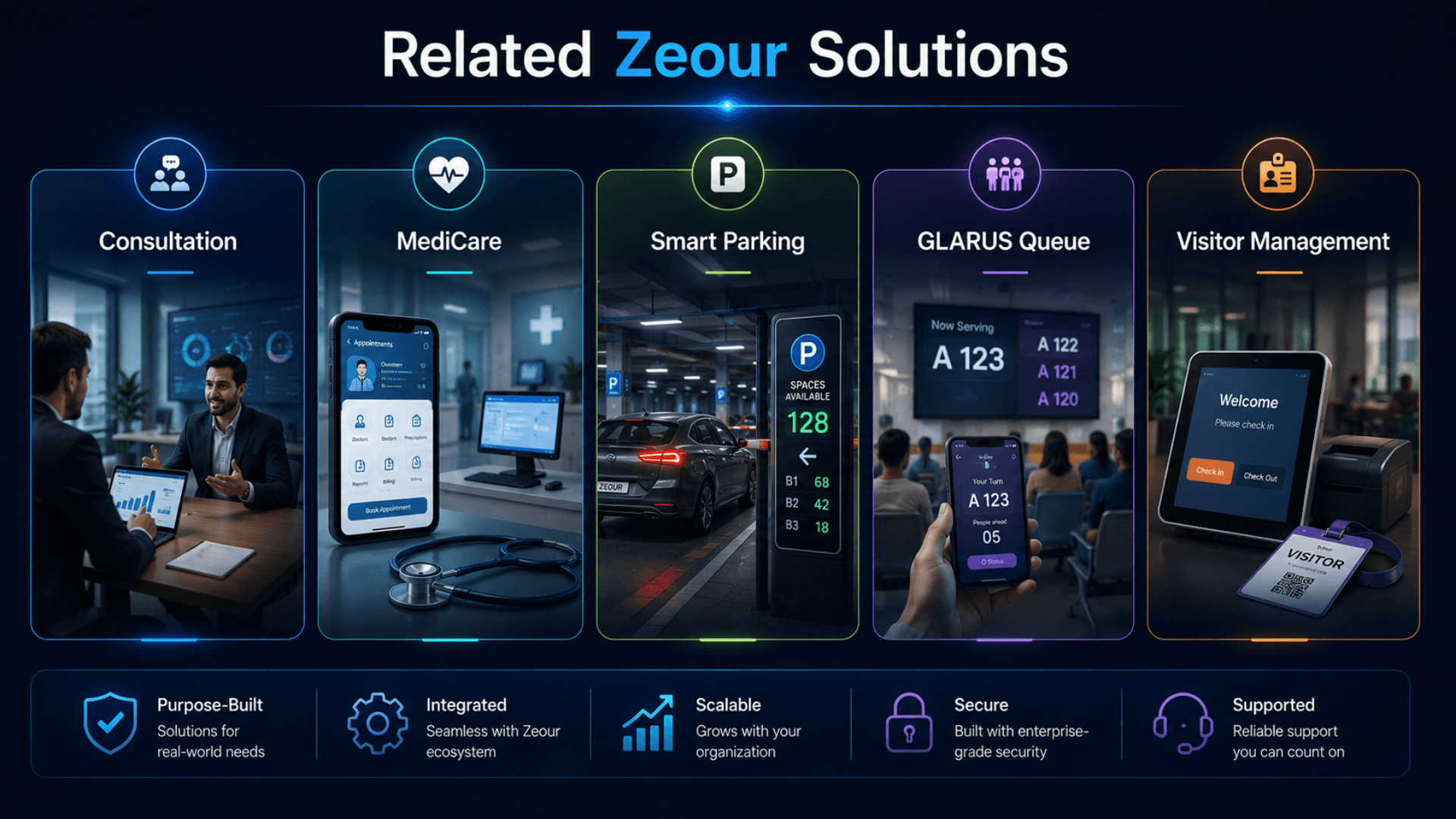
Explore Related Solutions
Review the advisory service and domain applications relevant to your development brief.
Ready to Transform Your Operations with Enterprise Development?
Discuss your workflows, deployment requirements and integration scope with the Zeour team.
Enterprise Dev — concepts you'll meet
Definitions for the operational terms that appear across this page. Tap any chip to read the long-form entry plus its cross-links.