
Education — Universities, K-12 & Training Centres
Cut campus reception time to under 90 seconds, give visitors and prospective students multi-floor wayfinding on kiosks and mobile, and process fee payments at unmanned kiosks. Engineered multilingual — extensible to any locale per engagement. GDPR / PDPL aligned; deployed at UK private institutions, EU universities and GCC campuses.
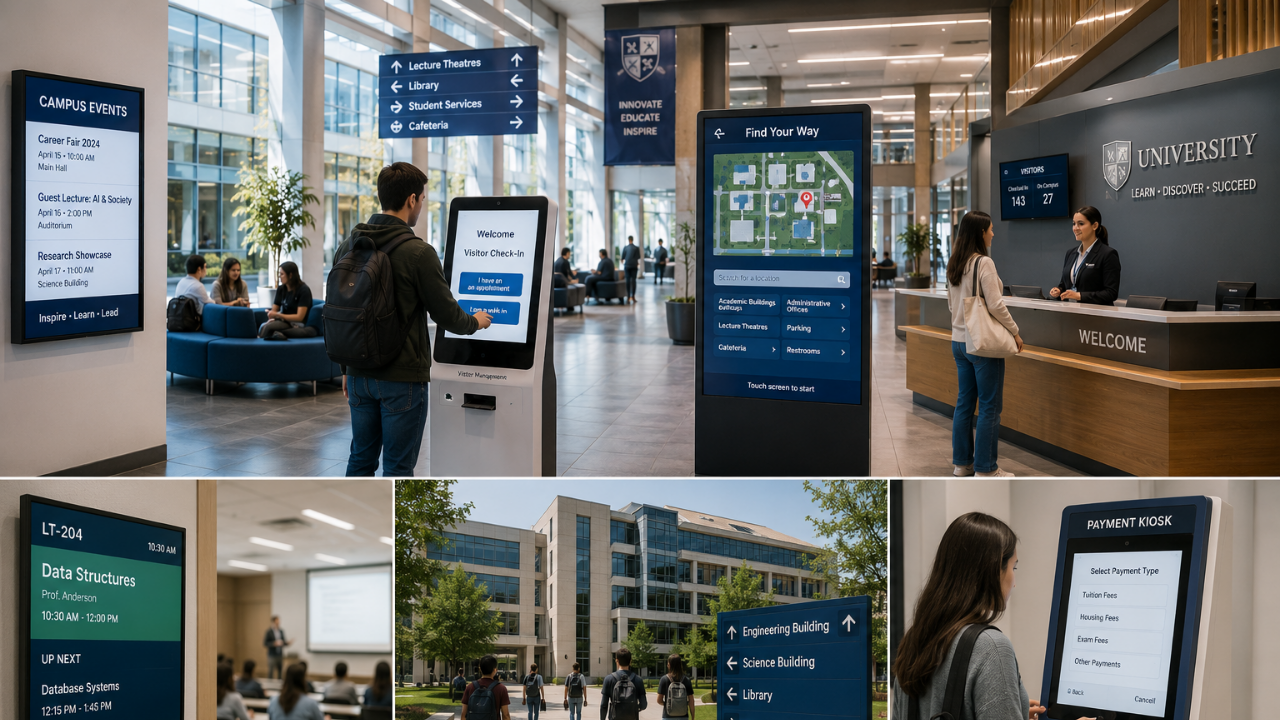
Production references
What Zeour deployments deliver for education operators.
Pre-registered visitor scans QR; badge prints with photo + valid-from / valid-until.
Client-side Dijkstra + polygon wall-collision; floor-graph BFS for lifts / stairs.
Kiosk replaces counter for routine payments; staff handle exceptions only.
GDPR-compliant zero-PII analytics — heatmaps + most-searched POIs only.
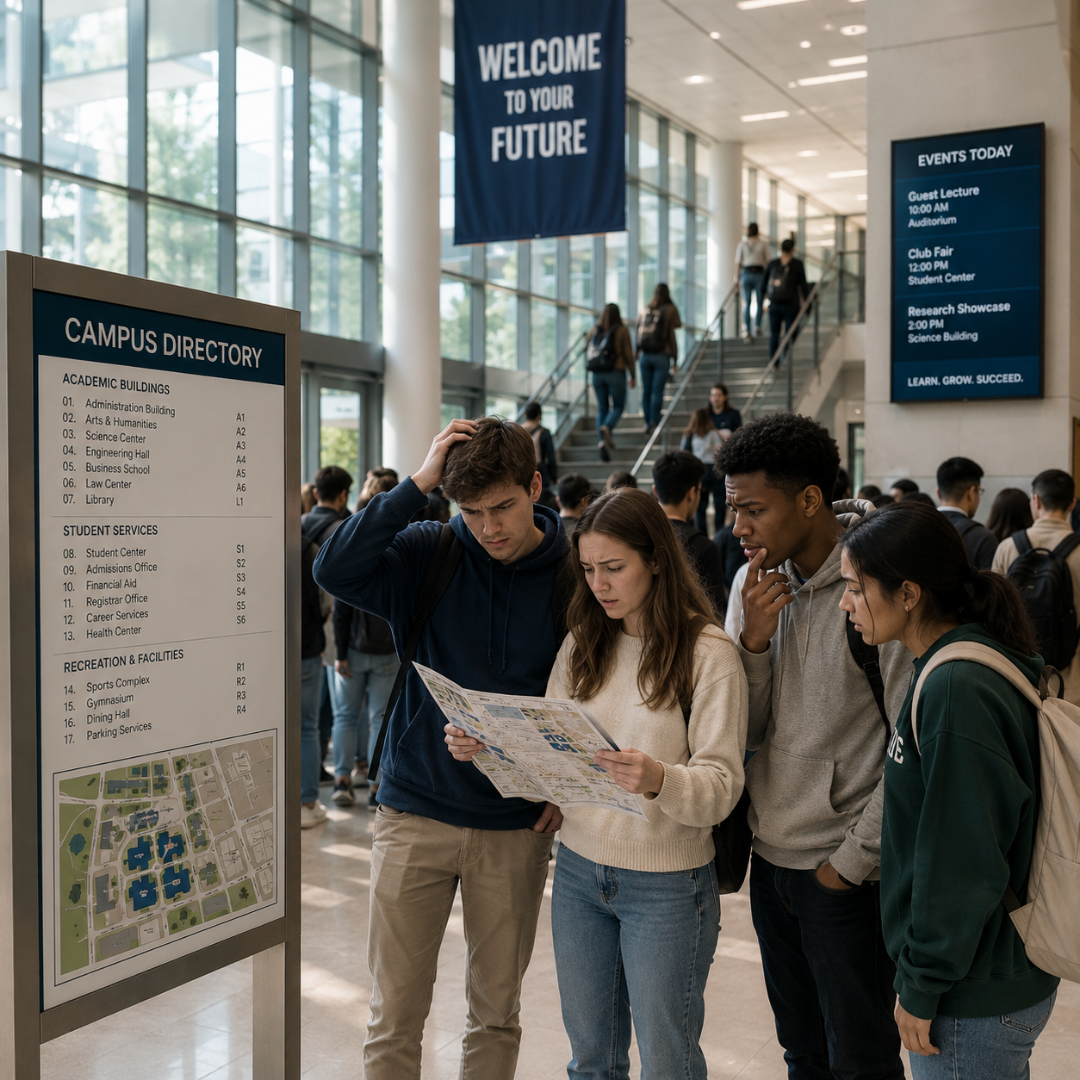
The four problems we hear from education buyers in every Discovery.
Open campus, closed reception desks
Universities and schools have open-campus access but a tight reception bottleneck — prospective students with parents, contractors, deliveries, alumni and visiting academics all funnel through the same door.
Multi-floor wayfinding is non-trivial
A university campus with 10+ buildings and 3-floor lecture blocks is genuinely hard to navigate. Static maps go stale; static signage doesn't handle building closures or class-room swaps.
Fee payment at a counter is queue + staff cost
Fee-payment kiosks (registration, accommodation, exam re-sit) cut counter staff cost by 50–70% on a typical mid-size university while extending hours to 24/7.
Lecture-hall signage is updated by twenty academics
Class-room signage updates, exam-room allocations and event banners are managed by department admins, not a central team. A signage CMS without per-department RBAC fails inside a semester.
Solutions deployed in education today.
Every solution below is in production with at least one education operator. Click any card for the full deep-dive.
Concrete deployment scenarios.
University open-day visitor flow
Prospective students + parents pre-register online; receive QR; arrive at the reception kiosk; badge prints in 10 seconds; route to faculty offices via mobile wayfinding handoff.
Lecture-hall + classroom signage
Per-room signage updates from department admin UI; exam-room banners; event takeovers; emergency overrides for the central security team — all within the same CMS.
Campus parking with staff RFID
Staff issued RFID cards; students + visitors use LPR fallback or paid casual parking; sub-5s exit; revenue reconciliation per parking lot per month.
Fee payment + document kiosk
Routine payments (registration, accommodation, exam re-sit), document requests (transcripts, certificates), and status checks — all at an unmanned kiosk in the student's language with student-ID-card authentication.
Deep dive — Zeour engineering for the education reality.
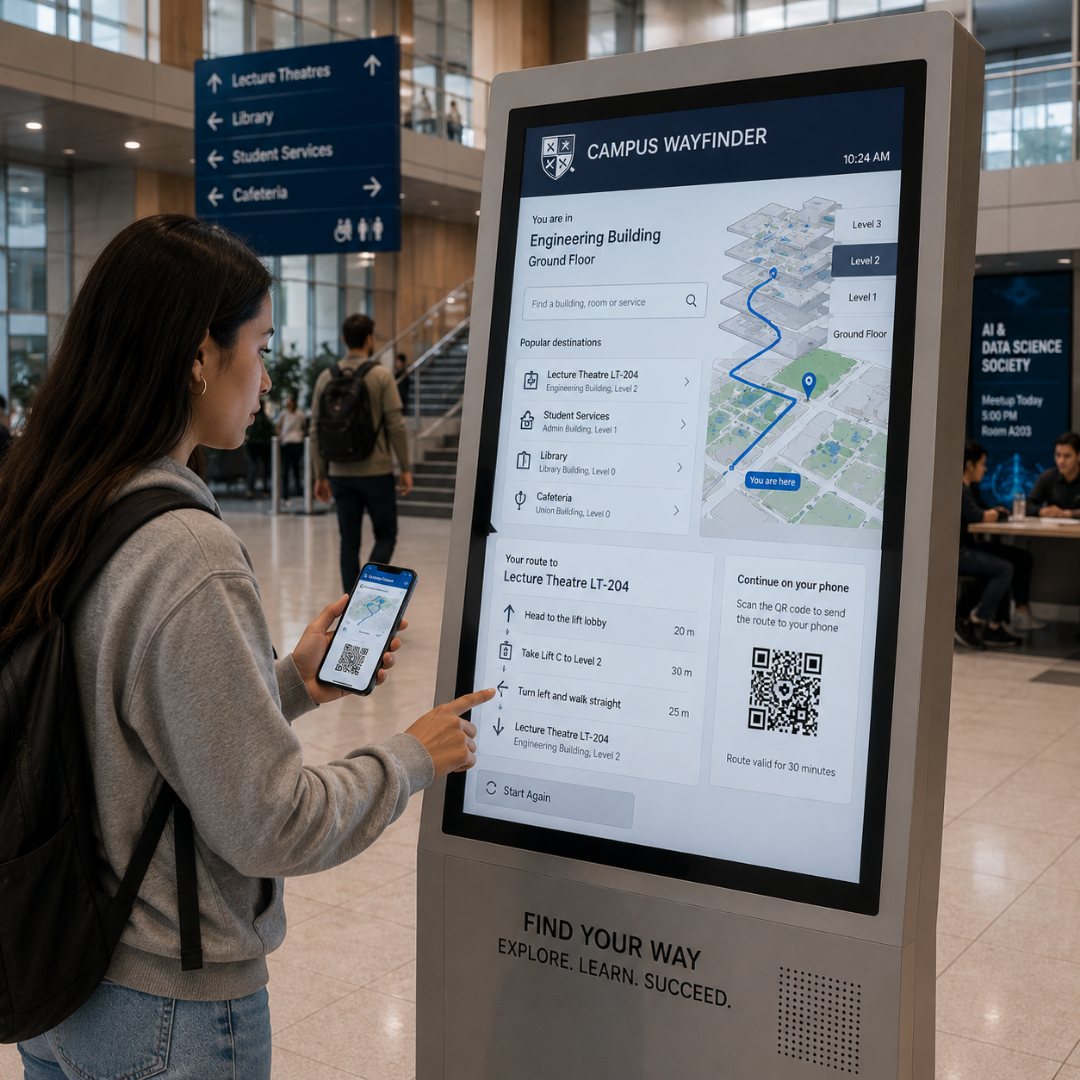
Wayfinding that's actually used after the launch week
A lot of wayfinding deployments ship at launch, get a press release, and then go stale within a semester as buildings change, classrooms re-assign and lifts come out of service. The reason is always the same — the admin UI for the floor graph is too painful to update, so it never gets updated. GLARUS WFS solves this by treating the floor graph as the single source of truth that the entire facilities team (cleaning, security, maintenance, events) shares. POIs, kiosks, walls and path templates are placed in a drag-and-drop map editor; advisory floor / kiosk locks coordinate edits via heartbeat so two admins editing the same floor don't overwrite each other. Per-floor heatmaps and most-searched POIs feed back into facility-planning decisions. Multilingual UI as a first-class skill — English + Arabic (full RTL) ship as a production baseline; any other locale is a 3-file change.
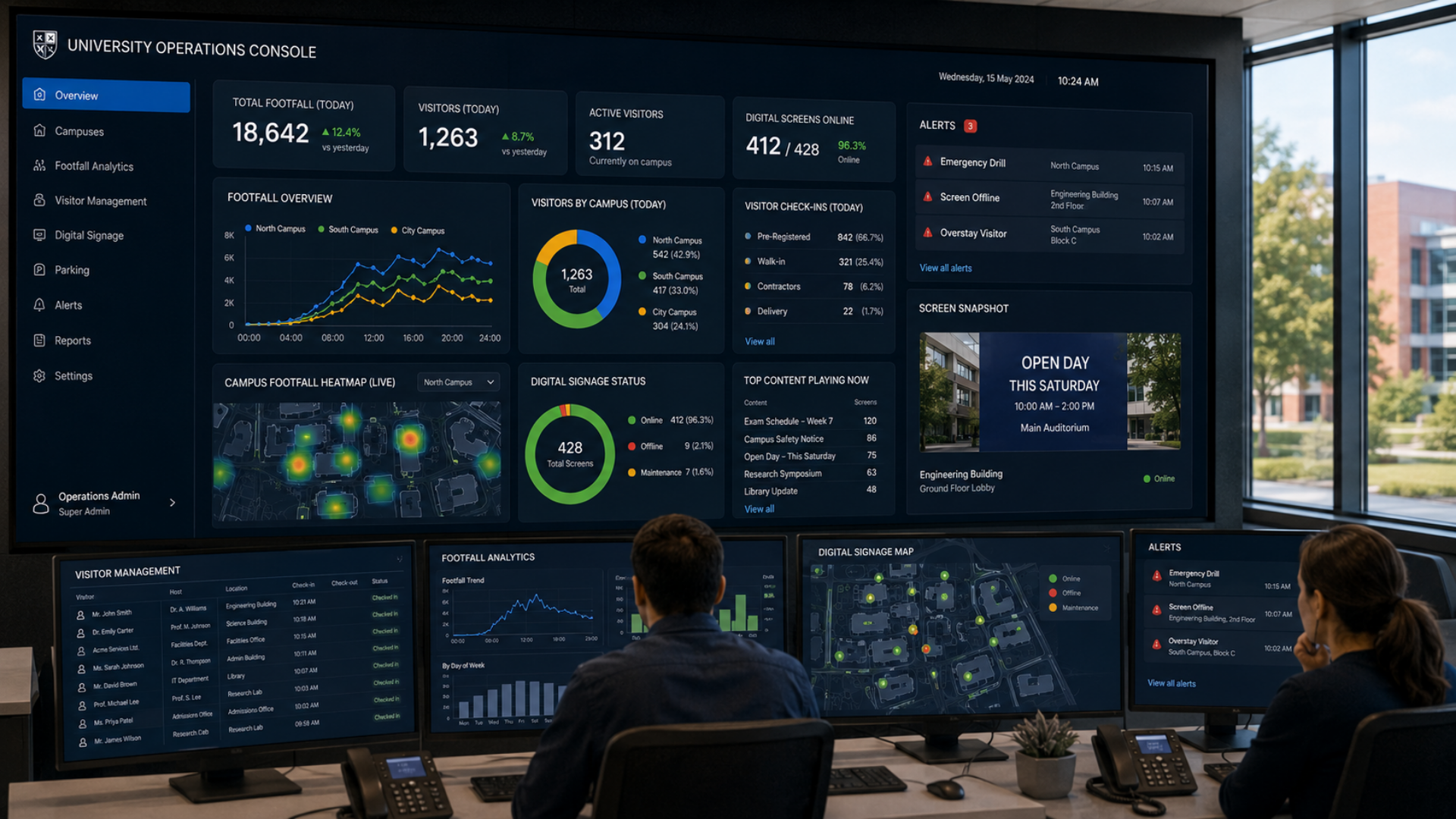
Campus visitor management without a security backlog
Pre-registration is the primary pattern: faculty / department admins register expected visitors via the host portal; ICS calendar invites carry the badge URL; the visitor arrives at the kiosk, scans the QR, and gets a printed badge with photo + valid-from / valid-until in under 90 seconds. Walk-in visitors are handled at the reception kiosk with photo capture and host notification via email or SMS. Smart-card inventory tracks issued / returned / lost / replaced badges. Overdue-visit security escalations fire after a configurable threshold. 5-role RBAC scopes per-building / per-department: Receptionist, Host, Security, Building Admin, Tenant Admin. The whole platform is GDPR + PDPL aligned and ships with an audit log on every administrative action.
Fee-payment kiosks as a revenue + ops play
Routine payments — registration fees, accommodation fees, exam re-sit fees, library fines — are the longest queues at the student-services counter. A kiosk fleet handles 60–80% of these in under three minutes with no counter staff in the loop. The kiosk authenticates via student-ID card, NFC mobile-ID, or OTP; takes payment via integrated PSP (PCI DSS 4.0 compliant; we never see the card data); and emits a receipt + system-of-record write to the SIS. We have prior integrations with Banner, PeopleSoft, Workday Student and several GCC-regional SIS platforms. The remaining 20–40% of transactions (exceptions, refunds, complex cases) still need counter staff — but the counter is no longer the bottleneck.
Signage with per-department RBAC
The thing that breaks at a university scale is the assumption that signage is centrally managed. It isn't — department admins update class-room signs, the registrar updates exam-room banners, the events team manages takeovers, and the security team needs override for emergencies. GRAVIA ships per-tenant RBAC scoped to specific screens / floors / buildings, with each department admin able to update their own scope and not anyone else's. Emergency override from central security pushes to every screen in five seconds regardless of who currently has the screen booked. The same CMS that runs the lecture-hall signage also drives any digital displays in the library, the food hall and the campus entrance.
Regional notes — what changes per market.
GCC + MENA
RTL Arabic shipping in the same build as English, Hijri calendar in academic-calendar handling, integration with national-ID systems where in production, PDPL alignment.
United Kingdom
GDPR + UK DPA 2018, KCSiE (Keeping Children Safe in Education) alignment for K-12 deployments, integration with Sims / Bromcom / Arbor in school deployments, NCSC alignment for higher-ed.
MENA + Africa
Multilingual EN / FR / AR support, integration with national-ID systems where in production, sovereign on-prem option for ministry-managed institutions.

Compliance frameworks
- GDPR
- UK DPA 2018
- PDPL
- ISO 27001
- Child-safeguarding (Keeping Children Safe in Education)
- FERPA-aligned
Active regions
- · United Kingdom
- · European Union
- · Americas
- · GCC
- · MENA
- · Africa
- · Asia
Production references.
GLARUS queue management for the university's admission office — students self-serve a ticket and are called to the right counter without crowding the front desk.
GLARUS queue management for the university's admission office — ticketed student flow that routes admission enquiries to the right counter without front-desk congestion.
Questions education buyers always ask.
Education deployments in production.
Talk to an engineer who has shipped this for education.
A 30-minute scoping call with the team that builds and operates Zeour — not a generalist account exec. We’ll walk your branch / site / network profile and give you a fixed-fee Discovery price by the end of the call.
Education — concepts you'll meet
Definitions for the operational terms that appear across this industry page.