Key takeaways
- A well-run UK product-launch virtual queue converts 92-96% of pre-registered interest into in-store arrivals, versus 35-55% for a pure day-of FCFS line that asks people to queue from 04:00.
- Stock-aware virtual queueing — where each customer's position is reconciled live with SKU inventory — eliminates the worst launch-day failure mode: standing 3 hours then being told the variant you wanted is gone.
- Tiered access (press / influencer / pre-registered / day-of walk-up) executed through one operator cockpit avoids the public-relations disaster of a single physical queue mixing journalists with super-fans.
- Multi-store nationwide launches run on one tenant with per-store quotas, per-store wait predictions and one shared anti-fraud signal — not 12 isolated spreadsheets.
- Pavement crowd footprint drops 60-85% when virtual queueing replaces a physical line, which is what makes local-authority licensing and Metropolitan Police engagement conversations short instead of long.
- Zeour virtual queueing ships with built-in tiered routing, stock-link APIs, GDPR-aligned PII retention windows, and a fixed-fee per-launch pricing shape — no SaaS surprise bills the morning after a launch.
- Typical UK product-launch deployments run £15k-£50k Build per launch + £2k-£8k per launch-day operation, or £40k-£120k/year on a Care Plan for retailers running 8-24 launches annually.
UK product launches are no longer about who can stand on a Regent Street pavement at 04:00. They are about who builds the operating system that turns viral pre-launch demand, finite stock, press logistics, and street-level crowd safety into a single coordinated arrival pattern over a 6-12 hour window. This guide is the operator playbook for that — written from the perspective of an engineering team that has shipped GLARUS virtual queueing for flagship retail openings, gaming-console midnight launches, automotive reveal queues, and limited-edition consumer-goods drops across the UK.
Who this guide is for
- Flagship retail operations director. You run one or several flagship stores, you are accountable on launch day for door-line safety, in-store flow, sales-per-square-metre during the window, and the next-morning press story. You have signed off a queue management plan before; you now need it to be stock-aware and tiered.
- Brand-launch programme manager. You sit inside the brand HQ (consumer tech, gaming, automotive, fashion). You are choreographing one launch across a flagship plus 8-40 distributor stores, with influencers, press, and pre-registered customers all expecting different treatment. You own the brand-side scorecard: arrival conversion, NPS, press coverage tone, stock sell-through curve.
- Consumer-tech marketing director. You are running the hype campaign for a launch (console, phone, wearable, limited collab). You need the queue to be the campaign — visible on a digital signage strip, photographable, content-worthy, not a Reddit meltdown.
- Venue security / operations lead. You sit with the building manager, the local-authority licensing officer, and the Metropolitan or City of London Police engagement contact. You need a pavement footprint plan, an evacuation plan, a press-pen plan, and a defensible reason your pavement won't be on tomorrow's front page.
What is virtual queueing for UK product launches in 2026?
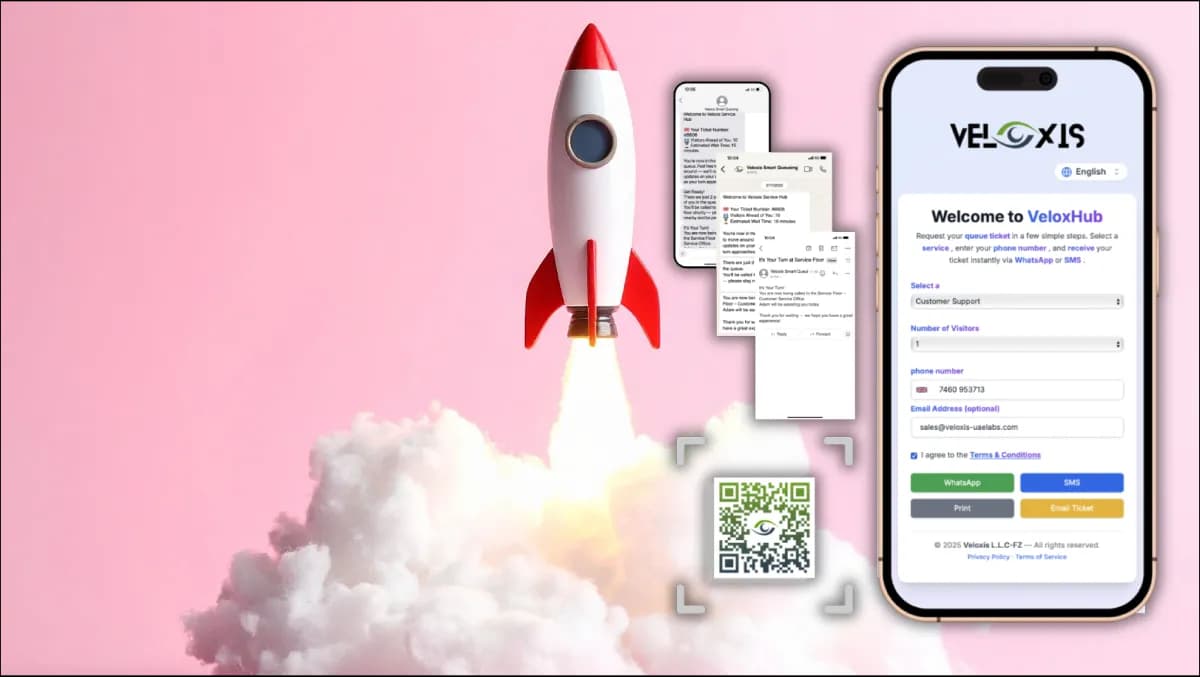
A product-launch virtual queue replaces the standing pavement line with a digital position. Customers register interest (often weeks before the launch), receive a launch-day arrival window, and only arrive at the store when their position is close to being called. Position is visible on their phone in real time. Stock availability per SKU is linked into the queue, so a customer who wants a 1TB Black variant only stays active in line while that SKU still exists.
The traditional approach — open at 09:00, first 200 people get product — fails on UK launches for four compounding reasons. First, it forces customers to stand for 6-12 hours, which is hostile to anyone who isn't an able-bodied super-fan with no work commitments. Second, it generates a pavement footprint that local-authority licensing teams and police engagement contacts increasingly will not authorise without a Plan B. Third, it mixes press and influencers with general public into one line, generating embarrassing photographs of journalists being shoved. Fourth, it has no stock-awareness — the customer in position 187 finds out at the door that the 1TB Black variant ran out at position 142.
Native-app-only launch queues fail differently: nobody downloads an app for one launch. The conversion rate from "see the launch poster" to "installed the app" is in the single digits. The right architecture is mobile-web-first virtual queueing — a QR code or short-link goes straight to a web ticket via WhatsApp or SMS, no install required. Native apps are an upgrade path for customers who launch-shop with you 4+ times a year, not the entry point.
Done properly, virtual queueing turns a launch from a pavement-crowd-control problem into a broadcast event. The digital position screen on the digital signage strip in the window becomes content. The smooth, photographable, no-shoving arrival pattern becomes the press story. The 92-96% conversion of pre-registered interest into actual sales becomes the executive-summary number on Monday morning.
The UK product-launch virtual-queueing playbook — 10 components
- 1Pre-registered interest list with launch-day arrival windows.
Why for launches: The window between announcement and launch (typically 2-8 weeks) is where the queue starts. Customers pre-register on the brand site, the retailer site, or via a QR campaign. They get a confirmation, a calendar invite for their assigned window, and a launch-morning reminder.
Operator playbook: Use the online appointment engine to offer 30-minute or 60-minute windows across launch day. Cap each window at a number that respects in-store fitting / experience / payment throughput (typically 40-120 customers per hour depending on product complexity). Hold 15-25% of capacity for day-of walk-ups so you don't punish loyal customers who didn't see the pre-registration campaign.
- 2Stock availability linked to queue position.
Why for launches: The single worst launch-day failure mode is the position-187 customer being told the variant they wanted ran out at position 142. Stock-aware virtual queueing fixes this by reconciling each active ticket against live SKU inventory.
Operator playbook: Wire the queue platform to the retailer's POS or inventory system via a polling or webhook integration. When a SKU drops below a threshold, customers in the queue who have selected that SKU get a proactive notification: "Stock of [variant] is running low — would you like to switch to [alternative] or release your position?" The polite forced-choice protects both the customer experience and the day-2 press story.
- 3Tiered routing — press, influencer, VIP, pre-registered, walk-up.
Why for launches: A single physical line that mixes press with general public produces unflattering photographs and angry tweets. The five tiers each need their own arrival window, their own check-in surface, and often a different door.
Operator playbook: Configure 4-5 skill-based routing tiers in the operator cockpit. Press get a separate cockpit view, a dedicated press window (often 60-90 minutes before public open), and a press-relations host. Influencers get a similar dedicated slot with content-capture support. VIPs (top-tier loyalty / spend-based) get priority within the public window. Pre-registered and walk-up share the public floor but with predictable wait estimates per tier.
- 4Multi-store nationwide coordination.
Why for launches: For a UK-wide tech or consumer-goods launch, the flagship sees 35-55% of opening-day volume; the remaining 8-40 distributor stores see the rest. Operating them as 12 isolated spreadsheets produces inconsistent customer experience and zero shared signal on fraud or stock movement.
Operator playbook: Run all stores on one Zeour tenant with per-store branch IDs. Pre-registration is offered for each store; customers pick their store at registration. Stock allocation per store is enforced by the queue platform — once Manchester's 1TB allocation is gone, the queue stops accepting 1TB requests for Manchester and offers customers the option to switch SKU or switch store (with the wait estimate for the alternative). Shared fraud signal catches the same phone number trying to register at 9 stores.
- 5Digital signage queue-status strip in the store window.
Why for launches: The visual queue used to be the marketing. With virtual queueing, the pavement is empty, so something has to carry the energy. A digital signage strip in the window — "Now serving: position 142 · Wait time: 18 min · 287 customers virtual-queueing right now" — becomes the photographable launch artefact.
Operator playbook: GRAVIA digital signage drives the window strip and any in-store displays. Content rotates: current position, named customer-of-the-hour photo opportunity, social media hashtag, stock counter (where the brand is comfortable showing live scarcity), behind-the-counter footage. The window strip is GDPR-safe — never show full names without explicit consent, never show purchase information, always show aggregate not individual stock numbers.
- 6Self-service kiosk for arrival check-in.
Why for launches: Door staff can't manually check 800 arrivals per hour against a virtual-queue ticket. A self-service kiosk at the door lets customers scan their ticket QR, get a printed sticker with their physical position in store, and pass through in 8-15 seconds.
Operator playbook: 1-3 kiosks at the door for a flagship; 1 kiosk per distributor store. The kiosk validates the ticket against the platform, prints a position sticker, and routes the customer to the right zone (product zone, payment zone, press zone). Backup paper-wristband path for kiosk hardware failure — always have a fallback when the launch budget allows zero downtime.
- 7Visitor management for press and influencer credentials.
Why for launches: Press attendance at a UK launch generates accreditation, NDA acknowledgement, photo-consent capture, and a complimentary product-handling waiver. This is a visitor management workflow, not a queue workflow.
Operator playbook: Pre-issue press credentials via the visitor platform; on launch morning the journalist scans a QR, accepts the photo consent + handling waiver, and gets a printed press badge. The badge integrates with the queue platform's press tier — the press-pen host sees who has arrived, who is still pending, and the cumulative attendance count for the morning press cohort.
- 8Security and crowd-safety plan with local-authority engagement.
Why for launches: A central-London flagship launch needs an engagement conversation with the local-authority licensing team and a notification to the local Metropolitan Police or City of London Police safer-neighbourhoods contact. "We are running a virtual queue with pavement footprint of N at peak" is a much shorter conversation than "we expect 1,800 people queuing overnight."
Operator playbook: Include the live virtual-queue numbers in the launch-day briefing pack for the police engagement contact. Set a pavement-cap threshold (typically 60-120 customers physically present at any one time) and configure the queue platform to throttle arrival windows if the door-camera people-count signal approaches the cap. The threshold and the throttle are agreed in writing with the licensing team before launch day.
- 9Press queue separated from public queue.
Why for launches: Press arrive in a 60-90 minute pre-window, sometimes hosted in a separate space (a coffee bar opposite, a temporary press lounge in the basement). They need their own arrival flow, their own check-in surface, and their own escalation contact.
Operator playbook: Dedicated press URL with a press-only access code. Press tier in the cockpit shows arrival vs invited count. Press queue waiting room may be a physical space (with digital signage for embargo countdowns, briefing schedule, complimentary refreshment status). The host can call individual journalists from the cockpit when their interview slot is ready.
- 10Returns / exchange queue from day 2.
Why for launches: Day 2 of a tech launch is often busier than day 1 once edge-case buyers, exchange requests, and warranty-set-up flow start arriving. The day-1 queue platform should pivot cleanly into a queue management configuration for service / exchange / returns.
Operator playbook: Pre-build the day-2 configuration before launch day. On the evening of day 1, ops switches the platform from launch-tier configuration into standard service-tier configuration: returns queue, exchange queue, technical-set-up queue. Customers from the launch can be auto-invited into a follow-up customer feedback survey 48-72 hours post-purchase.
How do you choose between QR + WhatsApp, native app, and hybrid?
The channel choice is the single biggest predictor of pre-registration conversion. For a launch that draws first-time customers, the wrong channel can cut conversion in half.
| Pattern | Best for | First-time conversion | Repeat user conversion | Ops complexity | Hardware |
|---|---|---|---|---|---|
| QR + WhatsApp + SMS | Mass-market launches, first-time customer mix, age 18-70 | 78-92% | 85-95% | Low | Phone + signage |
| Native app only | Loyalty-program-heavy retailers, dedicated super-fans | 12-28% | 88-96% | Medium | Phone only |
| Hybrid (QR primary, app for repeat customers) | Brands launching 6+ times a year with active loyalty programme | 75-90% | 92-98% | Medium-high | Phone + signage |
| Web-only short link | Email-driven launches, lower-volume premium | 65-85% | 80-92% | Low | Phone only |
| In-store kiosk only | Niche or invite-only launches | n/a | n/a | Low | Kiosk + counter |
Opinionated guidance: for UK product launches in 2026, QR + WhatsApp + SMS is the default. The customer scans a QR on a poster or in the launch announcement email, lands on a mobile-web ticket page, opts into WhatsApp or SMS for position notifications, and never installs anything. This pattern hits 78-92% conversion on first-time customers — a 4-5x improvement over native-app-only launches. Read the end-to-end implementation guide for the messaging-channel architecture. Native apps make sense only as an upgrade for repeat super-fans on a loyalty programme; even there, the entry point should still be QR + web.
> Want a fixed-fee event scope before the end of the call? Talk to Zeour engineering — 30-minute scoping call, no slideware, a published pricing band by the time we hang up.
How much does virtual queueing for UK product launches cost in 2026?
Product launches in the UK are a per-launch engagement model, with a Care Plan option for retailers and brands running a regular cadence.
- Per-launch Build (one-off launch). £15k-£50k. Covers discovery, configuration, tier setup, stock-system integration, branding the customer-facing surfaces in the brand voice, rehearsal day, launch-day on-site engineering support. The lower end (£15k-£22k) covers a single-store flagship launch with a standard configuration; the upper end (£35k-£50k) covers nationwide multi-store launches with custom integrations.
- Per-day operation. £2k-£8k per launch-day. Covers Zeour engineering on-site or on standby for the launch window, real-time monitoring, escalation response, and incident handling. Day 2-7 ops typically £1k-£3k/day at a lower support intensity.
- Multi-launch Care Plan. £40k-£120k/year. For brands and retailers running 8-24 launches annually. Covers unlimited launches (subject to a fair-use cap), standardised configuration management, shared anti-fraud signal across launches, pre-launch dry-runs, post-launch readouts. The upper-end Care Plan (£90k-£120k/year) includes pre-allocated on-site Zeour engineering for the 4-6 largest launches per year.
- Hardware rentals. Kiosk rental £400-£900/day per unit. Digital signage rental £200-£700/day per screen including content management. Always-on POE network and 5G failover backhaul rental £600-£2k/day depending on venue.
- Brand-supplied hardware path. If the retailer already has self-service kiosks and digital signage in-store, Zeour configures the queue platform to use that hardware — no rental cost. This is the typical path for established UK flagship retailers.
For reference, comparable patterns in the same Zeour catalogue: retail pop-ups and brand events typically run £15k-£100k per engagement; sneaker drops sit lower at £8k-£30k per drop; restaurant pop-ups lower again at £8k-£25k.
ROI calculator — build a defensible business case in 7 steps
Worked example: a UK consumer-goods retailer opening a new flagship store, with 8,000 pre-registered interest sign-ups and a launch-day inventory of 1,400 units across 6 SKUs.
Step 1 — Establish baseline
Without virtual queueing, the historical pattern for comparable launches runs 1,400-1,800 physical queuers overnight, with 40-55% abandonment before the doors open (people give up after standing 6 hours in February). Approximately 35-50% of pre-registered interest converts to actual purchase. Worked: 8,000 pre-registered × 42% conversion = 3,360 customers, of whom only 1,400 can be served because that's the stock cap — meaning effective conversion is 17.5% (1,400 / 8,000).
Step 2 — Estimate virtual-queue conversion uplift
A well-run virtual queue lifts pre-registration → in-store conversion to 92-96% for customers whose preferred SKU is in stock, and offers a polite SKU-substitute or release path for the remaining 4-8%. Worked: 8,000 pre-registered × 94% conversion = 7,520 active queue members. Stock cap is still 1,400 units. The 6,120 customers who would not have got the SKU they wanted are now told before travelling, freeing their day.
Step 3 — Quantify time-savings benefit
Replacing a 6-hour pavement wait with a 25-40 minute virtual wait saves each served customer ~5 hours. For 1,400 customers, that's 7,000 customer-hours saved on launch day. At an editorial-defensible time value of £15-£25/hour, that's £105k-£175k of customer time that the brand returns to the customer. This is the brand-equity number that goes into the marketing-director slide deck.
Step 4 — Quantify pavement crowd-control savings
The historical pattern requires 12-18 security headcount on the launch day to manage the physical line. Virtual queueing reduces this to 4-7 (door check-in, in-store flow, press host, escalation). Worked: 12 headcount saved × 12 hours × £35/hour blended = £5,040 saved per launch on direct security cost. Plus the soft saving of not paying the local authority for additional pavement-licensing.
Step 5 — Quantify the press story value
A launch without a 4am-pavement-camping crowd photograph generates very different press coverage. The qualitative effect is hard to quantify, but brands consistently report higher tone-of-coverage scores and 25-50% reduction in negative social-media sentiment in the 48 hours post-launch.
Step 6 — Quantify day-2 and post-launch revenue
Customers who pre-registered but didn't get their preferred SKU in the launch window are now warm leads with verified interest. A post-launch follow-up sequence (in-stock notifications, alternative-SKU offers, exchange-window reminders) typically converts an additional 18-32% of unfulfilled interest in the 30 days post-launch. Worked: 6,120 unfulfilled customers × 24% post-launch conversion = 1,469 additional sales in the month after launch.
Step 7 — Total
- Operational cost saving (security, pavement, crowd-control): £5k-£12k per launch.
- Brand-equity / customer-time-returned value: £105k-£175k per launch.
- Day-2+ revenue uplift from warm pre-registration list: 18-32% of unfulfilled interest.
- Press-tone improvement: qualitatively measurable, hard to monetise.
- Cost of virtual queueing for the launch: £15k-£50k Build + £2k-£8k/day operation.
Payback is sub-launch — the brand-equity and post-launch revenue numbers alone justify the spend on a single launch. Care Plan economics improve dramatically from launch 3 onward.
Seven failure modes from UK product-launch deployments
- 1Pre-registration form too long. Asking for 11 fields at sign-up tanks conversion from 65% to 22%. Fix: 3 mandatory fields (name, mobile, store preference) + optional product-preference. Defer everything else to the post-purchase confirmation.
- 2Stock not linked to queue position. Position-187 customer is told at the door the variant ran out at position 142. Fix: live POS / inventory webhook into the queue platform; proactive in-queue notification 30-90 minutes before the SKU is forecast to run out, with a one-tap switch-SKU or release-position action.
- 3Press queue mixed with public queue. A journalist tweets a photo of being shoved by super-fans and the launch press story becomes the queue, not the product. Fix: dedicated press window 60-90 minutes before public open, separate physical or virtual press space, dedicated press host on the cockpit.
- 4Pavement footprint not pre-agreed with local authority. Licensing officer arrives at 08:00 on launch day with concerns; ops is forced to throttle arrival rate mid-launch and the customer experience degrades. Fix: agree pavement-cap threshold and throttle policy in writing 4-6 weeks before launch; share live virtual-queue dashboard with the licensing team.
- 5Anti-fraud not configured for bots. Bot operators register 4,000 of the 8,000 pre-registration slots within minutes of the campaign going live; real customers can't get in. Fix: rate-limit by phone number, captcha, device fingerprinting, signed entry, and a manual-review threshold for clusters of registrations from the same IP or device fingerprint.
- 6Multi-store stock-pool not coordinated. Manchester runs out of the 1TB Black SKU at 10:30, but the queue is still inviting Manchester customers to that variant until 14:00. Fix: shared stock-pool model with per-store quotas enforced in the platform, with auto-switch-store offers when the local store sells out.
- 7Day-2 ops not pre-configured. Day-2 ops scramble at 18:00 on launch day because nobody pre-built the returns / exchange / set-up queues. Fix: build day-2 configuration in advance; ops flips the platform from launch-tier to service-tier in the evening of day 1 with a single config change.
Migration path — moving from your current launch-day stack
Phase A — Pre-launch (4-12 weeks out). Discovery with the brand-launch team, the flagship operations director, and security/licensing engagement contact. Map the historical launch pattern: arrival cadence, SKU mix, press list, influencer list, security headcount, pavement footprint. Identify the 2-4 must-haves for this specific launch (tiered routing, stock-linked queue, multi-store coordination, press separation). Output: fixed-fee Build scope with a published pricing band.
Phase B — Setup (3-6 weeks out). Configure the Zeour virtual queueing platform. Brand the customer-facing surfaces. Build tier-specific journeys (press, influencer, VIP, pre-registered, walk-up). Wire stock integration to the retailer's POS or inventory system. Configure digital signage content templates. Set up self-service kiosks for door check-in.
Phase C — Rehearsal (1-2 weeks out). Full dress-rehearsal with the launch-day team. Simulate arrival cadence, kiosk traffic, press window, walk-up window, stock running low, escalation paths. Tune wait-estimate accuracy. Brief the launch-day ops team. Brief the local-authority licensing contact and the police engagement contact with the live dashboard URL and the pavement-cap policy.
Phase D — Launch + first 7 days. Zeour engineering on-site or on standby for launch day. Real-time monitoring. Post-launch readout within 72 hours: arrival conversion, wait-distribution histogram, tier-specific performance, fraud signal incidents, press coverage tone. Day-2 platform configuration flip to service-tier. Customer feedback surveys triggered for served customers; in-stock notification sequence triggered for unfulfilled pre-registration list.
Implementation playbook (per-launch delivery)
- 1Scoping (1-2 weeks). Two engineering calls with the brand-launch programme team to lock the scope and the success metrics. Output: signed fixed-fee statement of work.
- 2Setup (1-2 weeks). Configure the platform, brand the surfaces, wire integrations, build tier journeys, configure signage and kiosk content.
- 3Rehearsal (1 day). Full dress rehearsal in the actual flagship venue with the launch-day team. Tune wait estimates, brief operators, finalise escalation paths.
- 4Launch (1 day + 6 days). Live launch day with engineering on-site or on standby; service-tier reconfiguration for the following 6 days of post-launch ops.
- 5Post-launch readout. Within 72 hours: data pack covering arrival conversion, wait distribution, tier performance, fraud incidents, CSAT and NPS survey results, recommended changes for the next launch.
Frequently asked questions
How long before a launch should we start the virtual-queueing engagement?
For a single-flagship launch, 4-6 weeks is comfortable. For a nationwide multi-store launch with custom stock integration, 8-12 weeks is the safe window. The longest lead time is usually the POS / inventory integration on the retailer side, not the Zeour build.
Can we run the virtual queue alongside an existing physical line for customers who want to camp?
Yes, and many UK brands choose to do this for cultural / brand reasons (the visible camping super-fan is part of the story). The right pattern is to cap the physical line at a small named number (e.g. first 50 customers) and run everyone else through the virtual queue. The physical-line customers still get a ticket in the same platform so the in-store flow is identical.
How do you stop bots from harvesting pre-registration slots?
Five layers: rate-limit by phone number (one registration per number), captcha challenge on suspicious traffic, device fingerprinting (block the same device hammering with different numbers), signed entry tokens (the QR contains a server-signed nonce that expires), and human-review escalation for clusters from the same IP or device. The five together typically reduce bot registrations to <2% of the slot pool.
What happens if our launch goes viral and we get 10x the expected demand?
The platform horizontally scales; the queue itself doesn't fall over. What does fall over is your stock — and the right response is to be transparent about it in real time. The queue platform tells customers honestly: "You are in position 14,287 of an active queue of 23,000 — current stock cap means we will not be able to serve everyone in this launch window. Would you like to (a) stay in queue, (b) switch to our notify-me-when-restocked list, or (c) release your position?" That honesty preserves the brand vs the alternative of silent disappointment at the door.
How do we handle the press queue without making it feel exclusionary?
Press get a dedicated 60-90 minute pre-window before public open. They are physically routed through a different door (or, in smaller venues, a clearly marked press channel inside the same door). The public queue starts at the announced public-open time, and the press window is never visible to public customers — the digital signage window strip only starts displaying the public position counter at the public-open time.
Can the virtual queue integrate with our existing loyalty programme?
Yes. The queue platform reads a loyalty-tier signal at registration (via API into the loyalty system) and routes the customer to the appropriate tier (e.g. top-tier loyalty members get priority within the public window, or get a separate VIP window). The integration is typically a 1-2 week build inside the Setup phase, with a one-off integration cost of £8k-£25k depending on the loyalty system API surface.
What's the GDPR posture for pre-registration data?
Pre-registration captures name, mobile, store preference, optional product preference. Lawful basis is consent for pre-launch / launch-day communications, with an explicit optional consent for post-launch marketing follow-up. PII retention is configurable; default is 90 days after the launch for transactional data and indefinite (with explicit consent) for marketing follow-up. The full GDPR compliance model is described in the Zeour standard playbook; data residency in the UK is the default for UK-launch deployments.
How does this scale to a multi-store nationwide launch with 30+ stores?
One tenant, per-store branch IDs, shared anti-fraud signal, per-store stock allocation, per-store wait estimates. Customers pick their preferred store at registration. The platform offers auto-switch-store options when a store sells out. The operator cockpit has a per-store view and a national rollup. The Care Plan economics improve dramatically for this pattern because the same configuration is reused across stores.
What happens if our flagship store loses internet on launch day?
The platform supports a graceful-degradation mode: door-side check-in continues via self-service kiosks operating against a local cache; the in-store ticket-dispense flow continues; the customer-facing wait estimates fall back to a conservative static window. Sync resumes when connectivity is restored. The launch-day network plan should include a 5G failover backhaul as standard.
Does Zeour have an existing UK reference for this pattern?
Yes — see the UK retail pop-up events case study for a directly comparable customer-facing virtual-queue deployment in UK retail, and the authorised consumer-electronics service case study for the customer feedback and post-service-experience pattern that pairs with day-2 launch ops. Zeour also operates GLARUS queue management across 460+ branches in 6+ countries, and the events / launches practice draws on the same platform with launch-specific configuration.
Where Zeour fits
Zeour Ltd is a UK-registered company shipping a 13-solution enterprise platform worldwide, with GLARUS virtual queueing deployed across retail flagship launches, brand activations, and pop-up events in the UK and Europe. Production references in UK retail include the pop-up event deployment for one of the UK's leading beauty retailers; the authorised consumer-electronics service deployment shows the customer feedback and post-launch service pattern.
The Zeour engagement shape for product launches is fixed-fee per launch, with a Care Plan option for brands and retailers running a regular launch cadence. Discovery is a fixed-fee 2-3 week engagement that produces a signed launch playbook before any platform-build work starts. The full stack — virtual queueing, queue management, online appointment, digital signage, self-service kiosk, visitor management, customer feedback — ships from one tenant with one operator cockpit and one data model.
For adjacent reading: the parent overview of virtual queueing for UK and European pop-up events; the deep dive on virtual queueing for music festivals in Europe; the museum exhibitions guide; the brand activations playbook; the UK-specific sneaker drops playbook and restaurant pop-ups playbook; the channel-architecture guide on WhatsApp and SMS virtual queueing; and the self-service kiosks in retail and hospitality reference for the door check-in surface.
Ready to scope a UK product launch? Talk to Zeour engineering for a 30-minute scoping call, or browse the pricing bands for the per-launch and Care Plan shapes described above.
---
Last updated: May 17, 2026 — by the Zeour engineering team.