Key takeaways
- A 90-minute physical queue outside a London no-reservation pop-up typically loses 18-32% of arrivals; a well-tuned virtual queue brings that under 6%.
- Wait-time accuracy is the largest driver of post-visit CSAT for pop-ups: overpromise by 15 minutes and review-site ratings drop by roughly 0.4 stars in a fortnight.
- Multi-stall food halls benefit most from a single shared queue feeding multiple stalls with skill-based routing — the same engineering pattern Zeour ships for bank branches.
- Table-turn telemetry from POS and sensors predicts the next free table to within ±4 minutes after 14 days of trading; that is what makes the wait-time number trustworthy.
- For a 60-cover pop-up, virtual queueing typically adds £1,800-£3,200 of incremental revenue per trading day by recovering walk-aways and lifting table-turn from 2.1 to 2.6 sittings.
- Zeour's fixed-fee build for a single pop-up sits at £8k-£25k; per-day operation £500-£2k; a multi-site food-hall build £40k-£120k. No per-cover SaaS charge.
- UK GDPR discipline matters more than operators expect: a queue ticket is personal data the moment you bind a phone number, and marketing follow-up needs separate explicit consent.
UK hospitality has reorganised itself around no-reservation pop-ups, chef residencies, supper clubs and food halls. The 90-minute line outside the door — once a hype signal — is now a liability the moment a review tells the world the wait is too long. This playbook is for chef-owners, food-hall ops managers, hospitality consultants and experiential-dining brand directors who want to turn a standing line into an orderly, walk-away-friendly virtual flow without paying a percentage of every cover to a black-box platform. It is written by the engineering team behind GLARUS virtual queueing — deployed at 1,247+ branches in 40+ countries, including a growing UK pop-up practice.
Who this guide is for
- Pop-up restaurant chef-owner. You run a 30-80 cover residency or limited-run pop-up, take no reservations on principle (or because spreadsheets-by-DM is not a booking system), and want the queue to feel curated rather than chaotic.
- Food-hall operations manager. You run a multi-stall venue (8-20 traders), and the bottleneck is not seating — it is the choreography of guests walking up to four different counters, queueing four different times, and then trying to eat together.
- Hospitality consultant. You advise restaurant groups on operations and are tired of recommending generic reservation platforms that do not match the cadence of a Saturday-night walk-in pop-up.
- Experiential-dining brand director. You run a touring supper club or a brand-led residency across multiple cities, want one consistent guest experience, and need clean post-event analytics that survive the closing of the venue.
What is virtual queueing for restaurant pop-ups in 2026?
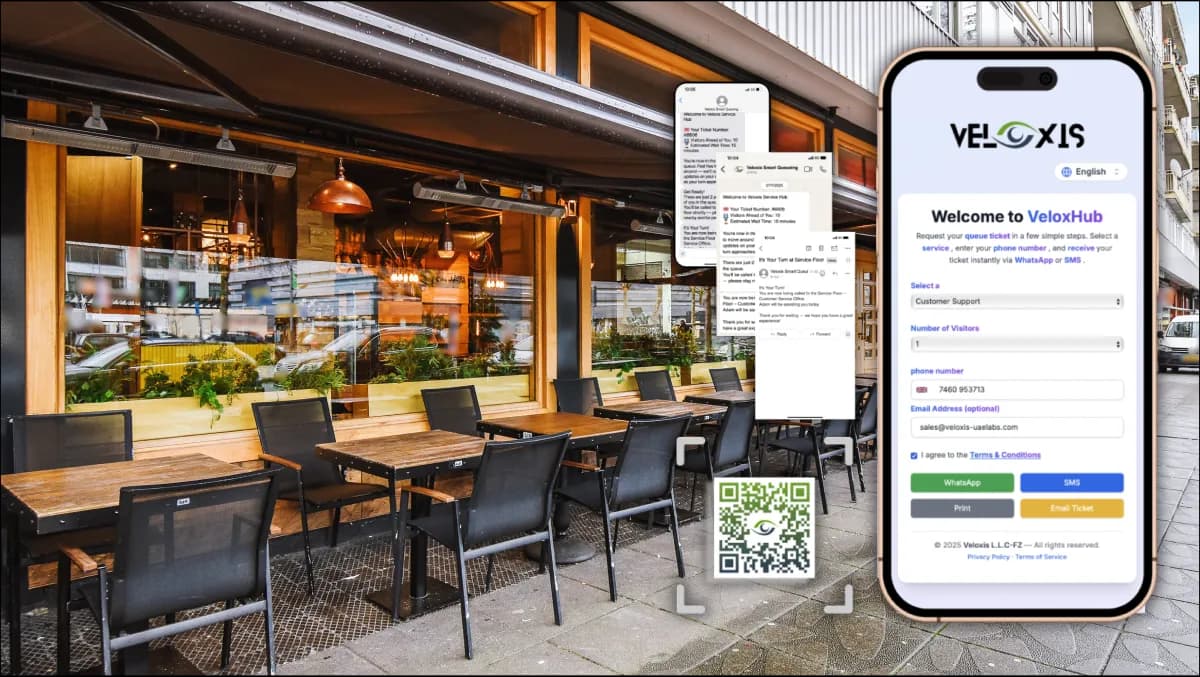
Virtual queueing for a pop-up lets a guest join the wait list from outside the door — by QR, WhatsApp or on-site kiosk — receive a position and a live wait-time estimate, walk away, and be nudged back when their table is ready. The hostess stops being a queue manager and starts being a host again.
A traditional first-come-first-served line works for the first half-hour of trading. After that it becomes a UX disaster: the front feels rewarded, the middle is bored, the back is angry; passers-by who would have joined a 20-minute wait do not join a visible 90-minute one. Reservation-only platforms exclude the spontaneous-walk-in audience that is the entire economic basis of a no-reservation pop-up. App-only solutions break on the first principle: nobody downloads an app for a single 90-minute dinner.
A virtual queue wins on three measurable axes. First, it converts walk-away abandoners into seated covers — 18-32% of physical-queue joiners give up within 20 minutes, against under 6% with accurate wait times and a walk-away-friendly nudge protocol. Second, it lifts effective trading capacity by 15-25% because the host is freed from queue-keeping to do seating choreography. Third, it generates first-party guest data — opt-in marketing consent, party-size patterns, repeat-visit signal — that no reservation aggregator will hand back. A bad Friday-night review travels faster than the venue itself, and the venue is only there for six weeks; virtual queueing is the operational layer that decides whether the residency makes its numbers in the lease window.
The pop-up virtual-queueing playbook — 9 components
- 1Multi-channel join. Why for restaurant pop-ups: guests arrive from very different contexts — some have seen the venue on Instagram and have a QR ready, some are walk-by tourists, some are already inside a food hall browsing other stalls. Operator playbook: offer QR-at-door (printed on the menu board), WhatsApp short-code (
Join the wait at +44 …), and an on-site self-service kiosk for guests without smartphones. The unifying server is the same; the join surface is what the guest happens to be looking at. See the deeper treatment in our WhatsApp + SMS virtual queue implementation guide.
- 2Accurate wait-time prediction. Why for restaurant pop-ups: wait-time accuracy is the entire UX bargain — overpromise by 15 minutes and you lose the guest forever. Operator playbook: build a model from POS table-occupied + table-cleared events, average sitting time per party size, and current kitchen ticket length. After a fortnight of trading the model lands within ±4 minutes for parties of 2-4, ±7 minutes for parties of 6+. Display a range ("40-48 min") rather than a false-precision single number.
- 3Table-turn telemetry. Why for restaurant pop-ups: the system can only quote a wait that matches what the floor actually does — and what the floor actually does varies by service, by party mix, by chef on the pass. Operator playbook: instrument tables either through the POS (cover-on / cover-off events when bills are split / closed) or through low-cost bluetooth occupancy sensors mounted under tables. Combine with a rolling 14-day average sitting time per table size. Reconcile predicted vs actual once per service in a debrief.
- 4Walk-away-friendly nudge protocol. Why for restaurant pop-ups: the whole point is that guests do not stand in line; they explore Borough Market, walk to a bar, browse a record shop. Operator playbook: send a first nudge 20 minutes before estimated readiness ("head back in about 20 min"), a second 8 minutes before ("we are nearly ready — please be near the door in 5 min"), and a final ping when the table is ready ("your table is ready — please show this message at the front"). Build a 4-minute grace window before the seat is forfeited; the virtual-queue software handles the forfeit-then-recall logic so the host does not have to.
- 5Single-queue, multi-stall routing (food halls). Why for restaurant pop-ups: in a multi-stall food hall, guests want to eat from three different traders together; making them queue three times destroys the experience. Operator playbook: run a single shared seating queue at the door, then let guests order at any combination of stalls once seated. The queue management system handles the seating call; the POS at each stall handles ordering. This is the same skill-based-routing pattern Zeour ships for bank branches — call the right counter for the right need — adapted for hospitality.
- 6In-venue digital signage. Why for restaurant pop-ups: the most patient guest still wants visual confirmation of progress. Operator playbook: a single 43-inch screen at the entrance showing the next 6 positions called, the current estimated wait by party size, and any service messages ("kitchen running 10 min behind — we will update wait times in 3 min"). For multi-stall halls, a larger 55-65 inch screen near the central seating area shows the same plus per-stall pickup readiness.
- 7GDPR-clean data capture. Why for restaurant pop-ups: a phone number bound to a queue ticket is personal data the moment it is captured, and the marketing follow-up everyone wants to send needs separate explicit consent. Operator playbook: capture only what is needed to operate the queue (party size, phone number, optional name) under a legitimate-interest basis with a short retention window — typically 30 days. Marketing consent is a clearly separate checkbox at join time, with its own purpose statement. See our GDPR glossary entry for the consent posture and the virtual-queueing definition for how the queue-ticket data model is structured.
- 8Customer feedback loop. Why for restaurant pop-ups: the entire economic case for the next residency depends on knowing what the last one felt like. Operator playbook: fire a one-question customer feedback prompt 90 minutes after the meal ends (
How was tonight?with thumbs-up / thumbs-down + optional free text). Pop-ups commonly hit 35-45% response rates because the experience is fresh and the prompt is single-tap. Aggregate into a weekly CSAT and NPS read.
- 9Post-service analytics. Why for restaurant pop-ups: the residency is over in six to twelve weeks, but the data is what feeds the pitch deck for the next venue or the move to a permanent site. Operator playbook: daily readout of joins, abandons, average wait quoted vs actual, table-turn rate, capacity utilisation, walk-away conversion, and feedback response. Export to a shared dashboard the chef-owner and the venue partner both see.
How do you choose between QR + WhatsApp, native app, and hybrid?
For a six-week pop-up, the joining surface choice is decided before anything else. The wrong choice destroys conversion before the first plate leaves the pass. Here is the trade-off:
| Dimension | QR + WhatsApp + Kiosk | Native iOS / Android app | Hybrid (web + app) |
|---|---|---|---|
| Time-to-join | 6-12 seconds | 45-180 seconds (download + open) | 6-12s web, 180s app |
| Conversion at door | 88-96% | 12-25% | 88-96% web, 18% app |
| Cost to build | £8k-£25k single pop-up | £45k-£140k both platforms | £25k-£70k |
| Multi-language | Yes, instant | App-store re-review per language | Web yes, app slow |
| Walk-by tourist capture | Excellent (QR is universal) | Almost none (no app installed) | Excellent (web side) |
| Marketing reach back | Phone number + opt-in | Push notification (if consented) | Both |
| Time to ship | 2-3 weeks | 8-14 weeks | 6-10 weeks |
| Update cycle on the day | Instant (server-side) | App-store cycle (7-14 days) | Instant web, slow app |
For a single-window pop-up or food hall, the answer is unambiguous: QR + WhatsApp + on-site kiosk, with no app at all. The download tax kills conversion, the build cost does not match the residency window, and the app-store review cycle does not match an operator who wants to change wait-message copy at 6pm on Friday.
For a multi-year touring brand running 20-40 events a year with a returning loyal audience, a hybrid is occasionally justified — but only when the app already exists for other reasons (loyalty, ordering). Even then, the QR + WhatsApp surface must work first, because the audience that the app will not reach is the audience that converts at the door.
For a permanent-future operator who plans to convert the pop-up into a fixed venue, treat the pop-up as the field trial for the permanent stack. The decisions you make on this six-week residency will be the production system in twelve months.
> Want a fixed-fee event scope before the end of the call? Talk to Zeour engineering — 30-minute scoping call, no slideware, a published pricing band by the time we hang up.
How much does virtual queueing for restaurant pop-ups cost in 2026?
Transparent UK pricing from Zeour for a typical pop-up engagement:
- Discovery (fixed-fee). £3k-£8k for a 1-2 week scoping engagement covering: queue topology, table-layout instrumentation, POS integration assessment, food-hall stall routing (if applicable), GDPR posture, signage placement, kiosk specification.
- Build — single pop-up (fixed-fee). £8k-£25k. Includes QR-join page, WhatsApp short-code, one self-service kiosk configuration, host-facing dashboard, signage feed, wait-time prediction model trained on a fortnight of trading, GDPR-compliant consent flow, and post-service analytics dashboard.
- Build — multi-site food hall (fixed-fee). £40k-£120k. Includes shared-queue routing across 6-20 stalls, per-stall pickup readiness, central seating call screen, multi-tenant POS integration where stalls run different systems, and per-stall analytics for the food-hall operator to share with traders.
- Per-day operation. £500-£2k/day depending on cover count, hours of service, and whether on-site staff support is included. Typical 4-6 service-day week sits in the £2,500-£8,000/week band.
- Care Plan (multi-event). £15k-£60k/year for an operator running 8-20 pop-ups or residencies per year, including reconfigured wait-time models per venue, signage redeploy, and post-event readouts.
- Hardware bands. Single 43-inch signage screen (rental, 6-week pop-up): £600-£1,200. Self-service kiosk (rental): £900-£1,800. Bluetooth occupancy sensors (per-table, purchased): £45-£90/table. Where the venue already has displays and POS, hardware spend can drop to near-zero.
What we do not do: per-cover SaaS, take-rate on covers, mandatory subscription. The platform is yours for the residency window; the data is yours forever. See the full pricing model for the framework that underpins every Zeour engagement.
ROI calculator — build a defensible business case in 7 steps
Step 1 — Baseline your current walk-in funnel
Count three numbers for a representative trading week before virtual queueing: total walk-up arrivals, total seated covers, total walk-away abandons (the front-of-house counts visually or the door-sensor counts entries minus seatings). Compute the abandonment rate — typically 18-32% for a hyped no-reservation pop-up.
Step 2 — Compute average revenue per cover
Pull average cheque per cover from POS. For a typical mid-market London pop-up this sits at £32-£58 including drinks. Multiply by current seated covers to get baseline revenue.
Step 3 — Model the recovered-abandoner uplift
Virtual queueing typically reduces abandonment from 18-32% to 4-7%. Take the midpoint reduction (~22 percentage points) and apply to current arrivals. At 240 weekly arrivals, that is 53 recovered covers per week at £45 = £2,385 weekly uplift.
Step 4 — Model the table-turn uplift
Freeing the host from queue-keeping typically lifts effective table-turn from 2.1 to 2.5-2.7 sittings per service. For a 60-cover floor over 6 services per week, the additional ~36 covers/week at £45 = £1,620.
Step 5 — Model the marketing-data value
Marketing opt-in rate at virtual-queue join time typically lands at 28-42% (it is higher than restaurant-platform aggregator data because the consent purpose is clear). For a residency that captures 800 opt-ins, the lifetime value of return visits across the next 12 months sits at £2k-£8k depending on the brand.
Step 6 — Total annualised uplift
For the 60-cover pop-up: ~£4,000/week incremental revenue × 6-week residency = £24,000 per residency, plus marketing data. For a brand running 6 residencies a year, that is £144k+ incremental.
Step 7 — Compare to total cost
Build (one-off): £15k average. Per-day operation across 6 weeks of trading: £18k. Total six-week investment: £33k. Six-week incremental revenue: £24k from in-residency + £30k from marketing-driven return visits = £54k. Payback inside the residency window.
Seven failure modes from pop-up deployments
Failure mode 1 — overpromised wait times. The system quotes 30 minutes and the guest is seated at 52. The post-visit review reads "wait time was a lie". Fix: always quote a range, lean conservative (quote the 75th-percentile, deliver the median), and rebuild the prediction model from POS data weekly during the residency.
Failure mode 2 — phone number capture without GDPR posture. A council compliance check shows phone numbers stored indefinitely with no consent record. Fix: set retention to 30 days for operational data, capture marketing consent separately at join time with its own purpose statement, and run a quarterly retention sweep. The GDPR glossary entry describes the data-minimisation pattern in detail.
Failure mode 3 — single-stall queue at a multi-stall food hall. Each stall has its own queue, guests queue three times to eat from three traders, and nobody sits together. Fix: run one shared seating queue at the door and let ordering happen post-seat at any combination of stalls. This is the skill-based-routing pattern from the queue management system playbook adapted for hospitality.
Failure mode 4 — no walk-away grace window. The system seats the next party the second the current ticket times out, leaving the guest who is walking back from a bar across the road with no table. Fix: engineer a 4-minute grace window between "your table is ready" and "position forfeited", and a one-tap re-join option without losing all position.
Failure mode 5 — kiosk-only or app-only join. Walk-by guests cannot join because they neither know about the kiosk nor will download an app for a 90-minute dinner. Fix: QR-on-door is non-negotiable. The kiosk is an accessibility surface for guests without smartphones, not the primary join channel.
Failure mode 6 — wait time displayed only on a tiny tablet at the door. Guests cannot see their queue position when they walk away, and the host gets interrupted every 90 seconds. Fix: a 43-inch digital signage screen at the door showing the next 8 positions and live wait, plus a live web view (no app) that updates the guest's own queue ticket.
Failure mode 7 — no post-service feedback or analytics. The residency ends with no defensible data for the next pitch. Fix: fire a single-question customer feedback prompt 90 minutes post-meal, capture NPS and CSAT, and produce a daily readout the chef-owner and venue partner both receive.
Migration path — moving from your current event-flow stack
Phase A — physical queue + clipboard. Most pop-ups start here. The clipboard is a paper list managed by a host. The pain is real, the data is non-existent, the abandonment is the highest possible. The migration begins by capturing the as-is — count arrivals, abandons, average wait quoted, average wait delivered — for one trading week. This is the baseline.
Phase B — reservation platform (with walk-in chaos). Some operators have layered a generic reservation tool on top, and now have two systems: a digital one for bookings and a paper clipboard for walk-ins. The bookings system handles 20% of the floor and the chaos handles 80%. The migration replaces the clipboard with virtual queueing; the reservations system can be kept in parallel for advance bookings, or migrated to Zeour's online appointment layer if the operator wants a single unified back-of-house.
Phase C — virtual queue, single venue, manual wait estimates. First production deployment. Wait times are manually entered by the host, which is better than nothing but not better than telemetry. The migration to Phase D is the table-turn model: instrument the floor (POS or sensors), run for 14 days to gather baseline, switch the model on.
Phase D — virtual queue, telemetry-driven, integrated stack. The endpoint. Wait times are predicted from live floor state; abandonment is single-digit; the marketing list is opt-in clean; the analytics roll into a weekly readout. For multi-site operators or food halls, this is the platform that scales to multiple venues with shared engineering and per-venue routing rules.
Implementation playbook (per-event delivery)
- 1Scoping (1-2 weeks). Joint workshop with chef-owner, venue partner, and operations lead. Map queue topology, table layout, party-mix expectations, opening hours, POS in use, signage placement, and GDPR posture. Output: a fixed-fee statement of work and an integration assessment.
- 2Setup (1-2 weeks). Build the QR-join page in venue branding, configure the WhatsApp short-code, install the on-site kiosk (or configure BYOD tablet), connect to POS for table-state events, deploy signage, and stand up the host-facing dashboard. Train the host and one back-up.
- 3Rehearsal (1 day). Friends-and-family or soft-launch service. Run the full flow with the host live and the engineering team standing-by. Measure wait-time accuracy and tune the prediction model. Iterate on signage copy.
- 4Live event (1-12 weeks). Trading. Daily 15-minute end-of-service debrief for the first week, weekly thereafter. The engineering team is on-call for the first weekend; standard support thereafter.
- 5Post-event readout. Within 2 weeks of closing: total arrivals, seated covers, abandonment rate, wait-time accuracy distribution, table-turn rate, CSAT, NPS, marketing opt-ins captured. Format: one shared dashboard, one PDF deck for venue partner and chef-owner.
Frequently asked questions
How long does it take to ship a virtual queue for a pop-up that opens in 4 weeks?
Four weeks is comfortably enough. Two weeks scoping + setup, one week rehearsal + tuning, one week buffer. Tight launches (less than 3 weeks) are deliverable but compress the rehearsal window, which raises the risk of wait-time inaccuracy in week one of trading.
Will the system work if our POS does not expose table-state events?
Yes. Two fallback patterns: (1) bluetooth occupancy sensors under each table provide cover-on / cover-off events independent of POS — install cost £45-£90/table; (2) the host can mark table-state manually from a tablet, which is less accurate but operationally fine for the first week of trading while we negotiate a POS integration. Production accuracy without telemetry typically lands at ±9-12 minutes versus ±4-7 minutes with telemetry.
How accurate are the wait-time predictions on day one?
Day one accuracy is roughly ±15-20 minutes. By day five the model has enough data to be ±8-10 minutes. By day fourteen the model lands at ±4-7 minutes for parties of 2-4 and ±7-10 for parties of 6+. Set guest expectations by quoting a range, not a single number, for the first fortnight.
What happens to a guest who walks away and ignores the nudges?
The system sends a first nudge 20 minutes before estimated readiness, a second 8 minutes before, and a final "your table is ready" ping. If the guest does not respond within a 4-minute grace window, the position is released and the next party is called. The forfeited guest can one-tap re-join the back of the queue without re-entering their details — a small grace that materially improves recovered-conversion.
Can we run a single shared queue across multiple stalls in a food hall?
Yes — and you should. The pattern is one seating queue at the door (managed centrally), with ordering happening at any combination of stalls once the party is seated. This is the same skill-based-routing engineering Zeour ships for bank branches, adapted for hospitality: one queue, multiple service points, party-and-need routing. See the queue management system walk-through for the underlying pattern.
How does the GDPR consent flow work for marketing follow-up?
The queue-ticket capture (phone number + party size) is held under legitimate interest with a 30-day retention. Marketing consent is a clearly separate checkbox at join time, with its own purpose statement ("We may contact you about future residencies — opt out any time"). The marketing list is held only for opted-in numbers, with a documented retention period and a one-tap unsubscribe. The GDPR glossary entry covers the full data-protection posture.
Will guests need to download an app?
No. The system is QR-to-web by default, with WhatsApp as a parallel join channel and an on-site self-service kiosk for guests without smartphones. There is no app to download. For a 90-minute pop-up dinner the download tax kills conversion; the broader UK + Europe data is in our parent events guide.
How do we handle very large parties (6+) and walk-in groups?
Large parties have a separate prediction model because their sitting time is longer (~75 minutes vs ~52 for parties of 2-4) and the table-availability window is narrower. The system quotes a wider range for these parties and the host has a one-tap "large-party arrived" flag that re-orders the queue with chef-owner-defined rules (typically: hold the next 4-top combination for the party of 6).
Can the platform run multilingual for tourist-heavy venues like Borough Market or Camden?
Yes. English ships as default; French, Spanish, German, Italian, Portuguese, Dutch, Mandarin, and Japanese are added per-engagement as 3-file locale changes — typically a 1-2 day uplift per language. The QR-join page auto-detects browser language; WhatsApp messages are templated per language; signage cycles through configured languages.
What is the difference between a virtual queue and a reservation system?
A reservation system commits a guest to a specific time slot days or weeks in advance — appropriate for guests who plan ahead and venues with predictable demand. A virtual queue is for walk-ins and serves spontaneous demand — guests who arrive and want to eat now. They are not substitutes; many venues run both, and Zeour's online appointment module sits alongside the queue for operators who want a unified back-of-house spanning bookings and walk-ins. The appointment booking buyers' guide explores the bookings side in detail.
Where Zeour fits
Zeour Ltd is a UK-registered platform engineering company shipping enterprise-grade queue, signage, and customer-flow systems worldwide — UK and EU directly from London, with regional partner-network strength across GCC, MENA, Africa, and Asia. GLARUS, our virtual queue management system, is deployed at 1,247+ branches across 40+ countries; the UK pop-up + events practice draws on the same engineering. Our Space NK UK pop-up events case study is the canonical retail-pop-up reference; the Bawasel AlJibal Apple Support case study describes a high-volume walk-in flow at scale.
Every engagement is fixed-fee and phased: a published pricing band in the first call, a fixed-fee discovery, milestone-fixed build, weekly demos, and operator self-sufficiency at exit with the platform, the data, and the deploy keys handed across. We do not take a percentage of covers, do not lock the data, and do not require a multi-year contract for a six-week pop-up.
If you are scoping a pop-up, a residency, a chef takeover, a food hall, or a touring supper club and want to know whether a virtual queue is right for the format, book a 30-minute scoping call. We will leave you with a fixed-fee band, a delivery timeline, and a one-page architecture sketch — even if you decide not to work with us.
---
Last updated: May 17, 2026 — by the Zeour engineering team.