Key takeaways
- A real European brand activation is a four-tier flow (VIP / press / influencer / public) running on tight 5-14 day windows across Milan, Paris, Berlin, Amsterdam and Barcelona — not a single queue against a single door.
- Virtual queueing on QR + WhatsApp + SMS is the right architecture; a native app dependency kills attendance because guests will not download for a 90-minute experience.
- Cashless pre-registration via a branded link captures consented data (GDPR + photo consent at entry) and feeds it into the brand's CRM in real time — Salesforce Marketing Cloud or HubSpot via webhook.
- A multi-city tour replicates a single configuration across 5-6 venues with city-specific languages added per engagement; EN + French + Italian + Spanish + German is the production minimum.
- A defensible per-activation budget lands £15k-£60k for Build, £2k-£10k per operating day, £80k-£400k for a full six-city brand tour over 8-12 weeks.
- Selfie + content-capture wait management is its own queue now — Instagram throughput drives the brand's earned-media ROI more than the experience itself.
- White-label brand UX is non-negotiable: the queue surface must look like the brand, not like a queue product, or the activation breaks suspension of disbelief.
A European brand activation in 2026 is a high-density, high-design, short-window event with four distinct guest tiers, four-figure-per-hour cost-of-failure and a content-capture window that drives the campaign's earned-media value. Generic queue products built for branch banking do not survive contact with a Mayfair flagship pop-up, a Milan Design Week installation or a Paris Fashion Week activation. This guide is the operator playbook for shipping virtual queueing into that environment — tiered routing, white-label UX, cashless pre-registration, GDPR + photo consent at entry, real-time CRM feed, multi-city tour replication, and the per-event ROI math an agency or in-house brand team can defend to the CMO.
Who this guide is for
- Brand experience director at a luxury, fashion, automotive or beauty house running 3-8 European activations a year. Wants the multi-city playbook that lifts dwell time, deepens earned media and feeds the customer feedback loop without breaking the brand's visual code.
- Agency event-production lead scoping per-activation budgets for client brands. Needs published pricing bands, a per-activation Discovery posture, and a vendor that ships in 6-12 weeks across multiple capitals without a per-city replatform.
- PR / influencer relations manager running tiered access (press first, influencers next, public last) across the activation window. Needs a tiering surface that respects time-slot exclusivity and feeds attendance data into the post-activation press pack.
- Venue partner operations lead at the gallery, showroom, hotel ballroom or pop-up flagship hosting the activation. Needs a setup that does not break the venue's existing access-control or security posture and respects fire-marshal occupancy limits.
What is virtual queueing for brand activations in 2026?
A brand activation is a short-window, high-design, high-media experience designed to anchor a campaign moment. Luxury maisons run them for new collection drops, automotive brands run them for new model reveals, beauty houses run them for fragrance launches, and lifestyle brands run them for collaborations. The format is always the same shape: a temporary venue (a Mayfair townhouse, a Marais courtyard, a Brera gallery, a Mitte warehouse, a Born loft), a tight window (3 to 14 days), an expected attendance that swings between 800 and 60,000 guests across the run, and four distinct guest tiers that must move through the experience on different timelines.
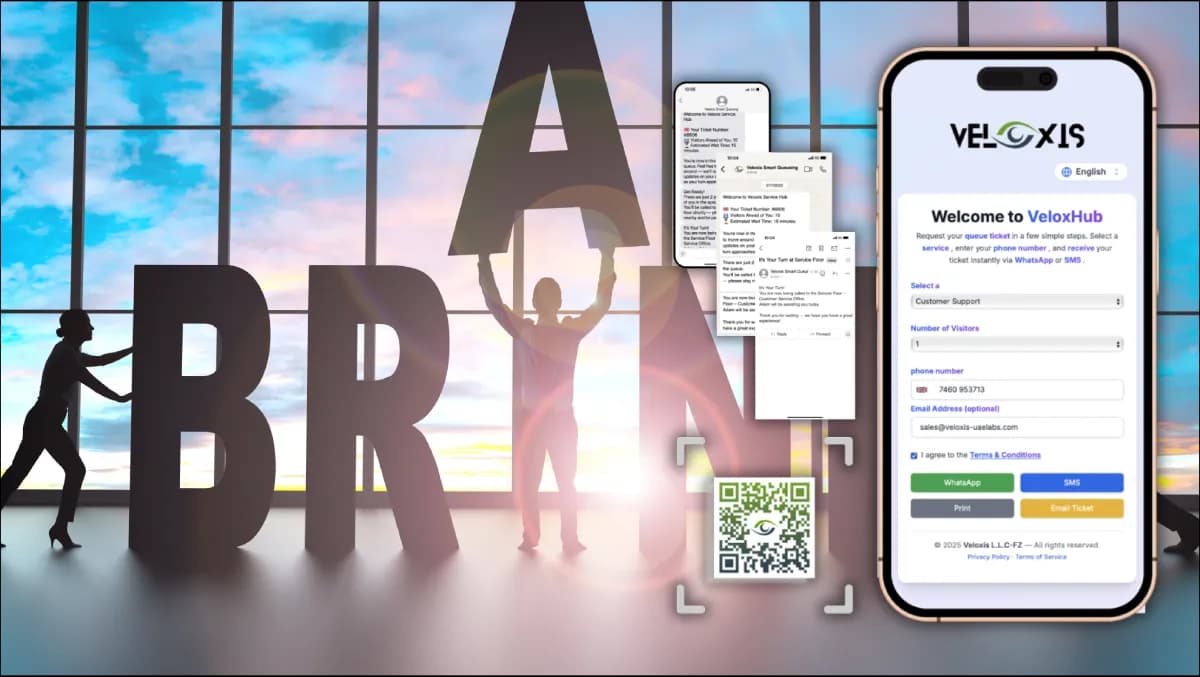
Virtual queueing in this context is the orchestration layer that issues guests a position by QR scan, WhatsApp link or pre-registered email; informs them by message of their estimated entry window; lets them wait 200 metres away instead of in front of the door; routes the four tiers (VIP / press / influencer / public) to the right door on the right schedule; and captures attendance data with explicit GDPR consent at the moment of entry. Under the hood, the platform owns the position queue, the messaging surface, the tier-routing logic, the content-capture pickup loop inside the venue (the second queue, for the photo wall or the immersive room), the cashless payment for any in-venue purchase, and the post-activation feedback survey via WhatsApp.
What separates a brand-grade platform from a generic queue product is whether the entire surface can be white-labelled to the brand's design language. Logo on the link page is not enough — the WhatsApp template tone, the position-update copy, the SMS sender ID, the colour of the digital signage at the venue, the typography of the printed receipt, the email confirmation, even the favicon on the public web page all have to align with the brand's identity. The instant the guest sees a generic "You're number 47 in the queue" the activation breaks. Treat the platform as a brand asset, not infrastructure.
A credible 2026 stack treats GDPR + photo consent capture as first-class, not an addendum. Photo and video at brand activations are the campaign's earned-media payload. The platform must capture explicit, granular, photo-specific consent at entry (separate tickboxes for editorial use, social media use, paid media use, web use, with timestamped audit trail) or the entire campaign's photo bank is unusable. This is one of the most common compliance failures in the category.
The brand activation playbook — 9 components
The sub-vertical breaks into nine operating components. Each must be specified in Discovery and rehearsed before the doors open.
- 1Tier-segmented door schedule. Why for this sub-vertical: VIP arrive at 18:00 for cocktails, press at 18:30 for guided tour, influencers at 19:30 for content capture, public at 20:00 for general access; the schedule is enforced or the activation breaks. Operator playbook: configure the platform with four distinct windows per door, each with its own message tone and arrival nudge; enforce with door-staff tablet showing the next-N-arrivals list, refreshed every 30 seconds.
- 2Branded pre-registration link. Why: the registration moment is where consent is captured and the brand's CRM gets a new contact; this is the activation's only durable conversion. Operator playbook: one short branded URL per activation (e.g. brand.com/event-city), one-page form, name + phone + email + four GDPR tickboxes; webhook to Salesforce Marketing Cloud, HubSpot or the brand's CRM within 30 seconds.
- 3Multi-channel position updates. Why: guests are on the move between dinner, drinks and the activation; they need updates on the channel they actually check, which varies by demographic and country. Operator playbook: parallel WhatsApp + SMS + email; let the guest pick at registration; default to WhatsApp in Italy, Spain, Brazil; default to SMS in Germany and the UK; default to email for the press tier.
- 4Tier-routed door arrival flow. Why: the wrong door for a VIP arrival is a status incident; the wrong door for a press arrival is a missed photo opportunity. Operator playbook: a separate QR / link per tier; staff at the door scan once and the platform decides routing; mistakes are visible on the staff tablet within 5 seconds.
- 5Content-capture pickup queue. Why: the photo wall, the immersive room, the bespoke installation is where Instagram throughput happens; treat it as a second queue. Operator playbook: a separate in-venue queue with its own QR; guests scan when they arrive at the photo area, get a 3-15 minute waiting position, the platform pings when their slot is ready; venue avoids 40-deep crowding around a single backdrop.
- 6Cashless in-venue transactions. Why: drinks, merchandise, brand collaboration purchases all happen at the activation; cash slows everything and breaks the brand polish. Operator playbook: Visa + Mastercard + Apple Pay + Google Pay tap terminals from Ingenico, PAX or Verifone; payment processor via Stripe or Adyen depending on the brand's existing acquirer relationship.
- 7GDPR + photo consent capture. Why: photo and video are the campaign's earned-media payload; without explicit, granular consent the photo bank is unusable. Operator playbook: four separate consent tickboxes at registration (editorial / social / paid / web), timestamped, exportable to the legal team's evidence pack; consent withdrawal flow active for 30 days after the activation.
- 8Multi-city tour replication. Why: a six-city European brand tour cannot afford per-city replatforming; one configuration must work in five capitals with language and local-formatting adjustments. Operator playbook: the platform templates the activation once, clones it per city, layers city-specific language packs and local-format adjustments (date format, address format, phone-number format, currency display); rollout 5 cities in 8 weeks is a realistic target.
- 9Post-activation feedback + brand recall survey. Why: the activation's success is measured in earned media + post-event brand recall; only a structured feedback loop captures both. Operator playbook: WhatsApp survey 24 hours after attendance; 4-6 questions max; recall + NPS + intent-to-purchase; results flow into the brand's customer feedback dashboard.
How do you choose between QR + WhatsApp, native app, and hybrid?
The core architecture decision determines whether the activation hits its attendance target.
| Dimension | QR + WhatsApp + SMS | Native app | Hybrid (web + light app) |
|---|---|---|---|
| Friction to join | Lowest — scan + tap | Highest — app store + install + signup | Medium |
| Brand-asset fit | High — white-labelled link page | High when designed well, low when generic | Medium |
| GDPR consent capture | First-class at registration | Buried in app onboarding | Variable |
| Multi-channel updates | Native | Push notifications only (often disabled) | Mixed |
| Tier routing | Per-link tier-tagged | Configurable in app | Web side handles it |
| Multi-city tour replication | Trivial — clone template | Re-submit app per city | Web side trivial |
| Cost-to-attend conversion | Highest (80-95% intent-to-attend) | Lowest (30-50%) | Medium (60-75%) |
The right answer for 95% of European brand activations is QR + WhatsApp + SMS. The native-app approach loses 40-60% of intended attendance to app-install friction. The hybrid model fits only when the brand already has a high-engagement loyalty app with daily active users (rare outside luxury beauty and a handful of fashion houses). Bias towards the lowest-friction architecture and earn engagement with the experience itself, not the queue surface.
> Want a fixed-fee scope for your next activation before the end of the call? Talk to Zeour engineering — 30-minute scoping conversation, no slideware, and a published pricing band by the time we hang up. We have shipped virtual queueing for pop-up events across the UK and Europe.
How much does virtual queueing for brand activations cost in 2026?
Published bands — agencies and in-house brand teams can budget against these honestly.
- Discovery (fixed-fee): £4k-£12k for a single-activation Discovery; £15k-£40k for a multi-city tour Discovery with shared template + per-city adjustment plan. Output: published Build price, integration map, message-template library, GDPR consent flow, multi-city rollout sequence.
- Per-activation Build: £15k-£60k depending on tier complexity, language count, content-capture pickup queue, in-venue payment integration and CRM-webhook depth.
- Per operating day: £2k-£10k for a multi-city flagship activation; covers platform operation, message-volume cost, on-site engineering support, dashboard monitoring.
- Multi-city European tour: £80k-£400k for a 5-6 city tour over 8-12 weeks; includes one Build + per-city language packs + per-city operating days + post-tour analytics.
- Hardware bands: digital signage at venue £200-£800 per screen (rental or supplied), tablet at door £150-£400, QR / link printed signage £50-£200 per print run, payment terminal (Ingenico, PAX, Verifone) £400-£900 per unit.
- Care Plan (multi-activation): £30k-£150k per year for a brand running 4-12 activations annually — covers platform operation, message-volume burst capacity, evolving templates, on-call engineering during live windows.
At these levels, the platform cost is typically 3-8% of the activation's total budget — well within the bracket where the platform should be a brand-positive investment rather than a pure infrastructure cost.
ROI calculator — build a defensible business case in 7 steps
Step 1 — measure the baseline attendance gap
- Invited × baseline arrival % (typically 45-65% for free RSVP activations without virtual queue) = baseline attendees
- Compare against capacity-based ideal attendance per door window
Step 2 — apply intent-to-attend uplift from low-friction architecture
- QR + WhatsApp + SMS architecture lifts intent-to-attend conversion 20-35 percentage points over native-app pre-registration
- Apply uplift × invited list × per-attendee earned-media value
Step 3 — calculate earned-media value lift from content-capture flow
- Per-attendee Instagram post probability (typically 12-28% at brand activations)
- × media-equivalent value (per post benchmark from the brand's media-buying team — typically £40-£250 for fashion / luxury / automotive)
- × incremental attendance from Steps 1-2 = incremental earned-media value
Step 4 — calculate CRM-record value from registration capture
- Captured opt-in records × consent-tier weighting × per-record CLV uplift
- For luxury, automotive and beauty, an opt-in event-captured CRM record is worth £40-£250 in incremental campaign reach
Step 5 — add operational savings versus historical activation operating cost
- Door-staff hours saved by automated arrival routing × hourly cost
- PR-team hours saved by automated tier scheduling × hourly cost
- Compliance / consent capture time saved versus manual tickbox-on-paper × hourly cost + risk-of-non-consent avoided
Step 6 — subtract the all-in platform cost
- Per-activation Build + per-day operation × activation days + share of multi-city Discovery × per-city operation cost
Step 7 — present the per-activation and per-campaign return
- Per-activation return = (Steps 2-5 summed) − Step 6
- Per-campaign return = sum across all activations in the campaign
For a 6-city European luxury tour with 12k expected attendance per city, the typical 8-week campaign delivers £1.4M-£3.8M incremental earned-media + CRM-record value against an £180k-£280k all-in platform cost. The platform is 5-7% of the campaign budget and contributes 35-55% of the campaign's measurable downstream uplift.
Seven failure modes from real activation deployments
Failure mode 1: forcing app install at registration. The brand insists on a native app because the marketing leader has a 2022 PowerPoint that says "engagement". Result: 40-60% of intended attendance never arrives. Fix: keep the app, add a parallel QR + WhatsApp + SMS path, instrument both, let the data decide for the next activation.
Failure mode 2: queue surface visibly off-brand. Guest scans the QR and lands on a queue page with the platform vendor's colours, typography and tone. The activation's brand polish breaks on contact. Fix: contractually require white-label UX in the Build phase; sign off on the queue page screen-by-screen during Pilot.
Failure mode 3: GDPR consent collected wholesale, not granular. Single tickbox "I agree to terms" covers photo, paid media, social, editorial. Legal team blocks the photo bank from use. Fix: four separate tickboxes at registration with explicit per-use language; timestamped audit trail exported to the legal evidence pack within 24 hours of event close.
Failure mode 4: tier-routing without enforcement at the door. Press and VIP both arrive at the same door, no staff tablet, no visible cue, both queues collide. Fix: per-tier QR, staff tablet at door with next-N-arrivals list, enforced 30-second refresh.
Failure mode 5: content-capture pickup not queued. A 40-person crowd forms around the photo wall, Instagram throughput collapses, earned-media value drops 50%. Fix: second virtual queue inside the venue, dedicated to the content-capture installation, with 3-15 minute slot allocation.
Failure mode 6: city-by-city replatforming. Build Milan, then build Paris from scratch because the local agency uses a different tooling. Costs double, schedule slips. Fix: one platform configuration cloned per city in Discovery; language packs added in the per-city operating day fee; reject any platform that cannot template + clone.
Failure mode 7: no post-activation feedback loop. Activation runs, attendance hits, photos go out, no quantitative recall data captured. CMO cannot defend the budget at next quarter's review. Fix: WhatsApp survey 24 hours after attendance, 4-6 questions, results flow into the brand's customer feedback dashboard alongside earned-media count.
Migration path — moving from your current event-flow stack
Phase A — Single-activation pilot. Apply the platform to one upcoming European activation in parallel with the brand's current event-management approach. Measure: registration conversion, attendance rate, content-capture throughput, post-activation NPS, CRM-record growth. Time: one activation cycle.
Phase B — Template formalisation. Convert the pilot configuration into a reusable template that the agency or in-house team can clone for the next activation. Time: 2 weeks.
Phase C — Multi-city tour rollout. Clone the template across 4-6 European cities for the next campaign tour. Layer language packs and local-format adjustments. Time: 4-8 weeks across the campaign window.
Phase D — Annual Care Plan. Move to a multi-activation Care Plan for the brand's full annual event calendar. Time: open-ended; review quarterly.
Implementation playbook (per-activation delivery)
- 1Scoping (1-2 weeks). Stakeholder workshop with brand, agency, venue. Output: activation profile, tier schedule, message templates, GDPR consent flow, integration map (CRM webhook, payment processor, signage), per-city language requirements, published Build price.
- 2Setup (1-2 weeks). Platform configured per template, white-label UX signed off screen-by-screen, message templates translated and approved per locale, CRM webhook tested end-to-end, payment terminals provisioned, on-site digital signage prepared.
- 3Rehearsal (1 day). Dry run on-site with door staff, content-capture staff, security, agency event lead. Test: tier routing, door scan, content-capture queue, payment, message delivery. Sign off the run sheet.
- 4Live activation (1-14 days). On-site engineering presence for first 24 hours of every venue. Real-time dashboard monitoring. Hourly attendance + tier-progress report to the agency event lead. Hot-fix capacity for tier window adjustments mid-event.
- 5Post-activation readout (1 week after event). Earned-media count, CRM-record growth, NPS, recall, intent-to-purchase summary. Per-tier breakdown. Recommendation for next activation. Feedback loop into the feedback system.
Frequently asked questions
How do you handle the GDPR + photo consent capture flow for European brand activations?
Four separate tickboxes at registration — editorial use, social media use, paid media use, web use — each with explicit per-use language, all timestamped, exportable as a CSV to the brand's legal team within 24 hours of event close. Consent withdrawal flow active for 30 days post-activation. Without this, the photo bank is legally unusable and the campaign's earned-media payload collapses. Do not let any vendor sell you a single "I agree" tickbox.
How do you make virtual queueing feel like brand experience instead of infrastructure?
White-label every surface — the QR landing page, the WhatsApp template tone, the SMS sender ID, the email confirmation, the on-site signage, the printed receipts, even the favicon — to the brand's identity. Specify this contractually during the Build phase and sign off screen-by-screen during Pilot. The instant the guest sees a generic queue product, the activation breaks suspension of disbelief.
How do you handle multi-city European tours without per-city replatforming?
One platform configuration templated in Discovery, cloned per city, layered with city-specific language packs and local-format adjustments (date format, address format, phone-number format, currency display, mada / local-acquirer for any in-venue payment). A 5-6 city European tour rolls out in 8-12 weeks against a single Discovery + single Build. Reject any platform that requires per-city rebuild.
How do you tier-segment VIP, press, influencer and public arrivals?
A separate QR / link per tier issued at registration, each tagged with the tier; staff at the door scan once and the platform routes the guest to the right window; mistakes appear on the staff tablet within 5 seconds. The four tiers arrive on different timelines (typically VIP at 18:00 cocktails, press at 18:30 guided tour, influencers at 19:30 content capture, public at 20:00 general access) and the platform enforces this.
What's the per-event ROI of virtual queueing for a multi-city luxury tour?
For a 6-city European luxury tour with 12k expected attendance per city, the typical 8-week campaign delivers £1.4M-£3.8M incremental earned-media + CRM-record value against an £180k-£280k all-in platform cost. The platform is 5-7% of the campaign budget and contributes 35-55% of the measurable downstream uplift. Earned-media value, CRM-record growth, and brand-recall lift are the three measurable contributions.
How do you integrate with Salesforce Marketing Cloud or HubSpot for the CRM record capture?
Webhook from the registration form fires within 30 seconds to the brand's CRM endpoint. Fields included: name, phone, email, four GDPR consent flags, source (which activation + city), tier (VIP / press / influencer / public). For Salesforce Marketing Cloud, the standard Data Extension target accepts these fields directly; for HubSpot, the standard contact-create endpoint with custom properties. Test the round-trip during Pilot.
How does the content-capture pickup queue work inside the venue?
A second virtual queue dedicated to the photo wall or immersive installation. Guests scan a separate QR when they arrive at the content area, receive a 3-15 minute slot allocation, get a WhatsApp ping when their slot is ready. The venue avoids 40-deep crowding around a single backdrop, Instagram throughput stays high, earned-media value preserved. Mandatory for any activation where photo / video is a campaign deliverable.
Should we white-label the WhatsApp Business sender or use the platform's?
White-label the WhatsApp Business sender to the brand's official BSP-authorised number. If the operator (brand) holds the BSP contract directly, the phone number transfers if the brand changes vendor — the platform's templates can move with you. If the platform holds the BSP contract, you lose the number and the template library at vendor exit. Hold the BSP contract directly. See the broader WhatsApp Business API enterprise playbook for the contracting posture.
How do you handle language packs across a multi-city EU tour?
English + Arabic full RTL ships as the engineered baseline at Zeour; French, Spanish, German, Italian, Dutch, Portuguese, Turkish, Urdu, Hindi and more are added per engagement as framework-layer changes plus translation. A typical European tour layers EN + French + Italian + Spanish + German into a single template; the per-city language pack is a configuration overlay, not a code change.
What does Zeour's deployment look like for a luxury brand's annual European calendar?
A single Discovery scopes the brand's full annual activation calendar (typically 4-12 activations). One platform template + one Care Plan covers all of them. Per-activation we layer city-specific language packs and venue-specific door schedules. The brand owns the registration data, the consent log and the post-activation analytics inside their own perimeter; the platform is operated on a fixed-fee phased engagement model with a 90-day exit window. Reference deployment: see the Space NK UK pop-up events case for a structurally-similar retail activation programme.
Where Zeour fits
Zeour ships virtual queueing as part of the GLARUS customer-flow ecosystem — alongside the queue management system, online appointment booking, the customer feedback system, self-service kiosks and the GRAVIA digital signage CMS. The reference deployment for the European brand-activation use case is the Space NK UK pop-up events programme. For the wider context, see the parent virtual queueing for events and pop-ups across the UK and Europe, the virtual queueing for music festivals in Europe, the virtual queueing for museum exhibitions in EU playbook, and the WhatsApp Business API enterprise playbook. Zeour delivers from London across retail, airports, education and adjacent sectors, with the same fixed-fee phased engagement and 90-day exit window across UK, EU, Americas, GCC, MENA, Africa and Asia. To scope your next activation: book a 30-minute scoping call, check the published pricing bands, or browse the case studies, the glossary and the rest of the Zeour blog.
---
Last updated: May 17, 2026 — by the Zeour engineering team.