Key takeaways
- Blockbuster EU exhibitions sell 300,000-700,000 timed-entry tickets across a 12-16 week run, with peak Saturdays touching 4,500-5,200 visitors against a fire-marshal capacity of 350-500 concurrent guests in-gallery.
- The reference mix is 70% pre-booked / 30% walk-up, with member-priority and accessibility-first lanes carved out of both pools.
- Timed-entry slots of 15 minutes are the European norm; over-issue 20-25% to absorb no-shows without breaching capacity.
- Tourist exhibitions in EU capitals routinely need 8 visitor-facing languages — English plus the local language plus French, Spanish, German, Italian, Japanese, Mandarin.
- Per-exhibition virtual-queueing builds land in the £25k-£100k range; per-day operation is £2k-£8k; permanent installations sit at £80k-£300k.
- Accessibility is the threshold the entire system clears: WCAG 2.2 AA, wheelchair routing, sign-language tour windows, audio-guide-aware capacity bands.
- GDPR discipline matters more in museums than in almost any other event sub-vertical because tourist data crosses jurisdictions in and out.
A blockbuster exhibition is a four-month operational concert — capacity-bound, tourist-heavy, accessibility-critical, and judged in equal parts by curators, fire marshals, and TripAdvisor. This playbook is how we deploy virtual queueing for major museum exhibitions across European capitals: timed-entry slot discipline, walk-in absorption, accessibility-first routing, eight-language tourist UX, and GDPR posture that survives auditors from any member state. It is the same engineering spine we run for retail pop-up events and enterprise help-desk activations, tuned for the cadence of a 14-week cultural programme.
Who this guide is for
- Museum visitor-services director. You own the doors, the gallery counts, the complaints inbox, and the operational difference between a five-star and a three-star review. You need a virtual queue management system that absorbs walk-ups without breaching the fire-marshal cap.
- Exhibition curator-operations lead. You translate curatorial intent ("Rooms 4 and 7 are the dwell rooms; Room 3 is the bottleneck") into capacity bands, dwell estimates, and slot sizing.
- Cultural institution programmes manager. You commission the technology stack for the season, hold the fixed-fee budget, and answer to the trustees on per-visitor cost.
- Tourism-board liaison. You coordinate with city tourism boards, hotel concierge desks, coach-tour operators, and inbound travel agencies — you care about multilingual UX and about not collapsing the city-pass scheme on opening weekend.
What is virtual queueing for museum exhibitions in 2026?
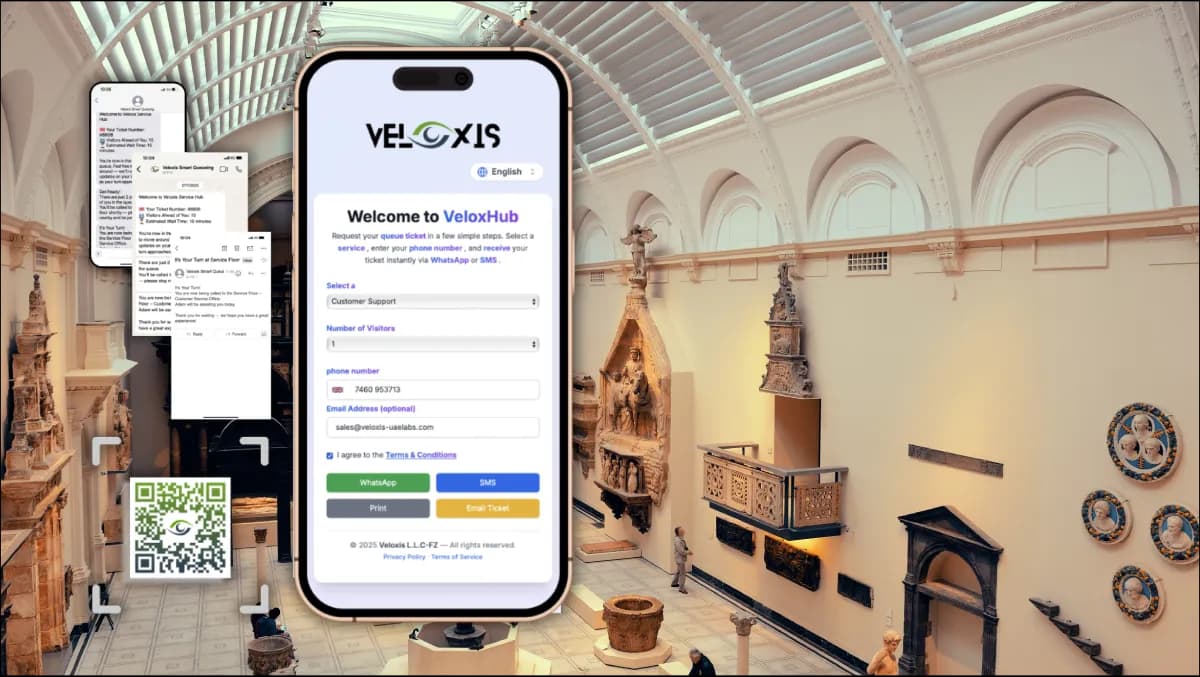
Virtual queueing replaces a physical line outside the entrance with a digital position the visitor holds on their phone (or a printed timed-entry ticket, or on the museum's wayfinding screens). The visitor receives a slot — typically a 15-minute timed-entry block — and is admitted when their slot opens, not when they physically arrive at the door. Walk-ups are funnelled into the same slot grid, given the next available band, and messaged when their window opens. The cousin discipline of online appointment scheduling covers the booking side.
Traditional approaches fail at exhibition scale for three structural reasons. First, fire-marshal capacity is not negotiable — a gallery rated for 380 concurrent visitors will be closed by the regulator the day after it admits 520. A physical line does not enforce capacity; it merely delays the breach. Second, weather destroys queue economics — a 90-minute outdoor line in 4°C Berlin January or 33°C Madrid August loses 30-45% of the queue to abandonment, with a long tail of negative reviews. Third, tourists are time-constrained — a visitor on a four-day Paris-Amsterdam-Berlin trip will not wait two hours for one room.
Virtual queueing wins because it lets the museum sell against the real capacity ceiling (fire-marshal, insurer, curatorial-dwell) rather than the optimistic ceiling ("we hope 5,000 will show today"). It also gives the visitor agency: walk-ups can see the next available slot before committing to the courtyard, and pre-booked guests can convert a booking into a real entry time without anxiety. The wider queue management system discipline applies, but the event-shaped variant has its own playbook.
The other reason virtual queueing wins for museums is that it is the only model that survives an accessibility audit. A physical line cannot route a wheelchair user to a step-free entrance, cannot reserve front-row capacity for a sign-language tour, and cannot enforce WCAG 2.2 AA on a paper ticket. A virtual queueing platform can — by design, not by exception.
The museum-exhibition virtual-queueing playbook — 10 components
- 1Timed-entry slot grid (15-minute blocks).
- 2 Why for this sub-vertical: curatorial dwell across a major retrospective runs 60-90 minutes; admitting in 15-minute bands smooths in-gallery density and gives cloakroom + audio-guide desks a workable cadence.
- 3 Operator playbook: divide opening hours into 15-minute slots; set max per slot = (fire-marshal cap × refresh rate); over-issue 20-25% to absorb predictable no-shows; lock the last 4 slots from over-issuance to avoid trapping late arrivals.
- 2Capacity-band enforcement.
- 2 Why for this sub-vertical: fire marshals, insurers, and the local heritage authority each carry a number — usually different. The system enforces the lowest of the three, automatically, with a visible margin.
- 3 Operator playbook: configure three capacity rails (fire, insurer, curatorial); display live in-gallery count on a back-of-house screen; auto-pause new admissions at the curatorial rail, alert at the insurer rail, hard-stop at the fire rail.
- 3Walk-in absorption (target 30% of daily admits).
- 2 Why for this sub-vertical: tourist cities have unplanned visitors — a hotel-concierge recommendation, a flat day, a missed flight. Capturing them without breaking pre-booked promises is the operational art.
- 3 Operator playbook: hold 25-35% of every slot for walk-ups; offer them via QR at the entrance and on-site self-service kiosks; message walk-ups via SMS or WhatsApp when their slot opens; cap walk-in lead times at 90 minutes.
- 4Member-priority routing.
- 2 Why for this sub-vertical: members fund the institution, and member experience is a year-round retention question. Priority needs to be real, visible, and respected by the door.
- 3 Operator playbook: member tickets enter a parallel slot pool sized to ~15% of capacity; member walk-ups admitted within 20 minutes on average; if held longer, push a complimentary coffee voucher; track member CSAT and NPS separately.
- 5Accessibility-first lane.
- 2 Why for this sub-vertical: wheelchair routing, sign-language tour windows, audio-described tours, sensory-friendly hours, and assistance-dog accommodation are non-negotiable. The system has to know the visitor's needs at booking and at the door.
- 3 Operator playbook: accessibility needs collected at booking with an explicit consent toggle; the door device shows the host a discrete prompt; reserve capacity for assisted-tour windows; ensure every visitor-facing surface clears WCAG 2.2 AA.
- 6Multilingual visitor UX (8 languages).
- 2 Why for this sub-vertical: a London or Amsterdam blockbuster will receive Japanese tour groups, Spanish school trips, German families, Mandarin-speaking solo visitors, French weekenders, and Italian art students in the same hour.
- 3 Operator playbook: deploy in EN + local + FR + ES + DE + IT + JA + ZH by default; let the visitor pick at QR-scan time; remember the preference; render wait timer, slot reminder, and entry call in the chosen language. This is the engineered-multilingual posture we ship across the GLARUS portfolio.
- 7Group-tour orchestration.
- 2 Why for this sub-vertical: coach tours, school trips, and travel-agent groups arrive as 20-50 visitors at once. Admitting them as a single block protects in-gallery density.
- 3 Operator playbook: group bookings reserved as a contiguous slot bundle; lead organiser receives a single QR; group members enter with a counted-down clicker at the door; pre-book audio-guide bundles to remove the in-gallery purchase queue.
- 8Wayfinding integration.
- 2 Why for this sub-vertical: admitted visitors need to find the exhibition without crossing the permanent collection, the gift shop, or the school-group cloakroom. Wayfinding plus virtual queue is one system.
- 3 Operator playbook: integrate with interactive wayfinding so the entry call includes the route; render the route in the visitor's chosen language; on egress, route to gift shop, cloakroom, exit.
- 9Digital-signage capacity messaging.
- 2 Why for this sub-vertical: visitors waiting in the courtyard, the cafe, or the foyer need a live status board. "Now serving slot 14:45" beats every concierge phone call.
- 3 Operator playbook: run digital signage at the entrance, cafe, and cloakroom; show now-serving slot + walk-in next-available + accessibility-tour windows; mirror to the museum's web page so off-site visitors plan their arrival.
- 10Post-visit feedback capture.
- 2 Why for this sub-vertical: exhibitions live or die on word-of-mouth; you have one window after the visit to capture a real review.
- 3 Operator playbook: deploy a customer feedback system at the exit and via the slot ticket; ask three questions max in the visitor's language; share the daily roll-up with the curator + visitor-services lead; surface negative responses to the floor team within four hours.
How do you choose between QR + WhatsApp, native app, and hybrid?
The choice of join channel is the single decision that determines walk-in abandonment rate. The trade-offs:
| Dimension | QR + WhatsApp / SMS / web | Native museum app | Hybrid (QR primary + light PWA) |
|---|---|---|---|
| Visitor friction to join | None — point camera, link opens | High — app download, account, push permission | None — same QR; PWA installs only if visitor chooses |
| Tourist usability | Excellent in every language at URL level | Poor — tourists will not install for a 90-min visit | Excellent |
| Member retention | Good — link can offer member sign-in | Excellent — push, year-round engagement | Excellent — PWA holds session for members |
| Accessibility | Strong — browser handles screen reader, font, contrast | Variable — depends on app WCAG conformance | Strong |
| GDPR / data minimisation | Strongest — no installed identifier | Weakest — device identifiers persist | Strong |
| Build cost | Low (£25k-£60k) | High (£120k-£400k) | Mid (£40k-£100k) |
| Maintenance | Low | High — iOS + Android update churn | Low |
For exhibition-scale tourist deployments, the answer is QR + WhatsApp + SMS + web, with a lightweight PWA option for members who want the year-round experience. Native museum apps are valid for the institution's overall product, but they should not be the entry path for a 14-week show. How we ship the messaging layer is in the WhatsApp + SMS implementation guide.
> Want a fixed-fee scope for your next exhibition before the end of the call? Talk to Zeour engineering — 30-minute scoping call, no slideware, a published pricing band by the time we hang up.
How much does virtual queueing for museum exhibitions cost in 2026?
We price exhibition virtual queueing on three shapes: a one-off per-exhibition build, a per-day operational fee, and a permanent installation for institutions that run rolling programmes.
- Per-exhibition Build (fixed-fee). £25k-£100k depending on languages, integrations, signage scope, and accessibility surface area. The lower band is a 4-language, 12-week run with QR + SMS only. The upper band is an 8-language, 16-week blockbuster with WhatsApp, signage, wayfinding integration, accessibility-tour windows, and a custom branded UX.
- Per-day operation. £2k-£8k for a fully managed run — platform, monitoring, on-call escalation, daily readout, weekly capacity tuning. Quiet weekdays sit near the floor; peak Saturdays near the ceiling.
- Permanent installation Build (fixed-fee). £80k-£300k for institutions running rolling programmes, where the same platform serves consecutive exhibitions, member events, school programmes, and after-hours activations.
- Hardware. Door scanners + signage rental run £800-£2,200 per day. Self-service kiosks for walk-up join are £3k-£8k per unit purchased outright, or £250-£600 per kiosk per day rented for the run.
- Care plan (multi-exhibition). £40k-£140k per year for institutions putting on 3-6 major shows per year — covers platform, monitoring, evolution, and per-exhibition reconfiguration.
Every quote is fixed-fee and milestone-paid. We do not bill on a per-visitor or per-transaction model for exhibitions; operational predictability matters more than optimisation upside, and curators do not want a budget that scales with attendance.
ROI calculator — build a defensible business case in 7 steps
Step 1 — Forecast visitor demand against capacity
A blockbuster in a top-20 EU capital museum will attract 300k-700k visitors across 14 weeks. Divide by opening days (84-96 days for a 14-week run) to get daily mean. Compute peak day (Saturday) as 1.6-2.1× mean. If peak day > fire-marshal hourly capacity × hours, virtual queueing is mandatory, not optional.
Step 2 — Estimate physical-line losses
A 90-minute physical queue in adverse weather will lose 30-45% of arrivals to abandonment; even in good weather, a 60-minute line loses 15-22%. Multiply lost arrivals × average ticket price + ancillary spend (audio guide + gift shop + cafe = 65-110% of ticket price) to get the daily revenue leak.
Step 3 — Convert to reclaimed revenue
Virtual queueing recovers 70-85% of abandoned demand because the visitor can wait in the cafe, the city, or back at the hotel. Calculate reclaimed revenue per day × operating days = annual gross uplift.
Step 4 — Estimate complaint reduction
Queue-related issues account for 55-72% of complaints during blockbusters. Virtual queueing reduces them by 75-88%. Each formal complaint costs £18-£42 in handling time + remediation.
Step 5 — Quantify accessibility uplift
Accessibility-first routing increases bookings from visitors with disabilities by 35-60% — most disabled visitors avoid blockbusters specifically because of unmanageable queues. This is both a revenue and a regulatory win.
Step 6 — Member-retention uplift
Member-priority routing typically lifts annual member renewal by 8-15% on first deployment, because members feel the value of their membership for the first time during a blockbuster.
Step 7 — Build the totals
Sum reclaimed revenue + complaint savings + accessibility uplift + member-retention NPV. Divide by per-exhibition Build + per-day operation × days. Payback for a single blockbuster lands at week 3-5; full-year ROI for an institutional Care Plan typically hits 4-9× in year one.
Worked example: a 14-week exhibition with 350k expected visitors at a major EU capital museum, average ticket £22, ancillary spend £18 per visitor, daily complaint cost £900, member uplift on a 22,000-member base. Reclaimed revenue alone: ~£1.4M over the run. Build £75k + operations £4.2k × 94 days = ~£470k total. Net: ~£930k in year one before counting member retention, accessibility uplift, and complaint savings.
Seven failure modes from museum-exhibition deployments
1. Slot over-issuance with no margin. Issuing at 100% of capacity is mathematically optimal and operationally fatal. Fix: over-issue 20-25%, hold the last 4 slots clean, monitor real-time in-gallery count, auto-pause new admissions if you breach the curatorial rail.
2. Walk-in pool starved. If 100% of capacity sells to pre-bookings, the courtyard fills with hotel-concierge-sent visitors who cannot be admitted. Fix: protect 25-35% of every slot for walk-ups; honour walk-up slots even if pre-bookings are full; never resell a walk-up slot to a late pre-booking.
3. Single-language UX. Deploying in English only for a tourist city is a 2010s mistake. Fix: deploy the 8-language baseline from day one; budget translation review with native-speaker tour guides, not literal translation.
4. Accessibility as an afterthought. If accessibility appears as a checkbox rather than a routing primitive, you will be the museum the local disability advocacy group writes about in the broadsheets. Fix: accessibility lane sized at 8-12% of capacity, audio-guide-aware dwell estimates, sign-language tour windows pre-allocated weeks in advance, WCAG 2.2 AA conformance audited before opening.
5. Member-priority that members do not feel. If members are routed into the same pool as the general public, the £85-£150 annual membership stops feeling worth it. Fix: visible member fast-track, sub-20-minute walk-up admit for members, separate member CSAT tracking, complimentary recovery when the system slips.
6. GDPR posture that does not survive the audit. Museum visitor data crosses jurisdictions at arrival, booking, messaging, and survey. Each hop has GDPR implications. Fix: minimise data collection at booking, store messaging consent explicitly, default to EU data residency, sign a DPA with every processor, retain visitor data for the minimum period required.
7. Post-event readout that never reaches the curator. The operational data is gold for the next exhibition. Most museums leave it in a dashboard nobody reads. Fix: weekly 1-page readout for the curator + visitor-services director; daily WhatsApp digest for the floor team; closing-week deep-dive that informs the next exhibition's slot grid.
Migration path — moving from your current exhibition-flow stack
Phase A — Discovery (1-2 weeks)
We walk the venue with the visitor-services director and the curator. We capture the fire-marshal cap, the insurer cap, the curatorial-dwell estimate, the gallery flow, the accessibility surface, and the language mix. We deliver a fixed-fee scope, a slot-grid design, and a capacity-rail proposal.
Phase B — Build + integration (2-4 weeks)
We wire the booking platform (most museums use a primary ticketing partner; we integrate at the ticket-issued webhook), the messaging stack (WhatsApp + SMS + web), the door scanners, the digital signage, the wayfinding layer, and the accessibility hooks. We ship the 8-language UX and harden GDPR — explicit consent at every channel, DPA with every processor.
Phase C — Rehearsal (1 day)
A full-day dry run with the floor team, typically the Saturday before opening week. We run synthetic traffic at 1.6× expected peak, exercise the capacity rails, walk the accessibility lane, and test the multilingual UX in all 8 languages with native-speaker stand-ins. Snag list closes by end of day.
Phase D — Live operation + readout
From opening to closing day, the platform runs with daily monitoring and a weekly readout. Capacity tuning happens weekly based on actual dwell, no-show rates, walk-in conversion, and complaint themes. Closing-week deep-dive feeds the next exhibition's slot grid.
Implementation playbook (per-exhibition delivery)
- 1Scoping (1-2 weeks). Venue walk, capacity-rail capture, slot-grid design, language mix, accessibility surface, GDPR review, integration map. Fixed-fee scope at the end.
- 2Setup (2-4 weeks). Build, integration to ticketing + messaging + signage + wayfinding, 8-language UX deployment, accessibility audit, GDPR posture lock-in.
- 3Rehearsal (1 day). Full-day dry run at 1.6× expected peak with the floor team, accessibility lane test, multilingual stand-ins for each language.
- 4Live exhibition (12-16 weeks). Daily monitoring, weekly capacity tuning, weekly readout to curator + visitor-services director, daily floor-team digest.
- 5Post-exhibition readout (1 week). Slot fill rates, walk-up conversion by channel, accessibility-lane usage, language mix actual vs forecast, complaint themes, member CSAT vs general public.
Frequently asked questions
How long does it take to deploy virtual queueing for a 14-week museum exhibition?
Standard timeline is 5-7 weeks from kick-off to opening day: 1-2 weeks Discovery, 2-4 weeks Build, 1 day rehearsal, then opening. We have shipped tighter — 3 weeks for a partner museum running an unplanned blockbuster — but 5-7 weeks gives proper rehearsal and an accessibility audit before the doors open.
What is the right split between pre-booked tickets and walk-ups?
The European norm for blockbusters is 70/30 pre-booked / walk-up, and this is what we configure by default. A niche specialist retrospective often runs 85/15 because the audience plans ahead; a populist immersive show often runs 60/40 because the audience is more spontaneous. We tune the split weekly during the run.
Can the system enforce capacity limits set by the fire marshal and the insurer separately?
Yes. We configure three capacity rails — fire, insurer, and curatorial — and the system enforces the lowest of the three with a visible margin. The floor team sees the live in-gallery count; admissions auto-pause at the curatorial rail and hard-stop at the fire rail. This is the only configuration that survives both an insurance audit and a fire-marshal walkthrough.
How do you handle wheelchair routing and accessibility tours?
Accessibility is a first-class routing primitive, not a feature. Visitors declare needs at booking with explicit consent; the door device shows the host a discrete prompt; the system reserves a parallel accessibility lane sized at 8-12%; sign-language and audio-described tours have pre-allocated slot windows; every visitor-facing surface clears WCAG 2.2 AA. Our retail industry deployments and education sector work carry the same posture.
How many languages do you support out of the box for tourist exhibitions?
By default, eight: English, the local language, French, Spanish, German, Italian, Japanese, Mandarin. The visitor picks at QR-scan time; the platform remembers the preference; the wait timer, slot reminder, and entry call render in their chosen language. We add languages per engagement — Korean, Portuguese, Dutch, Arabic, Hindi, Turkish are common adds — under the engineered-multilingual posture we ship across every GLARUS product.
What does GDPR compliance look like for tourist visitor data?
The baseline is data minimisation at booking, explicit consent for messaging (separate from booking consent), default EU data residency, signed DPAs with every processor in the chain (ticketing platform, SMS aggregator, WhatsApp BSP, email ESP), and a defined retention window — typically 90 days for messaging data and 24 months for booking data unless the visitor asks otherwise. Our deployments default to the strongest interpretation across all member states.
How do you protect member-priority routing during a blockbuster?
Members enter a parallel slot pool sized at ~15% of capacity (tunable per exhibition). Member walk-ups are admitted within 20 minutes on average. If a member is held longer, the system pushes a complimentary recovery — a coffee voucher, an audio-guide upgrade — automatically. We track member CSAT and NPS separately from the general public so the visitor-services director sees member-experience drift early.
Can the system handle group tours of 30-50 visitors?
Yes. Group bookings reserve a contiguous slot bundle. The lead organiser receives a single QR. Group members enter with a counted-down clicker at the door and the system reconciles the count. We pre-book add-on audio-guide bundles to remove the in-gallery purchase queue. Coach tours, school groups, and travel-agent bookings all run through the same pattern.
What happens if the messaging channel (SMS or WhatsApp) fails on a peak day?
We ship every exhibition with at least three parallel channels: web (the visitor's saved tab), SMS, and WhatsApp. The visitor's slot reminder fires across whichever channel is reachable. If all three fail (rare), the digital signage at the entrance and the live web-page mirror keep visitors informed. The floor team also has a tablet view of the slot grid for manual admit.
How does this compare to the generic events virtual-queueing approach?
The museum-exhibition variant is more capacity-disciplined, more accessibility-critical, more multilingual, and more GDPR-sensitive than the generic events posture. The generic virtual queueing for events and pop-ups in the UK and Europe covers the wider pattern; the music festivals variant covers the high-density crowd-safety case. Each sub-vertical inherits the same engineering spine — the GLARUS platform — with sub-vertical-specific tuning.
Where Zeour fits
Zeour Ltd ships GLARUS virtual queueing for major museum exhibitions across European capitals. The engineering posture is sovereign-on-premises where the operator wants it, engineered-multilingual (8 visitor languages by default, more added per engagement), accessibility-first to WCAG 2.2 AA, and fixed-fee per-exhibition or per-programme. Our events practice — proved in retail with Space NK's UK pop-event programme and in enterprise activations with Bawasel AlJibal's Apple support deployments — carries the same engineering spine that runs 1,247+ branches across 40+ countries.
For the wider operational picture, the queue management system buyer's guide and the interactive wayfinding buyer's guide sit alongside this playbook. The online appointment system covers the pre-booking layer; the customer feedback system covers the post-visit loop.
If you are scoping a blockbuster for the 2026 season, the next move is a 30-minute scoping call. We come back with a fixed-fee scope, a slot-grid design tuned to your venue, and a published pricing band. Talk to the engineering team when you are ready.
---
Last updated: May 17, 2026 — by the Zeour engineering team.