Event and pop-up queueing is a different sport from branch-network queueing. The venue is temporary, the operator team is half-staffed and half-volunteer, the load profile is spiky and unpredictable, the connectivity is whatever you can get through a 4G dongle, and the success criterion is "make sure nobody is angry by the time the doors close". GLARUS virtual queuing has been running these settings across the UK and Europe for a couple of years now — sneaker drops in Shoreditch, museum exhibitions in Madrid, food festivals in Berlin, restaurant pop-ups in Dublin. The product is the same one running 1,247+ branches across the network. What changes is how we configure it.
Why virtual queuing fits events better than physical queues
A physical queue at a 1,500-person London sneaker drop is an operational disaster. It snakes through the venue, blocks the entrance for non-queue customers, becomes a hostile interaction the moment somebody jumps the line, and forces the operator's team into crowd-control mode instead of customer-experience mode. Virtual queuing inverts the problem: the customer joins from their phone, gets a real ticket with a live position estimate, and is free to wander, sit, eat, drink, or shop until called.
For the operator, the wins are immediate. The physical footprint of the queue disappears. Staff stop refereeing line-jumpers. The data on who joined, when, and from where is captured automatically. And, critically for revenue, customers free to wander spend money they would not have spent standing in a line.
The technical envelope: small, portable, resilient
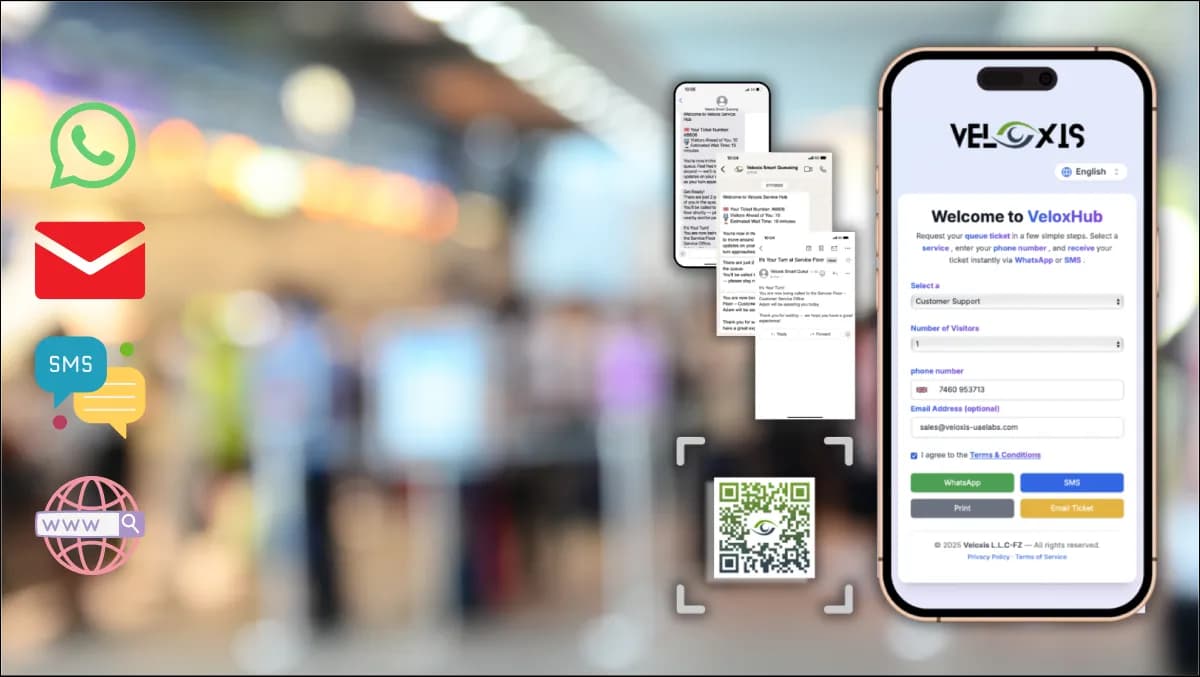
A pop-up GLARUS deployment runs on a kit that fits in a single Pelican case. One local server (a NUC or equivalent) for the operator cockpit, a 4G or 5G backup link for venue WiFi failover, two or three Android tablets for the call-forward operators at the front-of-house, and printed QR codes on standees for customers who do not want to scan a venue-provided link. The customer-facing surface is purely web — no app download, no app-store friction, no platform-specific UI to maintain. The customer joins by scanning a QR code, sees their position update in real time, and gets a phone alert (SMS or browser push) when their slot is ready.
The whole stack stands up in about 90 minutes. The operator team needs about 30 minutes of training. The kit ships with a printed runbook that covers the failure modes — what to do if the WiFi dies, what to do if a customer cannot scan the QR code, what to do if the local server goes unresponsive.
What changes for events versus branches
Three operational defaults shift when GLARUS is configured for an event versus a bank branch.
Wait-time estimation switches from a Bayesian model trained on the branch's historical throughput to a simpler moving-average model — there is no historical data for the pop-up, so the first 30 minutes of live throughput is used to calibrate. Notification policy switches from SMS-only (because branch customers might not be on the venue WiFi) to push-preferred with SMS fallback (because pop-up customers are usually on venue WiFi and push is instant). And the operator cockpit is simplified down to four buttons — call next, call by name, mark as no-show, mark as served — because pop-up staff are trained in minutes, not days.
The cockpit ships in the operator's language by default, and the customer-facing UI in six languages out of the box (English, Spanish, French, German, Italian, Portuguese), with other locales added per engagement when the audience demographic requires it. Pop-up audiences in the UK and Europe are linguistically mixed; asking customers to switch language at the queue-join screen is a friction point worth designing out.
UK regulatory specifics for events
Three UK-specific considerations the operator team needs to land before doors open.
First, GDPR. The virtual queue captures a phone number (for SMS fallback) and a session identifier — both are personal data under UK GDPR. The default is a 7-day automatic deletion policy on the entire dataset post-event, which keeps the operator's processing-purpose window narrow.
Second, ICO transparency. The QR-join page links to a one-paragraph data notice that names the operator, the purpose, the retention window, and the contact for subject access requests.
Third, accessibility. The customer-facing UI is WCAG 2.2 AA compliant — important for any event where the venue itself is accessibility-audited and a screen-reader-incompatible queue page would itself become an accessibility complaint.
European regulatory specifics
Across the EU, the same three considerations apply with two additions. The cookie consent banner is mandatory for any session-cookie use, which the deployment sidesteps by using sessionStorage instead. And — for events large enough to qualify — NIS2 incident-reporting may apply if the operator is itself an essential or important entity (large transport operators, large public-administration bodies, certain media organisations). The GLARUS cockpit ships a NIS2 incident-reporting hook that the operator can wire to their SOC if the threshold is hit.
What a typical UK event deployment looks like end-to-end
A typical UK pop-up deployment runs roughly as follows.
- T-minus 14 days: scoping call with the operator team — venue size, expected throughput, queue duration tolerance, customer notification preferences, languages needed.
- T-minus 7 days: kit dispatched, runbook delivered, operator training scheduled.
- T-minus 1 day: on-site setup and connectivity test with a Zeour engineer (remote unless the operator pays for on-site).
- Event day: live operation with on-call support.
- T-plus 1 day: data export to the operator, kit collection, post-event report.
The cost lands well inside the marketing budget for the event itself — usually a fraction of a single peak-day's WiFi rental at the venue.
Common failure modes and how to avoid them
Underestimating the no-show rate
Virtual queues at events have higher no-show rates than physical queues because the customer who walked away is sometimes too far away to return when called. The cockpit needs no-show handling that recovers gracefully — typically a 90-second hold-and-recall before the slot is released, with a configurable threshold per event type.
Connectivity assumptions that do not hold
Venue WiFi at a festival is often saturated by 11 AM and unusable by 3 PM. The deployment has to assume the worst and ship with a 4G or 5G backup link as a default, not as an optional add-on.
Training that does not survive volunteer turnover
Pop-up operator teams turn over within the day — morning shift, afternoon shift, evening shift. The training has to be a 5-minute video and a one-page runbook, not a half-hour onboarding session. Anything more elaborate will not survive contact with the staffing reality.
The pattern is the product
Events and pop-ups are not a separate Zeour product line. They are the same GLARUS virtual queue ecosystem running 1,247+ branches across UK, EU, Americas, GCC, MENA, Africa, and Asia — configured for a different operating envelope. The same code that runs a ministry queue at scale also runs a sneaker drop at the doorstep. The product has to be the same, because operators do not have time to retrain teams between deployments. The configuration changes; the architecture does not.
If you are planning a Q3 or Q4 2026 event, pop-up, or seasonal activation in the UK or Europe and want a virtual queue that does not break on the doorstep — talk to us. Two weeks of lead time is comfortable; one week is doable; less than that is brave but possible.