Key takeaways
- A 3-day, 80,000-attendee European festival typically generates 1.4-2.1 million queue events across stages, bars, merch, food, and toilets — only a fraction need physical lines.
- Bar wait at a headliner set sits at 22-38 minutes without virtual queueing; well-run virtual queueing cuts that to 4-9 minutes of standing plus 12-18 minutes of "wander, eat, watch" time.
- Festival abandonment rate at the bar near capacity is 18-29% — every abandoned customer is roughly £18-£32 of lost gross margin.
- Cashless RFID wristbands paired with a virtual queue ticket over QR + WhatsApp + SMS remove the battery and roaming-data failure modes that ruin app-only stacks.
- EU member-state event-safety regulators increasingly expect a documented queueing + crowd-flow plan signed off pre-event; virtual queueing materially improves the safety case file.
- A per-event fixed-fee Zeour engagement for a 3-day, multi-stage festival lands in the £20k-£80k Build range plus £3k-£15k per operating day.
- Multilingual UX — English, French, Spanish, German, Italian — is non-negotiable for any festival drawing pan-European attendees.
European music festivals are an outlier in queue engineering — a single weekend moves more people through more service points than a mid-sized airport, and the whole ecosystem has to come up in a field in three weeks and down in five days. This playbook draws on our virtual queue management system deployment patterns at multi-stage festivals across the UK and continental Europe, plus the wider GLARUS queue management system portfolio running at 1,247+ sites across 40+ countries.
Who this guide is for
- Festival production director. You own the operational plan end-to-end and you defend the crowd-flow design to the licensing authority and the insurer.
- Venue operations lead. You run the day-of mechanics — bar throughput, stage flow, toilet density, gate ingress. You need a system that does not collapse when 80,000 people decide they all want a drink at 21:47.
- Brand activation and sponsor partner. You need queueing infrastructure that gives your CRM team usable interaction data without trampling GDPR.
- Promoter and event organiser. You sit between the artist, venue, sponsor, and regulator. You need the queueing stack to look professional to all four at once.
What is virtual queueing for music festivals in 2026?
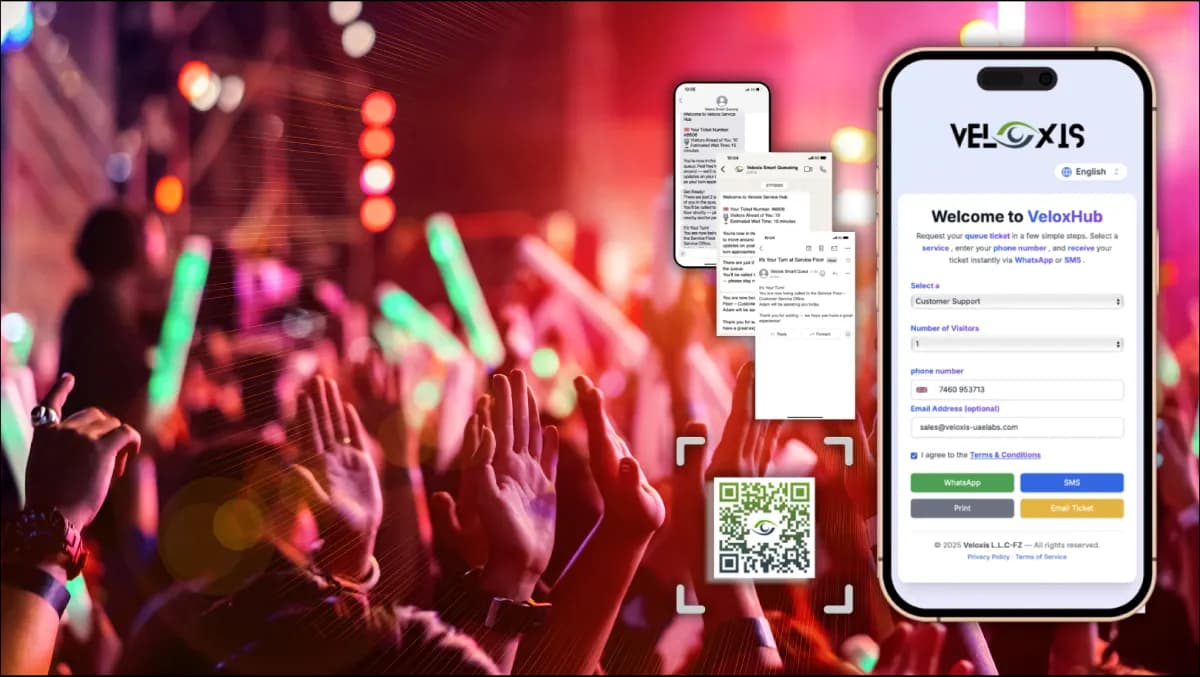
Virtual queueing for music festivals replaces static physical lines with a software-coordinated wait that lets attendees stand, sit, dance, eat, or move freely while a digital token holds their place. The token is issued through a low-friction join channel — a QR code at the bar, a WhatsApp message, an SMS reply, a kiosk tap, or a web link — and is redeemed at a service point at the moment the system predicts will minimise total wait while maximising throughput.
This is not the appointment queueing that works in a bank branch. Festival queueing is high-frequency, low-duration, identity-light, and patience-thin. A festivalgoer joining the bar queue will not fill in a form, will not download an app for a weekend, and will not tolerate a five-step booking flow. The interaction has to take five seconds and the value has to be obvious — "go enjoy the next 18 minutes, we will WhatsApp you when it is time to come back."
Traditional approaches fail at festival density for predictable reasons. A physical-only line wraps a bar at peak time, blocks stage sightlines, breaches the venue's crowd-density limits, generates safety incidents, and costs the concession 15-25% of its potential gross because the back half walks away. An app-only approach fails because casual attendees will not download a one-weekend app, mobile data is patchy in a field of 80,000 phones, and day-three battery life is a real-world constraint. The correct 2026 architecture is multi-channel join, identity-light by default, RFID-wristband-paired where one has been issued at gate, and resilient against partial network failure.
The music-festival virtual-queueing playbook — nine components
- 1Multi-channel join (QR, WhatsApp, SMS, kiosk, web). Why for festivals: Attendees arrive with whatever phone, network, and battery state they have — you cannot mandate a channel. Operator playbook: Print QR codes on every service point, expose a WhatsApp short-code on the programme, support SMS fallback, and stand kiosks at the busiest stalls — see our digital self-service kiosk. The wave-1 WhatsApp and SMS virtual queueing implementation guide is the deep dive on this channel pattern.
- 2Per-zone queue topology. Why for festivals: A festival is not one queue — it is dozens of independent queues with different service-time profiles. Operator playbook: Map every service point (every bar, merch stand, food stall, toilet bank, stage-pit gate, press / VIP door) as a distinct queue with its own service-time distribution, staff roster, and SLA. The platform should let you reconfigure topology in minutes when a stage runs late.
- 3Cashless RFID wristband integration. Why for festivals: Wristbands already serve as ticket, payment instrument, and identity proof — virtual queueing should ride on the same credential. Operator playbook: Bind the wristband at gate to entitlements (age verification, accessibility, VIP tier, press pass), then let any tap-point place that wristband into a queue. Visa, Mastercard, Apple Pay and Google Pay sit behind the wristband for the payment leg; Stripe or Adyen are the typical acquirers.
- 4Bar virtual-to-bartender pickup. Why for festivals: The bar line is the single largest queueing pain point — 30-40 minutes during a headliner set is a margin-killer. Operator playbook: Attendees order from the bar list on a QR-launched web page, pay via wristband or contactless, and get a notification when the drink is poured and ready at a numbered window. The bartender works a tablet-fed queue rather than a shouting front rail. Throughput per bartender typically goes up 30-60%.
- 5Merch and food pickup-window pattern. Why for festivals: Merch and food have prep time — they fit a pre-order plus pickup-window model far better than a single physical line. Operator playbook: Open ordering 45 minutes before peak, hold orders in a kitchen / merch-room queue, notify the attendee with a 5-minute pickup window, and route them to a dedicated collection counter. Walk-up service runs in parallel on a separate counter for attendees who refuse to use the app.
- 6Stage pit, VIP and press routing. Why for festivals: Pit access, VIP areas, and press pens are entitlement-controlled — you cannot let the wrong wristband through, and you cannot have stewards checking lanyards under a strobe light. Operator playbook: Pre-load the entitlement to the wristband, expose a virtual queue per access door, let the system pre-clear the next 50 attendees against the door scanner, and keep a manual override for the steward to escalate when the system rejects a legitimate guest.
- 7Toilet queueing at extreme density. Why for festivals: The most under-engineered queue at almost every festival, and it generates more complaints than the headliner running late. Operator playbook: Place sensor-counted entry / exit at every toilet bank, surface live wait-time on the digital signage screens dotted around the site, and let attendees join a virtual queue at a near-empty bank rather than walk to the main bank and find a 15-minute wait. Worst-bank wait typically drops 40-55%.
- 8Crowd safety regulator integration. Why for festivals: EU member-state event-safety regulators (and the UK Safety Advisory Group equivalent) increasingly require a documented crowd-flow plan, a real-time density dashboard, and a post-event readout. Operator playbook: Treat the virtual-queue platform as the source of truth for the safety case file. Stream queue density, throughput, and zone-level concentration to a regulator-facing dashboard, and snapshot data nightly so the audit has a defensible record.
- 9Walk-away-friendly UX. Why for festivals: The whole premise is that the attendee can leave the queue area, but festivals are noisy environments where audio notifications are unreliable. Operator playbook: Use SMS plus WhatsApp double-channel notification, give a 7-10 minute callback window rather than a 2-minute one, and use wristband vibrate or LED-flash where supported. Track callback compliance — what percentage of called attendees arrive within the window. Below 75% is a UX failure and the experience needs to be re-tuned.
How do you choose between QR + WhatsApp, native app, and hybrid?
| Approach | Onboarding friction | Battery + data load | Multilingual readiness | Regulator suitability | Festival-day failure recovery |
|---|---|---|---|---|---|
| QR + WhatsApp + SMS | Very low (5 seconds) | Minimal | Excellent (channel-native) | Strong audit trail | Robust — three channels |
| Native festival app | Very high (App Store download) | High (always-on) | Engineered per locale | Strong if attendance is high | Single point of failure |
| Hybrid (web + app) | Low for casual, high for power user | Medium | Engineered per locale | Strong | Robust if web-first |
For multi-day European festivals we recommend QR + WhatsApp + SMS as the production-default and treat any native app as an optional power-user surface. The reason is simple: festivals draw a long tail of casual attendees who will never download an app for one weekend. Forcing them through an app gate cuts adoption by 40-60% versus a QR plus WhatsApp join, and it gives the operator a worse safety case because a smaller share of attendees is in the system. A web layer on top of the QR + WhatsApp + SMS core covers the power-user, multi-festival, returning attendee.
> Want a fixed-fee event scope before the end of the call? Talk to Zeour engineering — 30-minute scoping call, no slideware, a published pricing band by the time we hang up.
How much does virtual queueing for music festivals cost in 2026?
Virtual queueing at festival scale is a per-event delivery — the costs are short-window and bounded.
- Per-event Build: £20k-£80k for a 1-3 day festival, depending on the number of zones, the depth of wristband integration, the multilingual scope, and the regulator-facing dashboard requirements. This is a fixed-fee scope agreed before the event.
- Per-day operation: £3k-£15k per operating day for on-site engineering presence, live monitoring, channel-cost pass-through (WhatsApp Business message volume, SMS gateway fees), and incident response.
- Multi-event Care Plan: £30k-£120k per year for a festival operator running 4-12 events annually — covers re-use of the platform across the calendar, on-call engineering during each event, and the small per-event configuration scope per festival.
- Hardware bands: signage rental £1.2k-£6k per screen for the festival period; kiosk rental £800-£2.5k per unit per event; bartender tablets £150-£300 per tablet per event; sensor-counted toilet bank instrumentation £1.5k-£4k per bank. Almost everything is BYOD-friendly on the attendee side — no festival-issued hardware required.
The meaningful number for a CFO is not the Build line — it is the gross margin recovered on bar, merch, and food because of the throughput uplift and the abandonment rate reduction. That is what the next section sizes.
ROI calculator — build a defensible business case in seven steps
Step 1 — count the queue events per day
For an 80,000-attendee festival across 7 stages with 35 bars, 14 merch stalls, 28 food stalls, 6 toilet banks, and 4 stage-pit gates, per-day queue events typically land between 480,000 and 720,000. Multiply by event days.
Step 2 — measure baseline wait and abandonment
Use last year's POS data or anonymous wifi-probe counters. Typical baseline at peak: bar 22-38 minutes; merch 12-22 minutes; food 15-28 minutes; toilet 4-15 minutes; pit-gate 18-35 minutes. Abandonment 12-29% across queue types.
Step 3 — calculate gross margin lost to abandonment
Multiply abandonment count by average transaction value by gross margin %. A 22% abandonment rate at a bar pouring £8 drinks at 70% margin loses £1.23 per attendee per visit — that scales fast across a 240,000-attendee weekend.
Step 4 — set the virtual-queue uplift target
A well-run deployment typically reduces wait by 50-70%, abandonment by 35-55%, and lifts throughput per service point by 25-45%. Use the conservative end for the business case.
Step 5 — quantify the labour saving
Steward and security headcount on physical line management typically drops 20-30%. At steward-agency rates of £24-£35 per hour, this is a five-figure saving per event.
Step 6 — book the NPS and licence-renewal benefit
Festivals live and die on sentiment — see our work on CSAT and NPS measurement. Queue complaints typically drop 40-60%, and the licensing authority is markedly more willing to renew when last year's incident log is clean.
Step 7 — compare against the fixed-fee Build cost
For an 80k / 3-day festival, the per-event Build sits in £40k-£60k mid-band. The gross-margin recovery from a 12-point abandonment reduction on bar alone typically returns 4-8x of this in a single weekend.
Seven failure modes from music-festival deployments
1. Treating the festival like a branch network. Festival queueing is not branch queueing slowed down — service times are shorter, join channels are different, the identity model is lighter, and the regulator audience is different. Teams that retrofit a branch platform spend the first 48 hours fighting wrong assumptions. The fix is a platform built with the events shape in mind, configured from a festival template.
2. App-only join in a long-tail attendee mix. Mandating a festival app cuts adoption by 40-60% versus QR + WhatsApp + SMS. Casual, international, day-pass, and older attendees will not download. The fix is to make the app an optional power-user surface and make QR plus WhatsApp the production default.
3. Under-instrumented toilet queues. Toilets have the highest complaint-per-wait-minute ratio and the lowest investment. Operators instrument only the main bank and guess elsewhere. The fix is to instrument every bank and surface live wait on signage at every junction so attendees self-route.
4. WhatsApp Business sender limits not negotiated in advance. WhatsApp imposes message-rate limits per sender; a festival weekend can generate hundreds of thousands of outbound notifications. Operators that do not raise their tier in advance get throttled mid-festival. The fix is to register the sender, request the appropriate tier, and warm up the volume in the weeks before the event.
5. No regulator dashboard. EU member-state event-safety regulators increasingly want a real-time view, and they will ask for it after the event if not during. Operators that cannot produce a credible density, throughput, and zone-concentration record are at a renewal disadvantage. The fix is to expose the dashboard at scoping and have the licensing authority review it before the event.
6. Single-language UX for a pan-European attendee mix. A festival drawing French, Spanish, German, Italian, and Dutch attendees and serving them English-only loses 20-35% of those attendees from the notification channel. The fix is multilingual UX engineered at the framework layer, with locale routed off the wristband entitlement or the WhatsApp country code.
7. No post-event readout, no learning loop. The festival lifts and the platform comes down — and nobody captures the operational lessons in a way that improves next year. The fix is a post-event readout discipline: queue-by-queue throughput, wait, abandonment, complaint correlation, and a written change-list. See our customer feedback system for attendee-side data capture and our virtual queuing for events and pop-ups across the UK and Europe parent post for the broader pattern.
Migration path — moving from your current event-flow stack
Phase A — Audit (1-2 weeks). Walk the site map, count every service point, talk to last year's bar managers and steward leads, pull the POS abandonment numbers, and document the regulator and insurer expectations. Output: a baseline document everyone signs.
Phase B — Design (2-3 weeks). Translate the audit into a per-zone topology, choose join channels (QR + WhatsApp + SMS + kiosk + web), define the wristband integration scope, design the regulator dashboard, and write the multilingual spec. Output: a fixed-fee Build scope.
Phase C — Build and rehearse (4-8 weeks). Stand up the platform, integrate the wristband and POS, deploy signage and kiosks, test notification channels at expected volume, and run a full-scale rehearsal on a quiet day. Output: a green-light readiness report.
Phase D — Live event and readout (3-7 days plus 1 week). Run the event with on-site engineering, monitor the regulator dashboard live, capture operational data, and produce a post-event readout for the operator, regulator, and insurer.
Implementation playbook (per-event delivery)
- 1Scoping (1-2 weeks). Audit the festival site, regulator expectations, and the wristband / POS landscape. Output: fixed-fee scope and Statement of Work.
- 2Setup (1-2 weeks). Configure the topology, channels, multilingual UX, and dashboards. Integrate the wristband binding and the bar / merch / food pickup workflow.
- 3Rehearsal (1 day). Full-stack walk-through with the production team. Channel volume test, dashboard sign-off, regulator preview.
- 4Live event (1-7 days). On-site engineering, live monitoring, incident response, daily readouts. Hard SLA on notification delivery and dashboard uptime.
- 5Post-event readout (1 week). Queue-by-queue throughput, wait, abandonment, complaint correlation, regulator audit record, written change-list for the next event.
Frequently asked questions
Do attendees really use virtual queueing at a music festival?
Yes — when the join is QR plus WhatsApp plus SMS rather than app-only, adoption typically lands in the 55-75% range. The remaining attendees still see a faster physical line because the virtual queue has absorbed the demand spike.
How does it integrate with the cashless RFID wristband?
The wristband becomes the identity carrier. At gate it binds to the attendee; at every tap-point it can place the attendee in a queue or redeem a ticket; at the bar it serves as the payment instrument behind the Visa or Mastercard rail with Stripe or Adyen as the acquirer.
What languages do you support out of the box?
English and Arabic are the engineered baseline for the GLARUS queue management system. For European festivals we routinely add French, Spanish, German, Italian, Dutch, and Portuguese per engagement — locale is a configuration, not a separate codebase.
How do you handle the data-protection requirements?
The platform is engineered for GDPR discipline by default. Attendee data can be held on the operator's perimeter, retention is configurable, and the regulator dashboard exposes only aggregate density and throughput.
What happens to my data after the festival?
Retention is contractual. Most operators choose a 90-day retention for individual notification logs and indefinite retention for the aggregated zone-level data that feeds next year's planning.
Can the platform run when the on-site network is unstable?
Yes — the architecture is fail-soft. Local gateways at the busiest zones keep the queue functional during a brief uplink loss; the central platform reconciles when the link comes back. SMS as a fallback covers the case where WhatsApp servers themselves are degraded.
How does virtual queueing affect the bar gross margin?
The typical lift is 18-32% on bar gross margin during peak hours, driven by throughput uplift per bartender, abandonment reduction, and easier upsell of a premium drink on a phone screen versus a shouted order at a crowded rail.
Will the licensing authority accept this as part of our safety case?
Yes — the regulator-facing dashboard, the documented topology, and the post-event audit record materially improve the safety case file. Engage the licensing authority during scoping so they see the dashboard before the event.
What does a typical multi-day, multi-stage deployment cost?
For a 3-day, 80k-attendee, 7-stage festival, expect a per-event Build of £40k-£60k mid-band, per-day operation of £6k-£12k, and a Care Plan of £60k-£100k per year for a 6-festival calendar. See our pricing page for the full bands.
How is this different from a generic events queueing tool?
Generic tools assume one venue, one queue, one channel. Festival queueing is multi-zone, multi-channel, RFID-paired, regulator-audited, multilingual, and on-site-engineered. Our virtual queue management system is engineered for this shape and proven on the events practice we describe in our Space NK UK pop-up events case study and adjacent retail references like the Bawasel Aljibal Apple support deployment.
Where Zeour fits
GLARUS virtual queueing is engineered for the events shape — multi-channel join, multi-zone topology, wristband-paired identity, multilingual UX, regulator-ready dashboards, on-site engineering during the live event. We deliver on a fixed-fee per-event scope so the festival production team owns a known number before the event begins, not a variable bill after. The wider GLARUS portfolio runs at over 1,247 sites across more than 40 countries, and our events practice — see the Space NK UK pop-up events case study — is growing as European festival, museum, and brand-activation operators move off ad-hoc spreadsheets. We ship worldwide from London, with regional strength across the UK, European Union, Americas, and the GCC and MENA markets.
If you are scoping the queueing stack for a festival on the 2026 European calendar, the next step is a 30-minute call to translate your site map and regulator brief into a fixed-fee scope. Talk to Zeour engineering — and see our broader retail events pattern reference and airport-scale crowd flow for adjacent contexts, the parent virtual queueing for events and pop-ups overview, and the wave-1 WhatsApp and SMS virtual queueing implementation guide.
---
Last updated: May 17, 2026 — by the Zeour engineering team.