Key takeaways
- A Kuwait ministry running 15-80 citizen-services centres needs a queue management system that treats sovereign on-premises hosting, Kuwait Data Privacy Protection Regulation data residency, and CITRA cybersecurity baselines as procurement gates.
- Bilingual EN+AR with full right-to-left rendering is non-negotiable end-to-end: kiosk UI, audio call-forward, signage call-out, PDF receipts, SMS notifications. Retrofitting is the most common Kuwait public-sector failure mode.
- WCAG 2.2 AA accessibility is mandatory for Kuwait government procurement under Civil Service Commission guidance: wheelchair-aware kiosk heights, screen readers, audio cues, and large-text mode are scored gates.
- Realistic 2026 budget for a 40-80 centre multi-ministry deployment is £300k-£1M for Build, £25k-£75k per integration, and £8k-£25k per centre for hardware.
- Discovery should be a fixed-fee 2-4 week engagement (£15k-£40k) producing a published scope and rollout plan - aligning with Kuwait procurement workflows and protecting the ministry from open-ended bills.
- The default answer for any Kuwait ministry handling citizen identity, civil-status, licence, residency, or benefit data is sovereign on-premises deployment on operator hardware inside Kuwait.
- A 90-day exit window with operator-owned repository, licence, and deploy keys must be written into the master agreement on day one - not negotiated at renewal when the ministry has no leverage.
If you run a citizen-services ministry in Kuwait in 2026, your queue platform is the front door to every Kuwait Vision 2035 service-delivery target your minister will be asked about. Wait times, completion rates, satisfaction scores, accessibility findings, and Kuwait DPPR data-subject requests all surface through the queue stack. The wrong choice locks you into a vendor-cloud architecture that fails CITRA review mid-rollout. The right choice ships sovereign on-premises, bilingual EN+AR from day one, and an operator-owned schema that survives every minister.
Who this guide is for
- Persona 1. A Ministry IT Director or CIO at a service-delivery ministry running 15-80 citizen-services centres - civil-status, licence, residency, labour, benefit, permit, or municipal services. You need a defensible architecture you can present to the CITRA reviewer and the e-Government Authority programme office in the same week.
- Persona 2. A Programme Director for the Kuwait Vision 2035 government digital transformation workstream, accountable for wait time, completion rate, NPS, accessibility coverage, and bilingual parity across the estate.
- Persona 3. A Citizen-Service-Centre Operations Lead managing 10-30 sites. You care about routing logic, staff utilisation, walk-in conversion for digitally-excluded residents, and the supervisor console that shows which centre is heating up before it overflows.
- Persona 4. A CISO writing the procurement spec. You want a vendor who demonstrates against the CITRA cybersecurity baseline, supports sovereign on-premises by default, and produces Kuwait DPPR data-subject reports on demand.
What is government queue management in 2026 - and why it's different for Kuwait?
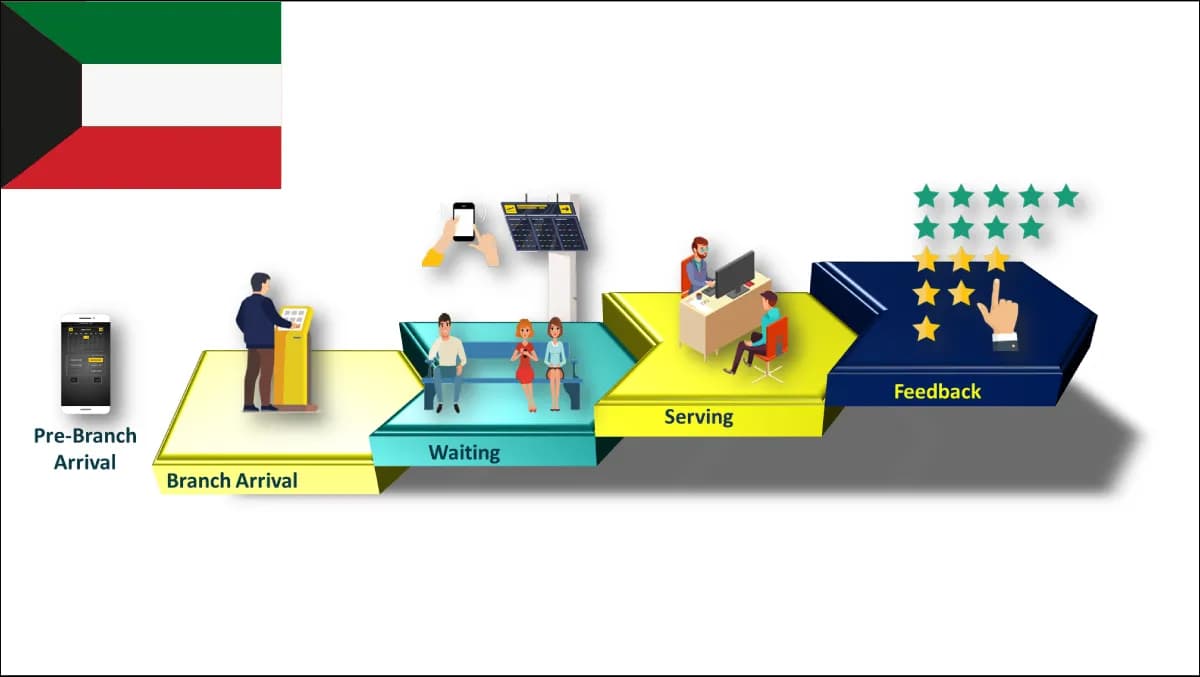
Government queue management in 2026 is no longer a ticket-dispenser. It is a layered platform that authenticates the citizen against the national identity gateway, issues a ticket bound to a service code (one of 40-200 in a typical catalogue), routes by skill and language, calls via bilingual EN+AR audio and signage, captures the post-service customer feedback score, and writes the interaction to an audit trail a CITRA reviewer can subpoena five years later.
For a Kuwait ministry, three realities reshape every decision. First, the regulatory shape: the Kuwait Data Privacy Protection Regulation - issued by CITRA - governs citizen personal data with strict residency, consent, and data-subject provisions; CITRA cybersecurity guidelines set the baseline the vendor must demonstrate against; the e-Government Authority signals strategic preference for sovereign hosting over offshore vendor-cloud. A vendor-cloud QMS landing citizen data outside Kuwait will not survive CITRA review.
Second, the operational shape: bilingual EN+AR full right-to-left is a hard procurement gate. PDFs render right-to-left with correctly positioned Latin reference numbers; audio call-forward pronounces tickets in Arabic; signage calls out in Arabic with mirrored English; SMS notifications deliver in the citizen's language of comfort. WCAG 2.2 AA accessibility reinforces this with screen-reader compatibility, large-text mode, wheelchair-height kiosk lanes, ramped queueing zones, and counter-induction hearing loops.
Third, the delivery shape: Kuwait Vision 2035 and the Civil Service Commission performance framework set measurable citizen-satisfaction and service-delivery targets ministries must report against. This favours fixed-fee phased engagements over open-ended consultancy. Kuwait public-sector procurement - published scope, milestone payments, demonstrable deliverables, transparent change-orders - aligns with the fixed-fee phased engagement model Zeour ships across the GCC.
The Kuwait-fit scoring rubric - 14 criteria
This is the rubric we use when a Kuwait ministry asks Zeour to evaluate an existing QMS or to score a new procurement shortlist.
- 1Sovereign on-premises by default. Why: CITRA + Kuwait DPPR alignment - citizen data never leaves the country. Test: Ask for a written architecture diagram showing where every citizen identifier and audit-log entry resides at rest and in transit.
- 2CITRA cybersecurity baseline. Why: The operator owns the security posture; the vendor must not break it. Test: Request a control-by-control mapping covering identity, segmentation, logging, vulnerability management, SDLC, and third-party risk.
- 3Kuwait DPPR data-subject access. Why: DSAR, consent, and retention obligations land on the operator the moment a citizen identifier is captured. Test: Ask for a sample data-subject export and a retention-purge run on synthetic data.
- 4Bilingual EN+AR full RTL. Why: Mandatory for any citizen-facing service. Test: Demand a live demo of an Arabic flow from kiosk arrival through PDF receipt opened on a citizen smartphone. See the bilingual baseline gate for what good looks like.
- 5National identity gateway integration. Why: Citizens and residents authenticate via OIDC against the national identity platform. Test: Confirm the QMS speaks OIDC, supports federated sign-on, and issues tickets tied to a verified identifier without storing it in plaintext.
- 6WCAG 2.2 AA accessibility. Why: Public-sector procurement gate under Civil Service Commission guidance. Test: Get the vendor's third-party audit; demand wheelchair-height kiosk lanes and bilingual audio cues.
- 7Multi-ministry or multi-tenant. Why: The e-Government Authority increasingly wants national-level rollups across ministries. Test: Inspect the corporate console for per-ministry, per-region, per-centre tenancy with role-scoped data access.
- 8Audit trail. Why: CITRA and Kuwait DPPR demand immutable, exportable, retention-managed logs. Test: Verify the audit log is append-only, SIEM-exportable, and retention-tunable per record class.
- 9Skill-based routing by service type. Why: Government one-stops carry 40-200 service codes; bad routing destroys the wait-time KPI. Test: Configure 10 codes with overlapping skills and run a synthetic load.
- 10Walk-in conversion path. Why: Digitally-excluded citizens must be served with dignity. Test: Walk the kiosk plus staff-tablet fallback as a citizen arriving without a portal booking.
- 11Fixed-fee phased engagement. Why: Procurement prefers known scope and milestone-paid delivery. Test: Ask for a sample Discovery deliverable and a milestone-priced Build proposal.
- 12Operator-owned schema and data export. Why: The ministry must be able to leave without paying ransom. Test: Request the full schema in writing; confirm bulk export is an operator action.
- 1390-day exit window. Why: Operator owns repository, licence, and deploy keys at exit. Test: Read the exit clause; confirm no perpetual lock-in on source, schema, or runtime keys.
- 14High-availability and WAN-drop resilience. Why: Outer-governorate centres lose connectivity; citizens still need to be served. Test: Pull the WAN cable mid-demo; ticketing should continue locally and sync on reconnect.
How do you choose between on-premises, sovereign cloud, and public-cloud SaaS in Kuwait?
The opinionated answer for a Kuwait ministry handling any citizen-identifiable data is sovereign on-premises by default, with in-country sovereign cloud as a supplementary option for non-sensitive analytics rollups. Public-cloud SaaS is effectively ruled out by CITRA and Kuwait DPPR review.
| Dimension | Sovereign on-premises | Sovereign cloud (in-Kuwait) | Public-cloud SaaS |
|---|---|---|---|
| Data residency | In-ministry datacentre | In-Kuwait region, vendor-managed | Vendor jurisdiction, often offshore |
| CITRA fit | Direct - operator controls baseline | Strong if vendor demonstrates controls | Weak - vendor jurisdiction conflicts |
| Kuwait DPPR fit | Direct - operator is sole data controller | Strong with in-Kuwait tenancy | Weak - data flows offshore |
| Latency to centres | 5-20ms in-country | 20-50ms via national backbone | 100-300ms across regions |
| 5-yr TCO (40 centres) | £900k-£2.0M | £800k-£1.8M | £1.1M-£2.4M (SaaS escalators) |
| Exit cost | Low - operator owns the stack | Medium - data egress + replatform | High - vendor-managed schema |
| Accessibility posture | Operator-controlled hardware spec | Shared - kiosks still operator-owned | Shared - kiosks still operator-owned |
> Want a fixed-fee Discovery price before the end of the call? Talk to Zeour engineering - 30-minute scoping conversation, no slideware, and a published pricing band by the time we hang up.
How much does government queue management cost in Kuwait in 2026?
All figures in £; KWD-quoted equivalents are produced during Discovery for the Kuwait procurement file. Pricing is shaped by centre count, service-code complexity, integration breadth, and hardware refresh scope - Kuwait is a smaller market than KSA or UAE, so entry-tier bands reflect that.
- Discovery. £15k-£40k for a 2-4 week engagement producing a scope document, integration map, schema draft, accessibility baseline, and a milestone-priced Build proposal.
- Build small (single ministry, 10-30 centres). £80k-£250k covers the core queue platform, bilingual EN+AR baseline, online appointment booking for the citizen-portal channel, the supervisor console, and a single-environment deployment.
- Build enterprise (multi-ministry or 40-80 centres). £300k-£1M covers the corporate console, per-ministry tenancy, digital self-service kiosks with accessibility hardware, visitor management for restricted-access centres, wayfinding, production + DR environments, and the full CITRA documentation pack.
- Integrate. £25k-£75k per upstream system - national identity gateway (OIDC), national payment rails, citizen-record-of-truth, and the ministry's case-management system.
- Pilot. £25k-£60k for a 4-6 week single-centre cutover with operations training.
- Per-centre hardware. £8k-£25k depending on kiosk count, digital signage size, counter displays, and whether accessibility hardware ships from day one.
- Care Plan. Tiered annual support at 12-18% of capex; Sunday-to-Thursday business cover for routine centres, 24/7 for critical estates.
ROI calculator - build a defensible business case in 7 steps
This is the model we walk through with Kuwait ministry programme directors when the Vision 2035 service-delivery office asks for a business case.
Step 1 - Baseline the current citizen-hour cost
Measure average wait time per service code at 4-8 representative centres over a 2-week window. Multiply by daily citizen volume for total wait-hours per week. If your ministry has no internal citizen-time value, £8-£15 per citizen-hour is a defensible figure.
Step 2 - Project wait-time recovery from skill-based routing
A realistic skill-based routing implementation reduces average wait time by 25-40% in the first six months. Apply the percentage to your Step 1 baseline to derive recovered citizen-hours per year. Kuwait centres serve a mixed citizen-and-resident population with varied language needs, making routing intelligence higher-leverage than in single-language jurisdictions.
Step 3 - Quantify the staff utilisation lift
Good routing lifts counter-staff productive minutes per hour by 8-15%. Multiply by counter-staff FTE and loaded cost. Be conservative - assume the lift reduces overtime, not headcount, unless your ministry has Civil Service Commission productivity targets.
Step 4 - Service-completion rate uplift
Digitally-managed flows reduce incomplete service journeys (citizen leaves, sent to wrong counter, returns next day) by 10-20%. Multiply by per-service throughput value.
Step 5 - Audit and compliance FTE reduction
A platform with built-in Kuwait DPPR data-subject exports and CITRA-aligned audit trails saves 0.3-1.5 FTE of manual compliance work per year for a 40-centre ministry.
Step 6 - Citizen-portal deflection savings
Citizens who book ahead via the unified citizen-services portal arrive within a 15-minute window and skip the walk-in kiosk path. Deflection of 20-40% of total volume reduces peak-hour pressure on counter staff.
Step 7 - Walk-in conversion and risk-avoided value
The digitally-excluded population must still be served. The risk-avoided value of a properly engineered walk-in path is the cost of a single national-press incident - typically £75k-£300k in reputational impact.
Worked example. A 40-centre ministry, 900k citizen visits/year, 26-minute baseline wait. Step 1: 390k citizen-hours at £10 = £3.9M baseline. Step 2: 30% recovery = £1.17M. Step 3: staff lift £0.22M. Step 4: completion uplift £0.16M. Step 5: compliance FTE £0.08M. Step 6: portal deflection £0.09M. Step 7: risk-avoided £0.12M. Annual benefit ~£1.84M against 5-year build-plus-run of £1.5M - payback inside 12 months.
Seven failure modes from Kuwait deployments
Failure mode 1: Public-cloud vendor selected, mid-rollout blocked by CITRA review. Diagnosis: The vendor's data plane lives outside Kuwait; CITRA flags residency violations under Kuwait DPPR and rollout pauses. Fix: Make sovereign on-premises or in-Kuwait sovereign cloud a procurement gate at RFP.
Failure mode 2: Bilingual retrofitted, Arabic receipts render in wrong direction at minister demo. Diagnosis: English-first UI with an Arabic translation layer bolted on; PDFs use an LTR engine that mirrors Latin numerals incorrectly inside Arabic prose. Fix: Demand bilingual EN+AR full-RTL as a build-time architectural baseline; verify on real citizen smartphones during Discovery.
Failure mode 3: AI inference outsourced to public-cloud LLM API, breaching CITRA and Kuwait DPPR. Diagnosis: The vendor uses a hosted LLM API; citizen text and identifiers are sent offshore. Fix: Use on-premises AI with open-weight models on operator hardware - the posture Zeour ships in healthcare and banking across the GCC.
Failure mode 4: Walk-in conversion path skipped, digitally-excluded citizens turned away. Diagnosis: The ministry assumed every citizen would book via the unified citizen-services portal; the staff-tablet fallback was nice-to-have; older residents arrive without bookings and are sent home. Fix: Engineer the walk-in path as a first-class flow from Discovery - staff-tablet check-in alongside the self-service kiosk.
Failure mode 5: Single-tenant per-ministry deployment, no central rollup, e-Government Authority cannot get national metrics. Diagnosis: Each ministry runs its own QMS silo; the national-dashboard team has no consolidated feed. Fix: Build the corporate-console layer from day one with per-ministry tenancy and an aggregated reporting pipe.
Failure mode 6: WCAG 2.2 AA accessibility skipped, wheelchair user routed up stairs. Diagnosis: Accessibility scoped as a post-rollout enhancement; the kiosk has a 90cm reach, audio cues are English-only, the queueing zone has a step. Fix: Treat accessibility as a procurement gate; demand a third-party audit before signing Build; specify wheelchair-height kiosks, ramps, and hearing-loop counters in fit-out.
Failure mode 7: Vendor lock-in with no exit window, ministry hostage at renewal. Diagnosis: No exit clause; vendor controls schema, keys, source. At renewal the ministry faces a 35-50% increase with no leverage. Fix: Negotiate the 90-day exit window on day one - operator-owned repo, schema, licence, and deploy keys.
Migration path - moving from your current stack
Phase A: Single-centre shadow and baseline. Pick one representative centre with 6-16 counters and 20-60 service codes. Install the new QMS alongside the existing system, run shadow mode for 2-4 weeks, and produce a comparison report for the programme office and Civil Service Commission liaison.
Phase B: Cluster cutover (4-8 centres). Cut over a regional cluster, capturing training data, hardware-install patterns, and integration edge cases. This is where you stress-test WAN-drop resilience and bilingual flows under peak service-day demand.
Phase C: Ministry-wide rollout. Roll the remaining centres in waves of 6-12 per month. The corporate console comes online; the supervisor team runs daily wait-time and SLA dashboards.
Phase D: Cross-ministry consolidation. Under an e-Government Authority-led national programme, ministry instances federate into the corporate console, accessibility audits standardise, and the national reporting pipe goes live. Typically a 12-24 month workstream feeding the Vision 2035 dashboard.
Implementation playbook
- 1Discovery (2-4 weeks, fixed fee £15k-£40k). Scope document, integration map, schema draft, accessibility audit baseline, milestone-priced Build proposal.
- 2Build (8-16 weeks, milestone-fixed). Core QMS platform stand-up, bilingual EN+AR full-RTL implementation, supervisor console, corporate console, hardware spec sign-off, weekly demos.
- 3Integrate (3-5 weeks). National identity gateway OIDC federation, national payment rails for service fees, citizen-record-of-truth lookups, ministry case-management system, SIEM audit-log export pipe.
- 4Pilot and Go-Live (4 weeks). Single-centre go-live, parallel-running with the legacy QMS for 2 weeks, full cutover, daily standup, first measurement cycle reported to the Vision 2035 dashboard.
- 5Operate. Care Plan tier aligned to ministry operating hours and centre criticality; quarterly CITRA review; annual accessibility re-audit; biannual citizen-satisfaction survey refresh.
Frequently asked questions
Why is sovereign on-premises the default for a Kuwait ministry QMS?
Because the Kuwait DPPR, CITRA cybersecurity guidance, and the e-Government Authority architectural preference all push citizen data inside Kuwait and inside the operator's perimeter. A QMS captures citizen identifiers, behavioural metadata, service history, and audit logs - all under Kuwait DPPR data-controller obligations. Hosting these on operator hardware in-country survives every regulator review.
How does the Kuwait Data Privacy Protection Regulation affect queue data?
Kuwait DPPR treats every citizen identifier and behavioural metadata point as personal data. The ministry is the data controller; the QMS vendor is a processor. Implications: consent capture at kiosk arrival, lawful-basis tagging, data-subject export workflows, retention schedules per record class, breach notification. Build these at the schema level - retrofitting is expensive.
What does CITRA compliance look like for a ministry QMS?
CITRA compliance is operator-owned; the vendor demonstrates the QMS does not break the baseline. That means a control-by-control mapping covering IAM, network segmentation, logging, vulnerability management, secure SDLC, third-party risk, and business continuity. The vendor produces the documentation pack; the ministry CISO runs the review against CITRA-issued guidance.
How do you integrate with the national identity gateway in Kuwait?
The gateway exposes OIDC federation endpoints. The QMS speaks OIDC, redirects citizens for authentication, receives the verified claim, and issues a ticket tied to the identifier - without persisting it in plaintext. Build scope is typically 2-3 weeks plus the regulatory paperwork with the gateway operator.
Is WCAG 2.2 AA really mandatory for Kuwait public-sector procurement?
In practice, yes. Kuwait procurement increasingly requires demonstrable WCAG 2.2 AA conformance for citizen-facing services - covering software (screen reader, contrast, keyboard nav, text scaling) and physical (wheelchair-height kiosks, audio cues, hearing loops, ramps). The Civil Service Commission treats accessibility as a measured service-quality indicator. Get the third-party audit done during Discovery.
How does Kuwait Vision 2035 shape the QMS metrics?
Kuwait Vision 2035 sets measurable service-delivery and satisfaction targets ministries report against. The QMS is the source-of-truth for wait time, completion rate, walk-in conversion, accessibility coverage, bilingual parity, and satisfaction scores. Engineer the reporting pipe into the national dashboard from day one - the e-Government Authority will ask for it in week six.
How do you handle walk-in conversion for digitally-excluded citizens?
With dignity. The walk-in path is a first-class flow: the citizen arrives without a unified citizen-services portal booking, the kiosk offers a bilingual baseline language-of-comfort selection, taps a service code or asks a staff member with a tablet, and the QMS issues a ticket with the same routing priority as a pre-booked citizen.
How does on-premises AI fit into a Kuwait ministry QMS?
On-premises AI is the only acceptable posture for any AI-augmented feature - routing suggestions, chatbot triage, feedback summarisation. Use open-weight models (Llama, Mistral, Qwen, Gemma) on operator hardware via vLLM, Ollama, or TGI. Inference stays inside the ministry perimeter; no citizen prompt leaves Kuwait. This addresses Kuwait DPPR residency obligations and CITRA guidance.
What does fixed-fee procurement mean for the QMS engagement model?
Kuwait public-sector procurement favours published scope, milestone payments, and demonstrable deliverables over open-ended consultancy. Zeour's fixed-fee phased engagement aligns: Discovery is fixed-fee; Build is milestone-fixed with weekly demos and priced change-orders; the 90-day exit window is in the master agreement on day one. KWD-quoted equivalents come out of Discovery; the published pricing bands are the starting reference.
What does Zeour's deployment look like at a 40-centre Kuwait ministry?
A typical 40-centre programme runs 9-15 months end-to-end. Discovery 3 weeks. Build 12 weeks. Integrate 4 weeks. Pilot 4 weeks. Rollout 6-10 centres per month via direct delivery from London plus an in-Kuwait implementation partner. Operate via tiered Care Plan with quarterly CITRA review. Reference architectures include adjacent Kuwait public-sector work - the Kuwait Ministry of Health programme is a production reference in the same regulatory and bilingual environment - plus worldwide deployments such as Servizz.gov in Malta, the Malta Finance Ministry programme, and the Ministry of Transport programme. The QMS guide for KSA government covers the GCC adjacent posture.
Where Zeour fits
Zeour's queue management system, online appointment platform, digital self-service kiosks, visitor management, wayfinding, and digital signage platform are engineered for the citizen-services context: sovereign on-premises by default, bilingual EN+AR full-RTL from day one, WCAG 2.2 AA accessibility, fixed-fee phased engagements with a 90-day exit window, and on-premises AI for any model-augmented feature. The platform runs at 1,247+ branches across 40+ countries - direct delivery from London into Kuwait and the wider GCC plus a certified partner network for in-country implementation. Read the QMS buyer's guide for 2026, the virtual queuing implementation guide, and the government industry brief. When you are ready, talk to Zeour engineering - we will publish a fixed-fee pricing band before the call ends.
---
Last updated: May 17, 2026 - by the Zeour engineering team.