Queue management for Oman government service centres starts with the citizen's task: reaching the right counter, completing the service and knowing what happens next. This guide helps ministry operations, IT and procurement teams turn that journey into an evaluation brief for a queue management system. It separates practical service-flow tests from hosting, privacy and commercial decisions that need approval for the particular organisation.
Map the citizen journey before specifying kiosks
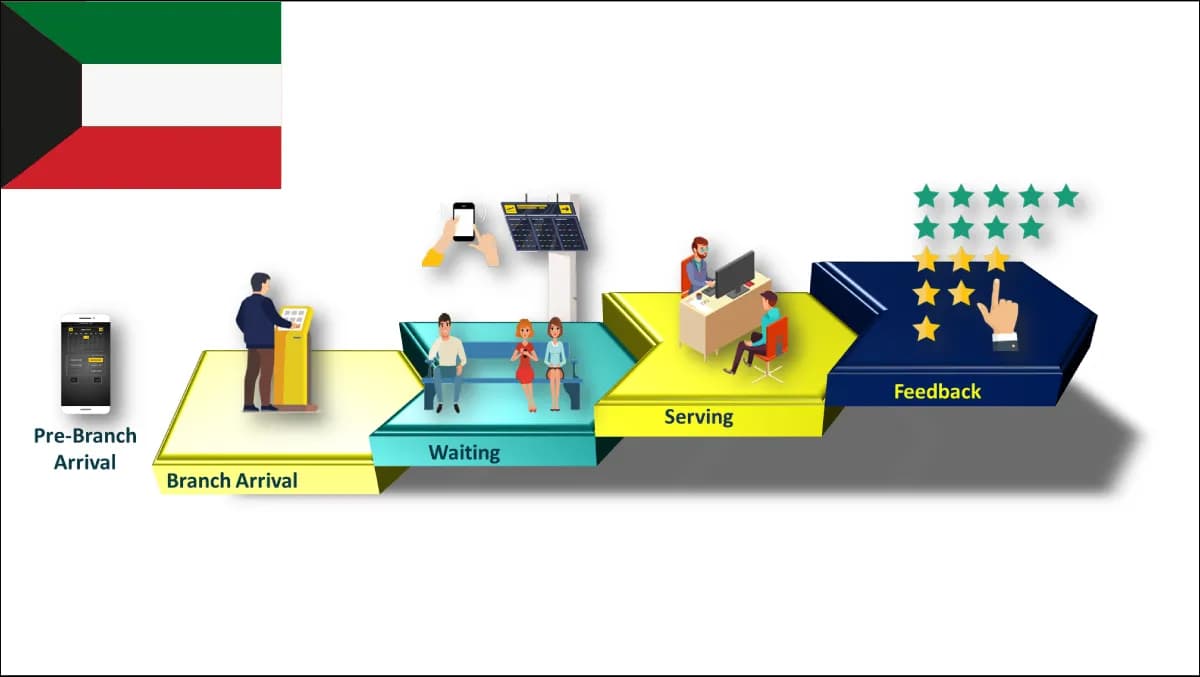
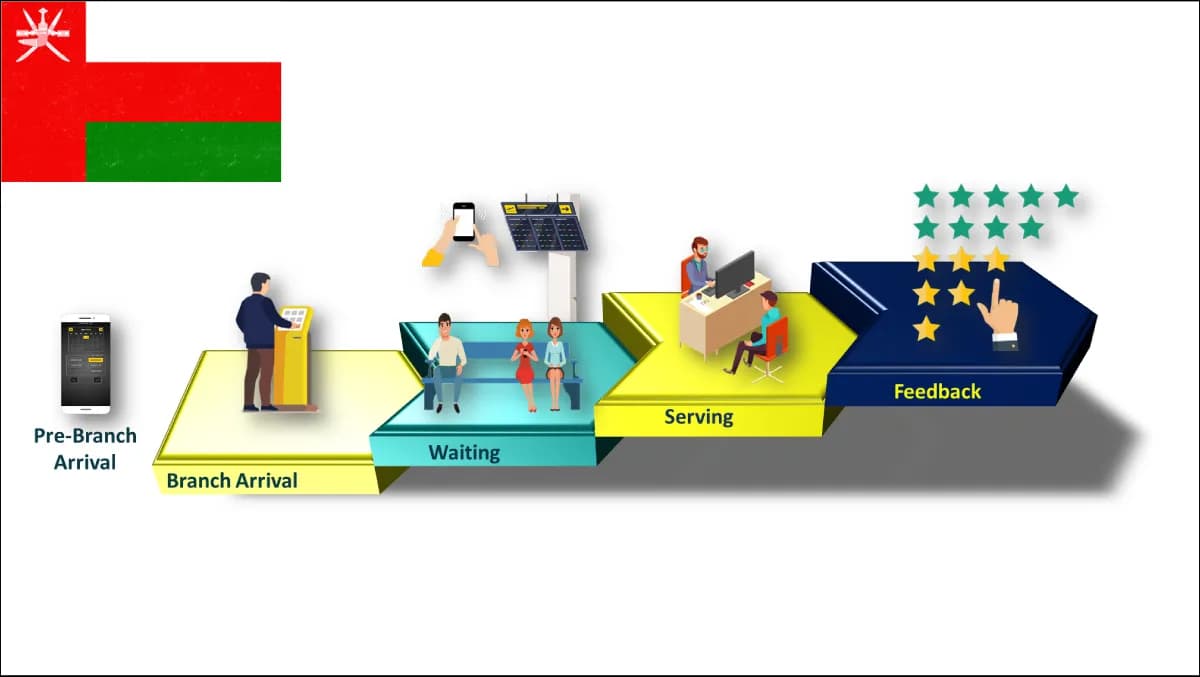
Use one service, such as a permit enquiry, to trace the complete visit. The following is a proposed evaluation scenario, not a description of a Zeour customer deployment.
| Stage | Decision to document | Evidence to collect during the pilot |
|---|---|---|
| Before arrival | Is this a walk-in service, an appointment, or both? | Published entry requirements and an assisted route for people without a booking |
| Arrival | How does the citizen select a service and language? | A staff-observed test of kiosk and assisted check-in |
| Waiting | Which rules govern priority, transfers and missed calls? | Ticket events matched to the approved service policy |
| At the counter | What happens when documents are missing or another department is needed? | A recorded outcome that distinguishes completion from referral |
| Departure | How will the citizen give feedback or understand the next step? | Clear follow-up instructions and a usable feedback route |
Do not treat a ticket being called as proof that the citizen completed the task. For a practical measurement method, see how to improve customer service with queue management. Keep the appointment workflow separate from the rules that determine live service order.
Establish the applicable Oman data-handling requirements
MTCIT's personal data protection guidance makes an important distinction: state administrative units and other public legal entities are exempt from the Personal Data Protection Law's scope, while Circular No. 6/2024 provides a personal-data protection policy for state administrative units. The guidance also describes safeguards for cross-border transfers where the law applies; it is not a blanket ban on offshore processing.
Have the ministry's legal and security teams establish the applicable policy, contractual controls and any additional sector requirements. Record the decision for each data flow: ticket identifiers, appointment details, notifications, support access, backups and reporting. Hosting location alone does not establish compliance. This is an engineering checklist, not legal advice.
Define an acceptance test for a service-centre pilot
Ask the supplier to demonstrate a normal visit and the exceptions: unavailable counters, missing documents, a late appointment, a missed call and a branch connection failure. Write down the expected staff action and the citizen-facing message before testing. Agree which functions remain available during an outage and reconcile events after recovery; do not infer offline behaviour from a diagram.
Include Arabic and English users in the test where those languages form part of the service brief. Assess the digital interface against the specified accessibility criteria and assess the physical kiosk separately. W3C's WCAG 2.2 guidance explains the web standard; it does not establish a universal Oman procurement requirement or certify a physical installation.
Ministry scope and commercial assumptions
The numerical budgets, rollout timings and performance examples retained below need project-specific validation. They are not a quotation, SLA or independently verified customer outcome. Confirm product editions, integrations and contractual commitments in writing.
- An Oman ministry running 15-80 citizen-services centres needs a queue management system that treats the approved hosting model, applicable data policy and ministry security controls as procurement gates.
- Bilingual EN+AR with full right-to-left rendering is non-negotiable end-to-end: kiosk UI, audio call-forward, signage call-out, PDF receipts and SMS. Retrofitting bilingual is the single most common public-sector failure mode in the Sultanate.
- WCAG 2.2 AA accessibility can be specified as a digital-interface evaluation requirement: wheelchair-aware kiosk lanes, screen-reader support, audio cues and large-text mode are scored gates.
- Realistic 2026 budget is £80k-£220k for a focused single-ministry build, scaling to £300k-£900k for an enterprise multi-ministry programme with corporate console and DR.
- Discovery should be a fixed-fee 2-4 week engagement (£15k-£40k) producing a published scope, integration map and rollout plan - aligning with the OmanGov procurement model and protecting the ministry from open-ended consultancy.
- The default answer for any Oman ministry handling citizen identity, civil-status, licence, tax or benefit data is sovereign on-premises deployment on operator hardware inside the Sultanate.
- A 90-day exit window with operator-owned repository, licence and deploy keys must be written into the master agreement on day one - not negotiated at renewal.
Use the ministry's own service objectives to evaluate the queue platform. Record who approves the workflow, hosting model and evidence pack before moving from a pilot to additional centres.
Assign ownership of the procurement brief
Operations owns the service catalogue and exception rules; IT owns the integration inventory and recovery plan; procurement owns acceptance evidence and commercial scope. Legal and security reviewers approve the applicable data-handling requirements. Bring these decisions together before comparing supplier prices.
Separate queue operations from ministry integrations
Ticket issuance, service routing, counter calls, queue displays and operational reporting form the queue workflow. Identity verification, payment and case-management connections are separate integration workstreams: document the authorised interface, owner, data exchanged and failure behaviour for each. A reference to an identity gateway is not evidence that access has been granted or an integration delivered.
For restricted-access buildings, distinguish visitor admission from customer service order. Ask how customer feedback is tied to a completed service without exposing unnecessary identity data. Agree records, access permissions and retention with the ministry rather than treating a generic software configuration as a compliance decision.
Supplier evidence checklist for ministry queue operations
This is the rubric Zeour uses when an Omani ministry asks us to evaluate an existing QMS or score a new procurement shortlist.
- 1Sovereign on-premises by default. Confirm the ministry's approved locations and access controls for each data flow. Test: Request an architecture diagram showing where every identifier and audit-log entry resides at rest and in transit.
- 2Ministry security baseline. Confirm the applicable framework with the security reviewer. Test: Request a control-by-control mapping covering identity, segmentation, logging and secure SDLC.
- 3Applicable data-handling policy. Use the scope distinction above to establish records, request-handling and retention requirements. Test: Ask for a sample DSAR export and a retention-purge on synthetic data.
- 4Bilingual EN+AR full RTL. Specify the language coverage required by the service. Test: Demand a live Arabic flow from kiosk arrival through PDF receipt opened on a citizen smartphone - not the demo laptop.
- 5National identity gateway integration. Citizens authenticate via OIDC. Test: Confirm the QMS supports federated sign-on and issues tickets tied to a verified identifier without storing it in plaintext.
- 6WCAG 2.2 AA accessibility. Use the tender's specified accessibility criteria. Test: Get the vendor's third-party audit; demand wheelchair-height kiosk lanes and bilingual audio cues.
- 7Multi-ministry or multi-tenant. MTCIT increasingly wants whole-of-government rollups. Test: Inspect the corporate console - per-ministry, per-governorate, per-centre tenancy with role-scoped access.
- 8Audit trail. Define the integrity, export and retention requirements with the security team. Test: Verify the audit log is append-only, SIEM-exportable and retention-tunable per record class.
- 9Skill-based routing by service type. Government one-stops carry 40-200 codes; bad routing destroys the wait-time KPI. Test: Configure 10 codes with overlapping skills and run a synthetic load.
- 10Walk-in conversion path. Digitally-excluded citizens must be served with dignity. Test: Walk the kiosk plus staff-tablet fallback as a citizen arriving without a national-app booking.
- 11Fixed-fee phased engagement. The OmanGov procurement model prefers known scope. Test: Ask for a sample Discovery deliverable and a milestone-priced Build proposal with priced change-orders.
- 12Operator-owned schema and data export. The ministry must be able to leave without paying ransom. Test: Request the full schema in writing; confirm bulk export is an operator action.
- 1390-day exit window. Operator owns repository, licence and deploy keys at exit. Test: Read the exit clause; confirm no perpetual lock-in.
- 14High-availability and WAN-drop resilience. Remote-governorate centres lose connectivity; citizens still need service. Test: Pull the WAN cable mid-demo; ticketing should continue locally and sync on reconnect.
How do you choose between on-premises, sovereign cloud, and public-cloud SaaS in Oman?
Compare hosting options against the approved data-flow map, support access, recovery responsibilities and contract. Do not score a deployment model as compliant solely because it is on-premises or rule out every cloud service without that assessment.
| Dimension | Sovereign on-premises | Sovereign cloud (Oman-region) | Public-cloud SaaS |
|---|---|---|---|
| Data residency | In-ministry datacentre, Oman | Oman region, vendor-managed | Vendor jurisdiction, often offshore |
| Security evidence | Operator documents controls | Operator and provider document controls | Provider and operator document responsibilities |
| Data-policy assessment | Review ministry policy and access | Review provider, region and access | Review locations, transfers and support access |
| Latency to centres | 5-20ms in-region | 20-50ms via national backbone | 100-300ms across regions |
| 5-yr TCO (50 centres) | £900k-£1.8M | £800k-£1.6M | £1.1M-£2.2M (SaaS escalators) |
| Exit cost | Low - operator owns the stack | Medium - data egress plus replatform | High - vendor-managed schema |
| Accessibility posture | Operator-controlled hardware spec | Shared - kiosks still operator-owned | Shared - kiosks still operator-owned |
> Want a fixed-fee Discovery price before the end of the call? Talk to Zeour engineering - 30-minute scoping conversation, no slideware, and a published pricing band by the time we hang up.
How much does government queue management cost in Oman in 2026?
All figures in £; OMR-quoted equivalents are produced during Discovery for OmanGov procurement files. Pricing is shaped by centre count, service-code complexity, integration breadth and hardware refresh scope.
- Discovery. £15k-£40k for a fixed-fee 2-4 week engagement producing a scope document, integration map, schema draft, accessibility baseline and a milestone-priced Build proposal - the artifact your procurement team posts into the OmanGov workflow.
- Build small (single ministry, 15-40 centres). £80k-£220k covers the core queue platform, bilingual EN+AR baseline, online appointment booking, the supervisor console and a single-environment deployment.
- Build enterprise (multi-ministry or 50-80 centres). £300k-£900k covers the corporate console, per-ministry tenancy, digital self-service kiosks with accessibility hardware, visitor management for restricted-access centres, wayfinding and digital signage for call-out, plus production and DR environments and the TRA documentation pack.
- Integrate. £20k-£60k per upstream system - typically the national identity gateway (OIDC), national payment rails for service fees, citizen-record-of-truth, and the ministry's case-management or licensing system.
- Pilot. £20k-£50k for a 4-6 week single-centre cutover with operations training.
- Per-centre hardware. £8k-£22k depending on kiosk count, signage size, counter displays and whether accessibility hardware ships from day one.
- Care Plan. Tiered annual support running 12-18% of capex, with SLAs aligned to operating hours and centre criticality.
These bands reflect the Omani market in 2026 - smaller than KSA or the UAE in centre count and procurement budget, but identical in regulatory rigour and bilingual baseline. For comparative figures from neighbouring jurisdictions, see the sibling guides for KSA government, UAE government and Kuwait government.
ROI calculator - build a defensible business case in 7 steps
This is the model Zeour walks through with ministry programme directors when the Vision 2040 Governance Performance Excellence office asks for a business case.
Step 1 - Baseline the current citizen-hour cost
Measure average wait time per service code at 5-10 centres over a 2-week window. Multiply by daily citizen volume for total wait-hours per week. If your ministry has no internal citizen-time value, £8-£15 per citizen-hour is a defensible figure for Oman.
Step 2 - Project wait-time recovery from skill-based routing
A realistic skill-based routing implementation reduces average wait time by 25-40% in the first six months. Apply the percentage to Step 1 to derive recovered citizen-hours per year.
Step 3 - Quantify the staff utilisation lift
Good routing lifts counter-staff productive minutes per hour by 8-15%. Multiply by FTE count and loaded cost. Be conservative - assume the lift reduces overtime, not headcount, unless the ministry has explicit Omanisation-aligned headcount targets.
Step 4 - Service-completion rate uplift
Digitally-managed flows reduce incomplete service journeys (citizen leaves before being served, sent to wrong counter, returns next day) by 10-20%. Multiply by per-service throughput value or your ministry's satisfaction proxy.
Step 5 - Audit and compliance FTE reduction
A platform with built-in Oman PDPL data-subject-access exports and TRA audit trails saves 0.5-1.5 FTEs of manual compliance work per year for a 50-centre ministry.
Step 6 - Citizen-app deflection savings
Citizens who book via the unified citizen-services portal arrive within a 15-minute window and skip the kiosk path. Deflection of 20-40% reduces peak-hour pressure on staff and consumables.
Step 7 - Walk-in conversion and risk-avoided value
The digitally-excluded population must still be served. The risk-avoided value of a properly engineered walk-in path is the cost of a single national-press incident - typically modelled at £80k-£400k in reputational impact.
Worked example. 40-centre ministry, 950k visits/year, 26-minute baseline. Step 1: 412k citizen-hours at £10 = £4.12M. Step 2: 30% recovery = £1.24M. Step 3: staff lift £0.22M. Step 4: completion uplift £0.16M. Step 5: compliance £0.12M. Step 6: deflection £0.10M. Step 7: risk-avoided £0.18M. Annual benefit roughly £2.02M against a 5-year build-plus-run of £1.4M-£1.7M - payback inside 12 months.
Service-centre risks to test before rollout
Failure mode 1: Hosting chosen before security approval. Diagnosis: The supplier design does not match the ministry's approved data-handling requirements. Test: Review production, backup, support and notification data flows before procurement approval.
Failure mode 2: Bilingual retrofitted, Arabic receipts render in wrong direction at minister demo. Diagnosis: English-first UI with an Arabic translation layer bolted on; PDFs mirror Latin numerals incorrectly inside Arabic prose. Fix: Demand bilingual EN+AR full-RTL as a build-time baseline; verify on real citizen smartphones during Discovery.
Failure mode 3: Unreviewed AI data flow. Diagnosis: A model-assisted workflow sends citizen information to an endpoint absent from the approved design. Test: Identify inference endpoints, retention and support access; evaluate on-premises AI if required by the agreed boundary.
Failure mode 4: Walk-in conversion path skipped, digitally-excluded citizens turned away. Diagnosis: The ministry assumed every citizen would book via the unified portal; older citizens and visitors from the interior arrive without bookings and are sent home. Fix: Engineer the walk-in path as a first-class flow from Discovery.
Failure mode 5: Single-tenant per-ministry deployment, no central rollup, MTCIT cannot get whole-of-government metrics. Diagnosis: Each ministry runs its own QMS silo; the national-dashboard team has no consolidated feed. Fix: Build the corporate-console layer from day one with per-ministry tenancy and an aggregated pipe into the MTCIT platform.
Failure mode 6: WCAG 2.2 AA accessibility skipped, wheelchair user routed up stairs, tribunal headline. Diagnosis: Accessibility scoped as a post-rollout enhancement; the kiosk has a 90cm reach, audio cues are English-only, the queueing zone has a step. Fix: Treat accessibility as a procurement gate; demand a third-party audit before signing Build; specify wheelchair-height kiosks, ramps and hearing-loop counters.
Failure mode 7: Vendor lock-in with no exit window, ministry hostage at renewal. Diagnosis: No exit clause; vendor controls schema, keys and customisation source. At renewal the ministry faces a 40% price increase with no leverage. Fix: Negotiate the 90-day exit window on day one - operator-owned repository, schema, licence and keys.
Migration path - moving from your current stack
Phase A: Single-centre shadow and baseline. Pick one representative centre in Muscat with 8-20 counters and 20-60 service codes. Install the new QMS alongside the existing system, run shadow mode for 2-4 weeks, baseline wait times and completion rates, and produce a comparison report for the programme office.
Phase B: Cluster cutover (5-10 centres). Cut over a governorate cluster - typically a Muscat sub-region or the Dhofar capital cluster. This is where you stress-test WAN-drop resilience and bilingual flows under real citizen load.
Phase C: Ministry-wide rollout. Roll across the remaining centres in waves of 5-15 per month. The corporate console comes online; supervisors run daily wait-time and SLA dashboards.
Phase D: Cross-ministry consolidation. If the rollout is part of an MTCIT-led whole-of-government programme, multiple ministry instances federate into the corporate console and the national reporting pipe goes live. Typically a 12-24 month workstream.
Agree pilot, rollout and operations responsibilities
- 1Discovery (2-4 weeks, fixed fee £15k-£40k). Scope document, integration map, schema draft, accessibility baseline, milestone-priced Build proposal - the artifact your procurement team posts into the OmanGov workflow.
- 2Build (8-16 weeks, milestone-fixed). Core platform stand-up, bilingual EN+AR full-RTL, supervisor and corporate consoles, hardware spec sign-off, weekly demos to the programme office.
- 3Integrate (3-5 weeks). National identity gateway OIDC federation, national payment rails for service fees, citizen-record-of-truth lookups, ministry case-management, and the SIEM audit-log export pipe.
- 4Pilot and Go-Live (4 weeks). Single-centre go-live, two weeks parallel-run with the legacy QMS, full cutover, daily standup, first measurement cycle reported to the Vision 2040 dashboard.
- 5Operate. Care Plan tier aligned to operating hours and centre criticality; quarterly TRA review; annual accessibility re-audit; biannual citizen-satisfaction baseline refresh.
Frequently asked questions
Why is sovereign on-premises the default for an Omani ministry QMS?
On-premises is an architectural option, not a compliance guarantee. Apply the ministry-specific policy assessment above and compare maintenance, access control, backup and recovery responsibilities before choosing it.
How does the Oman Personal Data Protection Law affect citizen-service queue data?
Establish the entity and processing scope first, using the MTCIT guidance linked above. Translate the applicable policy into approved fields, access roles, retention, request handling and incident procedures.
What does TRA cybersecurity alignment look like for a ministry QMS?
Ask the ministry's security team to identify the governing framework and reviewer. Map the queue platform's identity, logging, network, maintenance and recovery controls to that approved baseline.
How do you integrate with the national identity gateway in Oman?
The gateway exposes OIDC federation endpoints. The QMS speaks OIDC, redirects citizens for authentication, receives the verified claim, and issues a ticket tied to the citizen identifier - without persisting the raw identifier in plaintext. Build scope is typically 2-3 weeks plus the regulatory paperwork the ministry handles with the gateway operator.
Is WCAG 2.2 AA really mandatory for OmanGov procurement?
Check the tender and applicable policy rather than assuming a universal requirement. WCAG covers digital accessibility; physical reach, routes and installation need their own assessment. Request test evidence for the agreed criteria.
How does Oman Vision 2040 shape the QMS metrics?
The Strategic Pillar of Governance Performance Excellence within Vision 2040 sets measurable citizen-experience and service-delivery targets ministries report against. The QMS is the source-of-truth for wait time, completion rate, walk-in conversion, accessibility coverage, bilingual parity and satisfaction. Engineer the reporting pipe into the national dashboard from day one - the programme office will ask for it in week six.
How do you handle walk-in conversion for digitally-excluded citizens?
With dignity. The walk-in path is a first-class flow: the citizen arrives without a booking, the kiosk offers a language-of-comfort selection in EN+AR, taps a service code or asks a staff member with a tablet, and the QMS issues a ticket with the same routing priority as a pre-booked citizen. Skipping this turns citizens away and creates political risk.
How does on-premises AI fit into an Omani ministry QMS?
Assess model-assisted routing, chatbot or feedback processing as separate data flows. If the approved design requires local inference, scope the hardware, model, access and retention controls accordingly; do not assume either local or hosted inference is automatically acceptable.
What does the OmanGov procurement model mean for the QMS engagement?
The OmanGov procurement model favours published scope, milestone payments and demonstrable deliverables over open-ended consultancy. Zeour's fixed-fee phased engagement aligns: Discovery is fixed-fee with a published deliverable; Build is milestone-fixed with weekly demos and priced change-orders; the 90-day exit window sits in the master agreement on day one. The same posture has been used in cross-jurisdiction programmes including the OQBI deployment in Oman.
What does Zeour's deployment look like at a 50-centre Omani ministry?
A typical 50-centre programme runs 8-14 months end-to-end. Discovery 2-3 weeks, Build 12 weeks, Integrate 4 weeks, Pilot 4 weeks. Rollout proceeds at 5-10 centres per month through a regional partner network. Operate through a tiered Care Plan with quarterly TRA review and annual accessibility re-audit. Reference architectures from worldwide government deployments, the Malta Ministry for Finance programme and the OQBI Oman programme inform the playbook.
Discuss the queue platform and integration scope
Zeour's queue management system, online appointment platform, digital self-service kiosks, visitor management, wayfinding, customer feedback and digital signage are engineered for citizen-services in the Sultanate: sovereign on-premises by default, bilingual EN+AR full-RTL from day one, WCAG 2.2 AA accessibility, fixed-fee phased engagements with a 90-day exit window, and on-premises AI for any model-augmented feature. The platform runs at 460+ branches across 6+ countries - direct delivery in Oman, the wider GCC and MENA, with a certified partner network for regional implementation. For more context, see the government industry brief, the QMS buyer's guide for 2026, and the sibling guides for KSA government, UAE government and Kuwait government. When you are ready, talk to Zeour engineering - we will publish a fixed-fee pricing band before the call ends.
---
Editorially revised: September 28, 2026. Existing numerical and commercial claims are retained for separate verification.