Virtual queuing is past the phase where it had to justify itself. The customer behaviour is now well-established: when the queue is virtual, customers join from their phone, walk away, do something else, and come back when they are called. The operator behaviour is also well-established: when the queue is virtual, floor congestion drops, staff stop refereeing line disputes, and the throughput data lands in a warehouse where it can drive forecasting. The interesting questions are no longer about whether to virtualise the queue, but about how the next layer of features — prediction, personalisation, and integration — should land.
What is changing in 2026
Predictive wait times that are actually accurate
First-generation virtual queues estimated wait time by dividing the queue length by the historical average service rate. That estimate was wrong in predictable ways: it overestimated during quiet periods (when service rate is artificially fast because clerks are not under pressure) and underestimated during peaks (when service rate slows because clerks are tired and exceptions pile up). The next-generation estimate uses a per-counter Bayesian model that learns the service-rate distribution at each hour of each day of each week, accounts for staff scheduling, and produces a confidence interval rather than a point estimate. Customers do not need the exact minute; they need to know whether they have 10 minutes or 40, so they can decide whether to grab a coffee or commit to a longer detour.
Notification policy that respects attention
The early virtual-queue products fired a single SMS at the customer when their turn was up. That worked when phone notifications were rare. In 2026, the customer's lock screen is a battleground and a single SMS gets lost. The notification pattern that works now is staged: a soft notification at 50 percent of expected wait (a push or in-app cue, low priority), a firm notification at 80 percent (push with sound), and a final notification at 100 percent (SMS plus push plus, optionally, a phone call). Each layer is opt-out. The customer who set push-only does not get SMS-spammed; the customer who is on a flight gets the SMS that arrives when they land.
Integration with the rest of the customer journey
The virtual queue is rarely the whole interaction. The customer who joined the queue to renew a passport will also need to upload a document, pay a fee, and book a follow-up. The next-generation virtual queue is integrated with the appointment system, the document upload portal, and the payment surface — so the customer is funnelled from queue position to required action without re-authenticating, re-identifying, or re-keying their information at each step.
What the operator gets from virtual queuing that physical queues never delivered
The operational dataset from a virtual queue is qualitatively different from a physical queue's dataset. The operator now knows how many customers joined from outside the venue (and from where), how many abandoned mid-queue (and at what wait-time threshold), how many were called and did not show, how the no-show rate varies by time of day and by service type, and how customer satisfaction (collected at the post-service prompt) correlates with wait time, service type, and clerk. None of this data exists for a physical queue without intrusive observation.
The forecast that this data enables is the real prize. A regional bank running virtual queues across 60 branches can predict, by branch and by hour, the staff coverage required for the next four weeks — not from gut feel and last-year's-same-week, but from a learned model that accounts for the local calendar, payday cycles, public-holiday effects, and weather. That changes labour scheduling from an art into an engineering discipline.
Where virtual queuing is still hard
The first-time-user problem
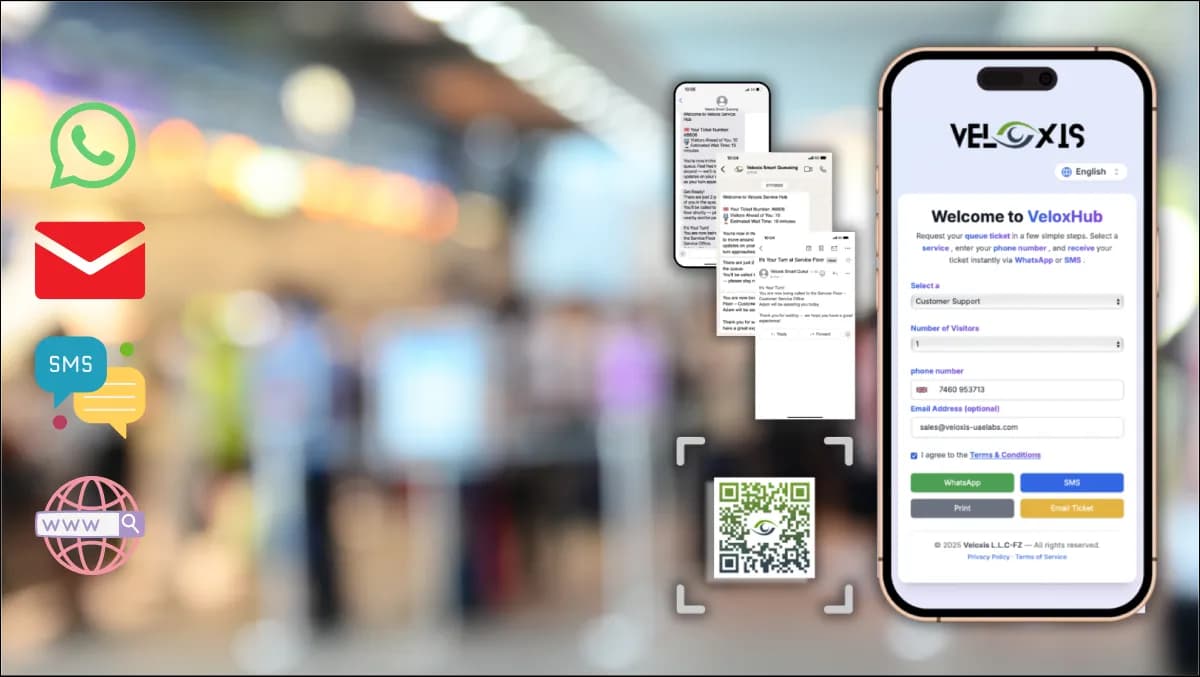
A new customer who has never used a virtual queue has to be onboarded in the moment, while standing at the venue, in whatever language they prefer, on whatever phone they happen to have. The friction has to be measured in seconds. Scan a QR code, see your position, get a confirmation, done. Anything that requires app download, account creation, or email verification has lost the customer.
Equity for non-smartphone users
For any operator with a public-service mandate — government, healthcare, financial inclusion — there must be a parallel path for customers who do not have a smartphone or who cannot use one. The pattern that works is a physical kiosk at the venue that issues a paper ticket linked to the same queue, with display screens that show position and call-forwards. Virtual and physical are not mutually exclusive; they are the same queue with two intake surfaces.
Cross-jurisdiction data handling
A virtual queue captures personal data — at minimum a phone number, often a name, sometimes a national ID or appointment reference. The handling of that data has to satisfy UK GDPR, EU GDPR, GCC PDPL frameworks, US state laws, Brazilian LGPD, and every other regime the operator is exposed to. The defensible answer is sovereign on-premises by default, with retention windows configured per deployment and the operator holding the keys.
Where the next 18 months take virtual queuing
Voice and language model integration
The customer who joins a virtual queue increasingly expects to be able to ask a question about their position, their service type, or the next steps using natural language. The pattern that works is a lightweight LLM-backed assistant scoped to the operator's own knowledge base, running on-prem against open-weight models. The customer asks "how long is this likely to take" and gets a context-aware answer that draws on the live wait estimate, the customer's service type, and the operator's published service-level expectation. The assistant does not need to be a general-purpose chatbot; it needs to handle the specific questions that customers actually ask in the queue context.
Cross-channel queue continuity
A customer who joins the queue digitally and arrives in-person should not have to re-identify themselves to a counter clerk. The queue management system, the appointment system, and the digital signage layer share a customer identifier, the counter clerk's terminal surfaces the context, and the handover is invisible to the customer. This is mostly an integration problem, not a product feature problem, but it is the integration problem that distinguishes a mature deployment from a bolt-on.
Operator analytics as a product
The operator's own dashboard is no longer the only consumer of the virtual queue's data. The data feeds workforce-management systems for staff scheduling, customer-relationship-management systems for service-history enrichment, and increasingly the operator's own analytical models for forecasting and capacity planning. The virtual queue platform that exposes its data through clean APIs — without vendor lock-in, without re-purposing licenses — becomes a strategic asset; the one that hides the data behind a proprietary dashboard becomes a constraint the operator eventually replaces.
Equity and accessibility as differentiators
The virtual queue platforms that win the public-sector and regulated-industry tenders are the ones that take accessibility seriously from day one. WCAG 2.2 AA on the customer-facing UI, screen-reader compatibility, high-contrast mode, large-text mode, audio-call confirmation as an alternative to push notification, and an on-site kiosk for non-smartphone customers — none of these are advanced features in 2026, they are the baseline. The operators who treat them as optional discover that their tender response gets rejected before the technical evaluation begins.
Where Zeour fits
We build virtual queue management as part of the GLARUS ecosystem, integrated with the physical queue management system, online appointment, self-service kiosks, and digital signage. The platform runs across 1,247+ branches in 40+ countries, sovereign on-premises by default, multilingual at the framework layer with English and Arabic full RTL as production baseline and any other locale added per engagement. The engagement model is fixed-fee phased with operator self-sufficiency at exit. The future of virtual queuing is not a separate product line; it is the same ecosystem continuing to learn from the load profile of every operator running it.