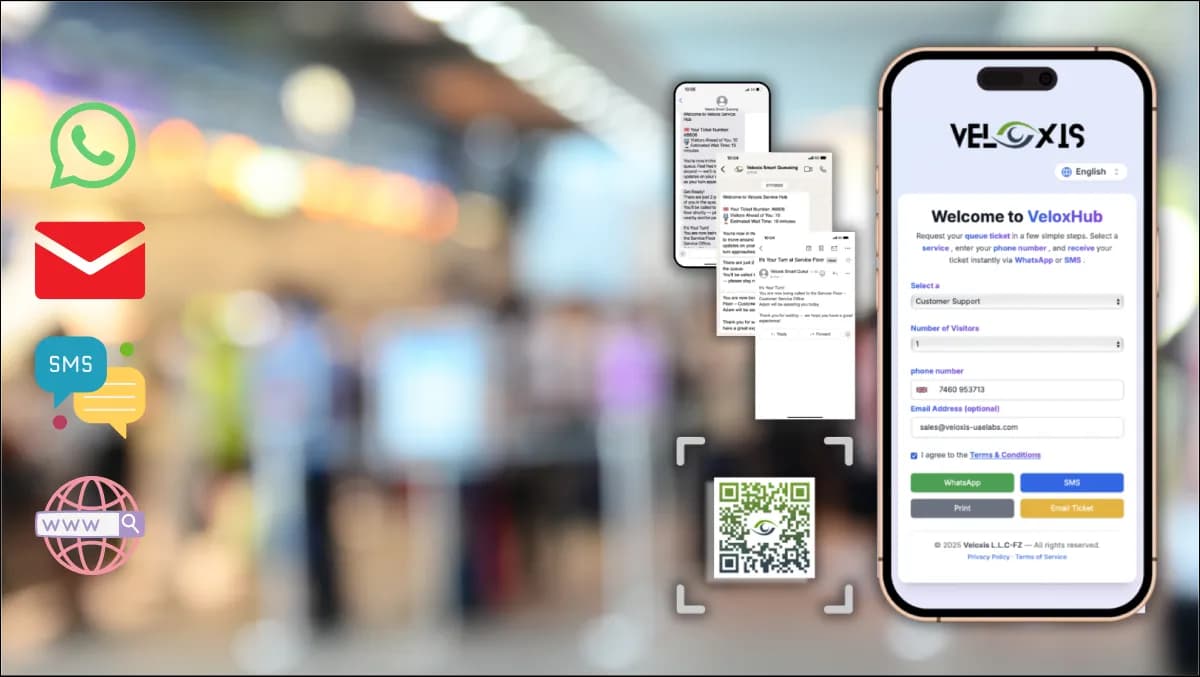
The physical queue is a customer-experience tax that operators have been paying for decades because the alternative looked harder than it was. Virtual queueing flips the model: customers reserve their position from wherever they are, see live updates on where they sit in the line, get a push notification when their turn is approaching, and arrive at the service point ready to be served. The waiting area, if there even needs to be one, becomes incidental rather than load-bearing.
What virtual queueing actually changes
Three operational realities shift the moment a site goes virtual.
The first is space economics. A bank branch, a clinic, a service centre, or a retail store no longer has to size its waiting area for peak. The waiting area becomes a small overflow buffer because most customers are not in it; they are in a coffee shop two blocks away, or still at home, or in a meeting that they will close out when their position drops below five. Floor space that was previously dedicated to chairs becomes service capacity, retail floor, or simply less expensive square footage to operate.
The second is staffing flexibility. With a virtual queue, the operator sees the live demand curve thirty to ninety minutes ahead. The shift supervisor can pull a second cashier from a back-of-house task before the queue spikes, rather than reacting to a visible line after it has already formed. This is a substantial productivity gain in any operation where staff can flex between front-of-house and back-of-house.
The third is customer behaviour. Customers who are not standing in a queue do not abandon at the same rate. Customers who arrive on a push-notification do not arrive irritated. Customers who can see their position drop in real time trust the system. The combined effect on customer satisfaction scores, conversion in retail, and complete-rate in service operations is consistently meaningful in every deployment we have run.
How a virtual queue is actually wired up
A working Virtual Queue Management System has three components that have to be designed together.
- Customer-side join. A QR code at the entrance, a link on the operator's website, a button in the operator's mobile app, or an SMS-to-join shortcode. The fewer steps between intent and joined-the-queue, the better. Asking the customer to install a vendor app before they can join the queue is a known abandonment point; avoid it.
- Operator-side service routing. The system knows which counters can serve which service types, which staff member is currently on which counter, and what the live wait estimate is per counter. When a customer is called, the system tells them which counter to walk to. This is where most off-the-shelf virtual-queue products fall over, because they treat the routing as an afterthought.
- Live communication channel. Push notifications via the operator's app where available, SMS where not, web-socket updates for the customer who joined via the web. The customer sees a position counter that ticks down and an ETA that updates as it learns from the actual service rate.
Underneath all three sits the same queue engine that runs the operator's physical Queue Management System. Virtual queueing is not a different product; it is the same queue model with a different join channel. Operators who try to run a separate virtual product alongside a separate physical product end up with two queues that disagree about position, which is worse than no virtual queue at all.
The mobile-first reality
In most markets across the UK, EU, Americas, GCC, MENA, Africa, and Asia, the customer's phone is the primary channel. Designing the virtual queue around the phone — not as an afterthought to a kiosk — is the only sensible 2026 default. That means a mobile-web join flow that does not require an app download for first-time customers, a deeplink for operators that do have an app, SMS fallback for customers without a smartphone, and a kiosk in the lobby for walk-ins who want a printed ticket for traditional reasons.
The mobile flow has to render correctly in both left-to-right and right-to-left scripts, because customer-facing surfaces cannot afford to be unilingual. Zeour's virtual queue ships with English and Arabic with full RTL rendering as a production baseline; French, Spanish, German, Portuguese, Italian, Dutch, Turkish, Urdu, and Hindi are added per engagement. The customer chooses their language at join; the operator dashboard sees the customer's preferred language so the staff member who serves them knows which language to greet them in.
What the data tells you that you did not know
A properly instrumented virtual queue is also the first honest picture most operators get of their service operation. Where the physical queue made it hard to see anything other than the current line length, the virtual queue stream gives you:
- True arrival distribution by hour and day, by service type, by channel of join
- Service time per counter and per staff member, including the long tail of outlier interactions
- Abandon rate by wait length, with the curve that tells you where customers start to give up
- Returning-customer rate, if the join is authenticated, which feeds CRM and loyalty
- No-show rate on appointment-backed joins, which feeds the appointment slot policy
These signals drive real operational change. The Tuesday-afternoon staffing model that everyone assumed was correct turns out to be twenty percent over-resourced. The five-minute service standard turns out to be fine for the simple service type and impossible for the complex one. The waiting area that was always full turns out to have been full of customers who had abandoned ten minutes earlier and were waiting for a refund.
The objections that turn out to be wrong
Three objections come up in every procurement conversation, and all three turn out to be weaker than they look.
'Our customers will not use their phones.' They already do, for everything else. The customer who books a flight, orders a meal, and reads a bank statement on their phone is the same customer being asked to take a paper ticket from a dispenser. The friction in the system is the paper ticket, not the phone.
'We will lose the walk-in customer who does not pre-book.' No. Walk-ins still walk in. The virtual queue is a parallel join channel, not a replacement for the lobby kiosk. The lobby kiosk still issues tickets. The walk-in customer joins the same queue the virtual customer joined; they are not penalised for arriving in person.
'Our staff cannot run a second system.' They are not running a second system. The counter terminal is the same counter terminal. The customer-call screen is the same screen. The only behavioural change for the staff member is that the next customer might not have been physically visible in the lobby — and the customer-name on the call gives the staff member a sentence of context they did not previously have.
Where virtual queueing belongs in the engagement
Virtual queueing is rarely a standalone purchase. Most operators arrive at it as part of a broader queue and customer-flow modernisation, often alongside online appointments, self-service kiosks, and customer-feedback collection at the end of the journey. Sequenced correctly, these pieces become one customer experience and one operator dashboard rather than four disconnected products.
Zeour ships the whole queue ecosystem as one platform, deployable on-premises in the operator's perimeter or as a managed cloud where the operator prefers, with the operator owning the deploy keys and the data at the end of a fixed-fee phased engagement. Replace the line with a notification, and your operation gets sharper in ways the physical queue was actively hiding.