Key takeaways
- A real smart parking management system is an operational stack, not an app — RFID readers, Android kiosks, barriers, payment hardware, ANPR cameras and a sovereign licence gate all have to behave like one product, online or offline.
- The single biggest 2026 buying mistake is choosing a satellite-GPS phone-app vendor that does not control the barrier — when WAN drops, your estate goes free-to-park and your revenue audit trail goes dark.
- Wiegand-only readers and proprietary kiosk OEMs are the lock-ins that bite year three. Insist on OSDP-capable readers and a commodity Android kiosk reference design.
- An RSA-SHA256 signed licence gate with a MAC-address allowlist gives anti-fraud enforcement without daily phone-home — essential for hospital, oil and gas and sovereignty-sensitive operators.
- 2026 hardware unit costs: RFID reader £150-£400, Android kiosk £1,200-£2,800, barrier gate £600-£1,500, ANPR camera £400-£1,200, PGS display £200-£800 per lane.
- Multi-site operators (10-200 car parks) need isolated billing, branding and reporting per site plus a consolidated HQ rollup — and the right to walk in 90 days without losing licence keys or customer data.
- Mid-market estates routinely recover build cost inside 18-30 months by removing cash leakage, automating staff lanes and monetising mid-day capacity via dynamic pricing.
The 2026 smart parking market is bifurcated. On one side, satellite-GPS phone apps that demo well but cannot raise a barrier without a backend round-trip. On the other, legacy ticket-spitter platforms that survive when the internet dies but cannot do mobile pre-booking, dynamic pricing or multi-site rollup. This guide is the playbook we use when scoping a new programme.
Who this guide is for
- Facilities director at a hospital, office campus or shopping mall. You run a multi-zone car park with staff, visitors, contractors and patients sharing a finite footprint. You need RFID access for permit-holders, a payment kiosk for visitors, integration with your visitor management system, and a hard guarantee that card data and plates never leave perimeter.
- Multi-site parking operator running 10-200 car parks. You need consolidated reporting, dynamic pricing rules that adapt to occupancy and time-of-day, a mobile-app channel for pre-booking and pay-on-exit, and a contractual exit window that lets you walk if your vendor underperforms.
- Municipal or city-authority CTO. You deploy parking across on-street and off-street estates citywide. You need sovereign deployment, integration with city payment rails and ANPR networks, a published anti-fraud posture, and a single revenue-reporting endpoint that satisfies the auditor general.
- Mixed-use developer or property-management firm. Your tenants expect parking that ties into the building's visitor management, digital signage and queue management — one operational stack rather than four contracts and four renewal cycles.
What is smart parking in 2026?
A smart parking management system is the software, hardware and on-prem control plane that turns a car park into a metered, auditable, multi-tenant revenue-and-access surface. At the simplest level it controls who enters, who leaves, what they pay, and what report lands on the operator's desk on Monday morning. At the enterprise level it does that across hundreds of sites, with isolated branding, configurable currency per country, and a unified rollup the CFO trusts.
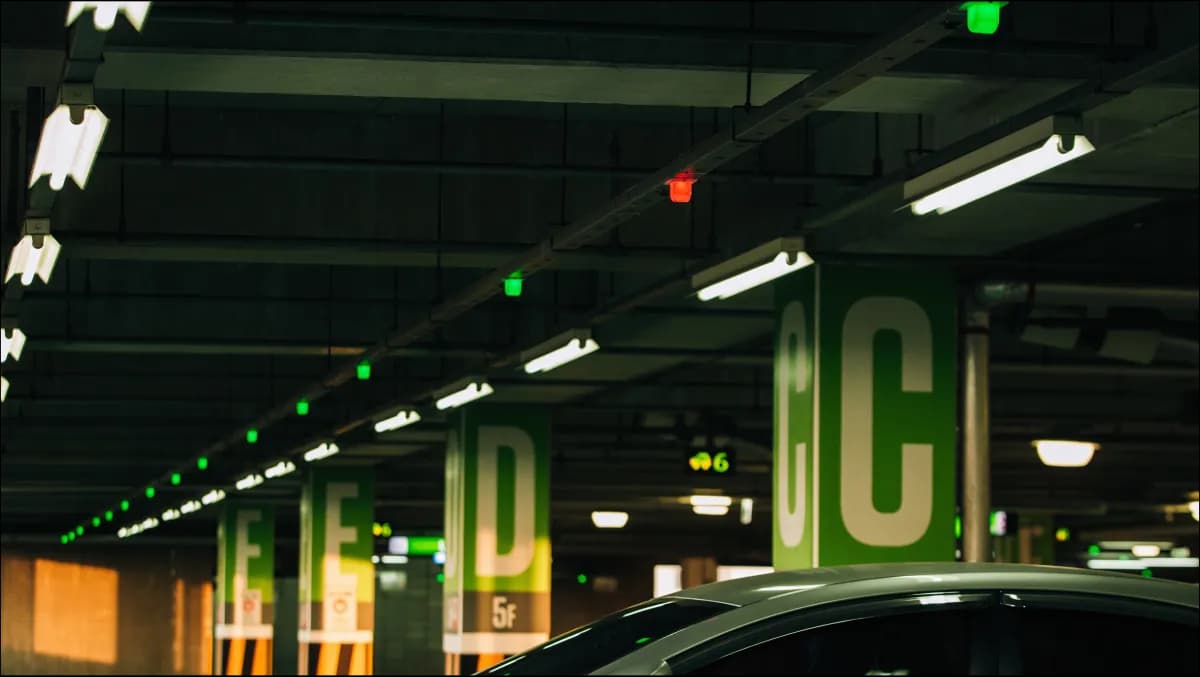
Technically the platform has six layers. The access edge — RFID readers (Wiegand or OSDP over RS-485), ANPR cameras for plate recognition, and barrier-gate controllers driving 24V relays. The kiosk — typically an Android touchscreen with thermal printer, card acceptor and optional cash recycler. The server — a Linux box on-prem (or a small HQ cluster) running rules engine, billing, audit log and reporting API. The licence gate — the cryptographic anti-fraud surface ensuring only paid, MAC-authorised kiosks run operator software. The integration surface — APIs into visitor management, digital signage, city payment, ANPR cameras and revenue reporting. The experience layer — mobile apps, signage, feedback and the PGS LED displays that tell drivers "Zone B: 23 spaces."
What separates a real platform from shelfware is the discipline at each layer. A real platform exposes its rules engine to the operator, not just to the vendor's professional services team. It lets the customer own the database, the licence keys, the kiosk OS image. It treats WAN as unreliable by default — every barrier lifts on the local edge whether or not the central server is reachable. It ships in any locale per engagement, with English and Arabic full RTL as production baseline.
The 14-criterion scoring rubric — score every vendor
- 1Sovereign deployment by default. Why: card data, plates and audit trails belong to the operator, not a vendor cloud. Test: demonstrate a fully air-gapped install where barrier, kiosk and reporting work with WAN unplugged.
- 2Open RFID protocol support. Why: Wiegand is legacy and insecure; OSDP v2 is the modern standard and lets you swap readers without rewiring. Test: require both Wiegand and OSDP in the kiosk firmware spec.
- 3Commodity Android kiosk hardware. Why: proprietary kiosk OEMs lock you into one supplier for a decade. Test: the vendor ships the kiosk OS image to your choice of touchscreen panel PC.
- 4RSA-SHA256 signed licence gate with MAC allowlist. Why: prevents pirated kiosks and orphaned devices from forging audit entries. Test: request the licence file format spec and a sample revocation flow.
- 5No daily phone-home requirement. Why: hospital basements and rural municipal car parks lose WAN routinely. Test: power the kiosk on, disconnect the internet, process 50 paid exits over four hours.
- 6Pluggable payment stack. Why: Ingenico, PAX and Verifone sell into different markets; CashCode, JCM, MEI and Glory recyclers have different audit hooks. Test: swap one card terminal for another model without a code change.
- 7Dynamic pricing engine with rule audit log. Why: time-of-day and occupancy-based pricing materially lifts revenue, but every rule change must be defensible to the regulator. Test: change a rule, then export who changed it, when, and the old value.
- 8Multi-site isolation with HQ rollup. Why: a 50-site operator cannot have one site's outage take down the others. Test: simulate a single-site database failure and confirm the other 49 keep operating.
- 9Configurable currency and phone format per site. Why: cross-border estates need GBP at London and EUR at Paris without a code fork. Test: spin up two sites in different currencies in the same console.
- 10Vendor-agnostic ANPR integration. Why: you do not want the parking software dictating which camera vendor you can buy. Test: connect a third-party ANPR feed via the documented spec and exit a vehicle by plate.
- 11Integration with visitor management, digital signage and queue management. Why: on mixed-use estates these systems share a customer lifecycle. Test: a visitor pre-registered in the VMS drives in, is recognised by ANPR, and has parking validated automatically.
- 12Mobile app for pre-book, pay-on-exit and find-my-car. Why: drivers expect this in 2026. Test: the app should function over LTE, but the barrier must function whether or not the app responded.
- 13Fixed-fee phased engagement model. Why: parking projects with time-and-materials contracts blow the budget. Test: Discovery, Build, Integrate, Pilot and Operate as fixed-price phases with milestone payment.
- 14Exit window at 90 days. Why: if the relationship sours, you need source code, database export and signed-out licence keys in 90 days — not 18 months of legal wrangling. Test: read the exit clause before signing.
How do you choose between cloud, on-premises and hybrid?
| Deployment | Strengths | Weaknesses | Best fit |
|---|---|---|---|
| Vendor-hosted cloud SaaS | Fast to spin up; vendor patches the stack | Card data and plates leave perimeter; barrier behaviour depends on WAN; data residency uncertain | Greenfield single-site operator that does not control the network |
| On-premises sovereign | Full data control; barrier works offline; auditable; licence-gated against piracy | Operator owns OS patching and hardware refresh; needs ops capability | Hospitals, oil and gas, municipal, mixed-use developers, multi-site operators with compliance load |
| Hybrid (edge-on-prem, HQ-rollup-in-cloud) | Edge resilience plus central analytics; lets HQ run BI without exposing card data | More moving parts; needs clear data-classification policy | Multi-site operators with mixed sovereignty requirements site-to-site |
| Satellite GPS phone-app only | Cheap to launch; no on-site infrastructure | Cannot enforce a physical barrier; no audit of revenue from cash payers; no plate-level anti-fraud | On-street pay-by-phone overlay only; not a real off-street platform |
| Legacy ticket-spitter | Survived 20 years; offline by default | No mobile, no dynamic pricing, no multi-site rollup, no modern integration | Single-site low-volume estates with no roadmap |
| Mobile-app-led with cloud lock-in | Sleek UX | Vendor controls the licence and the customer database; exit is brutal | Avoid for enterprise estates |
If you are running anything more sensitive than a high-street pay-and-display, on-premises sovereign is the default and the burden of proof is on anyone proposing cloud-only. The hybrid pattern wins when your operator has 30+ sites and HQ wants daily BI without exposing card data — push the rules engine and the licence gate to the on-prem edge, and ship hashed metrics to a central analytics tier. The pure cloud SaaS posture has its place in low-risk single-site greenfield, but it is the wrong default for the buyers reading this guide.
> Want a fixed-fee Discovery price before the end of the call? Talk to Zeour engineering — 30-minute scoping conversation, no slideware, and a published pricing band by the time we hang up.
How much does smart parking cost in 2026?
- Discovery (fixed-fee): £10k-£25k. Site walk, hardware BOM, licence gate design, integration scoping, phased plan. 2-4 weeks.
- Build small (8-12 weeks): £60k-£150k. One car park, RFID lanes, Android kiosk with payment, on-prem licence gate, basic dynamic pricing, audit log.
- Build enterprise (12-20 weeks): £250k-£700k. Multi-site, multi-zone, occupancy-based dynamic pricing, ANPR, mobile app, city-payment rails, BI rollup.
- Integrate (3-5 weeks per system): £15k-£50k. Each integration into a visitor management system, signage CMS, city revenue endpoint or third-party ANPR camera bank.
- Pilot + Go-Live (4 weeks): £15k-£40k. Shadow mode, parallel cutover, staff training, customer comms, first-month vendor support.
- Hardware per zone: RFID reader £150-£400, Android kiosk £1,200-£2,800, barrier £600-£1,500, ANPR camera £400-£1,200, PGS display £200-£800. A typical two-lane zone lands at £6k-£15k of hardware before installation.
- Care Plan: Self-Sufficient (operator-managed) up to Enterprise annual contracts with 24/7 incident response, quarterly upgrades and SLA-backed reporting — banded against estate size and operational scope.
Numbers are real-world ranges from the kind of estate we scope every month. Detail your own profile and we will publish a band on the call.
ROI calculator — build a defensible business case in 7 steps
Step 1: Baseline current monthly revenue per zone
Count paid transit-equivalent units per zone per month at current pricing. Multiply by the average transaction price. That is your baseline.
Step 2: Estimate cash-leakage recovery
Most estates lose 4-9% of cash revenue to manual handling. A reconciled cash recycler and the RSA-SHA256 licence-gate audit trail typically recover 60-80% of it. Apply to annual cash take.
Step 3: Quantify dynamic pricing uplift
Time-of-day and occupancy-based pricing lifts effective revenue per space by 8-15% on mixed-use estates without changing peak prices. Apply the lower bound.
Step 4: Capture staff-lane automation savings
Replacing a manned booth shift with an RFID + ANPR lane saves the fully-loaded cost of that shift. Compute annual saving per lane and multiply by lane-count.
Step 5: Capture corporate account uplift
Account-billed corporate parking against unused mid-day capacity is pure margin on assets you already own. Model 10-20% of mid-day off-peak inventory at a corporate rate.
Step 6: Add integration savings
If this platform replaces two vendors (e.g. a separate kiosk and ANPR vendor), book the avoided contract value. Same logic if it consolidates with visitor management and digital signage.
Step 7: Net against build + 5-year operate
Add Build + Integrate + Pilot + 5 × Care Plan on the cost side. Sum Steps 2-6 × 5 on the benefit side. Subtract; divide by build cost for payback period.
Worked example. A mid-market mall operator with eight zones, baseline £2.4M/year, books a £420k enterprise build, £25k integrate × 2, £30k pilot, £75k/year Managed Care Plan. Steps 2-6: £92k cash recovery + £216k dynamic-pricing uplift + £85k automation + £140k corporate uplift + £45k consolidation = £578k/year. Five-year net: (5 × £578k) − (£420k + £50k + £30k + 5 × £75k) = £2.0M net, 22-month payback.
Seven failure modes from real deployments
Failure mode 1: satellite-GPS phone-app vendor that does not control the barrier. Diagnosis: the operator buys the app for its UX, then needs a separate hardware vendor for the gate. Audit trails never reconcile across the two systems. Fix: the platform that runs the barrier owns the truth. Choose one stack, not two.
Failure mode 2: vendor-cloud-only platforms that fail when WAN drops. Diagnosis: a Sunday-morning fibre cut takes out a hospital basement car park; barriers fall open or stay shut. Fix: require offline barrier-decision at the edge with a 72-hour rules cache and a reconciliation queue that syncs when WAN recovers.
Failure mode 3: proprietary hardware lock-in. Diagnosis: Wiegand-only readers and vendor-specific kiosk OEMs trap the operator at year three when refresh is needed. Fix: mandate OSDP capability and a commodity Android kiosk reference design in the procurement spec.
Failure mode 4: no anti-fraud licence gate. Diagnosis: an outsourced installer clones a kiosk OS image and runs a third site with no audit trail. Fix: RSA-SHA256 signed licences pinned to a MAC-address allowlist. Pirated kiosks fail to boot the operator software.
Failure mode 5: ignoring cash recycler reconciliation. Diagnosis: cash arrives, the recycler counts it, the platform records one number, the bank deposit shows another. Three months in, variance is £40k and nobody can explain it. Fix: require cash-event APIs from the recycler (CashCode, JCM, MEI or Glory all expose them) into the platform's audit log, reconciled daily.
Failure mode 6: under-provisioning the kiosk OS update channel. Diagnosis: 200 Android kiosks across an estate, all on different OS versions, nobody knows which fixes are live where. Fix: a managed device-update channel (in-house MDM, or SOTI / Scalefusion) baked into the kiosk reference image with staged rollout.
Failure mode 7: no exit-window clause in the contract. Diagnosis: the operator wants to switch vendors and finds the customer database, licence keys and rules-engine config all hostage. Fix: contract a 90-day exit window with database export format, licence-key handover, and source-code escrow named in the agreement.
Migration path — moving from your current stack
Phase A: shadow mode. Install the new platform alongside the incumbent on a single lane in a single zone. New kiosk, new reader, new audit log — but the incumbent barrier still controls the gate. Compare entry/exit counts and payment totals daily for two weeks.
Phase B: cutover by service. Move staff RFID access first — staff tolerate teething issues better than the public. Then corporate account-billed parking. Then visitor card-payment. Public cash flow moves last.
Phase C: full pilot cutover. Cut the entire pilot zone over to the new platform. Keep the incumbent as a hot standby for 30 days with documented rollback steps. Customer service brief, signage update, FAQs published.
Phase D: estate rollout. Schedule remaining zones at a pace your operations team can absorb — typically 2-4 zones per week. Push configuration centrally via the multi-site console. Decommission the incumbent's audit-of-record once 90 days pass without rollback.
Implementation playbook
- 1Discovery (2-4 weeks). Site walks of every lane and every kiosk position. Hardware bill-of-materials. Network and power audit. Integration scoping for visitor management, city payment and ANPR. Output: a fixed-fee Build proposal.
- 2Build (8-16 weeks). Hardware procurement and pre-staging. Software configuration to the operator's rules, branding and pricing. Multi-site setup if applicable. Weekly demos. RSA-SHA256 licence keys generated per site, MAC-allowlist seeded.
- 3Integrate (3-5 weeks). Each downstream system wired in turn: VMS, signage, ANPR vendor cameras, city revenue endpoint, identity provider. Each integration shipped to a documented spec with a passing acceptance test.
- 4Pilot + Go-Live (4 weeks). Shadow mode → cutover by service → full pilot cutover. Customer comms. Staff training. Operate-with-vendor support for the first month.
- 5Operate. Care Plan tier of the operator's choice. Quarterly health review. Rules-engine and dynamic-pricing tuning. Hardware refresh planning.
Frequently asked questions
How long does a typical smart parking deployment take?
A single-site Build runs 8-12 weeks from contract to Go-Live; an enterprise multi-site programme runs 12-20 weeks for the platform plus 2-4 weeks per additional site. Discovery adds 2-4 weeks at the front. Hardware lead times on barriers, readers and PGS displays add 2-6 weeks — order long-lead items at contract signing, not at week eight.
Can the platform run in an air-gapped car park with no internet?
Yes — test it on day one. The kiosk, reader, barrier and on-prem server should function fully offline. WAN is needed only for HQ rollup, mobile-app pre-booking and software updates. A properly engineered platform queues analytics traffic during outages and reconciles when WAN recovers.
What is the difference between Wiegand and OSDP RFID readers?
Wiegand is the legacy 1980s protocol — point-to-point, no encryption, no cable monitoring. OSDP v2 is the modern SIA standard — bidirectional, encrypted, supports cable supervision and reader firmware updates over the same line. Specify OSDP-capable readers for any new deployment even if you initially wire Wiegand for compatibility.
How does the RSA-SHA256 licence gate prevent fraud?
Each kiosk receives an RSA-SHA256 signed licence file pinning it to a MAC-address allowlist. At boot, the kiosk verifies the signature against an embedded public key and refuses to launch operator software if the MAC does not match. Cloning the OS image to another device fails the licence check — pirated installs cannot produce valid audit entries.
Which payment hardware should we standardise on?
For card, Ingenico, PAX and Verifone are all reliable — pick the one with the strongest acquirer relationship in your market. For cash recyclers, CashCode, JCM, MEI and Glory all expose audit-event APIs; CashCode and Glory dominate high-volume estates, MEI and JCM are competitive at mid-volume. The platform should be terminal-agnostic so you can swap models without a code change.
How do you handle multi-currency for an operator with cross-border sites?
Per-site configuration. Each site carries its own currency, tax regime, receipt template, phone-number and date format. HQ rollup normalises to a base currency for reporting only — site-level transactions remain in the local currency end-to-end. The same configuration model handles multiple languages per site, with English plus Arabic full RTL as production baseline.
Can the platform integrate with our existing ANPR cameras?
Yes — modern parking platforms should be ANPR-vendor-agnostic. You provide the camera vendor's plate-read feed over a documented spec (REST + webhook or RTSP for raw frames); the platform matches the plate against permits, pre-bookings or account holders and instructs the barrier. Do not let a parking vendor dictate which camera you can buy.
How does this compare to satellite GPS phone-app parking?
GPS-app vendors give drivers a payment channel without on-site hardware — useful as an overlay for on-street pay-by-phone, but useless as a primary off-street platform because they cannot enforce a barrier. The audit trail is weak: no plate-level proof a paid driver actually entered. Serious off-street estates use a hardware-and-controls platform; GPS apps can be one accepted payment channel among many.
What is the right Care Plan tier for a 50-site operator?
Most 50-site operators land on Managed (£45k-£120k/year) with one or two flagship sites escalated to Enterprise with on-site SLA. Self-Sufficient works for sophisticated operators with in-house Linux and Android skills who only want the vendor on-call. Match the tier to your operational capability, not the vendor's revenue ambition.
What does the 90-day exit window actually deliver?
A documented database export, signed-out licence keys (so you can keep operating without vendor consent), source-code escrow release if you need to fork, runbooks and architecture docs, and 30 days of post-handover phone support. It is the contractual guarantee that lets you walk if the relationship sours — and the reason enterprise procurement teams insist on it before signing.
Where Zeour fits
Zeour Smart Parking is the platform we have shipped into hospital campuses, mixed-use malls, government car parks and municipal estates — RFID + Android kiosk + RSA-SHA256 licence gate + barrier + ANPR + payment, deployable on-prem and configurable per site. It integrates natively with our visitor management system, digital signage CMS and wayfinding, so mixed-use estates run one operational stack rather than four. For programme context, see our visitor management compliance buyer's guide and multi-tenant digital signage CMS buyer's guide. To scope a programme: book a demo, request a quote, browse the parking industry page or retail industry page, or dig deeper in the glossary and the rest of the Zeour blog.
---
Last updated: May 17, 2026 — by the Zeour engineering team.