Key takeaways
- A Saudi bank queue management system in 2026 is judged against four overlapping frameworks: SAMA cybersecurity, PDPL residency, NCA-ECC operator controls, and Vision 2030 Financial Sector Development Programme KPIs.
- Bilingual EN plus AR with full right-to-left rendering is a hard procurement gate — Arabic PDF receipts, Arabic call-forward audio, RTL kiosk UI, and mixed-script handling must render correctly out of the box.
- Public-cloud multi-tenant QMS is effectively off the table for SAMA-regulated banks; defaults are operator-owned sovereign on-premises deployment or single-tenant sovereign cloud with KSA-region residency.
- Realistic spend for a national rollout of 100-700 branches is £400k-£1.5M for build, plus £25k-£80k per upstream integration — quoted in SAR during Discovery on request.
- Integration with the national card scheme and federated authentication against the national identity gateway are the two integrations that most often slip if they are deferred past Discovery.
- On-premises AI — open-weight LLMs on operator hardware — is the only way to add intelligent triage without breaching NCA-ECC, PDPL, or SDAIA AI ethics.
- A fixed-fee phased engagement with a 90-day exit window maps onto KSA regulated-sector procurement preferences.
If you run branch operations, technology, or transformation for a SAMA-licensed bank in 2026, your queue management decision is a regulated platform decision — audited under PDPL and NCA-ECC and measured against Vision 2030 FSDP targets your board has committed to. This guide is a senior implementation engineer's view of how to choose, scope, and ship a programme that survives all four.
Who this guide is for
- Persona 1. Branch Network Director running 80-700 branches across Riyadh, Jeddah, Dammam, Makkah, and Madinah — with a board mandate from the FSDP and a wait-time KPI to defend at the next SAMA review.
- Persona 2. Bank CIO or Head of Technology managing core banking integration (Temenos, Finacle, Mambu), federated identity against the national gateway, and the SAMA cybersecurity baseline — for whom multi-tenant public cloud is already off the table.
- Persona 3. Head of Branch Experience or Retail Banking COO measuring NPS and CSAT per branch, with an Arabic-speaking customer base that treats Arabic-first UX as a brand promise.
- Persona 4. Programme Director for branch transformation running the FSDP-aligned modernisation — needing the integration map across queue management, virtual queue, online appointment, digital signage, and on-premises AI to land as one platform.
What is queue management in 2026 — and why it's different for KSA?
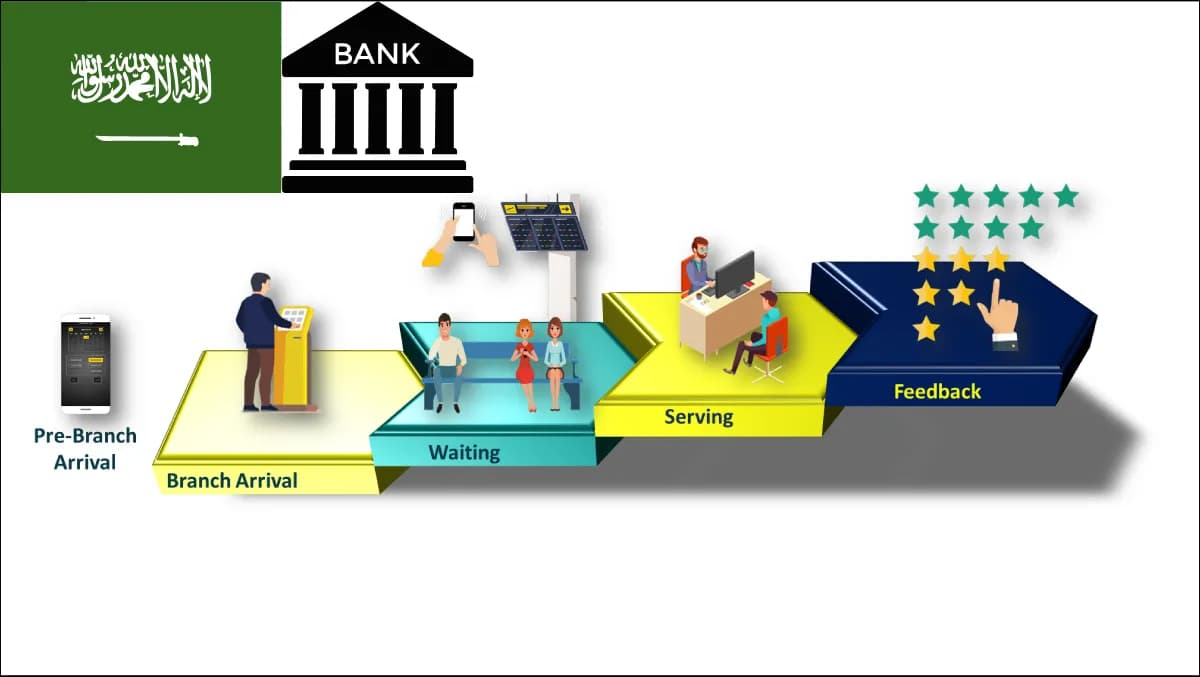
A modern QMS is no longer a ticket dispenser and a calling screen. It is the orchestration layer deciding which customer reaches which advisor through which channel, in what language, at what service level — and it is the audit surface that proves it. In a 2026 Saudi bank the same platform handles a walk-in customer with a mada-bound transaction, a pre-booked premium session, a SME visit booked through WhatsApp virtual queuing, and a wealth client with a private appointment — all routed correctly, all logged, all bilingual.
The KSA regulatory shape is the differentiator. Under PDPL, personal data of Saudi residents — the name, national ID hash, phone, ticket history, and segment held in a QMS — is subject to residency, consent, retention, and DSAR rules with the operator accountable. Under NCA-ECC, the operator owns the security baseline and the vendor demonstrates alignment. SAMA layers its own framework on top with stricter logging, change-management, and HA expectations. The combined effect is that public-cloud multi-tenant SaaS fails the audit before procurement starts.
The operational shape is just as distinctive. Bilingual EN plus AR full RTL is a hard requirement: Arabic-numeral receipts, RTL kiosk layouts, mixed-script handling, Arabic audio call-forward, and Arabic-correct PDF rendering. Vision 2030 FSDP has set explicit targets for digital adoption and customer experience the QMS is measured against. And the national identity gateway lets a customer authenticate once and have identity federated to bank-side systems — collapsing a 4-minute KYC step into a sub-30-second confirmation. Most of this has to be architected on day one. If you operate outside the Kingdom, the horizontal QMS buyer's guide and banking branch transformation guide cover the wider ground.
The KSA-fit scoring rubric — 14 criteria
- 1Sovereign on-premises deployment posture. Why for KSA: operator-owned hardware is the cleanest path through PDPL residency and NSDI preference. Test: a reference deployment on operator tin with no vendor egress.
- 2Bilingual EN plus AR with full RTL out of the box. Why for KSA: Arabic-first UX is mandatory; broken RTL is a brand and audit issue. Test: a live Arabic PDF receipt, RTL kiosk screenshot, and Arabic call-forward audio.
- 3NCA-ECC alignment. Why for KSA: the operator owns the Essential Cybersecurity Controls baseline. Test: a control-by-control alignment document.
- 4Core banking integration depth. Why for KSA: Temenos, Finacle, and Mambu dominate; the QMS reads service catalogues, writes back outcomes, and reconciles customer IDs. Test: references integrating with the same core you run.
- 5National identity gateway integration. Why for KSA: federated OIDC collapses KYC time at the counter. Test: a live OIDC handshake against a sandbox.
- 6National card scheme terminal integration. Why for KSA: card-bound counters need certified payment terminals (Ingenico, PAX, Verifone) — not vendor-proprietary protocols. Test: certified terminal SDK references.
- 7Multi-channel intake. Why for KSA: customers arrive via kiosk, virtual queue, online appointment, or walk-in — all four land on the same ticket. Test: an end-to-end demo across all four channels.
- 8Skill-based routing for premium, mass, and wealth segments. Why for KSA: segmented branch journeys are a Saudi banking norm. Test: a routing matrix for a customer with multiple holdings.
- 9Multi-branch consolidation plus per-branch tenanting. Why for KSA: head-office and per-branch metrics must both be first-class. Test: corporate and single-branch dashboards from one dataset.
- 10Audit trail aligned with SAMA plus PDPL. Why for KSA: every ticket event logged with actor and timestamp; DSARs satisfied in days. Test: a sample audit pack and DSAR walkthrough.
- 11High-availability posture with branch autonomy. Why for KSA: branches keep serving during WAN incidents; active-active with sub-60-second failover and local degraded-mode is the baseline. Test: a DR runbook with measured failover times.
- 12Fixed-fee phased engagement. Why for KSA: regulated-sector procurement favours scoped, milestone-priced contracts. Test: a published pricing band and milestone schedule before signature.
- 13Operator-owned data and schema. Why for KSA: the operator owns the schema and data, not leases them. Test: a written assertion in the master agreement.
- 1490-day exit window. Why for KSA: the operator owns the platform at termination — source code, licence keys, deployment artefacts. Test: a contractual exit window clause.
A bank scoring its longlist on a 0-3 scale cuts the field to two or three candidates in an afternoon. The remainder is delivery and references.
How do you choose between on-premises, sovereign cloud, and public-cloud SaaS in KSA?
The deployment posture decision is the single biggest one in a Saudi bank QMS programme — and the one most often made too late.
| Criterion | Sovereign on-premises | Sovereign cloud tenancy | Public-cloud SaaS |
|---|---|---|---|
| Data residency under PDPL | Operator hardware in KSA — strongest posture | Single-tenant, contractually KSA-region | Multi-tenant outside Kingdom — typically fails |
| NCA-ECC fit | Operator owns full control surface | Shared control surface, workable | Vendor owns control surface — hard gaps |
| SAMA cybersecurity alignment | Cleanest — bank's own SOC and keys | Workable with named sovereign provider | Material gaps on logging and key custody |
| Latency to branches | LAN-class, sub-100ms WAN to branches | 20-80ms inside Kingdom | Variable, dependent on egress |
| 5-year TCO, 100-branch estate | £900k-£2.2M all-in | £1.1M-£2.6M all-in | £1.4M-£3.2M annuity, rise risk |
| Exit cost | Operator already owns the platform | Moderate, provider-dependent | High — data extraction and re-platform |
| Default for SAMA-regulated banks | Yes | For adjacencies only | No — fails day one |
The opinionated answer is sovereign on-premises by default. Sovereign cloud has a role for adjacent workloads (analytics, marketing) where data sensitivity is lower — but the branch QMS belongs on the operator's hardware.
> Want a fixed-fee Discovery price before the end of the call? Talk to Zeour engineering — 30-minute scoping conversation, no slideware, and a published pricing band by the time we hang up.
How much does QMS cost in KSA in 2026?
Pricing is quoted in £ here; Discovery quotes for KSA buyers are issued in SAR on request at the spot rate.
- Discovery (fixed-fee). £15k-£40k for a 2-4 week scoping engagement — branch journey mapping, regulator-mapped requirements (PDPL plus NCA-ECC plus SAMA), integration discovery, and a published build price.
- Build — single-brand, 20-80 branches. £100k-£350k for platform configuration, bilingual EN plus AR theming, branch-tenant model, skill-based routing, operator dashboards, and initial integrations.
- Build — national rollout, 100-700 branches. £400k-£1.5M for the full platform with multi-tenant consolidation, segment routing, on-premises AI where in scope, and SAMA-aligned audit reporting.
- Integrations. £25k-£80k per upstream system — core banking (Temenos, Finacle, Mambu), national identity gateway, national card scheme via certified terminal SDKs, ITSM, and the analytics warehouse.
- Pilot. £25k-£60k for a 3-5 branch pilot with a measured baseline before rollout.
- Per-branch hardware. £8k-£25k depending on counter count, printer, kiosk, and signage.
- Care Plan. Tiered annual support and updates, always scoped after Build, never bundled into one annuity.
A 200-branch programme with the full integration set, on-premises AI, and a 5-year Care Plan typically lands inside £1.4M-£2.6M — more defensible than a public-cloud annuity because the operator owns the platform at exit.
ROI calculator — build a defensible business case in 7 steps
Step 1 — Baseline the current wait
Measure mean and 90th-percentile wait per service per branch over a 28-day window. Most Saudi banks discover the mean hides a long tail at peak — and the tail drives the NPS damage.
Step 2 — Quantify per-customer-hour value
Use blended branch revenue per customer-hour as the unit. Mass is modest; premium and wealth materially higher. Multiply recovered minutes by the segment mix.
Step 3 — Model staff utilisation lift
A properly routed QMS typically lifts advisor utilisation by 12-22 per cent versus a single-queue system — by removing idle time when one counter is overloaded and another is empty. Apply the lift to your branch staff cost base.
Step 4 — Apply the NPS-to-CLV bridge
A 10-point NPS lift correlates to a 4-9 per cent uplift in retail-banking customer lifetime value. Apply conservatively — use the lower bound for the business case.
Step 5 — Quantify compliance-FTE recovery
A QMS with a built-in PDPL DSAR pack and SAMA-shaped audit export removes 0.3-0.8 FTE of compliance work per audit cycle. Capitalise the saving over contract life.
Step 6 — Cost the self-service deflection
Deflecting 15-30 per cent of routine transactions to a self-service kiosk or virtual queue recovers counter time at full marginal cost. Use per-transaction labour cost as the unit.
Step 7 — Worked example: 200-branch national bank, 5 years
For a 200-branch national bank serving 4M retail customers, conservative 5-year NPV typically lands in the £14M-£28M range against TCO of £1.4M-£2.6M — payback inside year 1, and a clean board paper for the next FSDP review.
Seven failure modes from KSA deployments
Failure mode 1: Public-cloud QMS fails PDPL audit mid-rollout. A bank picks a generic cloud SaaS QMS on price, rolls into 30 branches, and is frozen by a regulator finding personal data is leaving the Kingdom. The fix is to make deployment posture a day-one gate — sovereign on-premises by default.
Failure mode 2: Bilingual retrofitted at framework layer fails Arabic PDFs at SAMA inspection. A vendor demos English UI, promises Arabic in phase 2, and ships a mode where PDF receipts wrap wrong and call-forward audio is in English. The fix is to make bilingual baseline — full RTL, Arabic PDFs, Arabic audio, mixed-script — a Discovery acceptance criterion with a live demo.
Failure mode 3: AI assistance outsourced to a public LLM API breaches NCA-ECC and SDAIA ethics. A bank adds advisor-assist calling a public LLM endpoint with redacted customer data — and discovers redaction is incomplete and provider terms allow training on inputs. The fix is on-premises AI from the start: open-weight models (Llama, Mistral, Mixtral, Qwen, DeepSeek) on operator hardware via vLLM or Ollama, with RAG against the bank's knowledge base.
Failure mode 4: Single-vendor lock-in with no exit window becomes a permanent annuity. Five years in, the bank discovers no contractual exit clause, no operator-owned source, and a renewal 60 per cent higher. The fix is a 90-day exit window and operator data ownership at signature, with a tested extraction runbook by year 3.
Failure mode 5: National card scheme terminal integration assumed, discovered vendor-proprietary. The bank assumes the QMS talks to certified Ingenico or PAX terminals on national card scheme rails — and discovers the vendor ships a proprietary protocol. The fix is to demand certified terminal SDK references in Discovery.
Failure mode 6: Multi-branch consolidation deferred to phase 2 breaks corporate reports until year 2. The first rollout ships per-branch dashboards with no cross-branch aggregation; head-office hand-stitches Excel for 14 months. The fix is to model the multi-tenant data layer in Discovery and ship the corporate dashboard with the first 10 branches.
Failure mode 7: No branch autonomy during WAN drop leaves branches unable to serve customers. A regional WAN incident isolates 22 branches and they stop dispensing tickets entirely. The fix is to architect for local degraded-mode from day one — the branch keeps queuing, calling, and printing locally and reconciles when the link returns.
Migration path — moving from your current stack
Phase A: Single-branch shadow plus measurement baseline (4-6 weeks). Pick a representative branch, deploy in shadow mode alongside the incumbent, and run both for 28 days to baseline wait, abandonment, NPS, and per-service throughput. The baseline removes the year-2 argument about whether the rollout moved the numbers.
Phase B: Cluster cutover, 5-10 branches (6-10 weeks). Cut over a cluster of comparable branches, incumbent retired by week 4. Bilingual EN plus AR, multi-channel intake, and skill-based routing are validated here — and branch autonomy is proven by deliberately failing the WAN to one branch.
Phase C: Regional rollout (12-24 weeks). Region-by-region cutover, driven by branch readiness and regulator visibility. The corporate dashboard goes live with the first regional wave so head-office reporting is correct from the start.
Phase D: National consolidation (8-16 weeks). Final rollout, incumbent retirement, and consolidation of corporate reporting, SAMA audit packs, PDPL DSAR pipelines, and cross-branch analytics. The platform enters operate-and-improve mode and the Care Plan takes over.
Implementation playbook
- 1Discovery (2-4 weeks, fixed-fee). Branch journey mapping, regulator-mapped requirements (PDPL, NCA-ECC, SAMA), integration discovery, bilingual baseline acceptance, published Build price and milestone schedule.
- 2Build (8-16 weeks, milestone-fixed). Platform configuration, bilingual EN plus AR theming, multi-tenant model, skill-based routing for mass / premium / wealth, on-premises AI scoping, operator-owned dashboards — with weekly demos and priced change orders.
- 3Integrate (3-5 weeks per system). Core banking (Temenos, Finacle, Mambu), national identity gateway via OIDC, national card scheme via certified terminal SDKs, ITSM, and analytics warehouse — sequenced by upstream readiness.
- 4Pilot plus Go-Live (4 weeks). 3-5 branch pilot against the Phase A baseline, regulator pre-review, phased cutover to the first regional wave with the corporate dashboard active.
- 5Operate (Care Plan). Tiered support and updates, quarterly SAMA-audit-pack regeneration, annual PDPL DSAR drill, on-premises AI refresh, and a year-3 exit-window dry-run.
Frequently asked questions
Why is public-cloud QMS off the table for a SAMA-regulated bank?
Because multi-tenant public-cloud SaaS typically stores personal data in vendor infrastructure outside the Kingdom, shares control surfaces across tenants, and gives the operator weak custody of keys and logs. That fails PDPL residency, breaches the operator-owns-the-baseline assumption in NCA-ECC, and creates SAMA gaps on logging and incident response. Sovereign on-premises is the default.
How does PDPL affect QMS data residency and DSAR posture?
PDPL requires personal data of Saudi residents — name, national ID hash, phone, ticket history — be subject to residency, consent, retention, and DSAR rules with the operator accountable. In practice the database stays inside the Kingdom on operator hardware, the QMS exposes a documented DSAR pipeline that satisfies a request in days, and retention policies are enforced in the platform, not a vendor SLA.
What does NCA-ECC compliance look like in practice for a QMS programme?
The operator owns the Essential Cybersecurity Controls baseline and the vendor demonstrates alignment, control by control. In practice that is a written mapping of each ECC control to the responsible party, a hardened deployment architecture (segmentation, key custody, SIEM logging), and an incident-response runbook the operator's SOC owns. NCA-ECC is not a vendor certification — it is an operator posture demonstrated continuously.
Is bilingual EN plus AR really mandatory for a Saudi bank QMS?
Yes, as a baseline, not a localisation option. Arabic-speaking customers are the majority in most branches, Arabic-first UX is a brand promise, and SAMA inspectors will look at the Arabic PDF receipt and call-forward audio. A QMS that ships English-only and promises Arabic in phase 2 risks failing both procurement and audit. Insist on a live Arabic demo in Discovery.
How does Vision 2030 FSDP shape the QMS programme timeline?
The FSDP sets explicit targets for digital adoption, financial inclusion, and customer experience the QMS is measured against. In practice that means a board-mandated rollout calendar, quarterly KPI reviews against wait-time and NPS, and a regulator-facing narrative tying the QMS to specific FSDP indicators.
How do you integrate with the national card scheme for payment-bound counters?
Via certified payment terminals (Ingenico, PAX, Verifone) routing through the national card scheme acquirer rails. The QMS brokers tickets to certified terminals and reconciles transaction outcomes into the ticket record. The risk is to assume a generic protocol; the fix is to demand certified terminal SDK references in Discovery and scope it into Build.
How do you integrate with the national identity gateway for customer authentication?
Via federated OIDC against the national gateway. The customer authenticates once, the gateway returns a signed identity assertion, and the bank-side QMS confirms the customer and pulls segment plus product context from the core banking stack. KYC at the counter then collapses from a 4-minute paper process to a sub-30-second confirmation.
What's the typical FTE redeployment per branch in a Saudi bank rollout?
In the rollouts we see, properly routed QMS plus virtual queue plus appointment plus kiosk together free 0.6-1.4 FTE per branch — not by reducing headcount, but by redeploying advisors from queue-management into advisory, cross-sell, and wealth conversations. Treat the recovery as an advisory uplift, not a cost cut — it is usually the largest revenue lever in the model.
How does on-premises AI fit into a Saudi bank QMS without violating NCA-ECC?
Through open-weight LLMs (Llama, Mistral, Mixtral, Qwen, DeepSeek) on operator hardware via vLLM or Ollama, with RAG against the bank's knowledge base and no egress to public LLM APIs. Personal data, advisor notes, and customer history stay inside the operator perimeter, model weights are owned by the bank, and inference logs go to the SIEM. That aligns with NCA-ECC, PDPL, and SDAIA AI ethics — the pattern is in the on-premises AI deployment guide.
What does a Zeour deployment look like at a 100-branch Saudi bank?
A sovereign on-premises deployment of queue management plus virtual queue plus online appointment plus digital signage plus customer feedback on operator hardware, integrated with the core stack (Temenos, Finacle, or Mambu), the national identity gateway via OIDC, certified payment terminals on the national card scheme, and the bank's SIEM and ITSM. Bilingual EN plus AR full RTL is the production baseline; on-premises AI is in scope where wanted; the contract is fixed-fee with a 90-day exit window. Discovery 2-4 weeks, Build 12-16 weeks, regional rollout 12-24 weeks, national consolidation 8-16 weeks.
Where Zeour fits
Zeour Ltd ships queue management, virtual queue, online appointment, self-service kiosk, digital signage, and customer feedback as one cohesive platform under the GLARUS brand — sovereign on-premises by default, bilingual EN plus AR with full RTL as production baseline, engineered for the SAMA plus PDPL plus NCA-ECC posture from day one. The production portfolio runs across 1,247-plus branches in 40-plus countries, with direct delivery into KSA and the wider GCC from London and a certified partner network across the banking sector worldwide. The engagement is fixed-fee and phased, with a published pricing band, weekly demos through Build, and a 90-day exit window at termination. For a 30-minute scoping conversation and a fixed-fee Discovery price before the end of the call, talk to Zeour engineering — or browse the banking case studies and the KSA QMS implementation guide.
---
Last updated: May 17, 2026 — by the Zeour engineering team.