Queue management in the Kingdom has evolved well past the ticket-and-display generation. The combination of Vision 2030's service-quality benchmarks, the PDPL data-protection regime, and a customer base that compares public-service experiences against private-sector apps has raised the bar for what an operator can ship. The implementation playbook in 2026 is less about installing hardware and more about integrating a service-delivery graph that covers the customer from arrival to feedback, across in-person and digital channels.
What a modern queue management system covers
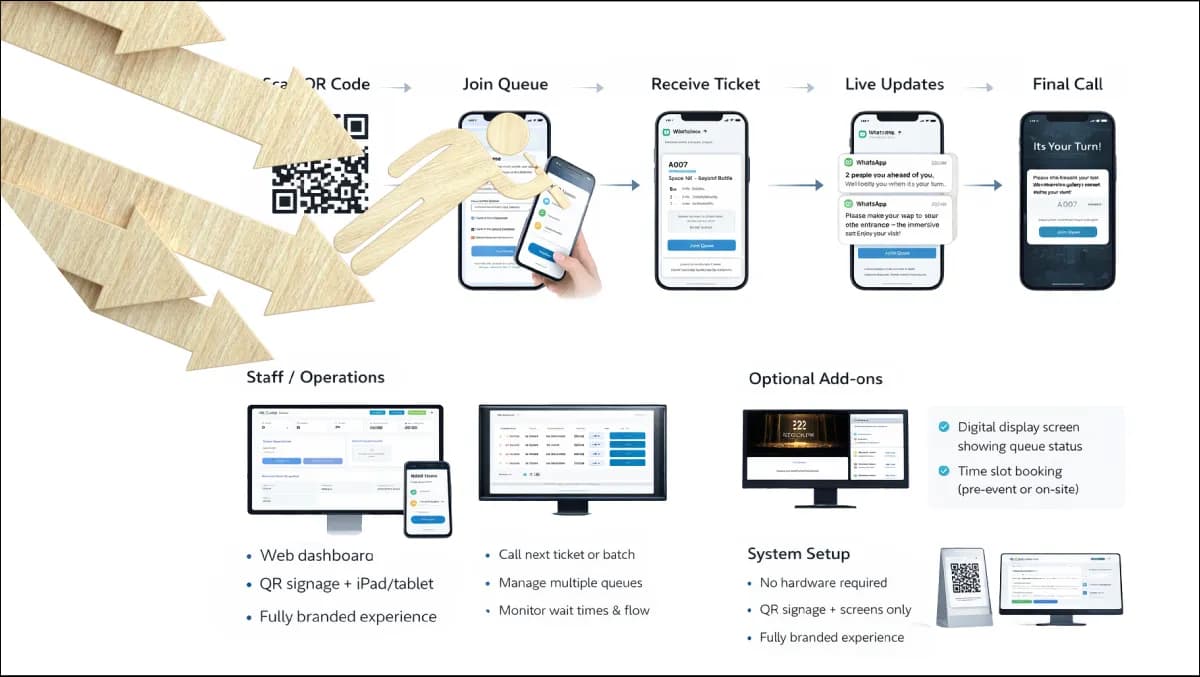
A queue management system today is rarely a single product. It is a stack of interconnected components: the intake surface (kiosk, mobile, online appointment), the queue logic (priority rules, service-type routing, multi-counter load balancing), the call-forward surface (counter displays, audio call, mobile push), the operator cockpit (live floor view, intervention controls, exception handling), the digital signage layer (waiting-area displays with wait times, service status, branded content), and the analytics layer (real-time dashboards, historical reporting, forecasting). The implementation success is determined by how well these components share state, not by how good any one of them is in isolation.
Why integration depth matters in Saudi context
Kingdom operators — ministries, banks, hospitals, retail chains — typically have existing systems that the queue management system has to coexist with. National identity systems where in production for citizen verification. Core banking platforms with their own customer-data models. EMRs with their own appointment systems. The queue management deployment that ignores those systems is a deployment that creates a parallel data island. The deployment that integrates becomes the operational layer that ties the customer journey together.
Vision 2030 alignment in practice
Vision 2030's customer-experience benchmarks are concrete. Service-time targets, waiting-time caps, customer-satisfaction floors, digital-channel adoption rates — all measurable, all reported, all enforceable. A queue management system that supports the operator in hitting those benchmarks needs to instrument the right metrics, surface them to the right roles, and produce the right reports without manual data wrangling.
For a ministry counter, that means: time-to-ticket, time-in-queue, time-to-service, service duration, post-service satisfaction, all rolled up by service type, by branch, by region, and by time bucket. For a banking branch, it means the same metrics plus channel mix (digital appointment vs walk-in vs virtual queue) and conversion (how many appointments led to a sale). For a hospital outpatient department, it means service-time variance against the appointment slot and the no-show rate.
PDPL and data-residency considerations
The Personal Data Protection Law sets specific requirements for how customer data is handled. Queue management captures personal data at multiple points — when a customer joins via mobile, when they take a ticket with a national ID, when they consent to feedback, when their interaction is logged for audit. The defensible architecture is sovereign on-premises by default: the database lives inside the operator's perimeter, the integration with any external system uses opt-in data minimisation, and the audit trail satisfies the PDPL's data-subject-rights queries (access, rectification, deletion) without manual archaeology.
For multi-region operators that have presence in the Kingdom alongside the UK, EU, Americas, GCC, MENA, Africa, and Asia, the architecture has to support per-region data residency configurations under a single operational model. The Riyadh branch's data stays in Riyadh; the London branch's data stays in London; the dashboards aggregate without the underlying records crossing borders.
Implementation playbook
Phase 1: Discovery (fixed-fee, 2–4 weeks)
Workshops with operations, IT, compliance, and customer-experience leads. Output: a service requirements specification covering service types, queue logic per type, integration points, multilingual scope (English plus Arabic full RTL as production baseline, with other locales added per engagement if the branch has expat customer mix), accessibility commitments, reporting requirements, and a fixed-fee Build estimate.
Phase 2: Build (fixed-fee, 6–10 weeks)
Configuration of the queue logic, integration with the operator's existing identity and core systems, setup of the operator cockpit and the digital signage content, training of the local IT team on day-to-day operations. Weekly demos against acceptance criteria.
Phase 3: Pilot (2 weeks)
Live operation at one branch with the Zeour team on-call. Data collection on baseline metrics, customer behaviour, and any system anomalies. End-of-pilot review with the operator's stakeholders.
Phase 4: Rollout
Branch-by-branch deployment using the playbook validated at the pilot site. Each new branch typically lights up in 3 to 5 days. Local IT trained on the branch-specific configuration.
Phase 5: Operate
The operator's team runs day-to-day; Zeour provides a Care plan for the agreed tier (Care, Care+, Self-Sufficient). At exit — typically 12 to 24 months after go-live — the operator owns the source, the license keys, the runbook, and the documented playbook for adding new branches without vendor involvement.
Common implementation pitfalls
Over-customising the queue logic
The temptation in early-implementation workshops is to map every existing operational quirk into the queue logic. That produces a system that is impossible to maintain, impossible to train staff on, and impossible to evolve. The discipline is to simplify the queue logic to the patterns that genuinely matter and to handle the long-tail exceptions through operator-cockpit intervention rather than through pre-coded rules.
Underestimating signage and audio
The queue management software is half the experience. The digital signage that tells the customer their position, the audio call that summons them, and the counter display that shows where to go — all of that is the other half. Operators who under-budget the signage layer end up with a software-perfect deployment that customers find confusing.
Treating the system as one-time
A queue management deployment that is not actively reviewed every quarter against the metrics it produces will degrade. Service patterns change. Staff turnover affects the operator-cockpit familiarity. Customer expectations rise. The operators who treat the system as a permanent operational practice — not a one-time project — get sustained value.
Sector-specific configuration patterns
Banking branches
Kingdom banks typically run a hybrid model: virtual queue for retail customers via mobile, physical kiosk for walk-ins, priority handling for premium-segment customers and people of determination. The integration with core banking lets the queue management system identify the customer at ticket issuance and route them to the right counter — teller, advisor, manager — based on the transaction type and the customer's relationship value. Post-service feedback collection on a tablet is the standard close.
Government service centres
Ministry counters typically handle longer service durations with higher document-handling complexity. The queue management system has to integrate with the document upload portal so the customer who pre-uploaded their paperwork is routed differently from the walk-in. The operator cockpit has to support intervention — pulling a customer out of the queue for a verification step and putting them back without losing position. The audit trail has to be PDPL-compliant and exportable for data-subject-rights queries.
Hospitals and clinics
Hospital outpatient queues are tightly coupled to the appointment system and the EMR. The patient who arrives early should not be called before their slot; the patient who arrives late should not be silently dropped. Service-time variance has to be tracked per clinician for capacity planning. Integration with the digital signage layer is where the patient-experience uplift comes from — clear wait estimates, room-call notifications, and onward-routing to the pharmacy or imaging desk after the consult.
Retail malls and large-format stores
Retail queues in the Kingdom often have peak-day volumes that swamp single-counter capacity. Multi-counter load balancing, service-type segmentation (returns, customer service, click-and-collect), and customer feedback collection at the close are standard. The integration with the loyalty program lets the queue management system recognise high-value customers and prioritise them invisibly without creating a visible two-tier line.
Where Zeour fits
We build the queue management system alongside virtual queue, online appointment, self-service kiosks, digital signage, and customer feedback. The GLARUS ecosystem runs across 1,247+ branches in 40+ countries, including Kingdom deployments at scale. Sovereign on-premises by default. Multilingual at the framework layer with English plus Arabic full RTL as production baseline. Fixed-fee phased engagement model with operator self-sufficiency at exit. The Kingdom-specific implementation pattern is identical to the international pattern — PDPL, national-identity integration, and Vision 2030 reporting are configuration, not bespoke development.