Key takeaways
- A real enterprise online appointment system is an engine plus channel adapters (web, WhatsApp, SMS, app, walk-in, staff console) sharing one appointment ID across the estate — not a calendar widget bolted onto a marketing site.
- The single biggest design decision is whether the booking platform is wired to your queue management system so a booked appointment becomes a priority ticket on arrival, not a separate flow.
- WhatsApp Business API templates need 24-72 hours to clear Meta approval per locale; SMS is the paid fallback for unverified destinations.
- A 50-branch, 25,000-appointments-per-month estate typically spends £8k-£35k per year on messaging, £40k-£100k on Build small or £200k-£600k on a multi-tenant Build enterprise engagement.
- No-show recovery (T-24h, T-1h, geo-fenced nudge, waitlist auto-promotion) recovers 2-5 percentage points of utilisation and is the fastest payback in the project.
- Sovereign on-premises matters for banking, healthcare and government — patient and citizen booking data does not need to leave the operator's perimeter.
- Per-individual-practitioner managed appointment SaaS does not scale to multi-branch enterprise estates; the rules engine, identity model and routing protocol are all the wrong shape.
This guide is the field manual we hand to operations directors about to buy or rebuild an enterprise online appointment platform across banking, healthcare, government, telecom or retail. It is written by an engineering team that has shipped multi-branch appointment systems wired into queue management, EMR, national identity, WhatsApp and card-present payment. We cover what the system does, a 14-criterion rubric, cost bands in pounds, an ROI calculator, the seven failure modes we keep cleaning up, and a migration path that does not break a single live booking.
Who this guide is for
- Retail banking operations director. You run 50-500 branches with a queue management system already in place. You need an appointment surface that lets a customer book a mortgage interview or relationship-manager slot on the web or WhatsApp and arrive at a routed counter without re-ticketing.
- Hospital outpatient operations lead. You schedule across multiple clinics, a teleconsultation surface, an EMR, an insurance authorisation step and a patient portal. You will not accept a SaaS that puts patient identifiers in unmanaged reminder messages, and the booking must round-trip into clinic management cleanly.
- Government service-centre programme manager. You run a national appointment platform across multiple ministries, with sovereign hosting, bilingual UI, national-identity integration and a complete audit trail. You also need walk-in conversion for digitally-excluded citizens.
- Telecom or large-retail estate lead. You run 100-2,000 service points and need appointment booking that mixes web, WhatsApp, app and walk-in for installation visits, retention conversations, SIM-swap appointments or sales consultations — with capacity rules, consolidated reporting and a clean CRM API.
What is an online appointment booking system in 2026?
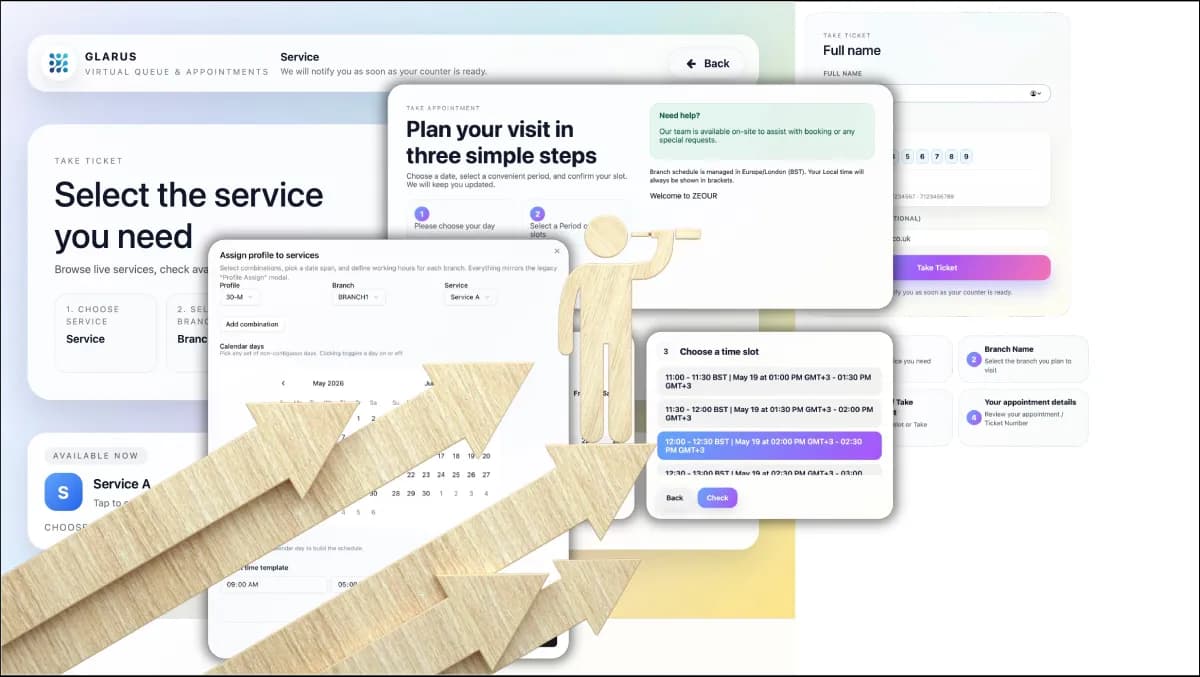
An online appointment booking system is the slot-allocation, identity-binding, channel-distribution and arrival-orchestration platform that turns a customer's intent into a confirmed time at a specific service point with a specific person or resource. The minimum surface is a customer-facing booking flow, a staff console, a capacity-rules engine, a reminder engine and a back-office reporting layer. The interesting part is the appointment object that flows across channels and survives integration with everything else.
Technically, the system runs an appointment engine that owns slot inventory, calendars and capacity rules. Channel adapters wrap the engine: web (mobile-first, no native app required), WhatsApp Business API with approved templates, SMS fallback, a native mobile app where one exists, a walk-in conversion screen, and a staff console for assisted booking. Each adapter creates the same appointment object, with one ID that follows the booking from creation through reminder, arrival, service and feedback. An identity layer (OIDC for citizens, SAML or OIDC for staff) attaches the user. A payment adapter (Ingenico, PAX, Verifone for card-present; tokenised PSP for card-not-present) handles pay-on-book. A no-show recovery loop sits above, sending T-24h and T-1h reminders, offering reschedule on tap and (where mobile telemetry permits) firing a geo-fenced arrival nudge as the customer enters a virtual queueing radius.
What separates a real platform from shelfware is whether all of that is one product, deployed inside the operator's perimeter, with a rules engine deep enough to model real-world capacity. Per-branch capacity, per-service slot length, per-consultant skill, per-counter concurrency, recurring availability, holiday calendars, skill-based routing hints for the downstream queue management system, VIP and accessibility priority slots, on-time-guarantee windows — these are the substance of the platform. A platform that cannot express them at the rule layer pushes the complexity into people, who handle it badly.
Where an enterprise platform differs from per-practitioner managed SaaS is on three axes. Identity: enterprise customers federate via SAML or OIDC against the operator's directory, and citizens federate via national identity. Integration: the booking has to round-trip into core banking, EMR, CRM, billing or citizen record. Governance: every change has an audit row, and data residency is a procurement requirement.
The 14-criterion scoring rubric — score every vendor
Walk every shortlisted vendor through these 14 criteria. Score 0-3 per criterion. Anything below 32 out of 42 is a procurement risk you will pay for later.
- 1Deployment model. Why: sovereign on-premises versus public cloud versus vendor-managed cloud determines who holds your booking data, identities and transcripts. Test: ask whether sovereign deployment on operator hardware is supported with the same feature set as the SaaS.
- 2Appointment object integrity across channels. Why: if web, WhatsApp and walk-in each create different objects, your funnel is fiction. Test: create one appointment on web, modify on WhatsApp, cancel on staff console — the audit log must show three actions on one ID.
- 3Queue management integration depth. Why: an appointment that does not become a priority ticket on arrival is just a printed reminder. Test: book a slot, walk in, scan a QR — the queue management system ticket must inherit the appointment ID, assigned banker, service code and priority flags.
- 4Capacity-rules engine expressiveness. Test: ask the vendor to model a service with 30-minute slots, two concurrent consultants, a 15-minute pre-lunch embargo, 48-hour lead time, a recurring Wednesday VIP slot and a holiday calendar — without code changes.
- 5WhatsApp Business API surface. Test: ask for the approved template inventory, the per-locale approval timeline (24-72h is normal), and what happens to a delivery failure (SMS fallback, retry strategy, opt-out handling).
- 6No-show recovery loop. Test: describe a 14:00 appointment; the vendor must explain T-24h reminder, T-1h reminder, geo-fence arrival nudge, one-tap reschedule and waitlist promotion exactly.
- 7Identity and federation. Test: require SAML or OIDC for staff via your IdP, and OIDC or national-identity federation for citizens. Local-account-only is a hard no.
- 8Audit log and forensics. Test: every actor, IP, channel, before-state and after-state per modification, with retention of 7 years for healthcare and 6 for banking.
- 9PHI / PII discipline in messaging. Why: reminder text leakage is the most common privacy incident in this category. Test: the template references an appointment ID and a service name only — not the diagnosis, doctor's name or any condition.
- 10Bilingual baseline and locale extension. Test: the platform must ship with English and Arabic (full RTL) as a bilingual baseline, with French, Spanish, German, Portuguese, Italian, Dutch, Turkish, Urdu, Hindi and others added per engagement.
- 11Payment tokenisation. Test: integrate with Ingenico, PAX or Verifone for card-present capture and with a PSP for card-not-present tokenisation, with refund and partial-cancellation flows clean.
- 12Telemetry and warehouse export. Test: the platform must emit booking funnel state transitions to your warehouse on a defined schedule, and the dashboard must surface no-show rate, slot utilisation, time-to-book and channel mix out of the box.
- 13Walk-in conversion path. Why: appointment-only systems lose 30-40% of walk-up traffic at the door. Test: a kiosk or door-side staff tablet must let a walk-in convert to a same-day slot with the same engine, rules and downstream routing.
- 14Exit window and source ownership. Test: require a 90-day exit window, source code or schema ownership for sovereign builds, and exported booking history in a documented format.
How do you choose between cloud, on-premises and hybrid?
The choice is rarely binary. Most enterprise estates land on a hybrid model where the booking engine and identity are operator-hosted, while the customer-facing web surface and messaging adapters sit closer to the public internet for latency and certificate management.
| Dimension | Sovereign on-premises | Hybrid (engine on-prem, edge in cloud) | Vendor-managed public-cloud SaaS |
|---|---|---|---|
| Data residency | Inside operator perimeter | Engine on-prem, edge metadata in region | Vendor's chosen region; mixed control |
| Identity model | SAML/OIDC against operator IdP | SAML/OIDC against operator IdP | Often local or social login |
| Capacity rules ceiling | Unbounded (operator-owned schema) | Unbounded | Vendor's product roadmap caps you |
| Integration latency | LAN-class for QMS, EMR, core banking | LAN to engine, WAN to edge | All integrations via internet |
| Messaging fallback when WAN drops | Branch-local queue and store-forward | Branch-local queue, edge degrades | System unusable |
| Total cost (5 years) | Higher capex, lower opex | Balanced | Lower capex, opex grows with volume |
| Exit window | 90 days, full schema | 90 days, full schema | Vendor-defined, often weak |
Our opinion: for banking, healthcare and government, sovereign on-premises or hybrid wins on every dimension that matters except up-front cost. For retail and telecom, hybrid is usually the right balance. Pure public-cloud SaaS is only sensible for single-site, single-brand operators with no integration ambitions.
> Want a fixed-fee Discovery price before the end of the call? Talk to Zeour engineering — 30-minute scoping conversation, no slideware, and a published pricing band by the time we hang up.
How much does an online appointment platform cost in 2026?
These are the bands we publish today for enterprise multi-branch appointment work. They assume the fixed-fee phased engagement model: Discovery, Build, Integrate, Pilot, Operate.
- Discovery (fixed-fee): £8k-£20k. Multi-branch scoping, integration map, capacity-rules workshop, identity model decision, channel mix decision, success metrics defined, fixed-fee Build price published at the end.
- Build small (8-10 weeks): £40k-£100k. Single-brand, multi-branch appointment engine, QMS integration, WhatsApp Business API surface, SMS fallback, staff console, basic reporting. Suited to a 10-50 branch estate or a regional hospital group.
- Build enterprise (10-16 weeks): £200k-£600k. Multi-tenant, multi-channel, multi-language, deep integrations with EMR (HL7 / FHIR), core banking (Temenos, Finacle, Mambu), national identity, CRM (Salesforce or Dynamics), payment terminals, advanced no-show recovery, waitlist engine, telemetry warehouse export. Suited to a 100+ branch estate or a national platform.
- Integrate (3-5 weeks per system): £15k-£55k. Per integration: HL7 / FHIR feed for EMR, FIX-style or REST for core banking, OIDC + national identity, CRM round-trip, payment terminal driver, digital signage ribbon for next-up.
- Pilot + Go-Live (4 weeks): £15k-£40k. Two branches or one clinic in shadow mode for one week, then cutover, with on-site engineering during business hours and a daily standup with operations.
- Messaging operating cost: £8k-£35k per year. For a 50-branch estate at 25,000 appointments per month with WhatsApp as primary and SMS as fallback for unverified destinations. Real costs depend on per-conversation pricing in each country, the share of utility versus authentication templates, and the SMS fallback ratio.
- Care Plan: Self-Sufficient through Enterprise. Self-Sufficient is documentation, ticket-only support and quarterly office hours; Enterprise includes named SRE, on-call, capacity reviews and integration version-tracking.
ROI calculator — build a defensible business case in 7 steps
Step 1: Establish your baseline volume
Count appointments per branch per week today across every channel — phone, walk-in, staff-assisted, ad-hoc text message. A 50-branch banking estate typically runs 4,000-7,000 weekly appointments. A regional hospital group runs 12,000-30,000. Multiply through to monthly and annual.
Step 2: Quantify the no-show baseline
No-show rate sits between 8% and 22% depending on sector. Pull the last 12 months. Multiply: annual appointments × no-show rate × average service revenue per appointment = annual revenue exposed to no-shows.
Step 3: Apply realistic no-show recovery
A disciplined T-24h, T-1h, geo-fence, waitlist-promotion loop recovers 30-50% of expected no-shows. Multiply: revenue exposed × recovery rate = annual recovered revenue. For private healthcare with £180 average consultation, this is typically £180k-£420k recovered per year on a 50,000-appointment book.
Step 4: Capture the staff-time saving
Manual phone-and-spreadsheet scheduling costs 6-9 minutes per appointment in front-line staff time. Online self-service drops that to 30-90 seconds for the share of appointments that move channel. Multiply: shifted appointments × minutes saved × fully-loaded hourly rate = annual staff-time saving.
Step 5: Capture the call-centre deflection
Around 35-55% of phone enquiries to a service centre are appointment-related (book, reschedule, confirm). Online self-service deflects 40-70% of those. Multiply: deflected calls × cost per call (typically £2.20-£4.40 in the UK) = annual deflection saving.
Step 6: Capture the slot-utilisation lift
A proper capacity-rules engine plus walk-in conversion typically lifts slot utilisation by 4-8 percentage points. Multiply: total slot hours × utilisation lift × revenue per slot hour = annual utilisation upside.
Step 7: Net against 5-year total cost of ownership
Sum the 5-year cost: Build + Integrate + Pilot + 5 years of messaging + 5 years of Care Plan. Subtract from annual benefit × 5. A representative mid-market estate (80 branches, 100,000 appointments per year) typically lands at £1.4m-£3.2m of 5-year net benefit against a £450k-£900k total cost — comfortably 3-4x return — with no-show recovery and call deflection doing most of the lifting.
Seven failure modes from real deployments
Failure mode 1: Vendor-cloud-only that fails when the WAN drops. A branch with no internet should still take walk-in conversions, print queue tickets, and queue WhatsApp confirmations for store-and-forward. The fix is a branch-resident appointment cache and a degraded-mode flow that converts walk-ins into the local queue management system and reconciles on reconnect. See the queue management buyer's guide for the same posture on the QMS side.
Failure mode 2: Managed appointment SaaS that does not integrate with your QMS. The marketing team buys a per-practitioner widget, the operations team owns a different QMS, and customers re-ticket on arrival. The right fix is to treat the appointment record and the queue ticket as the same object — one ID, one identity, one priority class. If the proposed platform cannot speak the QMS routing API natively, do not buy it.
Failure mode 3: No walk-in conversion path. Appointment-only systems lose 30-40% of walk-up traffic at the door because they have no story for the customer who shows up without a booking. The platform must support a door-side conversion flow (kiosk, staff tablet or QR) that creates the same appointment object with the same engine, rules, and downstream routing.
Failure mode 4: PHI or PII leakage in reminder messages. A reminder that names a diagnosis, a department or a clinician is a privacy incident in waiting. The fix is template discipline: the message references a service name and an appointment ID, the customer authenticates into the portal or app to see the rest. This is non-negotiable in healthcare and increasingly in government.
Failure mode 5: A capacity-rules engine that cannot express your reality. If the rules engine cannot model 30-minute slots with 15 minutes of preparation, three concurrent consultants of different skills, a recurring VIP window, a holiday override, and an accessibility-priority quota, your operations team will work around the platform with spreadsheets. Within six months, the platform is decorative and the spreadsheets are authoritative.
Failure mode 6: Per-individual-practitioner SaaS picked for enterprise scale. Per-practitioner managed appointment SaaS is excellent for a solo consultant. It is structurally wrong for a 200-branch bank or a 30-clinic hospital group: identity is local, integrations are weak, the rules engine is shallow, the audit log is anaemic, and there is no walk-in story.
Failure mode 7: No exit window and no data ownership. A platform whose vendor controls your booking history, customer database and scheduling rules controls your operations. A 90-day exit window, full booking history export, and ownership of the rules schema are non-negotiable for any sovereign-grade buyer. We have rescued operators who paid four times the original build cost to leave a SaaS contract because no exit plan existed at signing.
Migration path — moving from your current stack
Phase A — Shadow mode (2-4 weeks). Stand up the new platform in parallel. Mirror the legacy capacity rules. Take new appointments only via a staff console in a single pilot branch or clinic while the legacy system continues to serve everyone else. Daily reconciliation. Goal: zero customer-facing change, real production write path against the new engine.
Phase B — Cutover by service (4-8 weeks). Service by service, cut over customer-facing channels (web first, then WhatsApp, then SMS). Each service is a one-week burn-in: monitor no-show rate, funnel completion, message delivery. Roll back per service if any metric degrades by more than 10%.
Phase C — Full pilot cutover (3-4 weeks). The pilot branch or clinic cuts over to the new platform for all services and channels. Legacy is read-only for historical lookups. Operations runs a daily standup with engineering for the first 10 working days. The no-show recovery loop tunes itself to your operating tempo here.
Phase D — Estate rollout (8-16 weeks). Branches or clinics roll over in waves of 5-10, each preceded by a 2-day on-site readiness review and followed by a 5-day engineering presence. By the end of Phase D, the legacy system is decommissioned and historical telemetry is replayed into the operator's warehouse for continuity.
Implementation playbook
- 1Discovery (2-4 weeks). Stakeholder workshops with operations, IT, security, marketing and the integration owners for QMS, EMR, core banking, CRM and identity. Output: integration map, capacity-rules model, channel mix, success metrics, fixed-fee Build price.
- 2Build (8-16 weeks). Engine, channel adapters, staff console, capacity rules, identity federation, telemetry. Weekly demos with operations sign-off. Change-orders priced explicitly.
- 3Integrate (3-5 weeks per system). QMS via routing API, EMR via HL7 / FHIR, core banking via the operator's preferred protocol, CRM via REST, payment terminals via Ingenico / PAX / Verifone drivers, national identity via OIDC, digital signage ribbon via WebSocket.
- 4Pilot + Go-Live (4 weeks). One or two branches or clinics in shadow mode for week one, full cutover for week two, on-site engineering throughout. Daily operations standup. Roll-back plan rehearsed before week one.
- 5Operate. Quarterly capacity-rules review, monthly funnel review, weekly messaging-cost review. Care Plan tier selected at go-live; Self-Sufficient through Enterprise.
Frequently asked questions
How do you integrate online appointment booking with an existing queue management system?
The appointment record and the queue ticket must be the same object. On arrival (QR scan, kiosk, geo-fence), the booked appointment becomes a priority ticket in the queue management system, inheriting the assigned banker or clinician, service code and priority flags. If your vendor cannot describe this round-trip in 60 seconds, do not shortlist them.
How do you book appointments over WhatsApp at enterprise scale?
Via the WhatsApp Business API with approved templates per locale. Templates clear Meta's review in 24-72 hours and need re-approval when content changes. Conversational flows use interactive list and button messages parsed by the appointment engine. SMS is the paid fallback for unverified or international destinations.
How do you handle no-shows on a multi-branch estate?
Three loops together. T-24h and T-1h reminders via the customer's preferred channel. A one-tap reschedule link so a customer who knows they cannot make it can release the slot instantly. Waitlist auto-promotion: when a slot is released, the next waitlist entry is offered it within seconds. Where mobile telemetry permits, a fourth loop fires a geo-fence arrival nudge as the customer enters the virtual queueing radius. Together these recover 30-50% of expected no-shows.
How do you handle walk-in customers who did not book online?
The platform must support a door-side conversion path: a kiosk, staff tablet or QR poster that lets a walk-in convert to a same-day slot using the same engine, rules and routing as a pre-booked appointment. Without this, you lose 30-40% of walk-up traffic and fail service equity for digitally-excluded customers in government and healthcare estates.
How do you integrate with an EMR for hospital appointment booking?
Via HL7 v2 for legacy interfaces or FHIR for modern ones. The booking round-trips into the EMR as an appointment resource, the EMR returns the encounter ID, and arrival fires an admit event. For private healthcare, an insurance-authorisation check fires at booking and again at T-24h. The MediCare clinic management system shows this in production.
How do you handle payment on booking?
For pay-on-book scenarios, integrate a PSP for card-not-present tokenisation at the booking step, and Ingenico, PAX or Verifone terminals for card-present capture. Refunds and partial cancellations need clear rules: full refund 48 hours before, 50% inside 24 hours, none inside 2 hours is a typical pattern.
How do you handle data residency for sovereign deployments?
The appointment engine, identity service, rules engine and audit log are deployed inside the operator's perimeter — on-premises, in a sovereign cloud region, or on operator-controlled hardware in a service-centre back room. Customer-facing edges may sit closer to the public internet for latency, but they do not store booking content. This is the sovereign deployment posture we apply by default.
How do you scale across 500+ branches without losing consistency?
A single multi-tenant capacity-rules engine with per-branch overrides, fed from a centrally-managed service catalogue. Each branch inherits brand-level defaults, overrides only the rules that genuinely vary, and feeds telemetry into one warehouse for consolidated reporting. We have shipped this pattern across 1,247+ branches in 40+ countries — see the banking and telecom pages.
How do you keep reminder messages compliant with privacy law?
Template discipline. The reminder references a service name and appointment ID — nothing else. The customer authenticates into a portal or app to see the rest. Consent is captured at booking and re-affirmed if the channel changes. Retention follows sector law: 7 years for healthcare, 6 for banking, shorter in some retail and telecom contexts.
How long does it take to go live with an enterprise online appointment platform?
A Build small engagement (single-brand, multi-branch, QMS + WhatsApp + SMS) typically goes from Discovery to first-branch go-live in 14-18 weeks. A Build enterprise engagement (multi-tenant, deep integrations with EMR or core banking, national identity) takes 22-30 weeks. The first branch goes live in shadow mode within the Build window; the estate rolls over in waves.
Where Zeour fits
Zeour ships the online appointment system as part of the GLARUS customer-flow ecosystem alongside the queue management system, virtual queue management, customer feedback and digital signage. It is deployed in production across banking, healthcare, government, telecom, retail and education — see how a national bank booking platform is wired in the Kuwait National Bank London case study or how a ministry-grade service-centre appointment platform is shipped in the Servizz.gov Malta case study. Talk to us about a fixed-fee Discovery, browse the published pricing bands, check the case studies, the glossary and the rest of the blog.
---
Last updated: May 17, 2026 — by the Zeour engineering team.