Improving customer service with queue management starts with finding where a visit breaks down, not simply installing a ticket dispenser. This guide is for branch managers who want to measure waiting, test service rules and review whether customers complete their task. The queue management system page describes GLARUS capabilities; this article explains how to evaluate an operational change.
Establish a baseline before changing the queue
Define the service being measured and the events that count as arrival, first call, service start and completion. Record missed calls, cancellations and transfers separately. Otherwise a shorter reported wait may reflect a changed definition rather than a better experience.
| Measure | Definition to agree | Decision it informs |
|---|---|---|
| Waiting time | Service start minus the agreed arrival or check-in event | Which services or periods need investigation |
| Service time | Service end minus service start | Whether the task, documents or tools slow the counter |
| Completion | Completed tasks compared with eligible service attempts | Whether faster handling actually resolves the customer's need |
| Abandonment | Visits ended before service, distinguished from cancellation and missed calls | Whether the waiting or notification process needs attention |
| Feedback | Responses linked to the relevant visit stage, with response coverage reported | What the operational events cannot explain about the experience |
The GOV.UK method for measuring completion rate explains why transaction boundaries and the denominator matter. Adapt that measurement principle to a branch visit; it is not a claim that a queue ticket is itself a completed government transaction.
Run a controlled service-routing trial
Choose a specific problem, such as customers repeatedly transferring between counters. Review the service categories and document the current routing rule. Change one part of that rule, keep an operational fallback and compare similar periods using the same event definitions. Record staffing, demand and service mix so that these changes are not mistaken for a software effect.
Review the result with staff and customers. If waits improve but completion falls, inspect whether difficult cases were redirected or excluded. If averages improve but some customers wait longer, examine the distribution and priority rules before rolling the change out.
Pair operational data with customer feedback
Use a consistent question at the same point in the journey and report response coverage alongside the score. Invite feedback from unsuccessful visits too, where practical; hearing only from completed visits can miss the people with the most difficulty. GOV.UK's user-satisfaction guidance provides a reference for collecting feedback across a service.
Connect the review to an action: amend instructions, clarify eligibility, change a staffing pattern or test a routing rule. A customer feedback system supports collection; the team still needs to interpret and act on it.
Communicate the wait without promising an outcome
Customer service is mostly the management of expectations under load. The operator can have the best-trained staff in the country and the most generous opening hours in the market, and a 45-minute unmanaged wait will still erase all of it. Conversely, a 45-minute wait that the customer was told about up front, can see in real time, and was allowed to spend somewhere other than a plastic chair under fluorescent lighting, is forgivable. A queue management system is the operational layer that makes the second case possible.
Explain queue position and return instructions
There is a well-documented gap between measured wait and perceived wait. The same 30 minutes in a featureless waiting hall feels three times as long as 30 minutes spent walking around a shopping mall with a text message that tells you when your turn is coming up. The perception gap is the single biggest lever the operator has, and it is mechanically simple to close:
- Give the customer a number or a position in the queue so they know where they are.
- Give them an estimated wait time, even if it is approximate, so they know how long they have.
- Give them a way to leave the physical waiting space and return when their turn approaches.
- Tell them when the wait is over.
All four of these are baseline capabilities of any serious queue management system. The operator's installed base of paper-ticket dispensers and counter-lights handles maybe one of them, intermittently. The cost of the upgrade is small and the cost of not upgrading is silently borne by the customer.
Publish priority rules and handle exceptions consistently
The second mechanism a queue management system handles is fairness. A queue is fair when the customer who arrived first is served first, with documented exceptions for priority categories (elderly customers, customers with disabilities, customers with pre-booked appointments, customers under SLA-bound service tiers). The exceptions need to be visible to the rest of the queue or they read as favouritism.
A digital queue management system handles this with explicit service categories (e.g. general, priority, appointment, premium) and a configurable interleaving policy. The operator decides the policy; the system enforces it consistently; the customer can see why someone ahead of them was called. The complaint rate at deployed sites drops markedly once the fairness mechanism is made transparent.
Use branch monitoring to investigate bottlenecks
The third mechanism is the operator-side cockpit. Without a cockpit, the operator's branch manager has no real visibility of what is happening on the floor — they walk the hall, they ask the team lead, they get a partial answer, they make a decision based on incomplete information. With a cockpit, the manager sees: how many customers are waiting, by service category; how long they have been waiting; how the wait is trending against the last hour; which counters are calling, which are idle, which are slow; whether the wait has crossed the abandonment threshold; whether there are flagged exceptions (no-shows, escalations, complaints).
This is the layer that converts queue management from a customer-facing convenience into an operational tool. The manager uses it to retask staff in real time. The COO uses the historical reports to tune the staffing roster. The compliance team uses the audit log to answer regulatory queries.
Industry-specific shapes
The baseline mechanisms above are universal. The shape of the deployment varies by industry.
- Banking. Counter services compete with self-service kiosks (cheque deposit, statement print, debit-card swap) and with private-banking lounge flows. The cockpit has to handle the priority interleaving cleanly. Integration with the core banking system means the agent at the counter already has the customer's accounts on screen by the time the customer sits down.
- Healthcare. Outpatient flow runs against insurance pre-authorisation, lab and imaging system status, and pharmacy dispatch. Bilingual EN/AR is the operating norm in many regions; English-only or other locale combinations are per engagement. The cockpit fits a nurse-station workflow rather than a teller workflow.
- Retail. Checkout queues are the obvious case, but service-counter queues (returns, click-and-collect pickup, customer service) are usually the higher-value deployment. Mobile virtual-queue join means the customer can keep shopping while waiting.
- Government and public services. High-throughput multi-service flows with strong identity-system integration and a strong audit trail. The cockpit has to handle 20+ service categories at a single site without losing usability.
- Telecom and utilities. Multi-step services (number-port, contract upgrade, hardware swap) where the customer often needs to be handed between counters. The system tracks the multi-step interaction as one logical flow.
Zeour's queue management system is currently in production across all five of these verticals at 460+ branches across 6+ countries.
Channel coverage
The modern queue management system is multi-channel by default. The customer should be able to join the queue from:
- A counter-side ticket dispenser, for walk-in customers without smartphones.
- A self-service kiosk at the door, for customers who want to self-direct to the right service category.
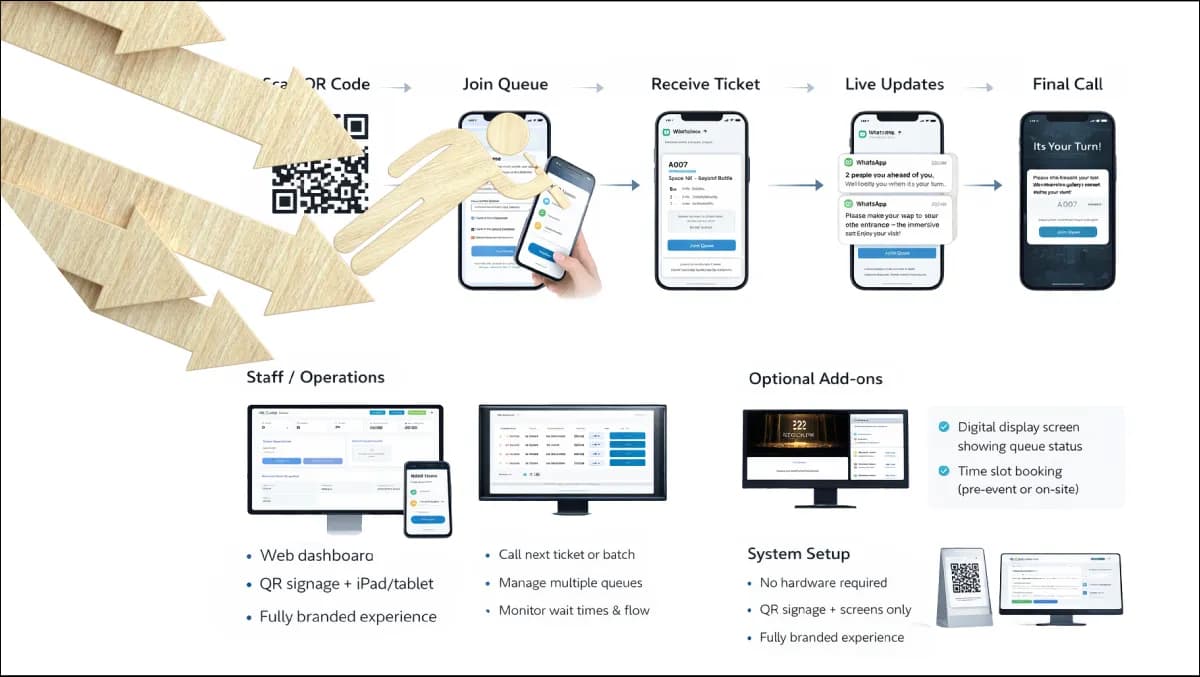
- A mobile virtual-queue link, scanned from a QR code at the entrance or in marketing material, so the customer never enters the hall until their turn approaches.
- An online appointment booking made hours, days, or weeks earlier.
- A staff-side check-in, for VIP or priority customers handled at the desk.
All five channels write to the same back-end. The cockpit shows them all. The reporting cross-tabulates them. Operators who want to push more of the flow upstream of the counter — to reduce hall density, to reduce staffing load, to lift customer satisfaction — extend the queue ecosystem with the virtual queue product, the online appointment system, or the self-service kiosk product.
Deployment and operating posture
Zeour's GLARUS queue management ecosystem deploys sovereign on-premises by default — the queue data, the cockpit telemetry, the notification logs all stay inside the operator's perimeter. The system ships with English and Arabic (full RTL) as a production baseline, with French, Spanish, German, Portuguese, Italian, Dutch, Turkish, Urdu, Hindi and other locales added per engagement.
The engagement model is fixed-fee phased: Discovery, Build, Pilot, Rollout, Operate. The 90-day exit window at the end of the engagement gives the operator the repository, the license, and the deploy keys, with optional Care Plan tiers for operators who want ongoing support. We have shipped GLARUS into operators across the United Kingdom, European Union, Americas, GCC, MENA, Africa, and Asia — including Servizz.gov Malta, OQBI Oman, MFCR Malta, SpaceNK UK, Kuwait National Bank London, Aljanoob bank, and the Romanian consulate in Birmingham UK among the named references.
What to measure once the system is live
The operator who deploys a queue management system without a measurement plan ends up with a lot of data and very little insight. A useful measurement plan focuses on a small number of metrics, tracked consistently, with explicit thresholds and explicit actions.
The core metrics we recommend tracking from go-live:
- Median and 90th-percentile wait time, by service category, by site, by day-of-week. The median tells you about the typical customer; the 90th percentile tells you about the worst-served customer, which is usually the more useful operational signal.
- Abandonment rate. Customers who join the queue and leave before being called. Spikes in abandonment are early-warning that wait time has crossed the customer-tolerance threshold.
- Service rate per counter, per agent. Coaching signal. Outliers warrant a conversation; persistent outliers warrant a process review.
- Channel mix. What fraction of queue joins come via kiosk vs mobile vs walk-in vs appointment. This shifts over time as the customer base adapts.
- Customer satisfaction at exit. Captured via the customer feedback system tablet at the exit point. Correlated to wait-time bucket and agent.
Five metrics. Tracked weekly. Reviewed monthly with the operations team. Acted on quarterly with staffing or process changes. That is the operating discipline that turns the cockpit data into actual operational improvement.
If the operator already has a queue and is unhappy with how it is running, the right next step is a Discovery conversation to understand the specific shape of the problem. If the operator has not yet instrumented the queue at all, the right next step is the same conversation, scoped slightly differently. Either way, the conversation comes first and the procurement decision comes second. The interesting deployments are the ones where the operator knows what they want to measure.
Turn the review into the next operational change
Choose one measurable issue and agree its owner, trial period and review date. For scheduled visits, review the appointment workflow; for waiting away from the branch, assess virtual queue management. Neither replaces the need for clear service rules. Discuss your queue workflow with Zeour using your baseline and exception list.