Queueing is a measurement problem disguised as a customer-experience problem. Most operators treat the line at the counter as a service issue when, mechanically, it is a throughput equation: arrival rate, service rate, abandonment threshold, and the standing inventory of waiting people. An advanced queue management system gives the operator visibility into all four of those numbers, in real time, and turns the cockpit into something that can be tuned.
Why the manual queue still costs operators money
Manual queueing — paper tickets, a counter clerk shouting numbers, or worse, a roped line with no ordering signal at all — fails in three predictable ways. First, the operator has no instrumented view of arrival rate by half-hour, so staffing decisions are made on yesterday's anecdotes. Second, the customer has no visibility of position or estimated wait, so the perceived wait inflates beyond the measured wait — the operator pays for both. Third, the operator has no instrumented view of service rate per counter, per agent, per service type, so the slowest counters silently degrade total throughput without anyone noticing.
The usual symptom is a Friday-afternoon spike that the staffing roster never caught, two counters quietly under-performing because of a software issue at one of them, and a customer-satisfaction score that nobody can map back to a specific operational cause. None of that is a fluff problem. It is a data problem and an instrumentation problem.
What a modern queue management system actually changes
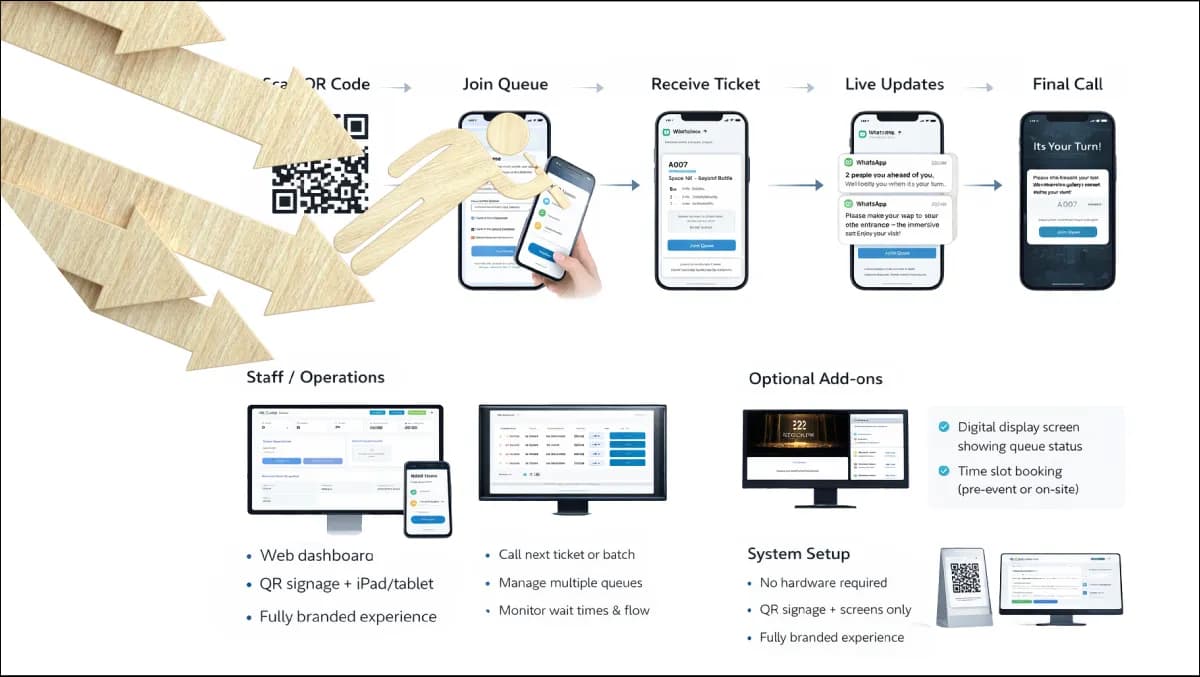
A modern QMS — the kind we ship under the GLARUS umbrella at /solutions/queue-management-system — replaces the manual ritual with an instrumented flow. The customer joins the queue through one of several channels: a counter-side ticket kiosk, the self-service kiosk at the door, a mobile virtual queue via QR code, an online appointment booked earlier in the week, or a staff-side check-in. Each channel writes the same shape of ticket into the same back-end. The operator sees one unified pipeline.
Three pieces then start working in concert:
- The cockpit — a real-time operator-side dashboard showing the live queue depth per service, the average wait, the average service time per counter, the current call-rate, and any flagged exception (a no-show, an escalation, a customer waiting beyond threshold). The supervisor uses this to retask staff on the fly.
- The customer-facing displays — wall-mounted screens in the waiting hall calling tickets, plus optional digital-signage overlays for marketing or operational announcements. The customer always knows where they are in the line and how long they have left.
- The notifications layer — SMS, in-app push, or WhatsApp messages that let the customer leave the waiting hall and return when their turn approaches, which is the difference between a 45-minute wait that feels like 45 minutes and a 45-minute wait that feels like 5.
Once these three are wired together, the operator has the data to start tuning. Service-rate per counter becomes a coaching metric. Arrival-rate by half-hour becomes a staffing-roster input. Abandonment-rate becomes the early-warning signal that wait-time has crossed the customer-tolerance threshold.
What the data unlocks over a 12-month deployment
After the first month of clean data, the operator can answer three questions that were previously unanswerable: when do we actually need staff, which counters or agents are out of line with the median, and which service types are silently absorbing more time than the operations plan allowed. Each of those answers translates into either a staffing change or a process change.
After the first quarter, the operator can start running counterfactuals. What happens if we move the cashiering function off the main counter and into a self-service kiosk? What happens if we pre-book the high-touch appointments and leave the counter for walk-ins only? What happens if we extend opening hours by 30 minutes on Thursday rather than running an extra Friday shift? The cockpit data lets the operator simulate before they commit.
After a year, the operator has a longitudinal view — seasonal patterns, weekly patterns, the impact of marketing pushes on counter load, the impact of new product launches on service time. The QMS stops being a queue tool and starts being a load-planning tool. The operator's COO or operations director ends up looking at it more than the counter staff do.
What we ship into operators worldwide
GLARUS, the queue management ecosystem at the heart of this, is currently in production across 1,247+ branches in 40+ countries — banks, hospitals, government services, retail, telecom — across the United Kingdom, the European Union, the Americas, the GCC, MENA, Africa, and Asia. The operating posture is sovereign on-premises by default: the queue data, the customer notifications log, the cockpit telemetry all stay inside the operator's perimeter. The system ships with English and Arabic (full RTL) as a production baseline; French, Spanish, German, Portuguese, Italian, Dutch, Turkish, Urdu, Hindi and others are added per engagement.
The engagement model is fixed-fee and phased — Discovery, Build, Pilot, Rollout, Operate — with a 90-day exit window at the end during which the operator takes the repository, the license, and the deploy keys and becomes self-sufficient if they want to. The same product family extends into virtual queueing, online appointment booking, and self-service kiosks when the operator wants to push more of the flow upstream of the counter.
The integration surface that matters in 2026
The queue management system is rarely the only system in the operator's stack. Useful deployments are the ones where the queue data flows in both directions across the operator's other systems. The integrations we wire most often:
- CRM and customer master data. The agent at the counter sees the customer's full context the moment they sit down — prior visits, open service tickets, account standing, preferred language. This compresses the service interaction by 30–90 seconds on average and removes the awkward opening where the customer has to re-explain who they are.
- Identity systems. National identity backbone integration where in production, so the customer can self-identify at the kiosk and the agent at the counter does not have to re-verify manually.
- Digital signage. The queue calls land on the digital signage system automatically — wall-mounted displays in the waiting hall, smaller displays at the counters, sometimes content overlays for marketing or operational announcements.
- Customer feedback. Exit-point surveys via the customer feedback system close the loop — the operator gets the satisfaction signal correlated to specific interactions, specific agents, specific wait-time buckets.
- The analytics warehouse. Daily exports to the operator's data lake so the cockpit telemetry feeds into the wider business-intelligence layer.
None of these are exotic integrations. They are standard scope. The operator who buys a queue management system without thinking through the integration surface ends up with a silo that nobody trusts.
Where this fits in the operator's broader transformation
For most operators, queue management is the first instrumented layer of a broader service-flow transformation. Once the cockpit data starts flowing reliably, the appetite to extend grows — virtual queueing to lift the customer out of the physical hall, online appointment booking to push high-touch interactions upstream, self-service kiosks to absorb routine volume, wayfinding for larger sites, customer feedback at the exit point. The deployment usually sequences over 12–24 months rather than landing all at once.
If the operator has a queue, the question is rarely whether to instrument it. The question is what the cockpit data will reveal once it is instrumented — and whether the operations team is ready to act on it. The interesting deployments are the ones where the operator is.