Queue management in 2026 is not what it was in 2018. Eight years ago a queue system was a ticket dispenser, a counter display, and a back-office report. Today a queue management deployment is a network of mobile-first virtual queues, kiosk arrival, staff cockpits, integrated appointment booking, real-time wait-time forecasting, and a data layer that feeds CX, ops, and compliance reporting at the same time. The product has been re-architected from a single-room device into a distributed operational system, and the buying conversation has moved with it.
What a modern queue management system actually does
The core primitives have not changed: a customer enters a service flow, gets a position in line, gets called to a service point, gets served. What has changed is every layer around those primitives.
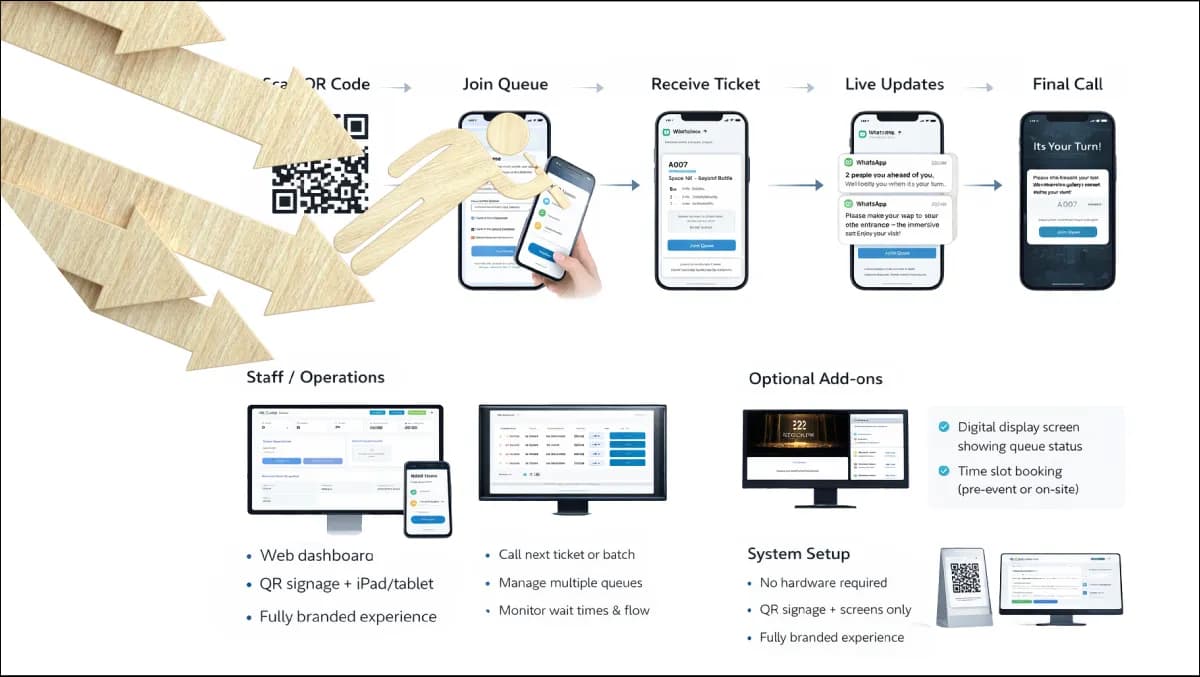
Arrival is now multi-channel. A customer can take a ticket from a kiosk in the branch, scan a QR code from outside and join virtually, book an appointment from the web or the operator's mobile app, or be added by a staff tablet during outreach. All four paths produce a single ticket in a single queue, and the system reconciles them in priority order based on rules the operator defines. The same ticket can move between channels — a virtual ticket converts to an on-site ticket when the customer walks through the door, an appointment slot converts into a confirmed arrival when the kiosk scans the booking confirmation.
The wait is now visible. Customers see their position, estimated wait, and a call-back notification on whatever channel they came in on — SMS, push notification, in-app banner, or the kiosk receipt. The visibility itself reduces complaint volume in every deployment we have run, because the friction of waiting is mostly the friction of not knowing. A customer who knows they have 18 minutes until they are called will leave the branch, take a coffee, and come back. A customer who has no idea will stand in the lobby and grow frustrated.
The service-point assignment is dynamic. A modern queue system does not statically map customer types to counters. It routes the next ticket to the best-matched available agent based on skills, load, and historical handle-time. When an agent goes on break, the system reroutes. When a peak hits, the system can auto-open standby counters. When the branch manager opens a triage flow at peak, the system can pre-classify tickets and shorten the assignment loop.
The data layer feeds the operations cadence. Every ticket, every wait, every service interaction lands in an analytics warehouse the operator can query. Daily ops reviews look at wait-time distributions, peak handling, agent productivity, and abandonment. Monthly reviews look at branch-level performance and staffing model fit. Quarterly reviews drive the workforce plan and the branch network refresh.
Where queue management is being deployed in 2026
The install base spans the regions Zeour ships into: United Kingdom, European Union, Americas, GCC, MENA, Africa, and Asia. The vertical pattern is consistent across regions.
Banking is the longest-running install base — branch transformation programmes deploy queue management as the operational backbone of the visit. The integration is into the core banking system, the CRM, and the appointment booking layer. Aljanoob bank in Iraq, IIB Bank, and the Kuwait National Bank London office are part of the bank reference base. The deployment pattern is the same in each: kiosk arrival, dynamic routing, agent cockpit, analytics layer.
Government counters across ministries, municipalities, and public-service points are the second-largest segment. Procurement is heavier; on-prem deployment is the default; integration into the national identity system where in production is standard. The Servizz.gov Malta deployment is the reference for a digital-first, citizen-facing service that runs across a national footprint of counters. MFCR Malta and the Ministry of Transport Malta sit on the same platform. The Iraq passport offices and the OQBI Oman deployment cover the broader public-sector use case.
Healthcare outpatient flows use queue management to manage clinic capacity, route patients to the right consultation room, and feed the EMR with arrival and visit timestamps. This is increasingly bundled with appointment booking rather than sold separately. The MoH Kuwait deployment is the reference at public-sector scale; private clinic deployments use the same platform with the MediCare Clinic integration layer.
Retail uses queue management for click-and-collect, in-store service desks, and high-touch sales (carrier stores, telecom service points, premium brand counters). The integration is into POS and CRM. SpaceNK in the UK is the premium-retail reference.
Charities and consular services are a smaller but interesting segment. Ayn-Yateem charity uses queue management for beneficiary visits; the Romanian consulate Birmingham UK uses it for consular appointments. These are low-volume, high-care deployments where the queue system is more about visit dignity than throughput.
What makes a queue management deployment work in production
Three things, in order.
First, integration depth. A queue system that runs in isolation is a toy; one that integrates into the core operational systems is infrastructure. The adapters that matter are the appointment booking platform, the CRM, the core banking or EMR or POS, the staff identity provider, the digital signage feed, and increasingly the operator's mobile app SDK.
Second, fleet management discipline. The dispensers, displays, kiosks, and call-forward panels are physical assets that need an SLA. A heartbeat console, a parts depot, a refresh cadence, and an operations team that owns the fleet are the difference between a deployment that lasts five years and one that degrades in 18 months.
Third, an honest operator-facing analytics layer that the branch manager actually opens every morning. The dashboard that nobody opens is not the dashboard that improves the operation. The reports that the operations director uses to drive the weekly review are the ones that justify the next renewal.
The Queue Management line within GLARUS is built on these three priorities. Multi-channel arrival, dynamic routing, full fleet console, and a data layer that the operator owns end-to-end. Sovereign on-prem by default; engineered multilingual with English and Arabic as the production baseline and additional locales (French, Spanish, German, Portuguese, Italian, Dutch, Turkish, Urdu, Hindi and more) added per engagement.
Where it pays back
Queue management deployments are unusual in enterprise software because the payback is measurable in weeks, not quarters. Wait-time reduction is visible from week one. Abandonment rate drops the day virtual queue goes live. Customer satisfaction scores move within the first month. Agent productivity improvements show up in the first quarter's workforce review.
The boards that approve these programmes care about the CX number on the customer survey. The operations directors who run them care about the throughput number on the daily report. The CIOs who own them care about the integration footprint into the rest of the stack. A queue management system that lands all three is the one that gets the rollout signed and the renewal signed three years later. The deployment model — fixed-fee phased engagement, Discovery to Build to Pilot to Rollout to Operate, with the operator owning the deploy keys and the repo at exit — is what makes the renewal a real conversation about value rather than a captive-vendor negotiation.
The practical reality across the regions Zeour ships into — United Kingdom, European Union, Americas, GCC, MENA, Africa, and Asia — is that the queue management deployment that wins is the one that treats sovereignty, language coverage, and integration depth as defaults rather than as upgrade paths. Sovereign on-prem deployment means the visit data, the customer identifiers, and the operational metrics stay inside the operator's perimeter. Multilingual posture means the kiosk, the agent cockpit, and the customer notification all speak the customer's language out of the box. Integration depth means the queue system is not a bolt-on but a node in the operational graph that the branch team already runs. Those three properties are what separate a queue management deployment that lasts five years from one that gets quietly retired at the next refresh.